
Introduction
In the last decades, Forensic Entomology has begun to play an important role as an investigative procedure for cases of homicide throughout the world, mainly for the determination of death chronology (postmortem interval – PMI). International scientific institutions already have specific laboratories to assist law officers at the death scene. Unfortunately, there are no such resources in Brazil and the application of this technique is unusual. In a pioneering action, the Department of Technical and Scientific Police of Rio de Janeiro is trying to bring the association of law officers with entomologists of the Museu Nacional – UFRJ into a conventional practice.
Decomposition studies have been conducted around the world. However, these succession patterns cannot be accurately applied to studies of PMI in Brazil [1, 2]. This is only possible if the habitats are similar with regard to especially temperature and humidity, because such environmental conditions have a direct influence upon the rate of postmortem decay. Recently, some studies have been carried out in Rio de Janeiro in order to establish some baseline data [3, 4, 5]. This work presents the application of Forensic Dipterology in three homicide cases, the PMI estimates of which were based on larval development rate.
Methods
It is desirable that in a crime report most evidence be analyzed as well as the factors that may influence the occurrence of carrion insects, including conditions which may accelerate or delay the arrival of insects attracted by odors given off by the corpse.
The local meteorological data from the five days prior to that on which the corpse was found was obtained from the meteorological station of Nova Iguaçu county, the nearest weather station to the crime scene. In addition, the ambient temperature was
The local meteorological data from the five days prior to that on which the corpse was found was obtained from the meteorological station of Nova Iguaçu county, the nearest weather station to the crime scene. In addition, the ambient temperature was measured in loco, including temperature from the mass of larvae and corpses as well as soil temperature in 1020 cm depth, in order to relate the meteorological data from the nearest weather station to the microclimate of the place of the crime.
The methods used in this work were based on the adaptation of methodologies for collection, transportation and rearing of the Diptera specimens described by various authors [6, 7, 8].
The stage of decomposition of the corpse was specified according to the morphological characteristics observed when it was found (fresh, bloated, early decomposition, advanced decomposition and remains) and the accuracy of PMI estimate was evaluated by reference to the statements from witnesses.
Adult insects were collected with the aid of a modified entomological net [9] and transported in the same plastic bag that was coupled to the net. This avoids contact of the collector with the insects, safeguarding his/her health. Eggs and larvae were collected from the corpses with the aid of forceps and brushes, and the living specimens were put in jars with moistened filter paper for the eggs and ground bovine meat for the larvae. The jars were closed with gauze to allow proper ventilation. Wandering larvae and pupae were also sought in the area around the corpse and taken to the lab in pots with a little sample of soil from the place. All the jars were labeled, indicating hour, date and environmental data.
In the laboratory, the immature insects were sorted by instar and morphological similarity and transferred to separate rearing jars. Adult insects collected at the crime site as well as those reared in the lab were killed by freezing. Later, they were identified to species.
Temperature is the most important factor affecting the growth and development rate of insects. The metabolic heat generated by maggot-mass can be sufficient to raise their micro-environmental temperature by several degrees above ambient [10] so it is essential to take into consideration the maggot mass temperature in determining insect development, specifically for last instar maggots. Consequently, ambient temperature was used to determine development time for earlier stages, maggot-mass temperature for later instars and soil temperature for pupae. A common approach is to use maggot-mass temperature as a constant which would provide the fastest growth of maggots (around 90 to 95º F or 32 to 35º C) [11].
As hourly temperatures were not available, the data were limited to daily maximum and minimum temperatures used to calculate the daily mean temperature. So, PMI estimates had to be based on accumulated degree-day (ADD) units. The calculation used for ADD was based upon a standard technique called the rectangle method [12]. The heat accumulation is the difference between the average temperature and the lower threshold times the days taken to develop [13]. Calculations without an appropriate threshold will overestimate the heat accumulation or degree-days. The equation used to calculate degree-days per day is:
Degree-days = ((Max. temp. + min. temp.) - (lower threshold) x 1 day) / 2
This method ignores the upper threshold temperature because the highest temperatures rarely reaches levels where they may have any lethal effect. Determining the lower developmental threshold is an important prerequisite to use the degree-day concept. For the two species encountered in the present paper, a lower threshold of 10º C was applied [11].
The development data (time and temperature) were obtained from literature for calculation of the ADD required for the involved species [14, 15]. The equation used to calculate degree-days per day from literature (ADD expected) is:
ADD expected = ((temp. – lower threshold.) x hours of development) / 24
| Source | Stage | Thresold Min. (ºC) | Environ. Temp. (ºC) | Develop. Time (h) | Exp. ADH | Exp. ADD |
|---|---|---|---|---|---|---|
| Wells & Kurahashi. (1994) | Egg hatch | 10 | 27 | 18 | 306 | 12.75 |
| 1st moult | 30 | 510 | 21.25 | |||
| 2nd moult | 72 | 1224 | 51 | |||
| Pupariation | 144 | 2448 | 102 | |||
| Emergence | 234 | 3978 | 165.75 |
2343978165.75 Tab. 1. The time of development obtained from literature and expected accumulated degree-hours (ADH) and degree-days (ADD) to Chrysomya megacephala.
For an estimate of the time elapsed since oviposition and, consequently, the minimum PMI, it is important to use the insect development in backtracking from the oldest instar collected to the time of oviposition [11]. Expected ADD was obtained from the literature for each instar (egg, larvae or pupae) and subtracted from each computed degree-day until the beginning (oviposition).
Case studies
Case study 1
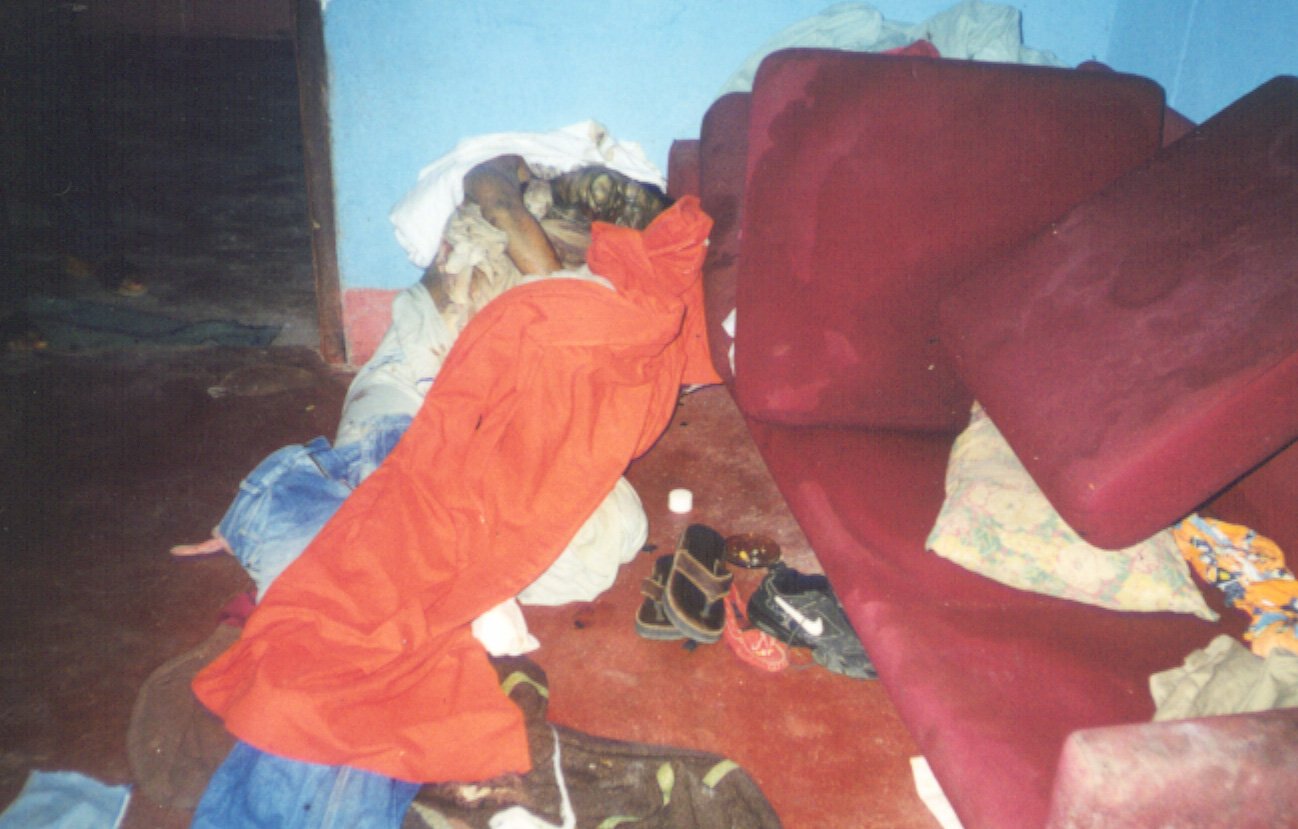
By the morning of July 6, 1999, the remains of a woman were discovered in a residential property. The doors and windows were shut and the corpse was found covered with varied blankets (fig. 1). Local environmental temperature was measured at 26º C, which was coherent with daily maximum and minimum temperature (27º C and 15º C respectively) obtained from the weather station. The body was in a bloated, partially decomposed state. The abdomen was bloated and its skin greenish-brown colored. The rigor mortis was generalized and lividity was fixed. The report of the investigation indicated that the woman had been seen alive three days before finding the body. In spite of these observations, just some eggs were located behind the ear and they hatched out in laboratory. These maggots were reared to adults. On July 16, after 240 hours, some specimens of Chrysomya megacephala emerged. The expected accumulated degree-day (Exp. ADD) was figured out as 12.75 basing on the time of development determined for this species under laboratory conditions [14], as 18 hours at 27º C (tab. 1). Considering that the expected ADD was calculated for egg hatch, but only eggs had been collected and that oviposition frequently occurs more than 12 hours after death, as Lothe [16] observed to C. albiceps and C. chloropyga and Oliveira-Costa [3] to species collected in this search, the PMI came to slightly more than 1 day (tab. 2). This result has not corroborated the estimate obtained by the usual Forensic Medicine methods (physical appearance of the body, lividity, rigor mortis and mainly by investigation report or witness’ statement). Probably, the delay in flies locating and ovipositing on the corpse derives from the fact that the doors and windows were shut and the corpse was found covered with blankets, creating a barrier and hindering the access of insects to the remains as well as the release of attractive odours.
| Day | Soil temp. | Max. Temp. | Min. Temp. | maggot mass temp. | DD-B10 | ADD-B10 |
|---|---|---|---|---|---|---|
| July 6 | 27º C | 15º C | 11 | 12.75 |
Tab. 2. Case 1: Calculation of the degree-day (DD) and accumulated degree-days (ADD) with lower threshold temperature of 10º C.
| Day | Soil temp. | Max. Temp. | Min. Temp. | maggot mass temp. | DD-B10 | ADD-B10 |
|---|---|---|---|---|---|---|
| August 9 | 25º C | 15 | 77.5 | |||
| August 8 | 32º C | 22 | 62.5 | |||
| August 7 | 27º C | 19º C | 13 | 40.5 | ||
| August 6 | 26º C | 18º C | 12 | 27.5 | ||
| August 5 | 28º C | 20º C | 14 | 15.5 | ||
| August 4 | 28º C | 19º C | 13.5 | 1.5 |
| Day | Soil temp. | Max. Temp. | Min. Temp. | maggot mass temp. | DD-B10 | ADD-B10 |
|---|---|---|---|---|---|---|
| July 6 | 31º C | 21 | 51 | |||
| July 5 | 25º C | 16º C | 10.5 | 30 | ||
| July 4 | 26º C | 19º C | 12.5 | 19.5 | ||
| July 3 | 25º C | 13º C | 9 | 7 |
Tab. 3. Case 2: Calculation of the degree-day (DD) and accumulated degree-days (ADD) with lower threshold temperature of 10º C.
| Source | Stage | Thresold Min. (ºC) | Environ. Temp. (ºC) | Develop. Time (h) | Exp. ADH | Exp. ADD |
|---|---|---|---|---|---|---|
| Byrd & Butler (1996) | Egg | 10 | 25 | 12 | 180 | 7.5 |
| 1st instar | 18 | 270 | 11.25 | |||
| 2nd instar | 24 | 360 | 15 | |||
| 3rd instar | 62 | 930 | 38.75 | |||
| Pupation | 116 | 1740 | 72.5 | |||
| Pupa | 124 | 1860 | 77.5 | |||
| Adult | 240 | 3600 | 150 |
Tab. 4. The time of development obtained from literature and expected accumulated degree-hours (ADH) and degree-days (ADD) to Cochliomyia macellaria.
| Day | Soil temp. | Max. Temp. | Min. Temp. | maggot mass temp. | DD-B10 | ADD-B10 |
|---|---|---|---|---|---|---|
| August 9 | 25º C | 15 | 77.5 | |||
| August 8 | 25º C | 15 | 62.5 | |||
| August 7 | 32º C | 22 | 47.5 | |||
| August 6 | 26º C | 18º C | 12 | 25.5 | ||
| August 5 | 28º C | 20º C | 14 | 13.5 |
Tab. 5. Case 3: Calculation of the degree-day (DD) and accumulated degree-days (ADD) with lower threshold temperature of 10º C.
Case study 2
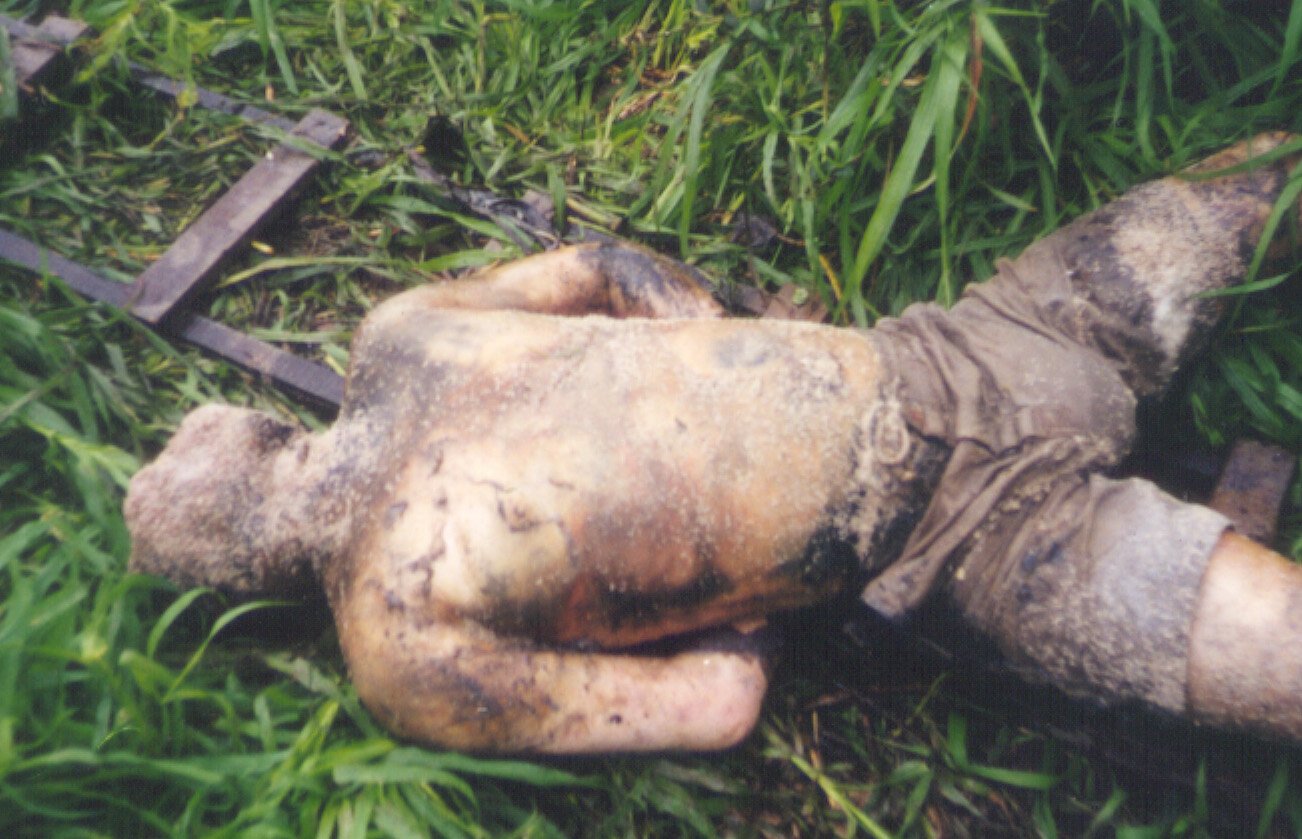
On July 6, 1999, in the morning, the corpse of a man in a bloated stage of decomposition was discovered in a vacant lot with an earthen floor covered by low vegetation (fig. 2). The abdomen’s skin was colored greenish-brown and it was bloated. The rigor mortis was generalized and lividity was fixed.
Environmental temperature was measured to 27º C, which was coherent with daily minimum and maximum temperature (27º C and 15º C respectively) obtained from the weather station. The investigation report indicated that the man had been seen alive four days before finding the body. The investigation indicated the authorship ratifying the date of death. Adult specimens of Chrysomya megacephala, Cochliomyia macellaria and Sarcophaga (Liopygia) ruficornis (Fabr.) were present. As for immature stages, a lot of third instar larvae were found, especially in the cranial area. Maggot-mass temperature was measured at 31º C. On July 14, after 141 hours, some specimens of Chrysomya megacephala emerged. Considering that oviposition frequently occurs more than 12 hours after death [3, 16], the accumulated degree-days (ADD) were calculated and the estimate of minimum postmortem interval was 4,5 days based on the time of development determined for the 2nd moult of this species under laboratory conditions as 72 hours at 27º C [14] (tab.1), corroborating the interval obtained by the traditional method (tab. 3).
Case study 3
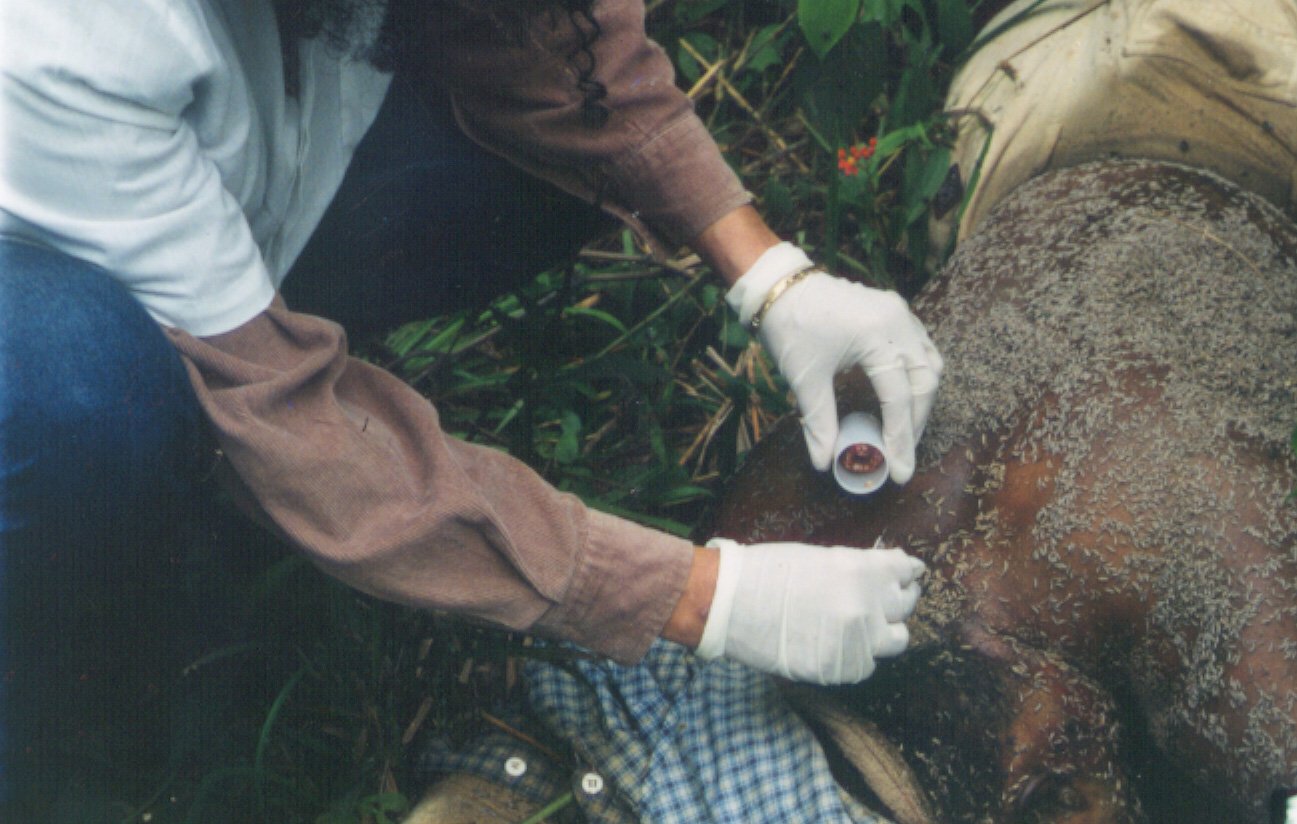
In the morning of August 9, 1999, the corpse of a man was discovered in a mixed forest (fig. 3), the local environmental temperature was 27º C and soil temperature was 25º C. The investigation report pointed out that the man had been seen alive six days before finding the body. The body was in an early decomposition stage and adult specimens of Calliphoridae and Sarcophagidae were present. As for immature stages, a lot of third instar larvae were found on the corpse and dark puparia were found in the soil near the body.
On August 13, after 92 hours, some specimens of Cochliomyia macellaria emerged. The expected ADD was based on the time of development determined for pupation of this species under laboratory conditions as 116 hours at 25º C [15] (tab. 4). As puparia were already dark, they had developed for at least 24 hours subject to the soil heat (tab. 5). Considering that oviposition frequently occurs more than 12 hours after death [3, 16], the estimate of postmortem interval for this case was 5.5 days, thereby confirming the interval indicated by the investigation report.
Discussion
The estimate of postmortem interval based on entomological evidence was in agreement with the PMI obtained by standard means, provided that all evidence from the death scene is taken into consideration, such as the delayed arrival of flies to a corpse when in enclosed environments. The estimate of PMI can be different from the real interval due to physical circumstances in the surroundings of the remains [17]. The application of the entomological method requires extensive knowledge of the mechanical and environmental factors that can interfere with the processes of colonization, the development time and the decomposition of the corpses by insects.
The forensic entomologist has to do careful measurements of the temperature which the immature insect was submitted to, in order to determine which temperature should be used for obtaining a more precise calculation.
Lamentably, in Brazil, there is little collaboration between entomologists and law officers. Only few officers have a basic training in entomology. Therefore, this study is pioneering, and the usefulness of this method depends on how the corpse is processed before the entomological analytical methods can be applied. As other authors have already stated [18], ideally, the team of professionals who are first called to the death scene or the autopsy should comprise a forensic entomologist.
Acknowledgments
Thanks to Dr. Thomas Pape for his useful comments on the manuscript.
References
- M. Benecke. Use of forensic entomology in cases concerning putrefied corpses. Arch. Kriminol. 198 (1996) 99-109. ↑
- J. B. Davis, L. Goff. Decomposition patterns in terrestrial and intertidal habitats on Oahu island and Coconut island, Hawaii. J. Forensic Sci. 45 (2000) 836842. ↑
- J. Oliveira-Costa. Dipterofauna cadavérica dos municípios de Duque de Caxias e São João de Meriti.[dissertation]. Univ. Federal do Rio de Janeiro, Rio de Janeiro. 2000. ↑
- J. Oliveira-Costa, C. A. Mello-Patiu, S. M. Lopes. Dípteros muscóides associados com cadáveres humanos na cena da morte no estado do Rio de Janeiro, Brasil. Bol. Mus. Nac. - série Zool. 464 (2001a) 1-6. ↑
- J. Oliveira-Costa, C. A. Mello-Patiu, S. M. Lopes. A influência de diferentes fatores na freqüência de dípteros muscóides em cadáveres humanos no Rio de Janeiro. Bol. Mus. Nac. - série Zool. 470 (2001b) 1-10 ↑
- W. D. Lord, J. F. Burger. Collection and preservation of forensically important entomological materials. J. Forensic Sci. 28 (1983) 936–944. ↑
- K. G. V. Smith. A manual of forensic entomology. British Museum, Natural History, London, 1986. ↑
- E. P. Catts; N. H. Haskell Entomology and death: a procedural guide. Clemson: Joyce’s Print Shop, Clemson, 1991. ↑
- A. Khouri. Notas sobre a confecção de uma rede de coleta e armadilha especialmente para Dípteros caliptratos em lixo. Bol. Mus. Ent. Univ. Valle 3 (1995) 55–59. ↑
- E. P. Catts, L Goff. Forensic entomology in criminal investigations. Ann. Rev. Entomol. 37 (1992) 253-272. ↑
- L. G. Higley, N. H. Haskell. Insect development and forensic entomology, in: J. A. Byrd, J. L. Castner (Eds.), Forensic Entomology: the utility of arthropods in investigations, CRC Press, Boca Raton, 2001, pp. 287302. ↑
- C. Y. Arnold. Maximum and minimum temperatures as a basis for computing heat units. Proc. Am. Soc. Horticult. Sci. 74 (1960) 430-445. ↑
- L. T. Wilson, W. W. Barnett. Degree-days an aid in crop and pest management. California Agric. Jan/Feb (1983) 4-7. ↑
- J. D. Wells, H. Kurahashi. Chysomya megacephala (Fabricius) (Diptera: Callipohoridae) development: rate, variation and implications for forensic entomology. Japn. J. San. Zool. 45 (1994) 303-309. ↑
- J. Byrd, J. F. Butler. Effects of temperature on Cochliomyia macellaria (Diptera:Calliphoridae) development. J. Med. Entomol. 33 (1996) 901-905. ↑
- F. Lothe. The use of larval infestation in determining time of death. Med. Sci. Law 4 (1964) 113-115. ↑
- L. Goff, B. C. Odom. Forensic Entomology in the Hawaiian Islands. Am. J. Forens. Med. Path. 8 (1987) 45-50. ↑
- K. Schoenly, K. Griest, S. Rhine. An experimental field protocol for investigating the postmortem interval using multidisciplinary indicators. J. Forensic Sci. 36 (1991) 1395–1415. ↑