
Introduction
The most commonly reported species of Phoridae breeding in buried human corpses in Europe is the coffin fly, Conicera tibialis Schmitz, whereas corpses disposed of in more exposed situations (such as under floorboards or in outbuildings) tend to be colonized by Megaselia rufipes (Meigen) [1]. Some other Phoridae such as Triphleba hyalinata Meigen and Megaselia scalaris (Loew), have also been found associated with human remains [2].
The scuttle fly Megaselia scalaris is a polyphagous saprophage species that has been transported around the world by man [3]. It is essentially a warm climate species and is common in the lowlands bordering the Mediterranean. In cooler climes it tends to occur in buildings, or other situations where it escapes frost. As a result of a forensic investigation in Italy, we now detail the first Italian report of a case of Megaselia scalaris (Loew) breeding in a human corpse.
Case description
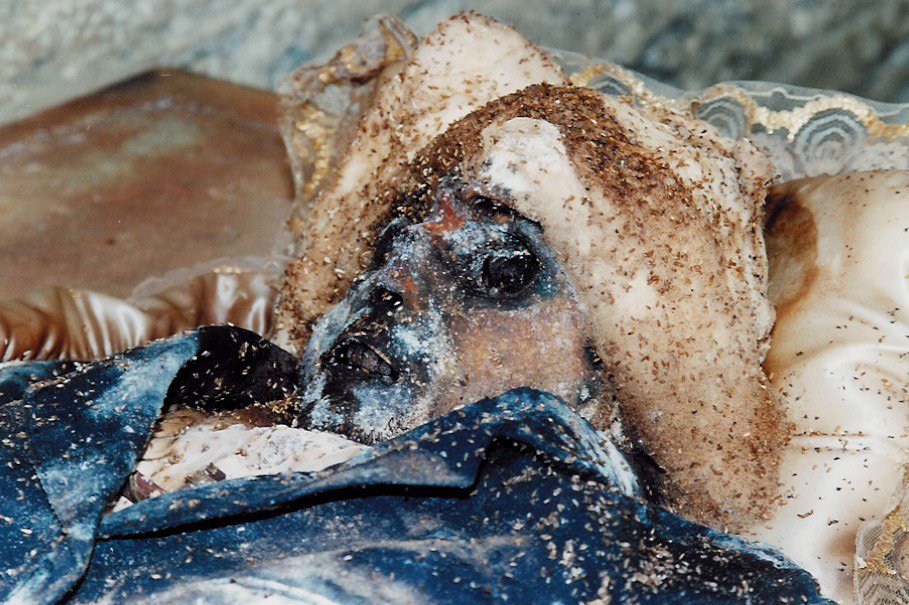
On 6 February 1999, at Bari in Southern Italy, the body of an adult male was exhumed. He had been buried at a depth of 30-40cm in a wooden coffin on 4 February 1998, approximately one year before the exhumation, having been killed by gunshot wounds to the head and the chest. He was 33 years old at the time of death. The fully clothed corpse was covered with numerous larvae, pupae and empty puparia. Pupae and puparia were particularly evident on the clothing, especially on the cotton-wool covering the head (Fig. 1).
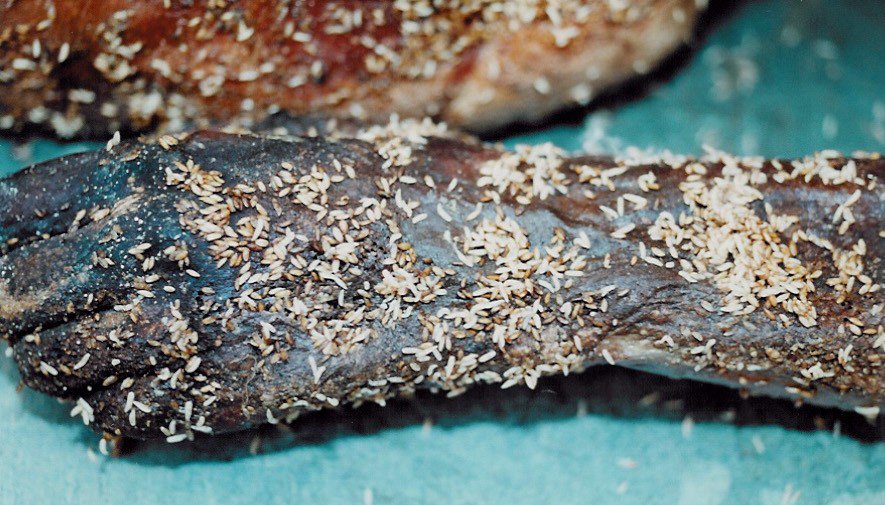
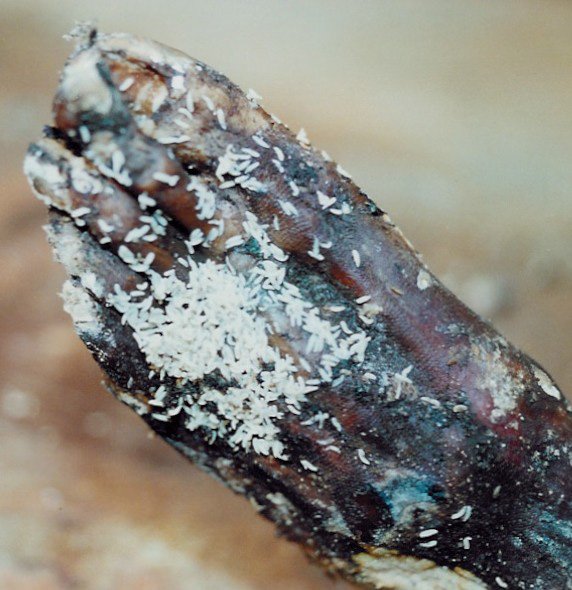
Subsequent examination during autopsy, performed by two forensic pathologists, revealed that the body was quite completely mummified with high densities of larvae, especially on the hands and feet (Fig. 2-3). The larvae and adult specimens collected during the autopsy were identified as individuals of Megaselia scalaris (Loew). This species was the only insect evidence associated to the human remains. The examination of the coffin revealed some very small holes of the wooden axis through which only small flies like M. scalaris were able to get the body.
Discussion
In many exhumations a vast number of flies and puparia can be found and it appear that many generations had successfully developed within the coffins. As in the case reported above, it is unusual to find only one species of Diptera such as Megaselia scalaris (Loew).
They may occur as the only insect evidence in bodies that have somehow been at least partially sheltered from colonization by larger flies through burial. Due to the predilection of Conicera tibialis for soft tissues of older carrion and its typically delayed arrival at a corpse, approximately 4-8 months after death [4], these flies are usually relegated to a secondary forensic role. However, other Phoridae may be found on corpses even in the early stages of decay, associated with some other species of Diptera as well as alone; and thus helping forensic experts to estimate the minimum post-mortem interval.
Megaselia scalaris can arrive at a carrion within a short time of its exposure and will lay eggs straight away. This species frequently breeds in human corpses in warmer climes, but only a few cases have been published. We review some of these below.
In South Africa the scuttle fly Megaselia scalaris has been reared from exposed corpses that were 4-6 months old and had been treated with a bleaching agent. The corpses had begun to mummify [3]. In Argentina this species seems to replace Conicera tibialis in buried corpses [5]. In the Neartic region, Megaselia scalaris has been reared from an exposed corpse 90-98 days old, partially mummified, found in Chicago, IL [6]. It has been reported breeding in a black and tarry, partially skeletonized, corpse buried in Puerto Rico for about one year [7]. Puparia of this species were recovered from the mummified remains of a woman drug addict who had died in her home in New England (U.S.A.), 33 months previously.
Some drugs such as amitryptilyne and nortriptyline were isolated from the chitinized insect remnants of its puparial cases as well from cerebral fragments and from stomach contents and, furthermore even from cast beetle (Dermestidae) skins and beetle fecal material. Results showed that the above drugs were greater in Phoridae puparia than exuviae or frass as this most likely reflects the propensity of Phorids for soft tissues where drug concentrations are likely to be higher [8].
Megaselia scalaris was the only insect observed breeding in a body found within a tightly sealed 7thfloor apartment in Kochi City, Shikoku, Japan [6]. In Belgium, Dewaele et al [9] describe a case of human myasis in a body of an adult female found dead in her apartment on 13. October 1999 in which very young larve of Megaselia scalaris were in the genital area (vagina); some specimens of these larvae were reared and eclosion of adult flies was observed after 9-10 days.
This time interval was considered too short for a complete life-cycle at body temperature of 22.8°C and ambient temperature of 15°C. Some experimental rearings demonstrated that M. scalaris develops from egg to adult in 22 days at 22°C, in 14-16 days at 27°C and in 11.1 days at 29°C, consistent with data recorded by Greenberg and Wells in 1998 who provided growth curves for the scuttle fly at different constant temperatures [6].
The above developmental data were essential to the final estimation of the time since death in the Belgium case and supported the inference of a Phorid vaginal myasis occurred before death. In the literature there are several cases of Phorid myasis illustrated worldwide: two cases in North America among which one of vaginal myasis [10], two were of urogenital and intestinal myasis caused by M. scalaris in India [1112]. Other such cases are reported from elsewhere and also a few cases of wound myasis in humans [3], thus further indicating the medical and forensic importance of this species.
The occurrence of this species of scuttle fly in forensic cases, such as reported above, relates to the shallow burial of the corpse and to the southerly lowland location. In fact, burial of cadavers usually restricts the access of many carrions insects to the body; but not of smaller flies, such as the Megaselia scalaris (Loew), that are particularly skilled in locating decaying tissues. By gaining access through very small holes in a closed coffin, they are able to avoid competition from larvae of larger Diptera species.
Acknowledgements
The authors gratefully acknowledge the assistance of Jeff Wells (Associate Professor, Department of Justice Sciences, University of Alabama at Birmingham, Birmingham, AL, U.S.A.).
R.H.L. Disney’s studies of Phoridae are funded by the Isaac Newton Trust (Trinity College, Cambridge).
References
- K.G.V. Smith, A manual of forensic entomology. London: British Museum, Natural History (1986). ↑
- M. Leclerq and Ch. Verstraeten, Entomologie et médicine légale. L’entomofaune des cadavers humains: sa succession par son interpretation, ses resultants, ses perspectives. J Méd Lég Droit Méd 36 (1993) 205-222. ↑
- R.H.L. Disney, Scuttle flies: The Phoridae. London: Chapman & Hall (1994). ↑
- P. Megnin, La faune des cadavrés: application de l’entomologie a la médicine légale. Encyclopédie scientifique des aides-mémoires. Masson, Paris (1894) 214. ↑
- A. Oliva, Insectos de interes forense de Buenos Aires (Argentina). Primera lista illustrada y datos bionomics. Revista del Museo Argentino de Ciencias naturals “Bernardino Rivadavia”, Buenos Aires, Entomologia 7 (1997) 13-59. ↑
- B. Greenberg and J.D. Wells, Forensic use of Megaselia abdita and M. scalaris (Phoridae: Diptera:): case studies, development rates, and egg structure. J Med Entomol 35 (1998) 205-9. ↑
- J.K. Barnes, Life history of Dohniphora cornuta (Bigot) (Diptera: Phoridae), a filth-inhabiting humpbacked fly. Journal of the New York Entomological Society 98 (1990) 474-83. ↑
- M.L. Miller, W.D. Lord, M.L. Goff, B. Donnelly, E.T. McDonough and J.C. Alexis, Isolation of amitriptyline and nortriptyline from fly puparia (Phoridae) and beetle exuviae (Dermestidae) associated with mummified human remains. J Forensic Sci 39 (1994) 1305-13. ↑
- P. Dewaele, M. Leclerq and R.H.L. Disney, Entomologie et médicine légale: les Phorides (Diptéres) sur cadavers humains. J Méd Lég Droit Méd 36 (2000) 569-572. ↑
- T.L. Biery, R.W. Clegern, W.W. Hart, Two cases og Phorid (Diptera: Phoridae) myasis in Texas. J Med Entomol 15 (1979) 122-123. ↑
- N.B. Singh, T.K. Singh, Y.I. Singh and M.A. Razaque, Intestinal myasis caused by Megaselia scalaris (Diptera: Phoridae): a case report. J Med Entomol 20 (1988) 163.
- T.S. Singh and D. Rana, Urogenital myasis caused by Megaselia scalaris (Diptera: Phoridae): a case report. J Med Entomol 26 (1989) 228-229.