
Introduction
Forensic Entomology as a valuable tool for PMIestimation became more and more popular recently. The developmental rate of the necrophagous insects used for calculation highly depends on external factors, e. g. on the ambient temperature. For a precise PMIestimation a appropriate collection of the colonizing organisms is required [1-5, 8].
Case Report
A 37-year old man was found shot July, 21st , 11.48 a. m., on the edge of a forest in Northern Germany.
Neither forensic pathologists nor entomologists were present at the crime scene. A post mortem was performed and as cause of death a pericard-tamponade due to a gunshot injury was diagnosed. An additional gunshot caused a fracture of the right jaw bone. Green discoloration of the abdominal wall was reported by the pathologists, no more rigor mortis was detected. In the course of the autopsy fly larvae and eggs were collected ”from the face” of the deceased and sent to our department for PMI-estimation.
3 samples stored in 70% ethanol arrived at our department, 2 of which contained fly eggs and one with several blow fly larvae. The ethanol solution of the last sample showed brownish discoloration, indicating that the maggots might have been feeding on blood. No living organisms were available. The larvae with a length ranging from 6 to 7 mm, were diagnosed as 2nd instar Calliphoridae on binocular investigation. As commonly known a further morphological determination in this developmental stateindispensable for PMI-estimation - has no real chance of success. Therefore PCR-RFLP identification of the larvae was applied [7, 9] and the larvae could be determined as Calliphora vomitoria Linné, the eggs as Lucilia sericata Meigen and Calliphora vicina Robineau-Desvoidy. The meteorological data were available from the nearest weather station with a maximum of 20°C and a minimum of 12°C, mean: 16,8°C (tab. 1).
A PMI of 5 days was calculated based on the data of Marchenko [6], referring to a total developmental time egg to imago of 33,7 days for 17°C and an assumed developmental period of 15% for the 2nd instar larvae investigated. These results were also in accordance with our own data [10]: Under laboratory conditions with a constant temperature of 20°C concerning larvae of Calliphora vomitoria L. after 4 to 5 days a length of 6 to 7 mm was measured. The PMI calculated would have led to the conclusion that the deceased died at July, 16th. However the police investigation revealed that the man was last seen alive 9.30 in the morning of July, 17th. This was stated by his girl friend whom the police thought to be absolutely reliable.
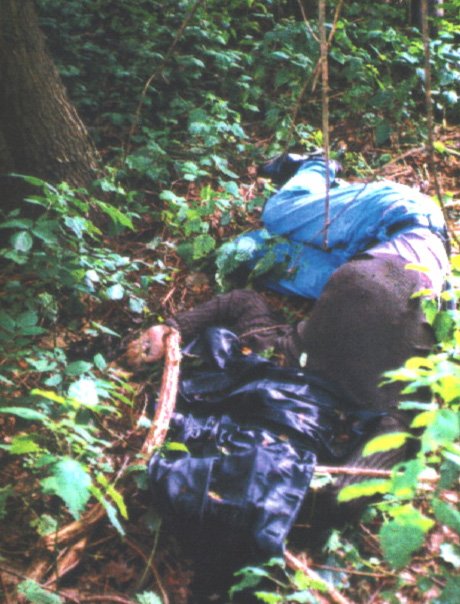
After discovering these irregularities a comprehensive reinvestigation of the circumstances of the case in its entirety was required. A reconstruction of the events at the crime scene revealed that the dead body was first found lying on his right side with a leather jacket over his head, which was removed by the emergency physician (fig. 1).
| 17.07. | 18.07. | 19.07. | 20.07. | 21.07. | |
|---|---|---|---|---|---|
| maximum | 20°C | 16°C | 18°C | 19°C | 20°C |
| minimum | 18°C | 15°C | 14°C | 12°C | (13°C) |
Tab. 1. Meteorological data
Discussion
The ambient temperature is one of the main factors influencing the developmental rate of necrophagous insects [1-5, 8]. The specimen age first calculated in this case was based on the information that the corpse had lain on his back and the maggots were collected ”from his face”. The circumstances, i. e. that the dead body was found with a leather jacket over his head, lead to the conclusion that the eggs and larvae were exposed to a higher temperature than first assumed. On inquiry it was finally reported by the pathologists who performed the autopsy that the maggots were actually collected from the oral cavity which was filled with blood due to the fracture of the jaw bone. As shown in fig. 1, the face of the deceased was not totally inaccessible for flies. Regarding the circumstances it seems very likely that the flies of Calliphora vomitoria L., which is known to be chiefly a forest species in Europe [8], were attracted by the bleeding wound and deposited their eggs close to the oral cavity. At this moment the body temperature might still have been very warm and probably decreased slowly in this area, because the face was covered. It also can be assumed that after the larvae hatched and migrated into the oral cavity due to the attractive feeding conditions that they remained constantly in this protected environment where the temperature was rather close to the maximum ambient temperature or even higher. Under these conditions a PMI of 4 days seemed more likely, meaning that the man was probably shot shortly after he was last seen alive by his girl friend. This was also in accordance with the police investigations.
Conclusions
Lack of information on both sides produced apparent inaccuracy in entomological PMI-estimation. If the time of death may be of interest in cases with insects colonisation of human corpses, preferably a person with experience in the field of forensic entomology should be present at the crime scene. Due to the enormous influence of ambient factors careful and comprehensive history taking is required if the entomologist responsible for PMI-estimation cannot visit the corpse at the scene. Collecting living organisms from the dead body and observing their further development under laboratory conditions leads to much better results in PMI-estimation because data from the particular species can be obtained and referred to. Also species determination is mostly difficult and sometimes impossible with young larvae but indispensable for calculating the time of death. The persons first involved in the presented case, policemen and pathologists, were apparently not familiar with these facts. Fortunately in the presented case the important species for PMI-estimation, Calliphora vomitoria L., could be identified by PCR-RFLP analysis, which would not have been possible for various other species. Regarding the possible consequences a more detailed education and special training of policemen, pathologists and other persons involved in the work at the crime scene as a task of forensic entomologists should be considered.
References
- J. Amendt, R. Krettek, H. Bratzke, Praxis der forensischen Insektenkunde. Teil 1: Insektenaufsammlung am Fundort einer Leiche. Arch. Kriminol. 204 (1999) 106-114. ↑
- M. Benecke, Zur insektenkundlichen Begutachtung in Faulleichefällen. Arch Kriminol. 198 (1996) 99-109. ↑
- M. Benecke, Six forensic entomology cases. Description and commentary. J. Forensic Sci. 43 (1998) 797805;1303. ↑
- B. Greenberg, Flies as forensic indicators. J. Med. Entomol. 28 (1991) 565-577. ↑
- N. H. Haskell, R. D. Hall, V. J. Cervenka, M. A. Clark, On the body: Insects’ life stage presence and their postmortem artifacts, in: W. D. Haglund, M. H. Sorg (Eds.), Forensic Taphonomy. The postmortem fate of human remains. CRC Press Boca Raton pp. 415-448. ↑
- M. I. Marchenko, Medicolegal relevance of cadaver entomofauna for the determination of the time of death. Forensic Sci Int 120 (2001) 89-109. ↑
- H. Schroeder, H. Klotzbach, S. Elias, C. Augustin, K. Pueschel, Use of PCR-RFLP for differentiation of calliphorid larvae (Diptera, Calliphoridae) on human corpses. Forensic Sci Int 132 (2003) 76-81. ↑
- K. G. V. Smith, A manual of forensic entomology. The Trustees of the British Museum (Natural History), London ↑
- F. A. H. Sperling, G. S. Anderson, D. A. Hickey, A DNA-based approach to the identification of insect species used for postmortem interval estimation, J. Forens. Sci. 39 (1994) 418-427. ↑
- J. Wolf, H. Schroeder, H. Klotzbach, K. Pueschel, Wachstumsverhalten nekrophager Insekten in Abhängigkeit von der Umgebungstemperatur, Rechtsmedizin 11 (2001) 167. ↑