
Introduction
Over the past several years, applications of entomological evidence have contributed significantly to legal investigations [1, 2, 3, 4]. This field, referred to as medicolegal forensic entomology, combines aspects of insect development, behavior and ecology with other investigative techniques. The most common application is to the estimation of the period of time since death or postmortem interval by determining a minimum period of insect activity on a decomposing body. Additionally, entomological evidence can provide significant data concerning postmortem movement of the body, assessment of wounds on a body, and circumstances of the death [1-6]. Another developing area is in the use of insects to detect drugs and toxins in a decomposing body, termed entomotoxicology [7].
In estimating the postmortem interval, an assessment of the physical condition of the body must be combined with an assessment of the fauna associated with the body [2, 4]. Basic to the faunal analysis is the correct identification of the species encountered, their biologies and ecological relations with the fauna surrounding the body [4, 8, 9]. In this assessment, attention must be given, not only to those taxa present, but also to those absent from the body, frequency, specificity to a given geographic region, seasonality, and biotic or abiotic factors that may serve to alter the developmental periods for the taxa and thus the potential errors in the postmortem interval estimate [8]. Studies on the insect fauna associated with decomposing carcasses have previously been conducted in the area of Campinas in both an urban setting [10] and in wooded areas [11]. These studies have been general in nature and more detailed studies of decomposition and arthropod species succession patterns are needed, particularly with respect to daily variations in carcass visitation by species. The present study concentrates on species of forensic significance present in the urban situation.
Materials and Methods
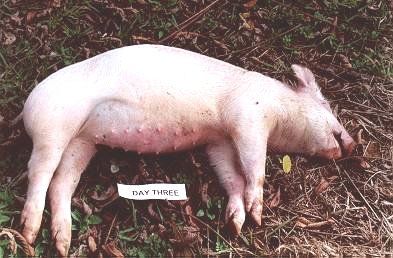
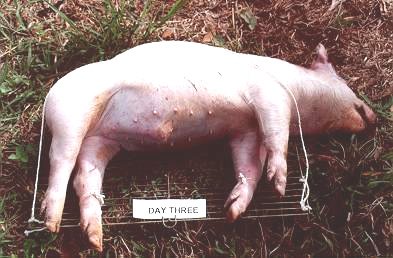
Carcasses of 2 domestic pigs (Sus scrofa L.), 17 kg in weight, were exposed in an open urban area on the campus of UNICAMP (State University of Campinas) in the city of Campinas – SP, Brazil, for 40 days during the months of Aug. and Sept. 2000. The carcasses were in an open area, exposed directly to sunlight and 2 m apart. One carcass was placed directly on the soil and was not manipulated or otherwise disturbed during the study. The second carcass was placed on a wire mesh platform to allow for weighing and collection of specimens. Both carcasses were photographed daily. Carcasses were sampled twice daily, once in morning and again during the afternoon. At each visit, weight of the experimental carcass was recorded to give an estimate of the rate of biomass removal. Internal temperature was recorded as well at temperatures in the mouth and anus. Ambient temperature was recorded, along with daily maximum/minimum temperatures, relative humidity, precipitation, and wind conditions from the university weather station adjacent to the study site. Representative specimens were collected at each visit. Adult Diptera were collected using a hand net. Adult Coleoptera and other adult insects were collected by hand as well as immature stages of both Coleoptera and Diptera. Adult specimens were preserved in 70% ETOH. Immature specimens collected were divided into 2 lots: One was fixed in hot water and preserved in 70% ETOH. The other lot was placed on beef liver and reared to the adult stage for positive identification. All specimens collected were deposited in the Laboratory of Parasitology, Department of Parasitology, UNICAMP.
Results and Discussion
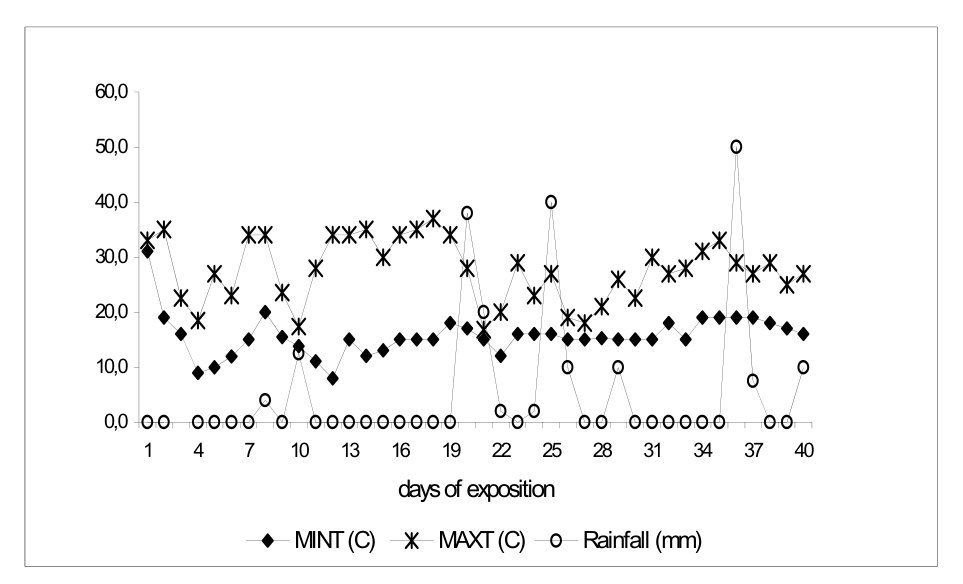
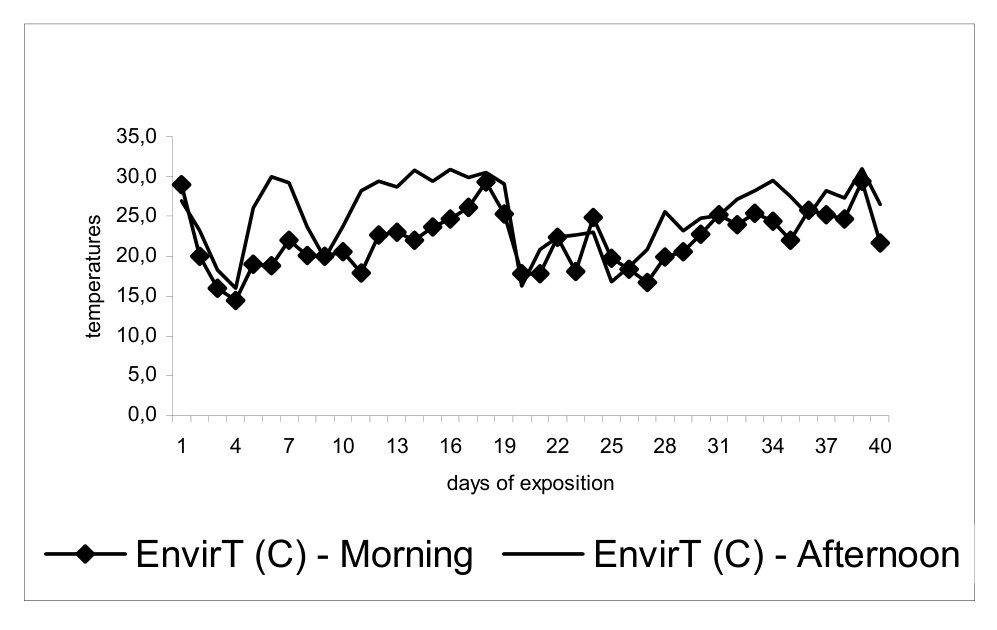
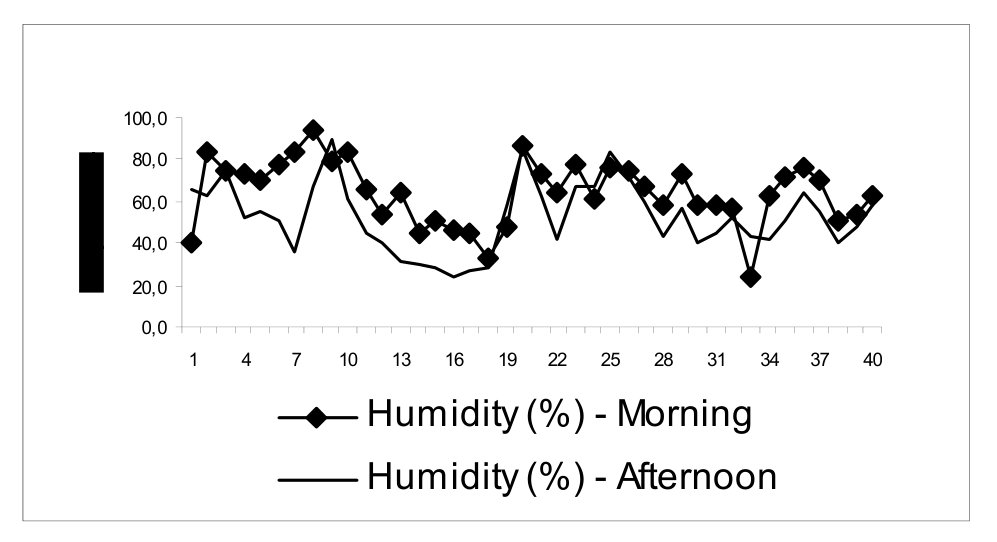
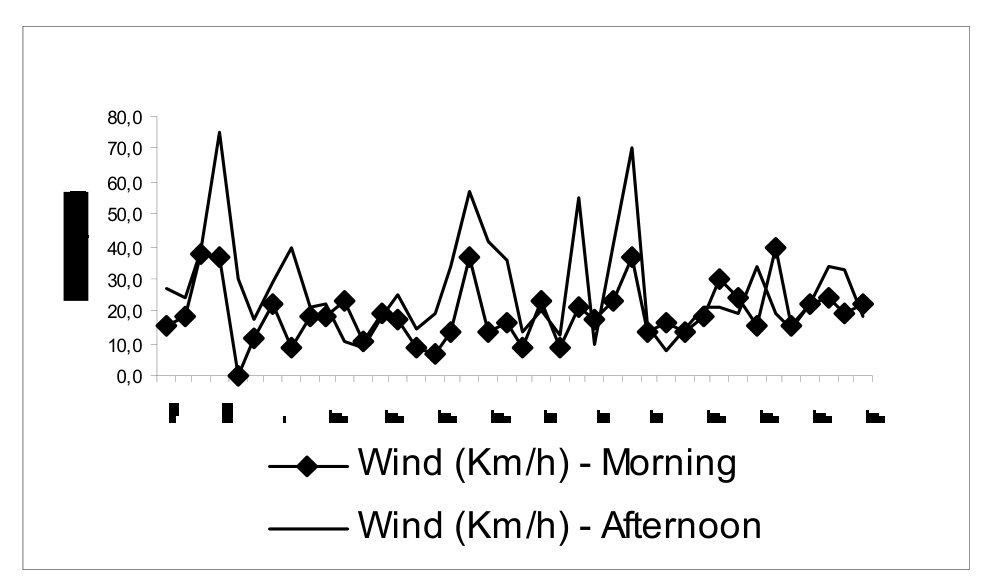
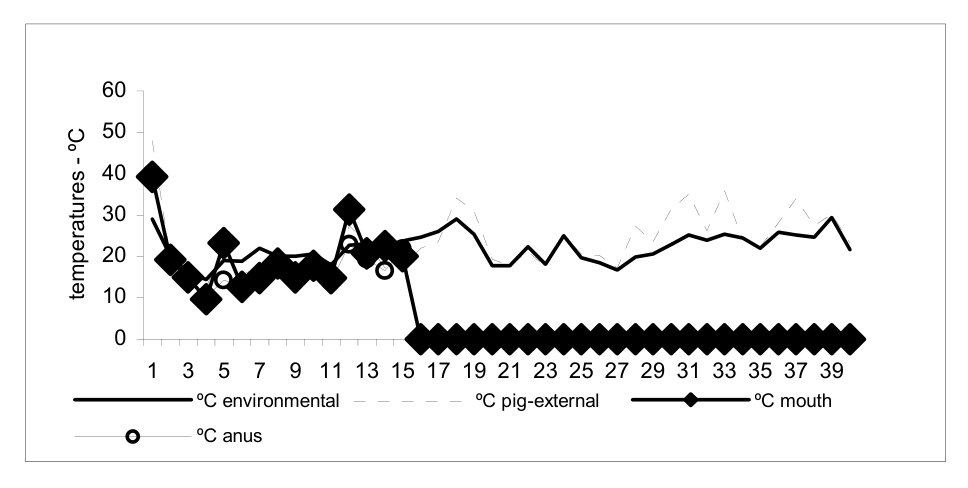
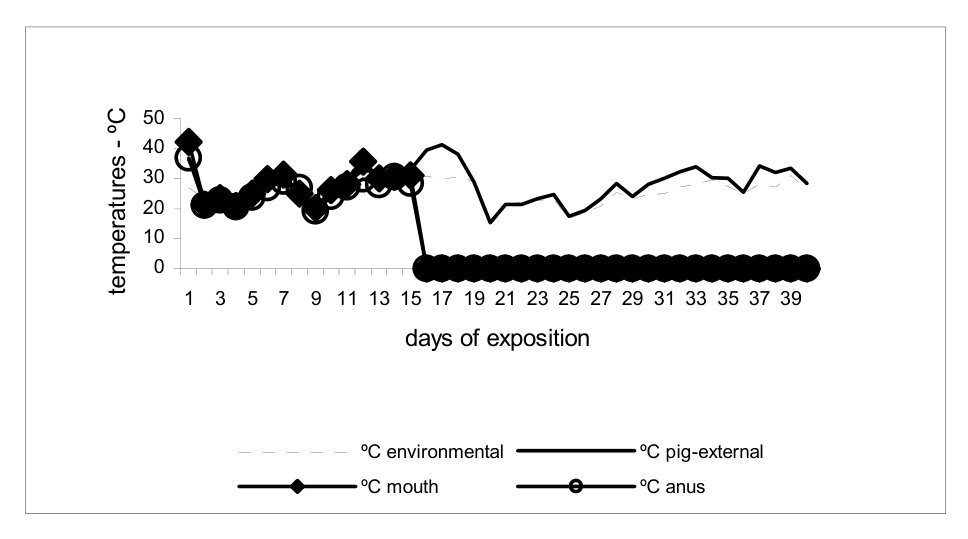
As shown in Fig. 1, daily minimum temperatures during the study period showed little variation, remaining around 15ºC for most of the study and rainfall was considerable. As shown in Figs. 2-4, ambient temperatures and wind speeds were generally higher during the afternoons than mornings, and correspondingly, relative humidity was generally lower during the afternoon periods. Internal temperatures of the carcass also varied from morning to afternoon measurements (figs. 7,8). The mouth and anus temperatures were taken only while was feasible due to carcass condition. During the morning period, internal carcass temperature approximated the ambient air temperatures while afternoon measurements were generally above ambient air temperatures.
There were adults of 5 families of Diptera collected from the carcasses. Adults in the families Calliphoridae and Muscidae were the initial colonizers of the carcasses, arriving shortly after exposure of the carcasses (tab. 1). Beginning on days 4 and 5, adults in the families Sarcophagidae and Phoridae were attracted to the carcass, followed by the Piophilidae beginning on day 11. This pattern is somewhat different from observations in other decomposition studies [12, 13], where Sarcophagiodae were early arrivals, sometimes arriving ahead of the Calliphoridae. In these same studies, Muscidae species often delayed several days prior to their colonization of a carcass. Coleoptera were also relatively late arrivals during this study (tab. 1), with adult Histeridae first appearing on day 12 and Staphylinidae on day 13. Other studies have indicated an earlier arrival of predatory Coleoptera taxa, although not a precisely predictable event. Arrivals of adults of other families (Dermestidae, Cleridae, and Scarabaeidae) were more closely similar to observations in other studies. Ants (Formicidae) arrived on day 1 and their activities continued throughout the study. These were omnivorous, feeding on both the carcass and exerting a significant predation pressure on other taxa colonizing the carcasses.
There were 4 species of Calliphoridae recorded from the carcasses in this study as immatures: Chrysomya albiceps, Chrysomya megacephala, Chrysomya putoria, and Lucilia eximia. A total of 9 species of Diptera of forensic significance have been recorded from the region of Campinas, 8 Calliphoridae and 1 Sarcophagidae (Patonella intermutans). In addition to those Calliphoridae recovered during the study are: Cochliomyia macellaria, Hemilucilia segmentaria, Hemilucilia semidiaphana and the Muscidae, Ophyra chalcogaster. Absence of H. segmentaria and H. semidiaphana is consistent with results of previous studies conducted in an urban habitat by Souza [10]. While L. eximia was among the first to arrive at the carcasses, it was the last to complete development, with C. megacephala and C. putoria producing the first emerging adults, followed by C. albiceps (tab. 2). Among the Muscidae, only Musca domestica was observed to complete its development on the carcasses.
| Day | Stage | Family | Species |
|---|---|---|---|
| 1 | Fresh | Formicidae | spp |
| 2 | Bloated | Formicidae | spp |
| Calliphoridae | Chrysomya albiceps | ||
| Muscidae | Musca domestica, spp | ||
| Tephritidae | spp | ||
| 3 | Bloated | Formicidae | spp |
| Muscidae | M. domestica, spp | ||
| 4 | Bloated | Formicidae | spp |
| Muscidae | Ophyra chalcogaster, Musca domestica, spp | ||
| Phoridae | Megaselia scalaris | ||
| 5 | Bloated | Formicidae | spp |
| Calliphoridae | C. albiceps | ||
| Muscidae | O chalcogaster, M. domestica, spp | ||
| Sarcophagidae | Patonella intermutans, spp | ||
| 6 | Bloated | Formicidae | spp |
| Calliphoridae | C. albiceps | ||
| Muscidae | M. domestica, spp | ||
| Sarcophagidae | P. intermutans, spp | ||
| 7 | Bloated | Formicidae | spp |
| Calliphoridae | C. albiceps | ||
| Muscidae | O chalcogaster, M. domestica, spp | ||
| Sarcophagidae | spp | ||
| 8 | Bloated | Formicidae | spp |
| Calliphoridae | C. albiceps, L. eximia | ||
| Muscidae | spp | ||
| Sarcophagidae | spp | ||
| 9 | Bloated | Formicidae | spp |
| Muscidae | spp | ||
| 10 | Decay | Formicidae | spp |
| Calliphoridae | C. albiceps, Cochlyomia macellaria, C. megacephala | ||
| Muscidae | O. chalcogaster, spp | ||
| Sarcophagidae | P. intermutans, spp | ||
| 11 | Decay | Formicidae | spp |
| Calliphoridae | C. albiceps, C. megacephala | ||
| Muscidae | M. domestica | ||
| Piophilidae | P. casei | ||
| Sarcophagidae | P. intermutans, spp | ||
| Histeridae | spp | ||
| Staphylinidae | spp | ||
| 12 | Decay | Formicidae | spp |
| Calliphoridae | C. albiceps, spp | ||
| Muscidae | M. domestica, O. chalcogaster, spp | ||
| Phoridae | M. scalaris | ||
| Sarcophagidae | spp | ||
| Histeridae | spp | ||
| 13 | Decay | Formicidae | spp |
| Calliphoridae | C. albiceps | ||
| Muscidae | M. domestica, O. chalcogaster, spp | ||
| Piophilidae | P. casei | ||
| Sarcophagidae | spp | ||
| Histeridae | spp | ||
| Staphylinidae | spp | ||
| 14 | Decay | Formicidae | spp |
| Calliphoridae | C. albiceps | ||
| Muscidae | M. domestica, O. chalcogaster, spp | ||
| Piophilidae | P. casei | ||
| Sarcophagidae | spp | ||
| Histeridae | spp | ||
| Scarabaeidae | spp | ||
| 15 | Postdecay | Formicidae | spp |
| Calliphoridae | C. albiceps | ||
| Muscidae | O. chalcogaster, spp | ||
| Sarcophagidae | spp | ||
| Histeridae | spp | ||
| Cleridae | N. rufipes | ||
| 16 | Postdecay | Formicidae | spp |
| Calliphoridae | C. albiceps | ||
| Muscidae | O. chalcogaster | ||
| Sarcophagidae | spp | ||
| Histeridae | spp | ||
| Cleridae | N. rufipes | ||
| 17 | Postdecay | Formicidae | spp |
| Calliphoridae | C. albiceps | ||
| Muscidae | M. domestica, O. chalcogaster, spp | ||
| Piophilidae | P. casei | ||
| Sarcophagidae | spp | ||
| Histeridae | spp | ||
| Cleridae | N. rufipes | ||
| 18 | Postdecay | Formicidae | spp |
| Calliphoridae | C. albiceps | ||
| Muscidae | M. domestica, O. chalcogaster, spp | ||
| Histeridae | spp | ||
| Cleridae | N. rufipes | ||
| Dermestidae | D. maculatus | ||
| 19 | Postdecay | Formicidae | spp |
| Calliphoridae | C. megacephala | ||
| Muscidae | M. domestica, O. chalcogaster, spp | ||
| Piophilidae | P. casei | ||
| Sarcophagidae | P. intermutans, spp | ||
| Histeridae | spp | ||
| Cleridae | N. rufipes | ||
| Dermestidae | D. maculatus | ||
| 20 | Postdecay | Muscidae | O. chalcogaster, spp |
| 21 | Postdecay | Formicidae | spp |
| Muscidae | O. chalcogaster, spp | ||
| Phoridae | M. scalaris | ||
| Neriidae | spp | ||
| Histeridae | spp | ||
| Cleridae | N. rufipes | ||
| Dermestidae | D. maculatus | ||
| 22 | Postdecay | Formicidae | spp |
| Muscidae | O. chalcogaster | ||
| Calliphoridae | C. albiceps | ||
| Phoridae | M. scalaris | ||
| Vespidae | ssp | ||
| 23 | Postdecay | Formicidae | spp |
| Calliphoridae | C. albiceps | ||
| Muscidae | O. chalcogaster, spp | ||
| Phoridae | M. scalaris | ||
| Sarcophagidae | spp | ||
| Cleridae | N. rufipes | ||
| 24 | Postdecay | Formicidae | spp |
| Calliphoridae | C. albiceps | ||
| Muscidae | O. chalcogaster | ||
| Piophilidae | P. casei | ||
| Cleridae | N. rufipes | ||
| Dermestidae | D. maculatus | ||
| 25 | Postdecay | Formicidae | spp |
| Muscidae | O. chalcogaster | ||
| Calliphoridae | C. albiceps | ||
| 26 | Postdecay | Formicidae | spp |
| 27 | Postdecay | Formicidae | spp |
| Muscidae | O. chalcogaster | ||
| Cleridae | N. rufipes | ||
| Dermestidae | D. maculatus | ||
| 28 | Postdecay | Formicidae | spp |
| Calliphoridae | C. albiceps | ||
| Muscidae | O. chalcogaster | ||
| Vespidae | spp | ||
| 29 | Postdecay | Formicidae | spp |
| Muscidae | O. chalcogaster | ||
| Vespidae | spp | ||
| Dermestidae | D. maculatus | ||
| 30 | Posdecay | Formicidae | spp |
| Calliphoridae | C. albiceps, C. megacephala | ||
| Muscidae | O. chalcogaster | ||
| Cleridae | N. rufipes | ||
| Dermestidae | D. maculatus | ||
| 31 | Postdecay | Cleridae | N. rufipes |
| Dermestidae | D. maculatus | ||
| 32 | Postdecay | Dermestidae | D. maculatus |
| 33 | Postdecay | Dermestidae | D. maculatus |
| 34 | Postdecay | Dermestidae | D. maculatus |
| 35 | Postdecay | Formicidae | spp |
| Dermestidae | D. maculatus | ||
| 36 | Skelettal | Formicidae | spp |
| 37 | Skeletal | Formicidae | spp |
Tab. 1. Adult specimens collected on a daily basis in the carcass in the decomposition different stages.
| Day | Stage | Family | Species |
|---|---|---|---|
| 8 | Bloated | Calliphoridae | C. megacephala; C. albiceps; L. eximia |
| 9 | Fermentation | Calliphoridae | C. albiceps |
| Muscidae | M. domestica | ||
| 10 | Fermentation | Calliphoridae | C. megacephala; C. albiceps; L. eximia |
| 11 | Fermentation | Calliphoridae | C. megacephala; C. albiceps; L. eximia |
| 12 | Fermentation | Calliphoridae | C. megacephala; C. albiceps; C. putoria |
| 13 | Fermentation | Calliphoridae | C. megacephala |
| 14 | Fermentation | Calliphoridae | C. albiceps |
| 15 | Putrefaction | Calliphoridae | C. megacephala; C. albiceps; L. eximia |
| 16 | Putrefaction | Calliphoridae | C. albiceps; C. putoria |
| 17 | Putrefaction | Calliphoridae | C. albiceps |
| 18 | Putrefaction | Calliphoridae | C. albiceps |
| 19 | Putrefaction | Calliphoridae | C. albiceps |
| 20 | Putrefaction | Calliphoridae | C. albiceps |
| 25 | Putrefaction | Calliphoridae | C. albiceps |
| 28 | Putrefaction | Calliphoridae | C. albiceps; C. megacephala |
| 29 | Putrefaction | Calliphoridae | C. albiceps; C. megacephala |
| 30 | Putrefaction | Calliphoridae | C. albiceps; C. megacephala |
| 31 | Putrefaction | Calliphoridae | C. albiceps; C. megacephala |
| 32 | Putrefaction | Calliphoridae | C. albiceps |
| 33 | Putrefaction | Calliphoridae | C. albiceps |
Tab. 2. Third instar larvae specimens collected on a daily basis in the carcass in the decomposition different stages.
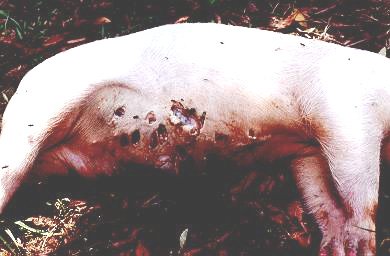
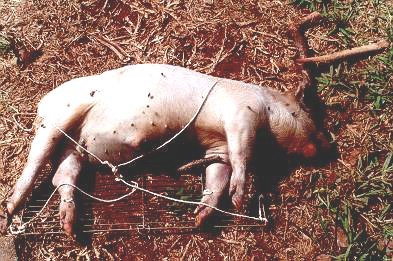
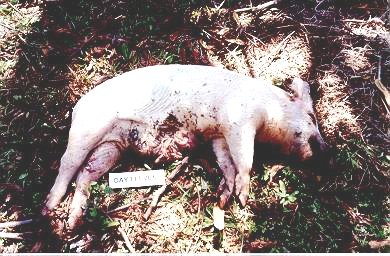
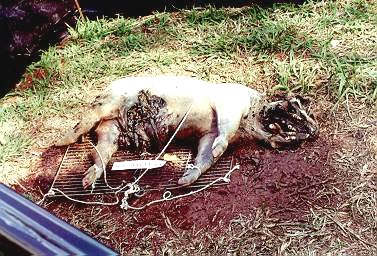
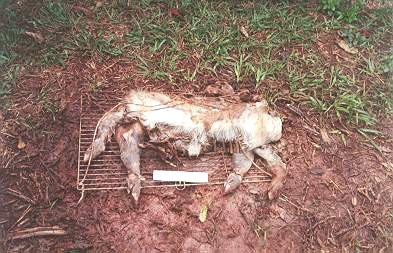
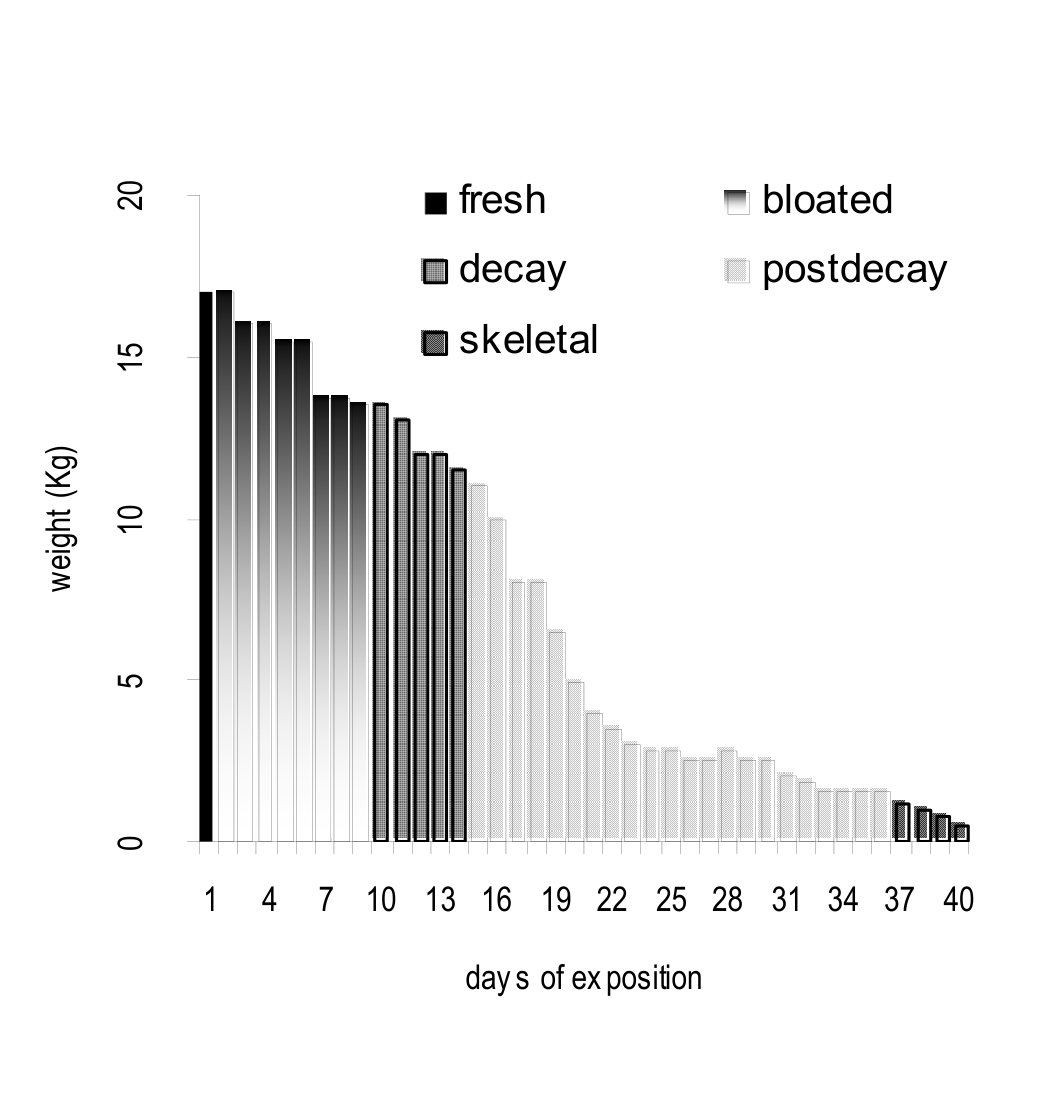
Five stages of decomposition were recognized during this study as defined by Goff [14]: Fresh (figs. 1,2), Bloated (fig. 10), Decay (fig. 11), Postdecay (fig. 12) and Skeletal (fig. 13). Rate of biomass removal is shown in Fig. 14. In this study, the rapid initial loss of biomass reported by several other workers was not observed. For example, Early & Goff [13] reported a reduction to only 20% of the original weight by day 9 working in Manoa Valley on the island of Oahu, whereas Richards & Goff [15] showed similar results by day 11 on the island of Hawaii. Payne [16], working in a continental situation in South Carolina, reported a reduction to approximately 10% of the original biomass by day 5. In the present study, this level was not reached until 23 days following exposure of the carcass. This pattern is similar to that observed by Early & Goff [13] for a carcass inside Diamond Head Crater, Oahu, Hawaii, where there was significant predation by ants. Similar effects have been noted by Stoker et al. [17] in Texas and Houston [18] in Brazil. As ant activity began on day 1 and continued throughout the study, it is probable that ant predation could be a factor in slowing the rate of biomass removal by necrophagous taxa, particularly Diptera larvae.
These results are important to development of Forensic Entomology in Southeastern region once they can be add in brazilian database.
Conclusions
As in other studies, adult Calliphoridae were the first to arrive at carcasses. However, the early arrival of Muscidae and delayed arrival of Sarcophagidae species were departures from previous observations. Of the 9 species of Calliphoridae reported from carrion in the area around Campinas, only 4 species were of significance in the urban habitat in which the study was conducted: C. albiceps, C. megacephala, C. putoria, and L. eximia.
Acknowledgements
We are grateful for the support of FAPESP to Dr M.L. Goff as visiting professor to UNICAMP. Process nº 00/03599-0.
References
- E.P. Catts, M.L. Goff, Forensic entomology in criminal investigations. Ann. Rev. Entomol. 37 (1992) 253-272. ↑
- K.G.V. Smith, A manual of Forensic Entomology. Cornell Univ. Press, Ithaca, NY, 1986, 205 p. ↑
- B. Keh, Scope and applications of forensic entomology. Ann. Rev. Entomol. 30 (1985) 137154. ↑
- P. Nuorteva, Sarcosaprophagous insects as forensic indicators, in: C.G. Tedeshi, W.G. Eckert, L.G. Tedeshi (Eds.), Forensic medicine: a study in trauma and environmental hazards, Vol. II, London, 1977, pp. 1072-1095. ↑
- A. Oliva, J. Ravioli, F. Trezza, C. Navarri, Entomologia forense. Pren. Méd. Argent. 82 (1995) 229-234.
- E.P. Catts, N.H. Haskell, Entomology & Death: a procedural guide. Joyce’s Print Shop, USA, 1990, p.182.
- M.L. Goff, W.D. Lord, Entomotoxicology: a new area for forensic investigation. Am. J. Forensic Med. Pathol. 15 (1994) 51-57. ↑
- M.I. Marchenko, Medicolegal relevance of cadaver entomofauna for the determination of the time of death, Forensic Sci. Internat. 120 (2001) 89-109. ↑
- Y.Z. Erzinçlioglu, The application of entomology to forensic medicine. Med. Sci. Law 23 (1983) 5763 ↑
- A.M. Souza, Linhares, A.X., Diptera and Coleoptera of potential forensic importance in southeastern Brazil: relative abundance and seasonality. Med Vet. Entomol., 11 (1997) 8-12. ↑
- L.M.L. Carvalho, A.X. Linhares, Seasonality of insect succession and pig carcass decomposition in a natural forest area in Southeastern Brazil. J. Forensic Sci. 46 (2001) 604-608. ↑
- G.A. Anderson, S.L. VanLaerhoven, Initial studies on insect succession on carrion in Southwestern British Columbia. J. Forensic Sci. 41 (1996) 617625. ↑
- M. Early, M.L. Goff, Arthropod sucession patterns in exposed carrion on the Island of Oahu, hawaiian Islands, USA. J. Med. Entomol. 23 (1986) 520531. ↑
- M.L. Goff, Estimation of postmortem interval using arthropod development and successional patterns. Forensic Sci. Rev. 5 (1993) 81-94. ↑
- E.N. Richards, M.L. Goff, Arthropod succession on exposed carrion in three contrasting tropical habitats on Hawaii Island, Hawaii. J. Med. Entomol. 34 (1997) 328-339. ↑
- J.A. Payne, A summer carrion study of the baby pig Sus scrofa Linnaeus. Ecology 46 (1965) 592602. ↑
- R.L. Stoker, W.E. Grant, S.B. Vinson, Solenopsis invicta (Hymenoptera: Formicidae) effect on invertebrate decomposers of carrion in Central Texas. Environ. Entomol. 24 (1995) 817-822. ↑
- D.C. Houston, Effect of ant predation on carrion insect communities in a brazilian forest. Biotropica, 119 (1987) 376. ↑