
Introduction
Forensic entomology is a discipline that can be used as a tool in crime scene investigations. Insects are usually the first visitors to a dead body and blowflies are able to oviposit on carrion within a few hours after death. Insects in criminal investigations could help an investigator estimate the post mortem interval (PMI), indicate that the body has been moved or disturbed after death, shed light on the causes and related circumstances of death (i.e. detecting the presence of drugs), match a suspect with the scene of a crime and produce information in cases of neglected children [1-3].
Insects are the most numerous group among the invertebrates in carrion, owing, in part, to their ability to quickly colonize different habitats. Recently, many studies on entomological fauna associated with criminal events have been carried out to better define insect groups as "forensic entomo-indicators". Many species belonging to the families Calliphoridae, Sarcophagidae, Fannidae, Phoridae, Drosophilidae and Piophilidae among Diptera and to the families Dermestidae, Cleridae, Histeridae, Staphilinidae and Tenebrionidae among Coleoptera associated with decomposing bodies have been identified from forensic institutes and police crime scene investigations [4-10].
The aims of this study are A, to determine which insects, Diptera in particular, first colonize a corpse and B, to better define their ethology by describing the development cycles and variability of these species as they correlate to climatic conditions in the urban habitat of Parma, Northern Italy. Comparing the species obtained from these experiments with those reported in literature, we propose a suitable and quick method to estimate the presence of insects associated with a dead body in an area in which a crime occurred that is climatically comparable to the one studied. The influence of parameters such as temperature, relative humidity, season and habitat on the activities and life cycles of the insects collected in the two environments, potentially simulating two different crime scenes, are described.
Materials and Methods
The study was carried out in the Botanical Gardens and Natural History Museum of Parma in an urban habitat. As bait we employed pork meat with the knowledge that pigs are used in human research in both medical and forensic fields.
Six pieces of meat, weighing from 56 gr. to 90 gr. (fresh wt.) have been used. Each piece was placed in a Petri dish with 20-25 gr. of sterilized sand at the bottom. To avoid rapid desiccation, 5 ml of distilled water was added daily to keep the sand moderately moist.
The baits were located in an open area (in shade on a terrace) and were exposed for 72-90 hours to allow oviposition time of Diptera attracted to fresh meat.
Two experiments were carried out:
Exp. 1 from April 24 to May 17
To simulate the post-mortem movement of the body to another location after a bit of time, six Petri dishes were left exposed for 90 hr. After the exposure period, three Petri dishes with meat were transferred to a plastic container (length 40 cm, width 20 cm, height 20 cm), closed with gauze to avoid further Diptera oviposition and were moved to the top floor of a building in a room with glass walls after the exposure time. The remaining three Petri dishes were transferred to the same kind of container and were moved to a cellar with constant temperature and relative humidity values. This was a dark room with a window partially opened.
Exp. 2 from May 28 to June 24
Again, six Petri dishes were exposed on the terrace for 72 hr, three of the Petri dishes with meat were transferred to a plastic container (length 40 cm, width 20 cm, height 20 cm) and after the exposure time were closed with gauze to avoid further Diptera oviposition, and left on the terrace. To simulate the post-mortem movement of the body to another location after a bit of time, the remaining three Petri dishes were transferred to the same kind of pot and were moved to the cellar with constant temperature and relative humidity values as in the exp. 1.
During each experiment, pig meat pieces were monitored daily and data of ambient, temperature/humidity and atmospheric conditions were recorded. All insect forms (eggs, larvae, pupae and adults) were collected from the meat and their activity was described. In the laboratory collected samples were preserved in 70% alcohol; pupae and adults were preserved both in 70% alcohol and in a freezer (-4°).
Pupae and adults of Diptera and adults of Coleoptera were observed under a stereo microscope and identified to genus and family. For each group, further analysis to recognize species specific characters were carried out; some specimens were carefully dissected and morphological features mounted on slides and analysed.
Results
Three families of Diptera of forensic interest: Calliphoridae, Sarcophagidae and Phoridae, and three families of Coleoptera: Dermestidae, Histeridae and Staphilinidae, were collected during this study.
Among Diptera, Calliphora vicina RobineauDesvoidy, 1830 (=erythrocephala Meigen, 1826), Sarcophaga africa (Wiedemann, 1824) and Megaselia scalaris (Loew, 1866) were identified [4, 11-14].
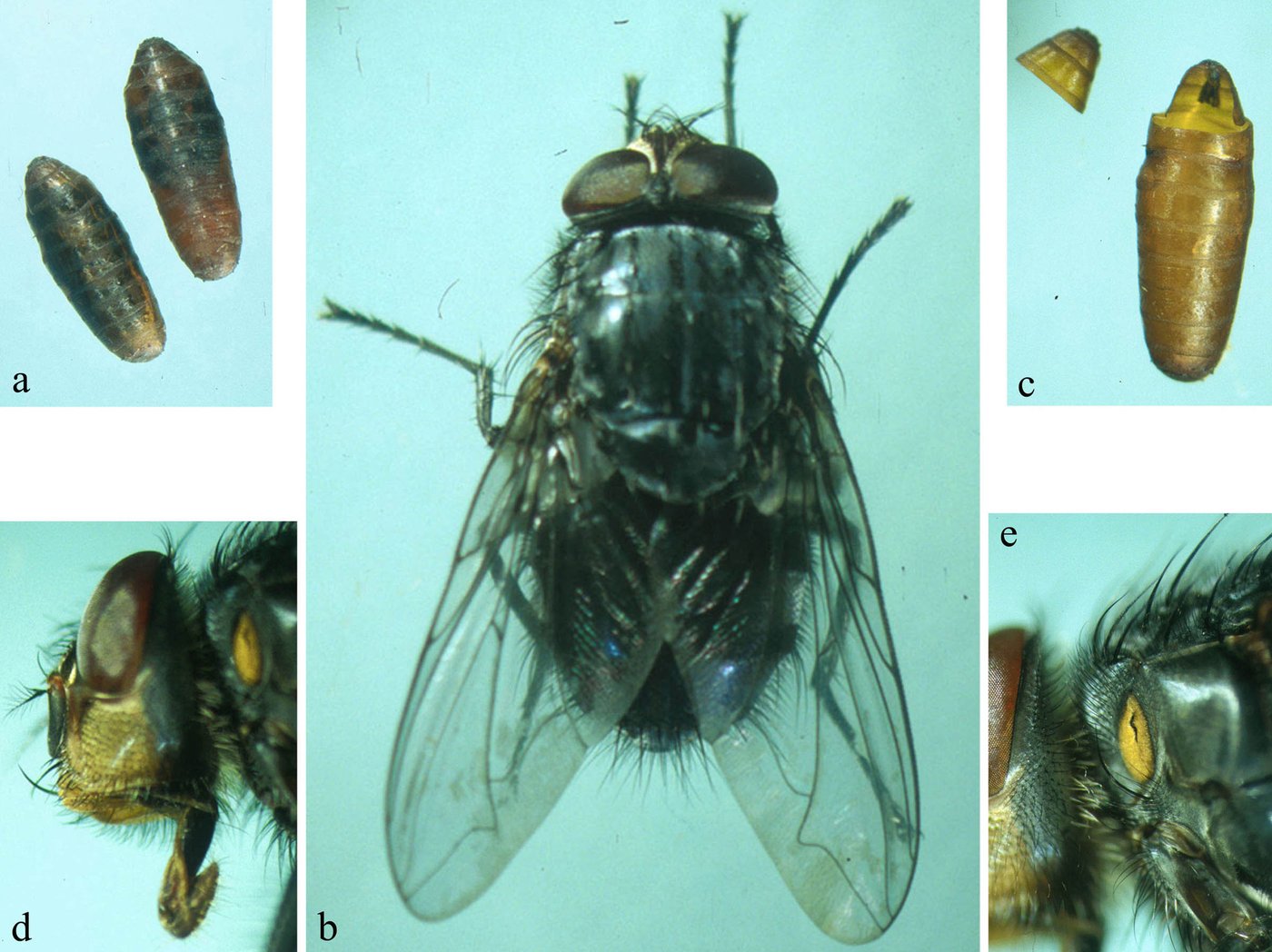
During the first experiment Calliphora vicina (Fig. n. 1) was the only species ovipositing; 1730 specimens from a total of the 208 gr. (fresh wt.) of meat moved to the cellar, were obtained.
Regarding meat moved to the top floor of the building, a small number of blowflies reached the stage of pupa but eclosion of the adults did not take place. Pupae appeared extremely dried, it is likely that the strong daily fluctuations of the temperature and humidity (average maximum 37° and minimum 15°, relative humidity 80% and 38%) registered could have interfered with the blowflies development. This environment was not used in the second experiment.
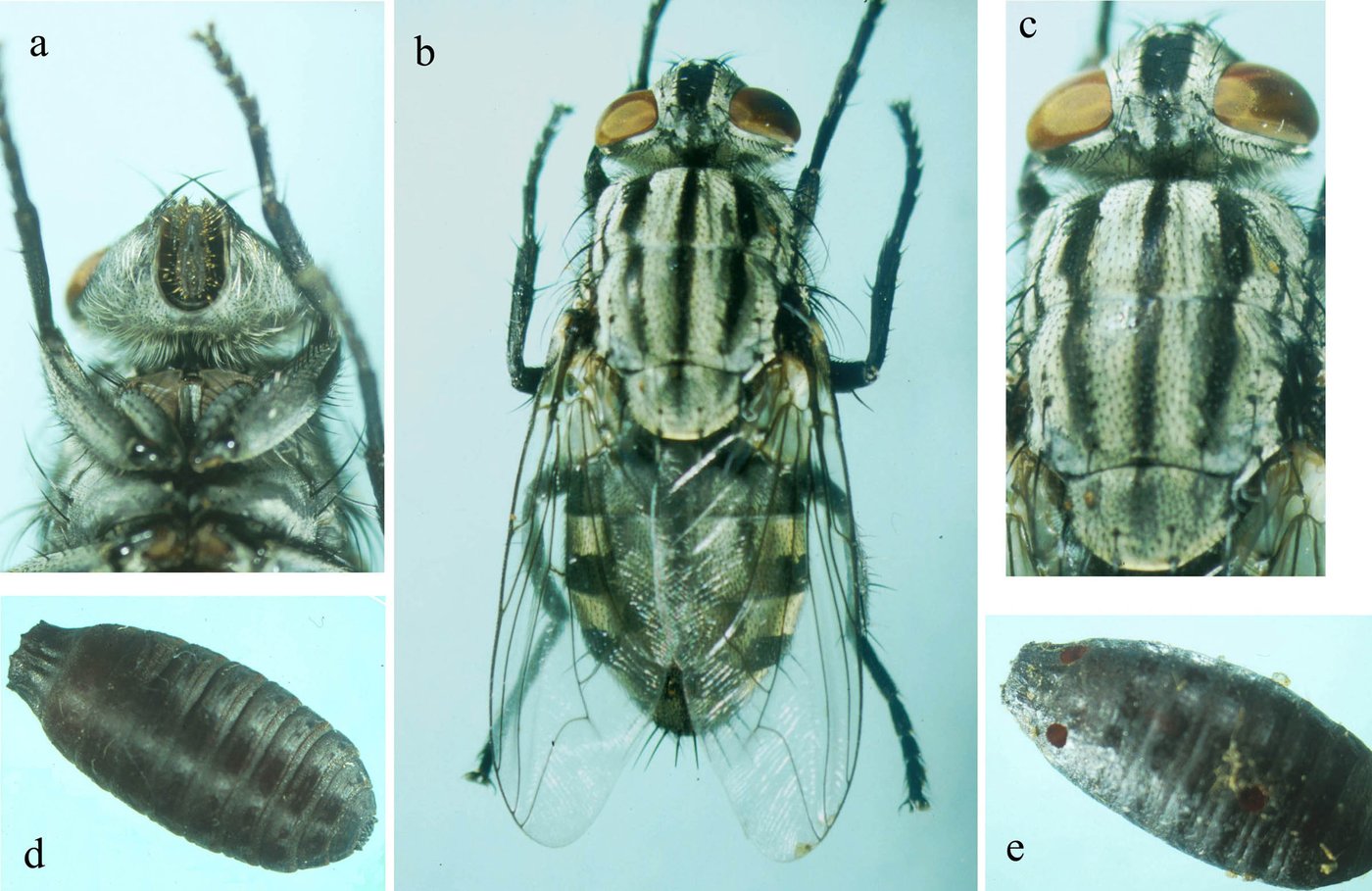
During the second experiment 356 specimens of Sarcophaga africa (fig. 2) from a total of the 253 gr. (fresh wt.) of meat were obtained in outdoor conditions but no adults emerged due to 11% parasitism by Hymenoptera as well as a strong rainfall that submerged pupae. In indoor conditions 70 specimens of Sarcophaga africa and only two samples of Calliphora vicina developed into adults.
It can be assumed that oviposition of Calliphora vicina, occurring in late April, was replaced by Sarcophaga africa, being the dominant species larvipositing in late May.
Also in indoor conditions, Megaselia scalaris (Phoridae) was identified, using the taxonomic keys of the Natural History Museum of London [13]. The genus Megaselia Rondani, 1856, includes around 1400 described species but it is thought it could be between 5,000 and 20,000 species [13]. In the experiment more than 2000 specimens of M. scalaris were counted and the adults showed sexual dimorphism in which female size was 4.11 cm of length with a standard error of 0.09 (N=24) and male size 2.72 cm of length with a standard error of 0.06 (N=24). The Phoridae is a family, in which larva is always enclosed in the puparium, characterised by the presence of respiratory horns.
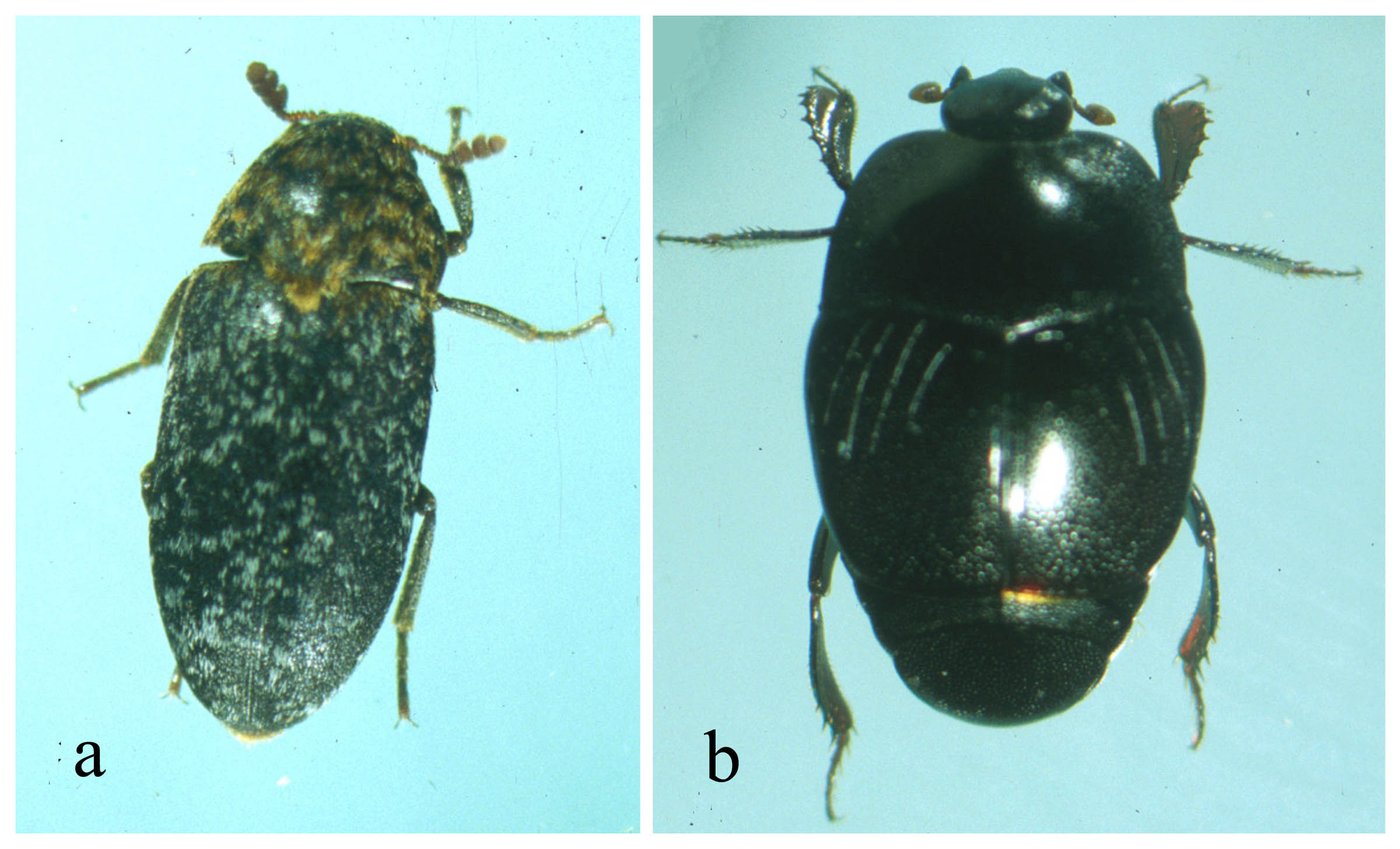
Regarding Coleoptera, species identification is quite difficult, especially for Staphilinidae, so only the genus Dermestes sp. (Dermestidae) and Saprinus sp. (Histeridae) were identified (fig. 3). Adults of Dermestes sp. brown coloured have elytra covered by hairs while adults of Saprinus sp. are shiny black coloured. They were found feeding under the meat in hidden places, moving fast when disturbed and they, generally, produce recognizable feces similar to sawdust.
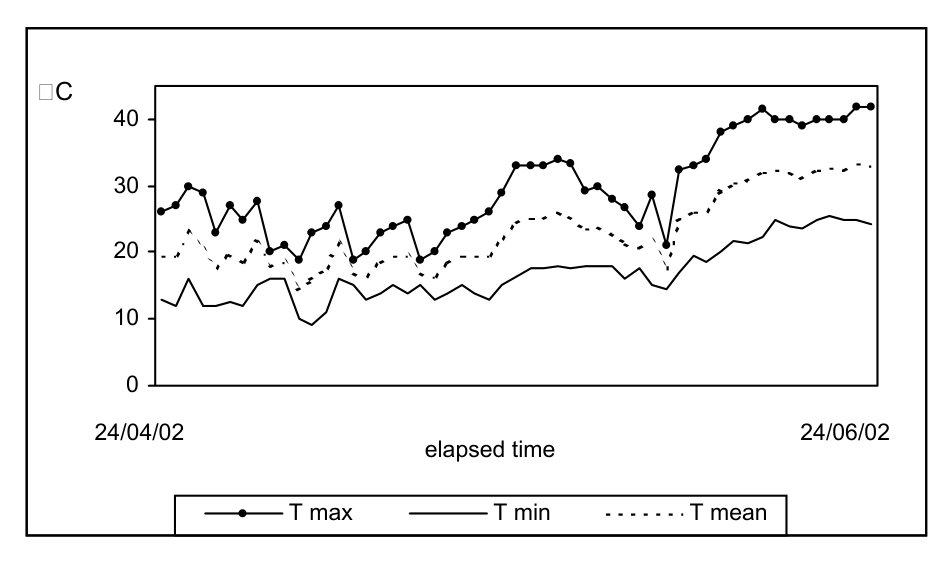
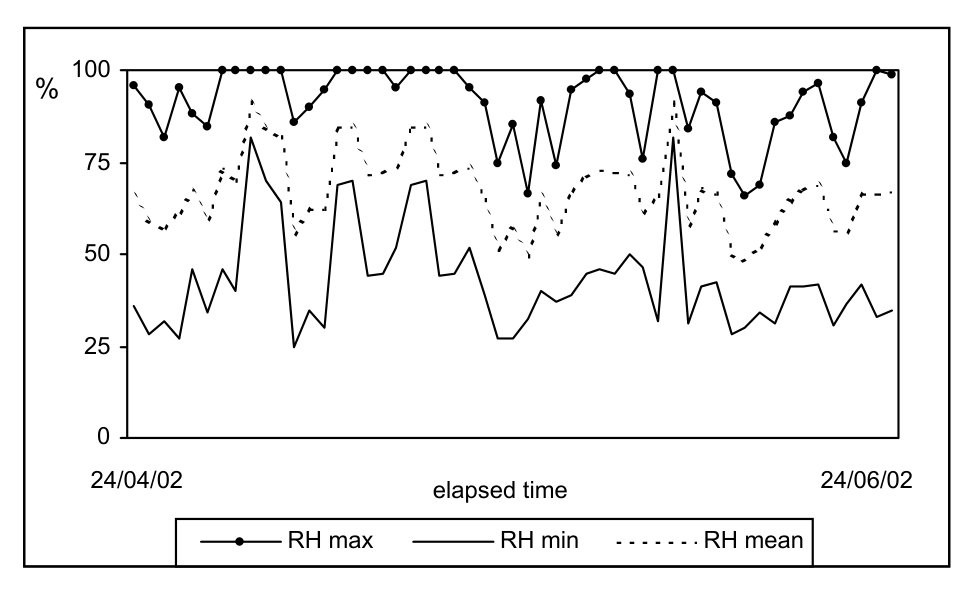
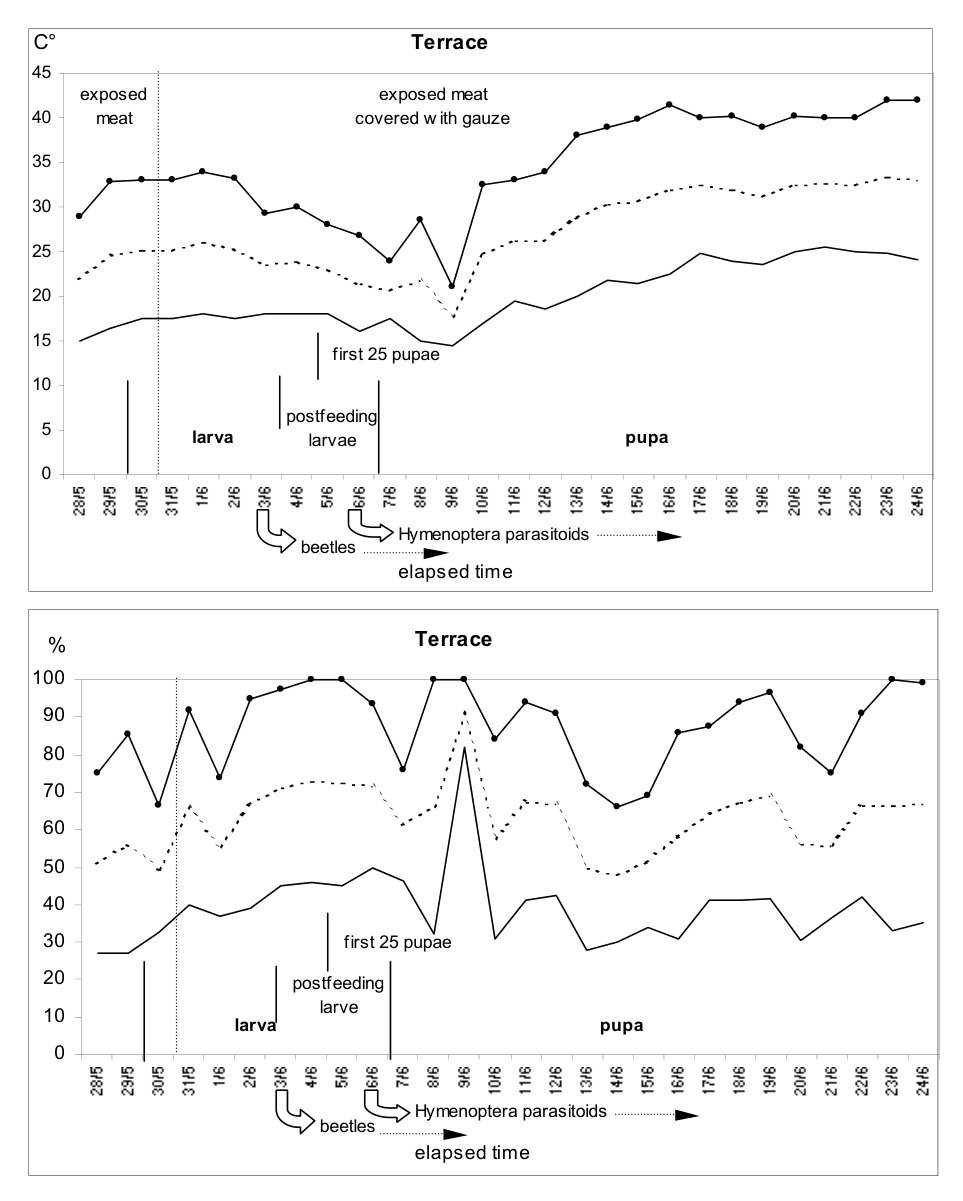
In outdoor and indoor conditions, temperature and relative humidity data were quite different. From late April to late June their trends are reported in Fig. n. 47. From April 24th to 27th during meat exposition on the terrace, the average maximum temperature was 28° and the minimum temperature was 13°; the maximum relative humidity was 91% and the minimum 31%.
Environmental temperature and relative humidity had high daily maximum and minimum variation compared to the cellar.
After June 20th, the maximum environmental temperature reached 40-42°, the highest registered in the entire experimental period.
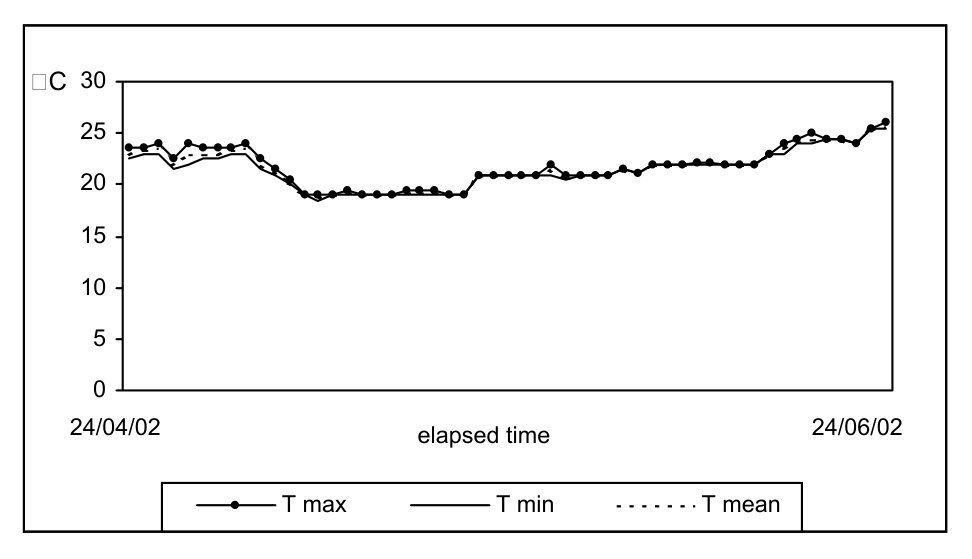
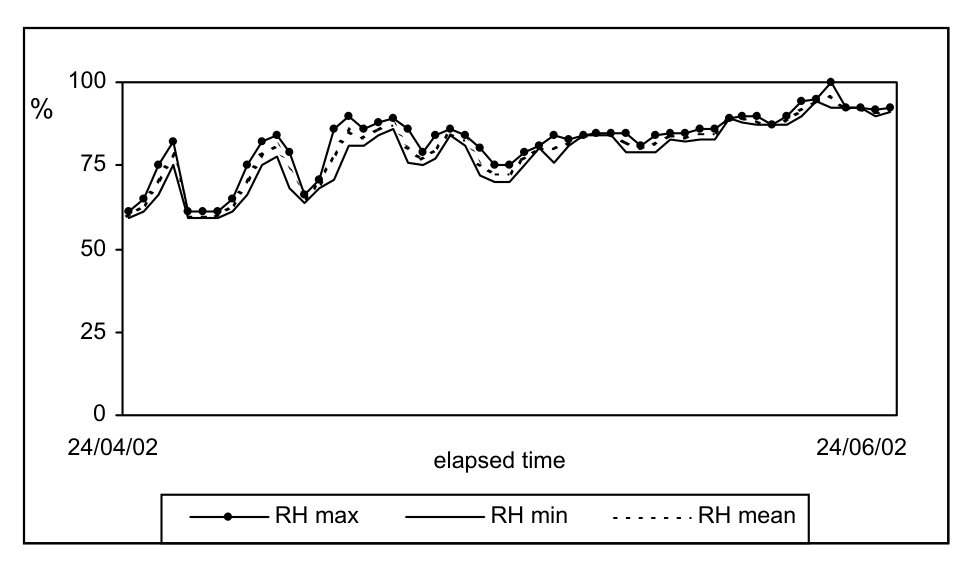
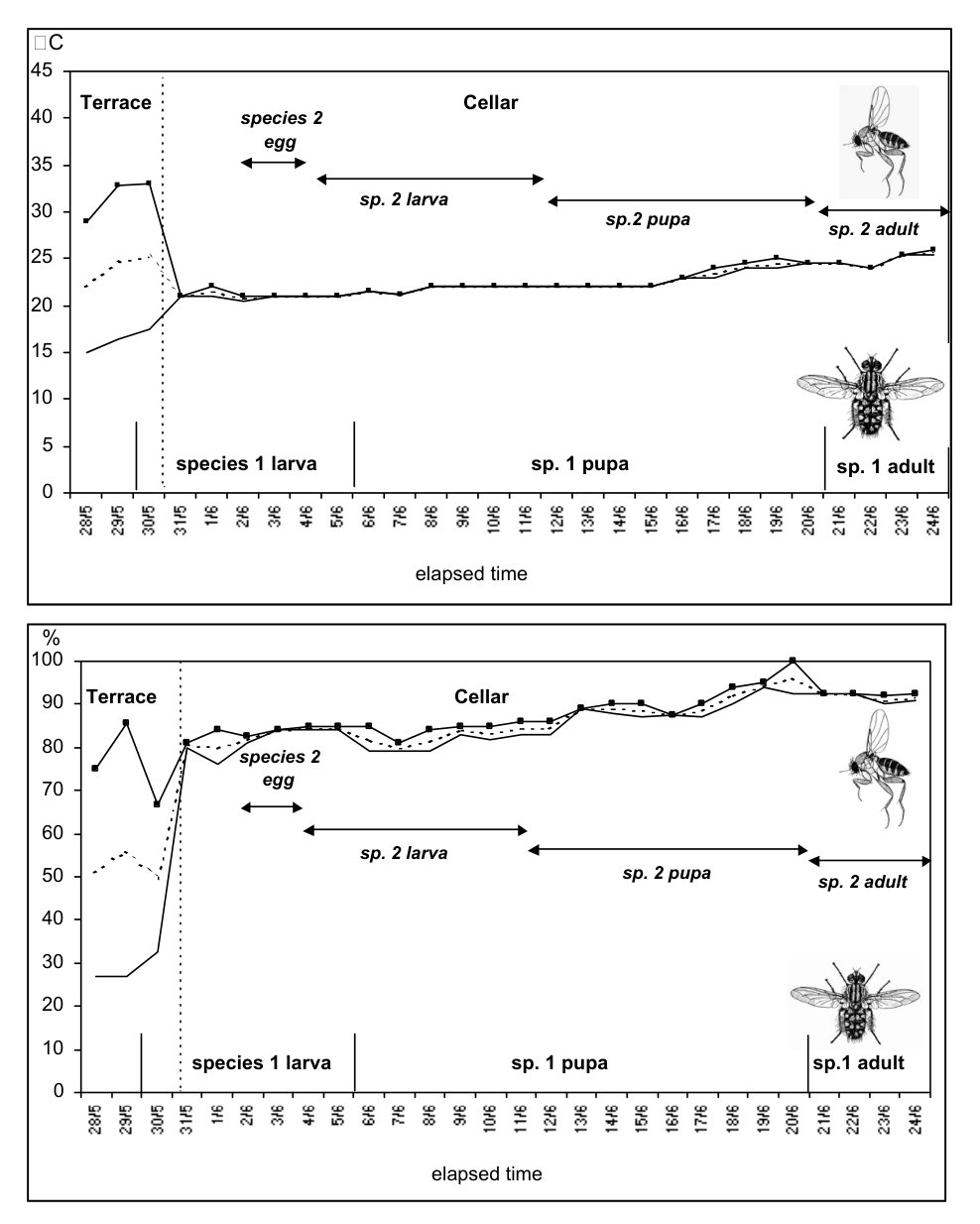
Regarding the indoor conditions in the cellar, temperature and relative humidity values had no daily variation and temperature had an average ranging from 20° to 25° during the whole period. In the literature for controlled dipteran rearing conditions, temperature values of 22-27° are reported [14-16]. So the indoor conditions were suitable for the complete life cycle of dipterans feeding on the meat.
In the first experiment with pig meat pieces, moved to the cellar on April 28th, eggs were observed after two days on those exposed on April 24th. On the 28th many maggots were feeding under the meat and two days later mature migrating larvae were observed. On May 3rd, the first three pupae appeared and on the 14th the first adult of Calliphora vicina emerged. Calliphora vicina underwent complete development in the climatic conditions described in fig. 8. Under these relatively stable conditions, Calliphora vicina had a development cycle from egg to adult of 19-22 days (2 days: eggs; 5 days: maggots with the last 3 days spent as postfeeding larvae; 11 days: pupae).
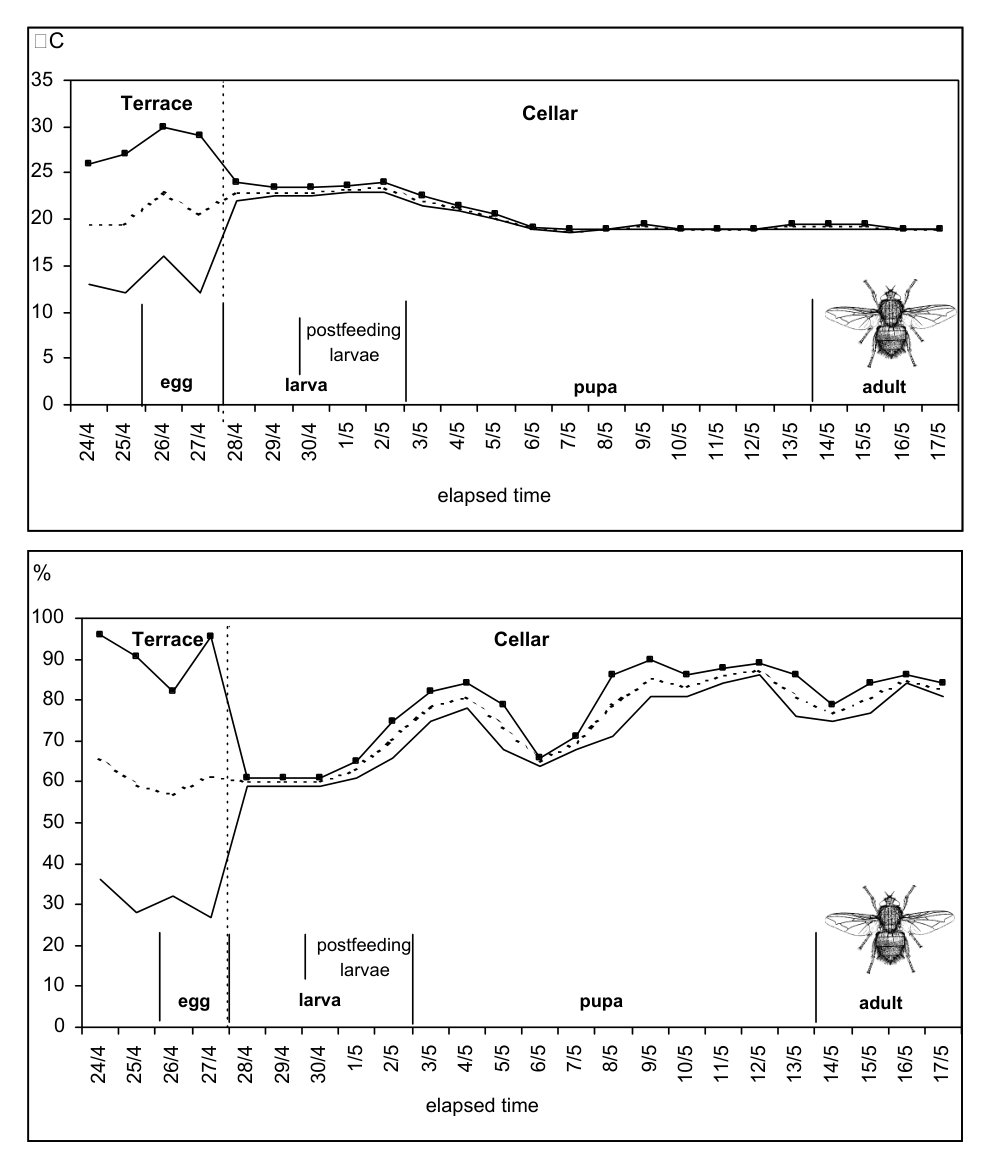
During the second experiment, six meat pieces were exposed on the terrace from May 28th to the 31st and on the 30th larvae at the first developmental stage (L1) were feeding on the meat. In outdoor conditions on June 3rd postfeeding larvae belonging to the genus Sarcophaga spp. were identified. On the same day, Coleopteran adults of Dermestidae, Histeridae and Staphilinidae appeared and remained until the end of the experiment.
Two days later, 25 pupae, together with flesh fly postfeeding larvae, were observed. On the 6th, Hymenoptera parasitoids were observed flying around flesh fly maggots. On the 9th a strong rainfall, two days long, submerged puparia. Small parasitoid emergence holes on flesh fly puparia were observed and more than 20 parasitoid wasps inside some dissected puparia were found.
In conclusion, in outdoor conditions Sarcophaga sp. were in the larval stage for 6-8 days including 3 days as postfeeding larvae. Adults of Coleoptera appeared 6 days after meat was exposed and adults of Hymenoptera parasitoids appeared 9 days after, when the highest number of flesh fly mature migrating larvae was registered (fig. 9).
The remaining meat chunks transferred to the cellar had different results. On the 30th larvae L1 were observed and on June 2nd, together with flesh fly larvae, small Diptera were attracted to the rotting meat and many small eggs were detected. On the 6th, 20 pupae of Sarcophaga sp. appeared and on June 12th many small dipteran pupae belonging to the species Megaselia scalaris were observed. On the 21st the first adult of Sarcophaga africa and 10-15 adults of Megaselia scalaris emerged (fig. 10).
In indoor conditions Sarcophaga sp., under the climatic conditions described in fig. 10, had a development cycle of 23-26 days (7 days: maggots with 2 days of postfeeding larvae; 15 days: pupae), larviposition occurred two days after meat was exposed. Megaselia scalaris, at the same temperature and relative humidity conditions, had a life cycle of 1922 days (7-8 days: larvae; 10 days: pupae), oviposition occurred five days later.
Discussion
The use of pig meat pieces both in outdoor and indoor conditions, represents a methodological procedure to get an estimation of insects' presence as "forensic indicators". Pig meat is a cheap food substrate without the social implications associated with the use of human material and is suitable for the development cycles of necrophagous Diptera like Calliphoridae, Sarcophagidae and Phoridae. By attracting insects of forensic interest this kind of meat can be considered to estimate the forensic fauna in different Italian geoclimatic areas (different climatic areas, for example north vs. south, can have different insects attracted to a dead body so it is possible to give an experimental estimation in this way). Moreover this methodology can be used to check Diptera species collected at the crime scene and their life cycle; in this work the results obtained on the precence of Calliphoridae and Sarcophagidae and their development cycles have been reported in real cases from cadavers in fields and/or during autopsy [17-19] and from experiments with carrion [15, 20].
In the urban area of Parma, Northern Italy, from late April to late June, Diptera belonging to the species Calliphora vicina, Sarcophaga africa and Megaselia scalaris were collected and identified. In this period the species that first appeared, were Calliphora vicina and Sarcophaga africa confirming the primary role of sarcophagids in carrion colonization [16]. Calliphora vicina were the dominant species in the colder months while Sarcophaga sp. were dominant in the warmer months [21]. Development rates of Calliphora vicina obtained in this experimental work coincides with conclusions reported by Professor Pekka Nuorteva in two real cases (case 806/65 and case 757/66) [17-19].
From this study the use of Megaselia scalaris in real forensic cases has been pointed out; the abundance of each life cycle stage of this species, together with Sarcophaga sp., could contribute to an estimation of post mortem interval (PMI). Megaselia scalaris, associated with dark indoor conditions and attracted to rotting meat has a secondary forensic role [22-23].
The appearance of Coleoptera in outdoor conditions confirm their role in carrion colonization after Diptera when the suitable stage of desiccation of the flesh is reached [23-24].
In indoor conditions in the cellar, for temperature and relative humidity values registered, the period of dipteran development was consistent, suggesting that the entomological conclusions based on PMI are precise and useful. In outdoor conditions, some biotic and abiotic factors could interfere with the insects' life cycle. For example, rainfalls flooding flesh fly puparia caused them to die of anoxia. Parasitism by Hymenoptera [9], even if in low percentage, or predation by Coleoptera and other insects, could contribute to a limitation of the number of flies emerging from the carrion [25]. In this work, the influence of abiotic factors on frequency and abundance of Diptera was highlighted. Environmental temperature, relative humidity, presence or absence of wounds on a corpse and access of insects to the body can affect the presence and abundance of Diptera specimens as well as other arthropods. The influence of all of these factors is specific to aspects of each crime scene.
Acknoledgments
I am grateful to Professor Vittorio Parisi, Director of Natural History Museum of Parma (Italy) and Dr. Mark Benecke, Director of International Forensic Research and Consulting of Cologne (Germany) for their encouragement and interest during my work and for their useful comments on the manuscript. I would like to thank the staff of the library of the Experimental Institute for Agricultural Zoology of Florence (Italy) for their availability during books and reviews consulting. I also thank Dr. Daniel de Bettencourt for his helpful suggestions and English manuscript revision.
References
- E. P. Catts, M. L. Goff, Forensic entomology in criminal investigations. Ann. Rev. Entomol., 37 (1992): 253-272.
- B. Keh, Scope and applications of forensic entomology. Ann. Rev. Entomol., 30 (1985): 137-154.
- M. Benecke, R. Lessig, Child neglect and forensic entomology. For. Sci. Intern., (120) 2001: 155-159.
- K. G. V. Smith, A manual of forensic entomology, in: The Trustees of the British Natural History Museum London, 1986. ↑
- K. G. V. Smith, Forensic entomology. In K.G.V. Smith (Eds.) Insects and other arthropods of medical importance. British Natural History Museum, London, 1973, pp. 483-486. ↑
- P. Freeman, Diptera - Introduction, in: K.G.V. Smith (Eds.) Insects and other arthropods of medical importance. British Natural History Museum, London, 1973, pp. 21-36. ↑
- H. Oldroyd, Diptera: Introduction and key to Families, in: Handbooks for the identification of British insects, vol. 9 - part I, Royal Entomological Society of London, 1949. ↑
- H. Oldroyd, K. G. V. Smith, Eggs and larvae of flies, in: K.G.V. Smith (Eds.) Insects and other arthropods of medical importance. British Natural History Museum, London, 1973, pp. 289-323. ↑
- A. Oliva, Insectos de interés forense de Buenos Aires (Argantina). Primera lista ilustrada y datos bionomicos. Revista del Museo Argentino de Ciencias Naturales "Bernardino Rivadavia" e Instituto National de Investigation de la Ciencias naturales, 7 (1997): 13-59. ↑
- R. W. Merritt, M. J. Higgins, J. R. Wallace, Entomology, in: Encyclopedia of Forensic Sciences, vol. 2, Academic Press, 2000, pp. 669-705. ↑
- F. I. Van Emden, Diptera Cyclorrhapha Calyptrata (I) section (a): Tachinidae and Calliphoridae, in: Handbooks for the identification of British insects, vol 10 - part 4 (a), Royal Entomological Society of London, 1954. ↑
- E. C. M. D'Assis Fonseca, Diptera Cyclorrhapha Calyptrata section (b): Muscidae, in: Handbooks for the identification of British insects, vol. 10 - part 4 (b), Royal Entomological Society of London, 1968. ↑
- R. H. L. Disney, Scuttle flies. Diptera, Phoridae, Genus Megaselia, in: Handbooks for the identification of British insects, vol. 10 - part 8, Royal Entomological Society of London, 1985. ↑
- Y. Z. Erzinclioglu, Immature stages of British Calliphora and Cynomya, with re-evaluation of the taxonomic characters of larval Calliphoridae (Diptera). J. Nat. His., 19 (1985): 69-96. ↑
- S. Kamal, Comparative study of thirteen species of sarcosaprophagous Calliphoridae and Sarcophagidae (Diptera) I. Bionomics. Ann. Entomol. Soc. Am., 51 (1958): 261-271. ↑
- R. D. Hall, K. E. Doisy, Length of time after death: effect on attraction and oviposition or larviposition of midsummer blow flies (Diptera: Calliphoridae) and flesh flies (Diptera: Sarcophagidae) of medicolegal importance in Missouri. Ann. Entomol. Soc. Am., 86(5) (1993): 589-593. ↑
- P. Nuorteva, H. Schumann, M. Isokoski, K. Laiho, Studies on the possibility of using blowflies (Dipt., Calliphoridae) as medicolegal indicators in Finland. II Four cases where species identification was performed from larvae. Ann. Ent. Fenn., 40 (1974): 70-74. ↑
- P. Nuorteva, M. Isokoski, K. Laiho,. Studies on the possibilities of using blowflies (Dipt.) as medicolegal indicators in Finland. I. Report of four indoor cases from the city of Helsinki. Ann. Ent. Fenn., 33 (4), (1967): 218-225. ↑
- M. Turchetto, S. Lafisca, G. Costantini, Postmortem interval (PMI) determined by study sarcophagous biocenoses: three cases from province of Venice (Italy). Forensic Sci. Int., 120 (2001): 28-31. ↑
- Hanski, Breeding experiments with carrion flies (Diptera) in natural conditions. Ann. Ent. Fenn., 42 (3), (1976): 113-121. ↑
- H. Schroeder, H. Klotzbach, K. Puschel, Insects' colonization of human corpses in warm and cold season. Legal Medicine, 5 (2003): 372-374. ↑
- B. Greenberg, J. D. Wells, Forensic use of Megaselia abdita and Megaselia scalaris (Phoridae: Diptera): case studies, development rates and egg structure. J. Med. Entomol., 35(3), (1998): 205-209. ↑
- B. Bourel, N. Hubert, V. Hedouin, D. Gosset, Entomologie medico-legale appliquee a un cas de momification. Ann. Soc. Entomol. Fr., 36(3), (2000): 287-290. ↑
- P. Kulshrestha, D.K. Satpathy, Use of beetles in forensic entomology. Forensic Sci. Int., 120 (2001): 15-17
- R. Norris, The bionomics of blow flies. Ann. Rev. Entomol., 10 (1965): 47-68. ↑