
Review · Vol. 23, No. 2
Book Reviews: Technical Books Section
Ref:Aggrawal A. NACPFMT’s Practical Medicolegal Manual in Forensic Pathology, 1st Edition, 2022 [book review]. Anil Aggrawal's Internet Journal of Forensic Medicine and Toxicology [Internet]. 2022;23(2): Available from: https://www.anilaggrawal.com/ij/vol_023_no_002/reviews/tb/page001.html . DOI: 10.5281/zenodo.7994057
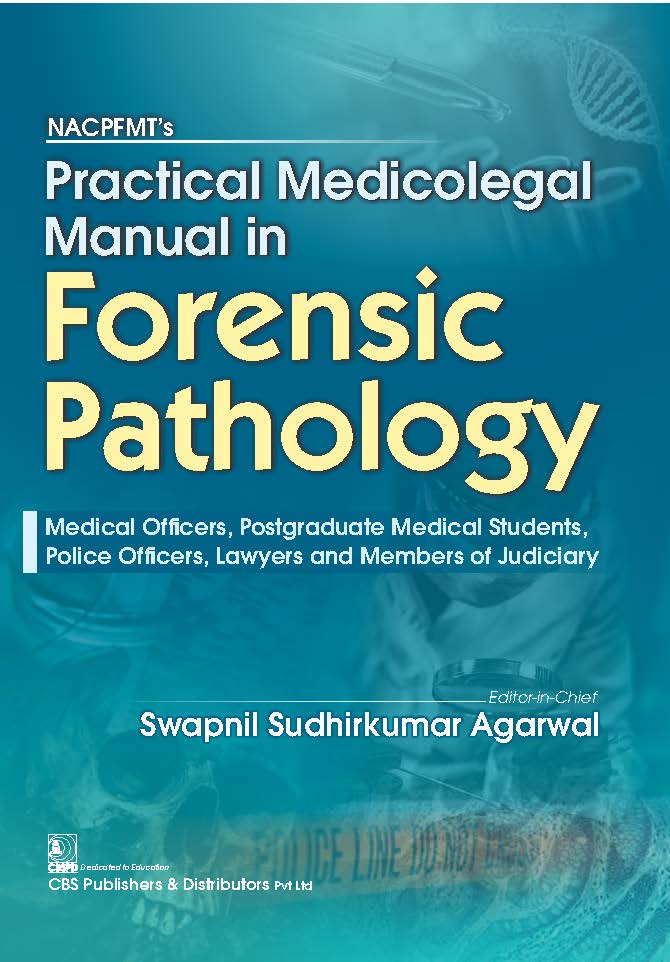
NACPFMT’s Practical Medicolegal Manual in Forensic Pathology, 1st Edition, by Swapnil Sudhirkumar Agarwal [Editor in chief]. Soft cover, 53.34 x 45.72 x 3.81 cm.
CBS publishers and distributors Pvt Ltd.;
Publication Date 2022. 243 pages, ISBN-10: 9354663591; ISBN-13: 978-9354663598. Price: Paperback- Rs. 577.00; Kindle Edition-Rs. 513.60.
Visit this book on Publisher's site by clicking here
 |
For some strange reason, forensic medicine in our country is not seen in good light – neither by the doctors, nor administrators, nor general public. It has often been said that forensic medicine is the refuge of doctors who do not get any other subject; leave aside several persons [like this reviewer], who left good attractive clinical disciplines to choose forensic medicine. There is a marked apathy to conduct postmortems among doctors, as this is usually considered a dirty job. I always found conducting postmortems an inordinately charming task, and often resorted to conducting anatomical autopsy, like dissecting out vertebral arteries [to see traumatic hemorrhages in road side accidents], thoracic duct [to see signs of malignant cells spreading through it] and eye balls [to see retinal hemorrhages in shaken baby syndrome, methyl alcohol poisoning etc.]. So much so, that several of my colleagues used to jokingly comment that I am a necrophile – I find enjoyment in the company of a dead body. My stand has always been that the dead body is trying to say a lot of things about its death. But it says so, in its own language, which we have to learn. My definition of forensic pathology has always been that “it is the art of learning the language of the dead.”
So how much language of the dead have I learnt so far? At the age of 66 – having spent about 40 years in forensic medicine – I can say, I am still learning the basic alphabet of this language. Probably in my next birth, I will learn some words, and in still next some basic sentences; such is the complexity of this language.
Swapnil, the editor-in-chief of this beautifully written book says something on similar lines in his preface, “It is an irony that with more than 500 medical colleges currently in India.. ..most of the medicolegal work… [is] …. undertaken by undergraduate medical officers (even in medical colleges).” This is one of the biggest paradoxes I have never been able to understand. While it is unimaginable to conceive of a UG performing a laparotomy, or say, a cesarian section, it is considered perfectly okay for him to conduct an autopsy, which in my opinion calls for far more skill than the procedures mentioned. Probably it is because while the living can drag the doctor to court, the dead cannot.
Whether we like it or not, this trend is probably going to continue indefinitely. So, what is the way out for the poor medical officers, with nothing more than a UG training [or with PG training in some other discipline] who are stranded with postmortem work? For a long time, no one had an answer. But fortunately, now we have – in the form of a new book edited by Agarwal.
This book is intended for those medical officers, who willy-nilly find themselves in the task of performing postmortems, and yet do not possess a PG qualification in forensic medicine. As Swapnil says very correctly, these doctors follow what their senior colleagues do [who in turn have followed what their own seniors did]. It is best left to imagination, what these seniors teach youngsters.
As I thumbed through the book, I realized that this is exactly the kind of book our district level doctors -who are required to conduct postmortems- need. The chapters are written by about 20 well-known forensic practitioners in this country, like Chavali, Doshi, Kuppast, Lagali, Lavlesh, Modi, Mugalimath, Parekh, Parmar, Sane, Saraf, Shivaraj, Sutay, Thube, Tumram and Agarwal himself. All chapters deal with simple instructions to doctors on how to conduct autopsies in various kinds of deaths and what findings to expect.
Virtually every finding has been depicted in the form of clear color photographs. The most beautiful part is that no prior knowledge of autopsy is assumed by any author. Each author starts with the basics, and instructs on how to recognize the most vital findings. No attempt is made to explain rare/exotic findings, which is the staple food of experts. Every possible kind of death is covered. Sample some of the chapters - autopsy in deaths due to mechanical trauma, asphyxia, thermal injury, firearm injury, bomb explosions, electrocution, poisoning and so on. In a total of 20 chapters, this excellent group of forensic teachers takes an undergraduate virtually to the level of a postgraduate.
I would recommend this book not only for district medical officers who conduct autopsies [for whom it is primarily written], but also for all undergraduate students. The pictures are a visual feast, and probably even a layman, who likes to delve into murder mystery novels would find this book interesting, in as far as he would know how the detectives solve murder cases. The language is simple enough for a layman to understand.
-Anil Aggrawal
Request a PDF file of this review through the contact page. (If your screen resolution can not be increased, or if printing this page is giving you problems like overlapping of graphics and/or tables etc, you can take a proper printout from a pdf file. You will need an Acrobat Reader though.)