




Introduction
Post Mortem Interval (PMI) or time of death of an individual is of great significance in death related investigations to reconstruct the events of crime and to prove or disprove the alibi. But, as the time progresses it become difficult to estimate PMI using different medical parameters, and after 72 hours of death forensic entomology is the most accurate and perhaps the only method available to estimate PMI. This estimation is greatly influenced by the time of fly oviposition and based on the age of the oldest insects found on carcass [1]. Insects colonizing the carcass can be helpful in estimating the PMI, which is specific to a defined bio-geographical region [2, 3, 4]. Forensic entomology has also been reported to provide useful information and strong evidence not only in estimating the PMI, but also in determining season of death, geographical location of death [5], movement or storage of remains following death, time decapitation or dismemberment [6], submersion interval [7], specific site of trauma on the body [8], use of drugs [9], child abuse/neglect, identification of suspect [10], sexual molestation and in linking a suspect to the crime scene [11]. However, the accuracy of this method, rate of decomposition, insect succession and composition of carcass communities are influenced not only by the biogeoclimatic zone, but also by temperature and humidity, the type and the physical state of the carcass remains, access to the carcass, as well as by habitat loss and fragmentation due to anthropogenic activities [12, 13, 14]. Determining the insect’s preference for specific habitats can also reveal the postmortem relocation of a carcass [14, 15, 16]. So, it is important to determine the insect fauna associated with carcass in a given area. Though, forensic entomology has become one of the most reliable and promising tools in legal and forensic investigations [15, 17, 16] still there is a need for more research in order to strengthen entomological investigative methods and reference data on carcass specific insect fauna. Some studies have shown differences in the composition of the carcass insect fauna under different environmental conditions [15, 18, 19, 20, 21, 22] and very few researchers and scientists have reported different reference data based on different factors like seasonality of insect succession in Brazil [23], seasonal insect succession in India (Punjab) [24], effect of rainfall and temperature [25], effect of various climatological changes such as global warming etc. [26] and effect of clothing on insect succession [27]. Keeping in view, that there is a lack of studies on these issues and taking into account the necessity for database for specific regions and seasons present study was designed.
Methodology
This is the first study of its kind in the selected regions, forest areas in the West Himalayan region of India were selected and categorized into three groups based on three seasons i.e. summer, monsoon and winter, at three different altitudes i.e. low, medium and high (Table 1). The selected sites were ensured unhindered accessibility of the carcass to different kinds of insects, it should be within reach to take observations and there should be minimum disturbance to and by humans. This study is the first study of its kind in which effect of both seasonal and altitudinal variation on carcass decomposition and insect succession has been studied.
| Groups | Altitude (Above Mean Sea Level) |
Season (May, 2016- Jan, 2018) | ||||||||
|---|---|---|---|---|---|---|---|---|---|---|
Summer (March to June) |
Monsoon (July to October) |
Winter (November to February) |
||||||||
| Temperature (0C) | Average Rainfall (in mm) | Temperature (0C) | Average Rainfall (in mm) | Temperature (0C) | Average Rainfall (in mm) | |||||
| Max | Min | Max | Min | Max | Min | |||||
| Lower altitude (440 m) | 38 | 22 | 54.6 | 34 | 22 | 111.5 | 24 | 7 | 114.5 | |
| Medium altitude (1,128 m) | 32 | 18 | 277.9 | 34 | 12 | 90.2 | 20 | 3 | 3.6 | |
| Higher altitude (2,140 m) | 29 | 7 | 143.7 | 30 | 9 | 129.6 | 22 | 2 | 2.8 | |
Experimental setup
A total of 09 adult rabbits (Oryctolagus cuniculus) were used as animal model and to ensure that the animals are disease free, they were procured from the registered breeders with Committee for the Purpose of Control and Supervision of Experiments on Animals (107/99/CPCSEA/2016-01). To prevented the disturbance by carnivorous scavengers and allow insects to access the carcass metallic cages (2.5ft × 2.5ft × 3ft) with wired mesh (1 inch × 1 inch) were used to enclose the rabbit carcass. The carcass was inspected at the interval of 2 hours (hrs) and at each visit the physical condition of the carcass, stage of decomposition, insect fauna and their respective stages were documented and photographed.
Sampling
Flying insects were captured using standard aerial sweep net method whereas, Beetles and immature stages of different species were collected with forceps and spoons. The carcass was carefully lifted for its physical examination and collection of insect fauna samples present underneath. Adult flies were immobilized using ethyl acetate vapors, while immature stages of different fly species were put in hot water (80-90oC) for 1-2 min and then preserved in 75-80% ethyl alcohol. Beetles, wasp, bees etc. were directly preserved in 75-80% ethyl alcohol.
The number of samples collected depends on their abundance. The temperature data on (maggot mass temperature) and around the carcass was recorded with the help of a digital thermometer, and climatological data were also collected from the meteorological station. Collected samples were transported to the laboratory for record and identification. Each sample was identified in the laboratory with the help of keys given by Thyssen [28], Thompson [29], Oldroyd [30], Carvalho and Mello-Patiu [31], Smith [32] and also by using online museums [33, 34].
Results and discussion
Four stages of carcass decomposition i.e. fresh, bloated, active decay and dry stages were recognized, the duration of onset and end of each stage of decomposition was observed to be varied with change in season and altitude (Fig 1).
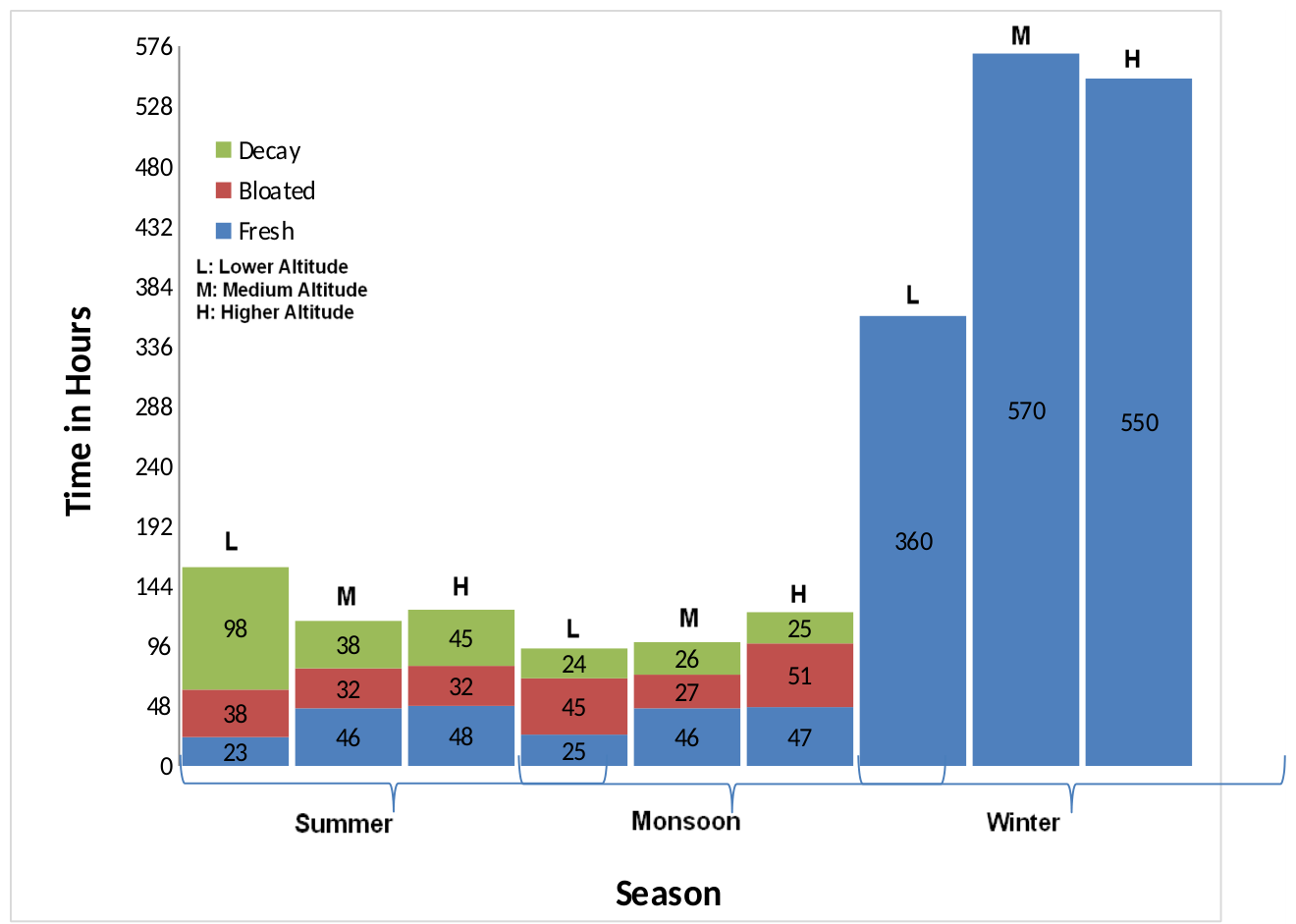
A dissimilar and substantial variation was recorded in winter season, with no external signs of decomposition and entomological succession at all the selected altitudes. The probable reason for this variation can be the surrounding temperature which was witnessed to be very low (Table 1) and that lead to delayed carcass decomposition and inhibition of insect succession. During the study Diptera and Coleoptera were by far the predominant groups, flies showed preference for natural body openings (mouth, nose, and anus) for oviposition. The Calliphoridae were more abundant during the earlier stages of decomposition followed by Sarcophagidae, and Coleopterans which were dominant during the later stages. Seven species of Diptera belonging to five families i.e. Calliphora vicina, Calliphora vomitoria, Sarcophaga haemorrhoidalis, Sepsis (genus), Lucilia cuprina, Megaselia scalaris and Piophila casei were recorded. Calliphoridae and Sarcophagidae were found to be responsible for maximum carcass tissue clearing, and combinations of these flies dominated in all the seasons and were found to be the first to reach the carcass. Similarly, five species of Coleoptera belonging to three families i.e. Oiceoptoma noveboracense, Nacrophila americana, Silphidae (Family), Hister (Genus), Dermestes caninus were also recorded.
Insect succession and carcass decomposition
Low altitude
The initial stage of carcass decomposition was characterized by normal intact body, moveable limbs and soft fur, known as Fresh stage. For all the seasons no insect activity was seen during this stage of decomposition. The variation in time period of this stage was observed, when compared to a similar study reported by Bharti and Singh [24] at an altitude of about 230 m above mean sea level. Time taken by fresh stage to end was 22 h post-mortem in summer and 18 h post-mortem in monsoon, which is different from the present observations, in current study fresh stage was observed for 23 h post-mortem in summers and 25 h post-mortem in monsoon season (Table 3). After initial hours of fresh stage, the carcass body became stiff, hair loss started, stomach became distend this indicated onset of Bloating stage. The bloated stage persisted for 38 h in summer and 45 h in monsoon season, in prior study [24] this stage was reported for 32 h in summer and 25 h in monsoon season. The odor of decay became noticeable after 48 h in summer and 32 h post-mortem in monsoon. Both blow flies and flesh flies were prominent during this stage, their eggs were observed on body and mouth. Lucilia cuprina and Sarcophaga haemorrhoidalis were the first visitor on the carcass. L. cuprina visited the carcass within first 24 h and 26 h post-mortem in summer and monsoon seasons respectively. Whereas, S. haemorrhoidalis was observed visiting the carcass after 26 h in summer and 56 h post-mortem in monsoon season. Different larvae stages of blow flies and flesh flies were also observed on and around the carcass. and also observed on and around the carcass at the end of this stage.
The insect colonization and assimilation of carcass tissues reaches its peak, representing the Decay stage. During this stage eggs of the insects get developed into larvae and, were very much active, that’s why this stage is also denoted as the consumption phase with regard to carcass insect activity. The liquefaction and disintegration of tissues were recorded, the carcass was infested with maggots, and small section of pre-pupal larvae were also observed underneath carcass. The number of both blow flies and flesh flies visiting the carcass get reduced and, black scavenger flies and necrophagous insects (e.g. beetles) started visiting the carcass. Hister (Genus) and Dermestes caninus were observed visiting the carcass within 88-90 h post-mortem in summer season, Sepsis (genus), Silphidae (Family), Megaselia scalaris and Piophila casei were observed in monsoon season within 72-132 h post-mortem (Fig 2 and Fig 3). This stage persisted for long 98 h in summer and took only 24 h to end in monsoon season. Whereas, in the previous study [24] this stage was observed for 40 h in summer and 64 h in monsoon season.
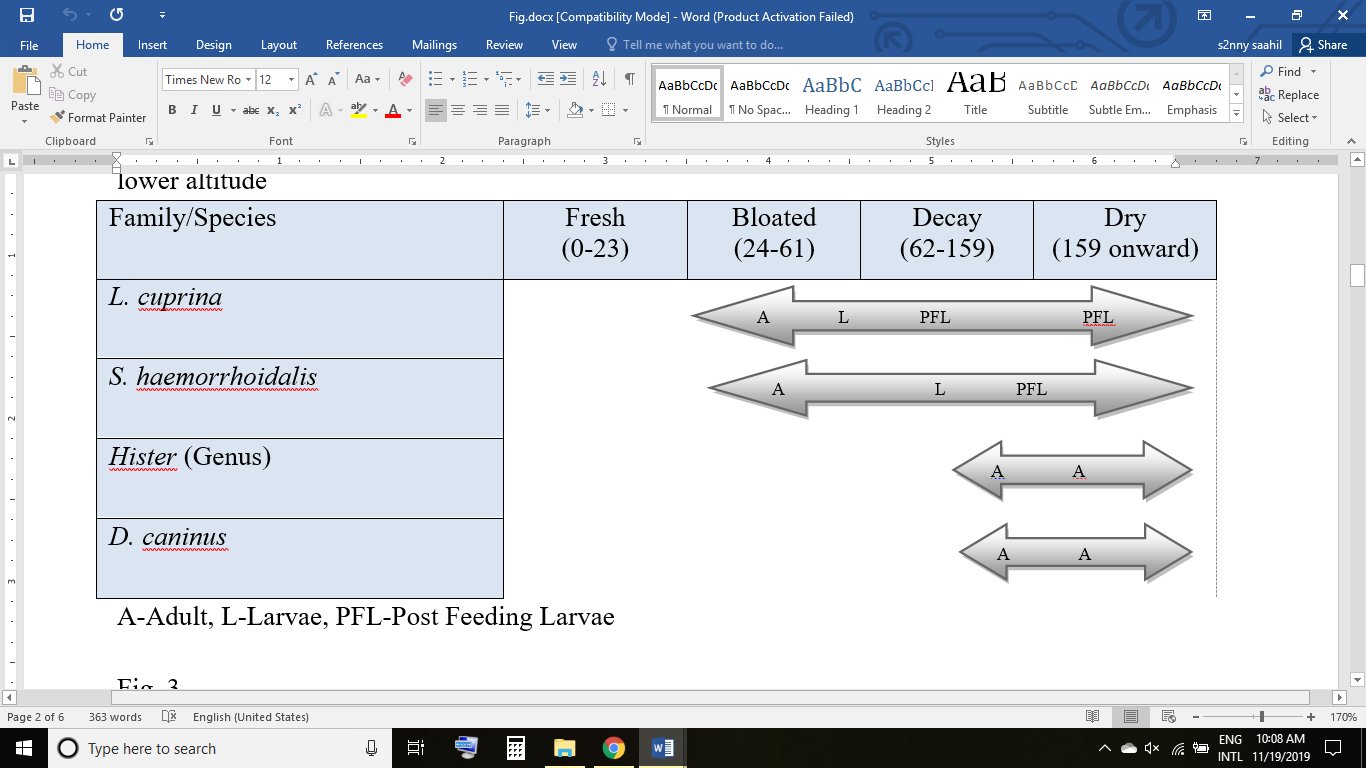
A-Adult, L-Larvae, PFL-Post Feeding Larvae
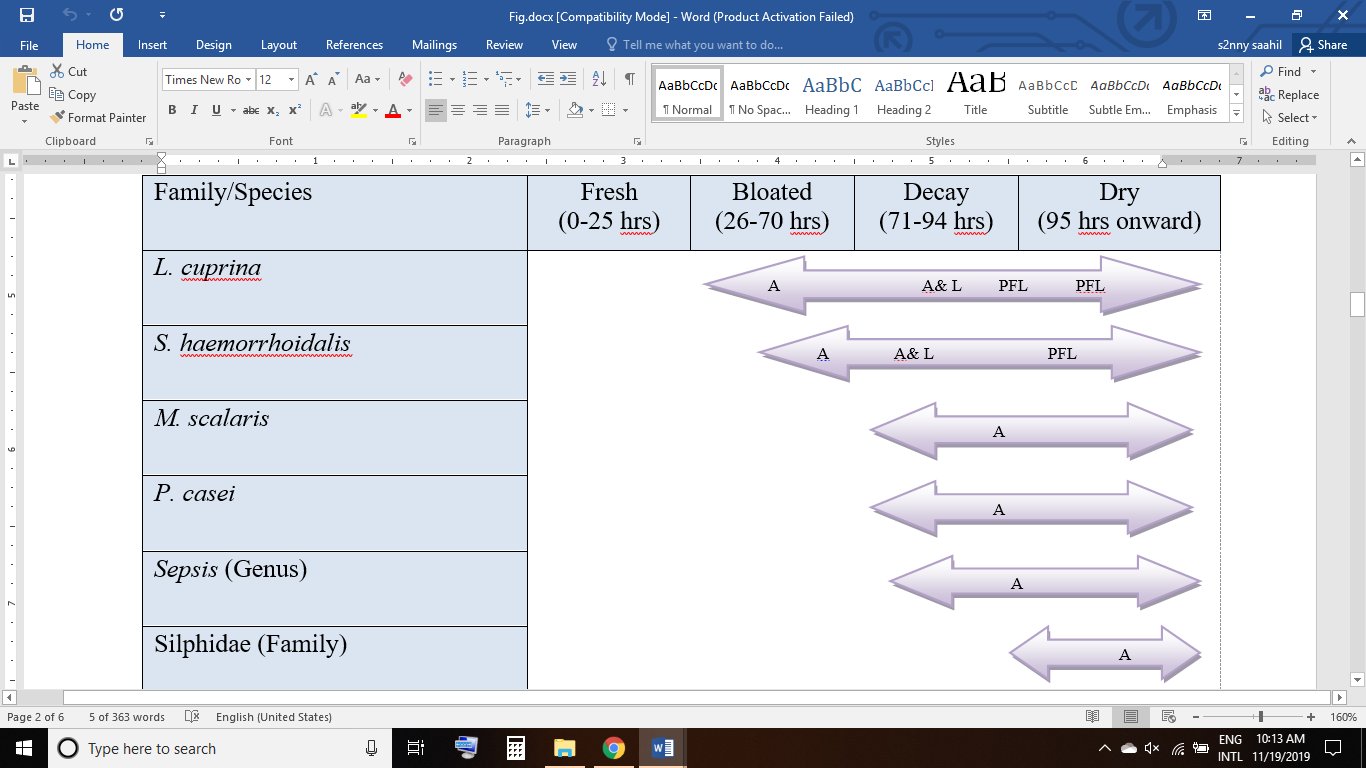
A-Adult, L-Larvae, PFL-Post Feeding Larvae
After decay stage the carcass was reduced to bone and hair known as Dry stage. Unlike other phases of decomposition, this stage has no definitive end, because the access to carnivorous scavengers was prevented by metallic cage used. Thus, this stage may require months to years to reach completion and in summer after 159 h and after 94 h post-mortem in monsoon season the carcass reached this stage, in previous study [24] this stage was reported to be observed after 95 h in summer and 108 h in monsoon season. The number of insects visiting and their activity was reduced to minimum during this stage. Only few of the migrating larvae, some beetles and pupae were observed on and around the carcass remain.
Medium altitude
The characteristics based on which different stages are identified remained similar to that of low altitude but, the time of insect species, succession and carcass decomposition was observed to be dissimilar. For first 46 h post-mortem in both summer and monsoon season fresh stage of decomposition was detected. There was no insect activity in this stage. After 46 h post-mortem carcass body became stiff, hair loss started, stomach became distend. The hair loss was observed to be less in summer compared to monsoon season, where the flesh can be seen during bloated stage. This stage was observed for 32 h in summer and 27 h in monsoon season. Blow flies i.e. L. cuprina were the first visitor in summer season, that visited the carcass after 41 h, followed by Necrophilia americana that visited the carcass after 94 h. In monsoon season L. cuprina visited the carcass after 52 h and after 85 h the N. americana visited the carcass. In bloated stage, all the visitors of blow flies and flesh flies laid eggs in and around natural openings. Slowly the number of blow flies visiting the carcass was reduced. Larvae stages feeding actively on the carcass was indicator of decay stage and was observed for 38 h in summer and 26 h in monsoon season. The flesh flies were also observed visiting the carcass along with the beetles during Dry stage. This stage was observed after 99 h of decomposition in monsoon season and after 116 h in summer season (Fig 4 and Fig 5).
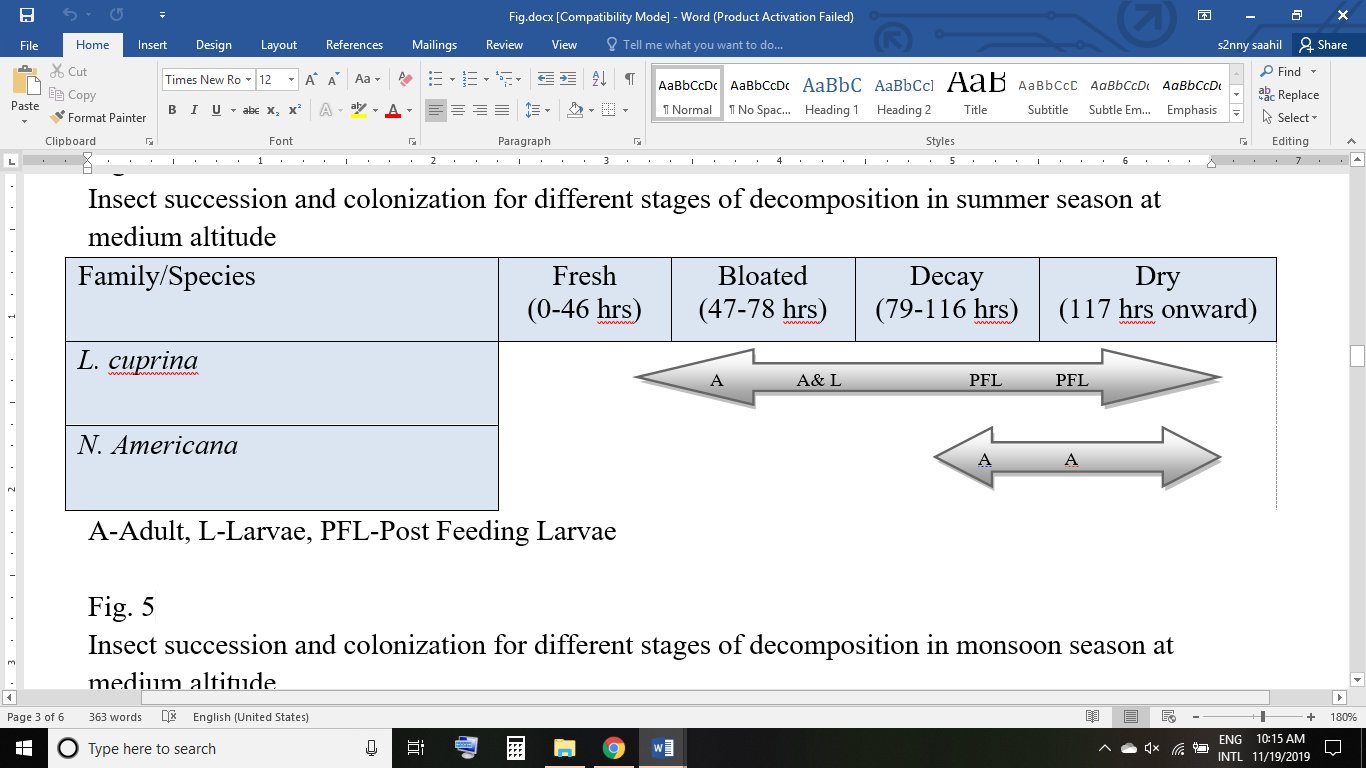
A-Adult, L-Larvae, PFL-Post Feeding Larvae
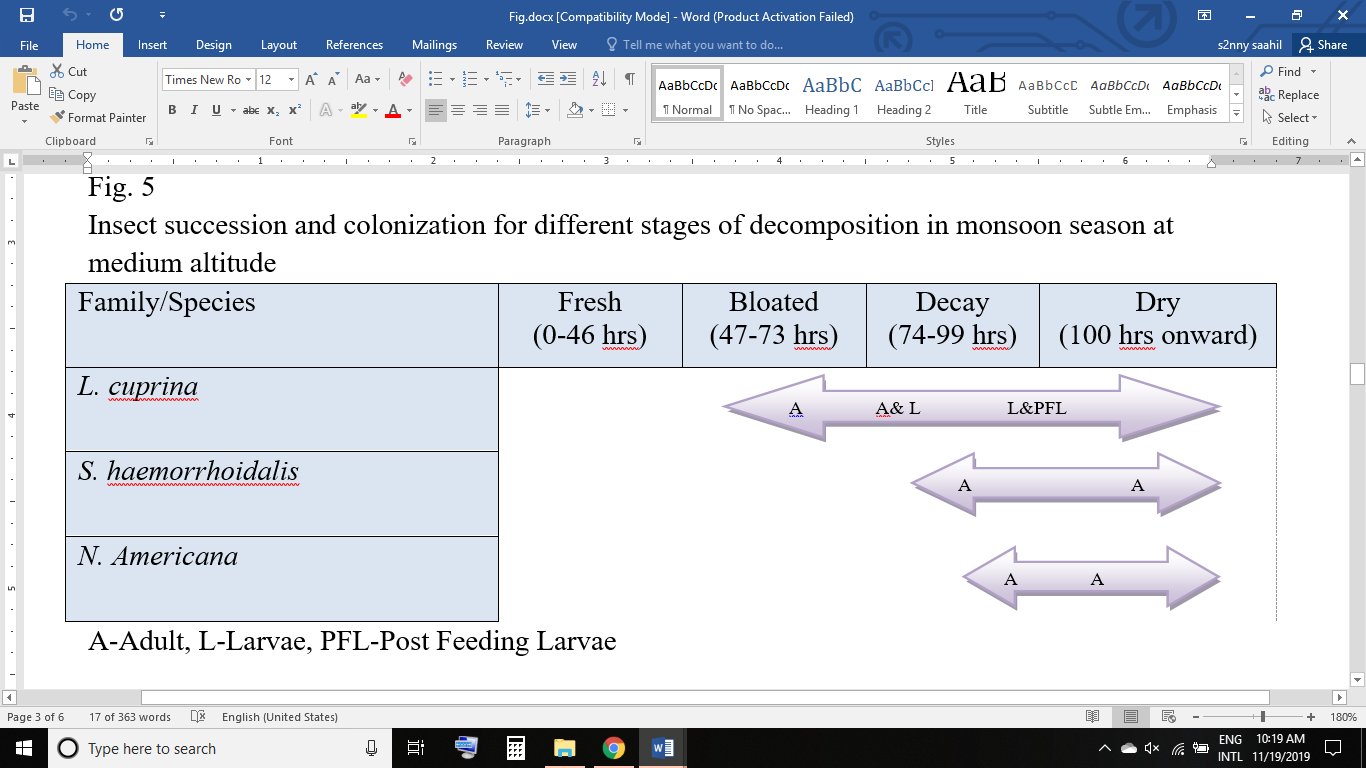
A-Adult, L-Larvae, PFL-Post Feeding Larvae
High altitude
It was observed that the total time taken for carcass decomposition was similar for summer and monsoon season. But, variation was detected in the time taken by different stages of decomposition. The fresh stage persisted for 48 h in summer compared to 47 h post-mortem in monsoon season. Within 23 h post-mortem in both summer and monsoon season Calliphora vicina and Calliphora vomitoria were observed visiting the carcass. The flesh flies Sarcophaga haemorrhoidalis were also observed visiting the carcass in summer season after 47 h post-mortem. After fresh stage the carcass entered bloated stage, that was observed only for 32 h in summer season, but took 51 h in monsoon season. In summer, blow flies and flesh flies were prominent during this stage, and black scavenger flies i.e. Sepsis (Genus) were also observed visiting the carcass. The eggs of blow flies started hatching and as the time progressed the larvae stages were also observed. The decay stage ended for 45 h in summer and for only 25 h in monsoon. Sepsis (Genus) after 68 h and beetles i.e. Oiceoptoma noveboracense after 81 h were recorded during this stage. After 123 h in monsoon season and after 125 h post-mortem in summer season the carcass entered Dry stage and number of insects visiting the carcass decreased during this stage. Hister (Genus) was recorded in summer season during dry stage (Fig 6 and Fig 7).
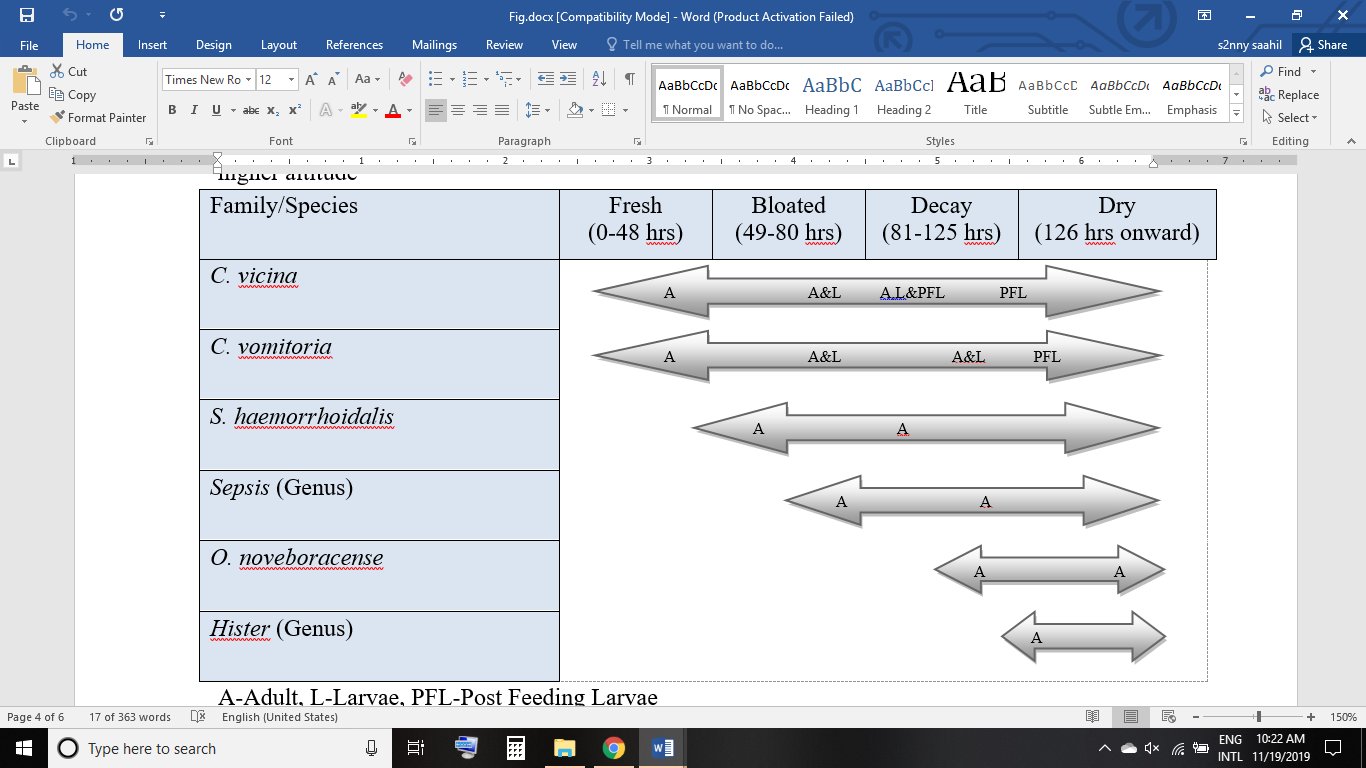
A-Adult, L-Larvae, PFL-Post Feeding Larvae
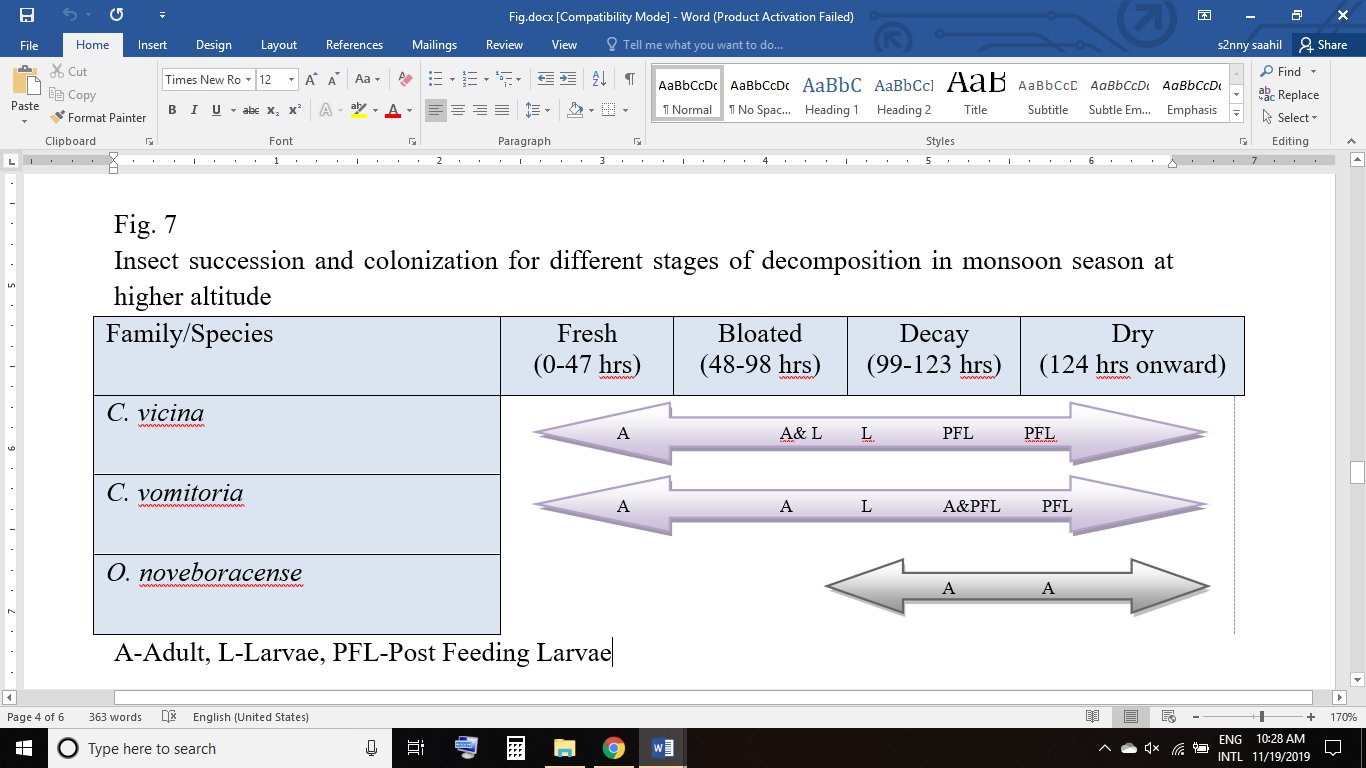
A-Adult, L-Larvae, PFL-Post Feeding Larvae
From these above observations it is evident that change in season and altitude mark key deviation in the insect species visiting, insect succession and carcass decomposition. As L. cuprina was recorded at low and medium altitude for both summer and monsoon season but, C. vicina and C. vomitoria were recorded at high altitude for both summer and monsoon season. S. haemorrhoidalis was recorded in summers at low and high altitude, and in monsoon low and medium altitude. Sepsis (Genus) was recorded in monsoon at low altitude and summer at high altitude. N. americana was only observed at medium altitude for summer and monsoon season, similarly O. noveboracense was recorded at high altitude in summer and monsoon. Hister (Genus) was recorded at low and high altitude in summers only. Whereas, M. scalaris, P. casei and Silphidae (Family) were found only at low altitude in monsoon and D. caninus in summer. This shows the insect species visiting the carcass varied significantly with change in season and altitude (Table 2). Though, some species were found common at different altitudes for a season, but the succession was different that signifies the relevance of specific insect data for a specific region.
| Insect Fauna | Lower Altitude | Medium Altitude | Higher Altitude | ||||
|---|---|---|---|---|---|---|---|
| Order | Family | Summer | Monsoon | Summer | Monsoon | Summer | Monsoon |
| Diptera | Calliphoridae | L. cuprina | L. cuprina | L. cuprina | L. cuprina | C. vicina, C. vomitoria |
C. vicina, C. vomitoria |
| Sarcophagidae | S. haemorrhoidalis | S. haemorrhoidalis | S. haemorrhoidalis | S. haemorrhoidalis | |||
| Sepsidae | Sepsis (Genus) | Sepsis (Genus) | |||||
| Phoridae | M. scalaris | ||||||
| Piophilidae | P. casei | ||||||
| Coleoptera | Silphidae | Silphidae (Family) | N. americana | N. americana | O. noveboracense | O. noveboracense | |
| Histeridae | Hister (Genus) | Hister (Genus) | |||||
| Dermestidae | D. caninus | ||||||
In the present study delayed carcass decomposition and no insect activity was recorded in winters but, Bharti and Singh [24], Martinez et al. [35] and Segura et al. [36] reported carcass decomposition in winters at altitude of 230 m, 3035 m and 2700 m above mean sea level respectively. When the observations of the present study were compared to these studies, significant difference in the stages of decomposition was observed (Table 3). They have reported carcass decomposition in winter season whereas in present study we observed that when the surrounding temperature decreases to 20oC or below the carcass decomposition get slow and even the insect activity get seized. This shows every geographical zone has its own environmental properties which influences the carcass decomposition and insect succession on the carcass. Thus, decompositional pattern and insect succession should be recorded for different geographical areas with respect to different environmental conditions.
Altitude (above sea level) |
Season (May, 2016- Jan, 2018) | |||||||||||
|---|---|---|---|---|---|---|---|---|---|---|---|---|
| Summer | Monsoon | Winter | ||||||||||
| Stages of Decomposition | Stages of Decomposition | Stages of Decomposition | ||||||||||
| F | B | D | S | F | B | D | S | F | B | D | S | |
| Lower altitude (440 m) | 0-23 hrs | 24-61 hrs | 62-159 hrs | 160 hrs onward | 0-25 hrs | 26-70 hrs | 71-94 hrs | 95 hrs onward | No sign of Entomological succession for 558 hrs | |||
| Medium altitude (1,128 m) | 0-46 hrs | 47-78 hrs | 79-116 hrs | 117 hrs onward | 0-46 hrs | 47-73 hrs | 74-99 hrs | 100 hrs onward | No sign of Entomological succession for 570 hrs | |||
| Higher altitude (2,140 m) | 0-48 hrs | 49-80 hrs | 81-125 hrs | 126 hrs onward | 0-47 hrs | 48-98 hrs | 99-123 hrs | 124 hrs onward | No sign of Entomological succession for 550 hrs | |||
| Martinez et al. (2007) (3035 m) | - | - | - | - | - | - | - | - | 0-72 hrs | 73-288 hrs | 289-312 hrs | 313 hrs onward |
| Bharti and Singh (2003) (230 m) | 0-22 hrs | 23-54 hrs | 55-94 hrs | 95 hrs onward | 0-18 hrs | 19-43 hrs | 44-107 hrs | 108 hrs onward | 0-117 hrs | 118-237 hrs | 238-357 hrs | 358 hrs onward |
| Segura et al. (2009) (2700 m) | - | - | - | - | - | - | - | - | 0-72 hrs | 73-168 hrs | 169-240 hrs | 241 hrs onward |
Effect on life cycle
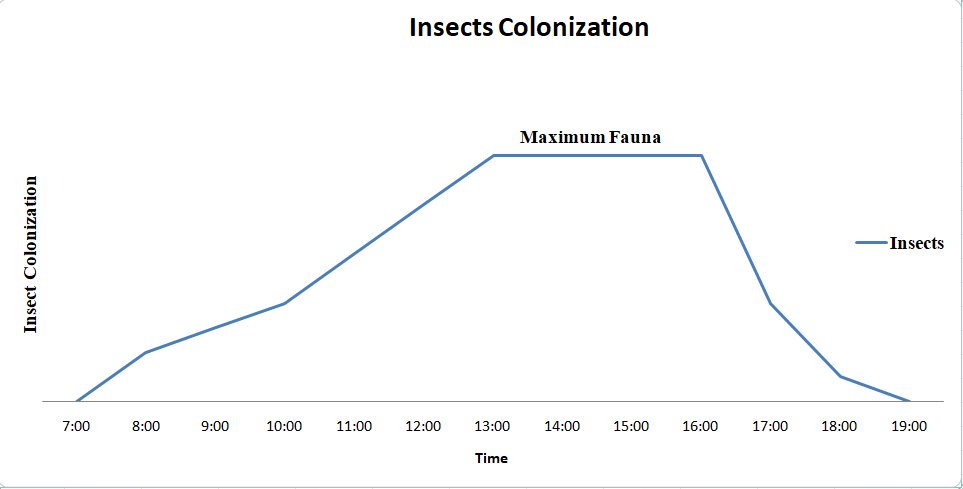
During the experiment it was observed that Calliphoridae (i.e. C. vicina, C. vomitoria and L. cuprina) were the first visitor on the carcass. During the Fresh stage of decomposition adults of Calliphoridae visited the carcass and laid eggs in and on the natural opening of the body. It has also been recorded that the number of insect’s species visiting the carcass were on peak during day time i.e. between 12:30 PM –4:00 PM, before and after this time duration the number of insects declined significantly (Fig 8). At low altitude, total of 8 species were recorded and among these only L. cuprina and S. haemorrhoidalis laid eggs and colonized the carcass. At medium altitude, out of recorded 3 species only L. cuprina laid eggs and colonized the carcass. At high altitude, the insect fauna was found to be different from that of low and medium altitudes. Only two sp. C. vicina and C. vomitoria laid eggs and colonized the carcass within 5-6 h after their visit. These eggs get developed into larvae, first instar, second instar and third instar, and it has been observed that the variation in altitude and season affected the life cycle of various insects visiting the carcass (Fig 9).
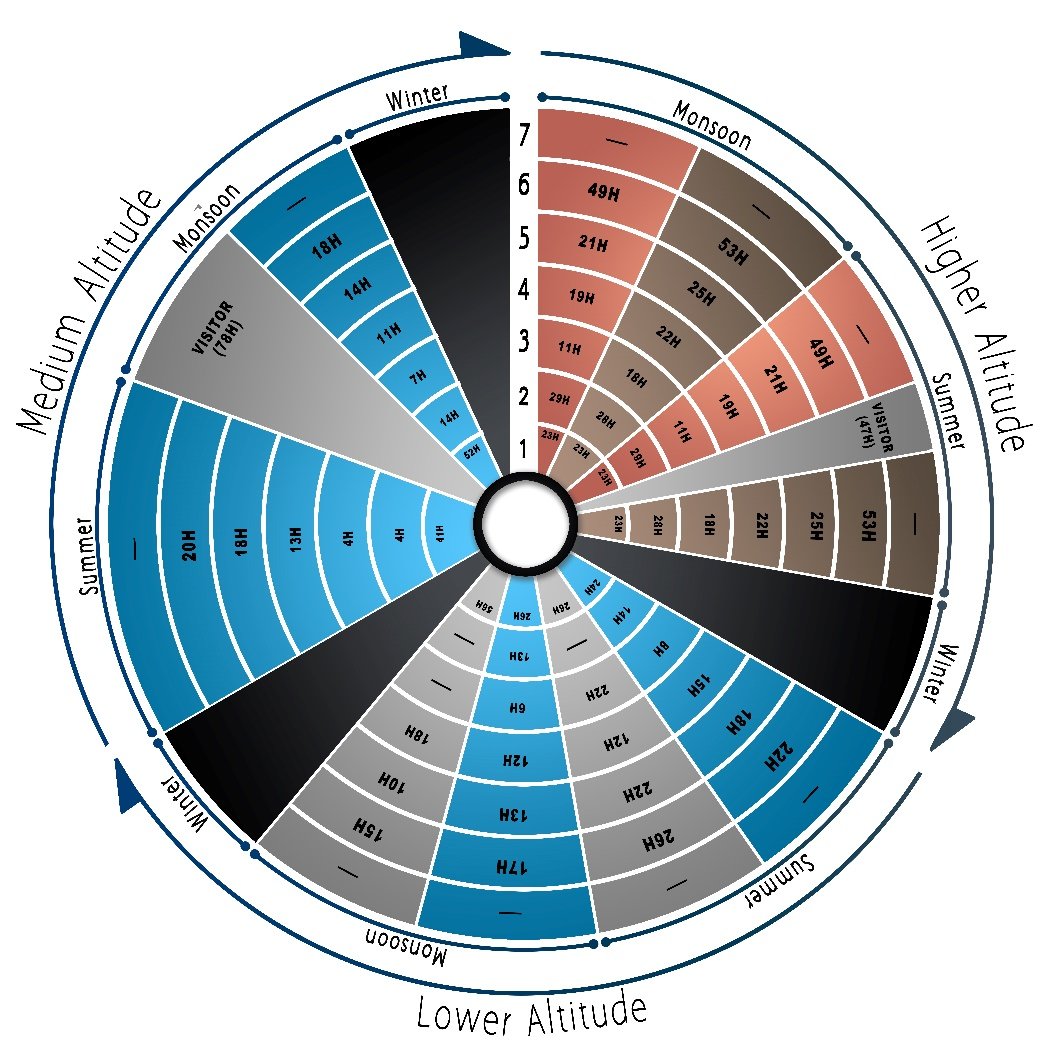
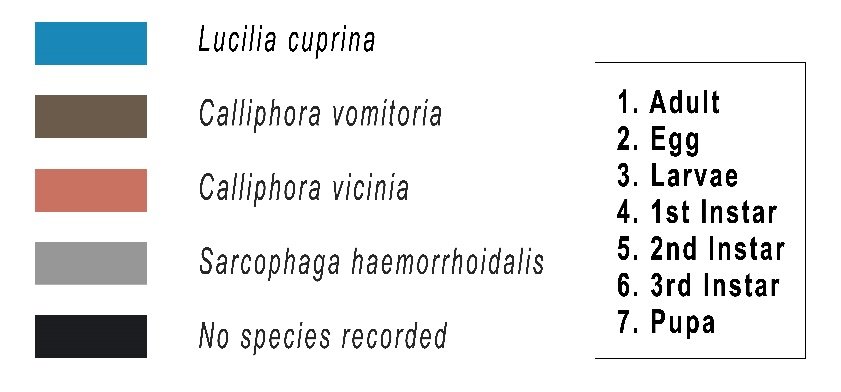
L. cuprina was observed at low and medium altitudes, in both summer and monsoon season. L. cuprina laid eggs within 14 h in summer and 13 h in monsoon after visit on carcass at low altitude, which get developed into larvae, first instar, second instar and third instar after 8 h, 15 h, 18 h and 22 h respectively in summer and 6 h, 12 h, 13 h and 17 h respectively in monsoon. This variation in lifecycle was affected by different environmental conditions among which rainfall played an important role. In monsoon season the life cycle was short because of heavy rainfall compared to summer and most of the rainfall was observed at night. Similarly, at medium altitude L. cuprina laid eggs within 4 h in summer and 14 h in monsoon after visit on carcass. The eggs get developed in larvae, first instar, second instar and third instar after 4 h, 13 h, 18 h and 20 h in summer and 7 h, 11 h, 14 h and 18 h in monsoon. Though, average rainfall was observed very high in summer, but time taken for completing the life cycle was less in monsoon because in summer, the rainfall was recorded low during the experimental days and observed during day time only, whereas in monsoon more rainfall was observed during the experimental days which affected the decomposition and life cycle. Life cycle of S. haemorrhoidalis was recorded at low altitude in summer and monsoon season. In summer larvae, first instar, second instar and third instar was observed whereas, in monsoon only first instar, second instar and third instar stages were recovered and the time taken for these stages was 22 h, 12 h, 22 h and 26 h in summer and 18 h, 10 h and 15 h in monsoon for respective. Similar to L. cuprina, S. haemorrhoidalis also took less time to complete its life cycle in monsoon compared to summer.
At high altitude C. vicina and C. vomitoria were observed laying eggs within 29 h and 28 h respectively of visit on the carcass for both seasons and those eggs get developed in larvae, first instar, second instar and third instar stages. The time taken by C. vicina for completing these stages was 11 h, 19 h, 21 h and 49 h, C. vomitoria took 18 h, 22 h, 25 h and 53 h both the species took similar time in both summer and monsoon to complete the respective developmental stages, because the environmental conditions for both the seasons were observed to be similar. The pupa stage was not recorded in summer and monsoon at all the selected altitudes, because after reaching third instar stage the larvae started migrating away from the carcass into the grass or soil available in the surroundings. Thus pupa was not recorded in this study.
In the present study along with the variation in the insect fauna at different attitudes for different seasons, the maggot mass temperature was also recorded. It has been observed that the insect fauna needs temperature above 20oC for their visit on the carcass and laying eggs, whereas insect’s larvae need temperature ranging between 32-380C (i.e. maggot mass temperature recorded) for their development. During experimental days, rise in temperature was observed only after 11:00 AM and till 3:00 PM, after that again decrease in temperature was observed due to which the carcass body temperature was not recorded more than 13.4oC, consequently, in winter season no entomological succession was observed for all the three altitudes,
Conclusion
Forensic entomology, which plays a vital role in estimation of PMI, is highly affected by altitude and seasonal variations. The change in season and altitude leads to the change in number of factors, among which temperature is one major factor that plays a very crucial role in the carcass decomposition, insect fauna visiting the carcass, its succession and colonization. The carcass decomposition took less time during monsoon season at all the three altitudes and the time taken for carcass decomposition increased with increase in altitude. The amount and time of rainfall has affected the temperature and humidity of a particular area, and also the access to the carcass for insects. The rainfall during nights accelerated the process of decomposition as it leads to removal of fur and softening of skin of the carcass but, when the rainfall was observed during day time day (peak insect arrival and colonization time) the arrival and activity of the insects got affected leading to delayed carcass decomposition. During medium altitude, in summer season the carcass decomposition took less time than that of high and low altitude, because maximum of rainfall was observed at nights due to which the process of decomposition got accelerated and insect arrival and activity during day time was not much affected. But, at high altitude where the rainfall was less compared to medium altitude but, most of the rain was observed during day time leading to delayed insect arrival and activity on the carcass. Similar delay in carcass decomposition was observed at low altitude where the rainfall was less compared to high altitude in summer season. Maximum temperature was recorded during 11:00 AM till 03:00 PM, after that decrease in temperature was observed, due to which the carcass body temperature did not exceeded 13.4oC and no insect colonization was recorded in winter season at all three altitudes. Out of total 12 insect species recorded, only 4 sp. are found to be of forensic significance, as they laid eggs, colonize the carcass and subsequently complete their life cycle at different altitudes and seasons. Because, while calculating PMI using forensic entomology we should have insect database along with life cycle of sp. recorded for that region. If none of the recorded sp. lay eggs, colonize the carcass and complete their life cycle, then it became difficult to estimate PMI using forensic entomology. Though, only few species are found to be of forensically significant in PMI estimation, other sp. can be used for the identification of area to which they are observed to be specific. Thus, forensic entomology of a specific area can be used to estimate PMI along with area identification.
In conclusion, it is strongly recommended that for the proper utilization of forensic entomology for the estimation of PMI, it is the need of the hour that forensic entomologists must develop reference database on forensically important insects for different geographical locations with variation in factors such as temperature, habitat, rainfall, sunshade, indoor/outdoor etc. that affects insect succession as well as carcass decomposition in order to avoid serious errors in the estimation of PMI. Calculation of PMI during winter season appears to be the biggest challenge using entomological evidence, so new methods should be developed to address this issue.
References
- Siti Zulaikha A.B., Raja M.Z. (2016) Nocturnal oviposition of the forensic scuttle fly, Megaseliascalaris (Loew) (Diptera: Phoridae), indoors. Egyptian Journal of Forensic Sciences. 6(4): 489-491. ↑
- Watson E.J., Carlton C.E. (2003) Spring succession of necrophilous insects on wildlife carcasses in Louisiana. J. Med. Entomol. 40: 338–347. ↑
- Grassberger M., Frank C. (2004) Initial study of arthropod succession on pig carcass in a Central European urban habitat. J. Med. Entomol. 41: 511–523. ↑
- Matuszewski S., Bajerlein D., Konwerski S., Szpila K. (2010b) Insect succession and carcass decomposition in selected forests of Central Europe. Part 2: composition and residency patterns of carcass fauna. Forensic Sci. Int. 195: 42–51. ↑
- Byrne A.L., Camann M.A., Cyr T.L., Catts E.P., Espelie K.E. (1995) Forensic implications of biochemical differences among geographic populations of the black blow fly, Phormiaregina (Meigen). J. Forensic Sci. 40: 372-377. ↑
- Anderson G.S. (1997) The use of insects to determine time of decapitation: a case-study from British Columbia. J. Forensic Sci. 42: 947-950. ↑
- Haskell N.H., McShaffrey D.G., Hawley D.A., Williams R.E., Pless J.E. (1989) Use of aquatic insects in determining submersion interval. J. Forensic Sci. 34: 622-632. ↑
- Haskell N.H., Hall R., Crevenka V.J., Clark M.A. (1997) On the body: insects life stage presence and their postmortem artifacts, in: Haglund W.D., Sorg M.A. (Eds.), Forensic taphonomy: the postmortem fate of Human remains. CRC Press, Boston. 1072-1095. ↑
- Goff M.L., Lord W.D. (1994) Entomotoxicology: a new area for forensic investigation. Am. J. Forensic Med. Pathol. 15: 51-57. ↑
- Introna F., Wells J.D., Di Vella G., Campobasso C.P. (1996) Sperling F.A.H, in: Proceedings of 51st Annual Meeting AAFS Human and Other Animal mtDNA Analysis from Maggots. Orlando, FL. 196. ↑
- Carlo P.C, Introna F. (2001) The forensic entomologist in the context of the forensic pathologist’s role. Forensic Science international. 120: 132-139. ↑
- Mann R., Bass W., Meadows L. (1990) Time since death and decomposition of the human body: variables and observations in case and experimental field studies. J. Forensic Sci. 35: 103–111. ↑
- Anderson G.S. (2010) Factors that influence insect succession on carcass. In: Byrd J. H., Castner J. L. (Eds.) Forensic Entomology: The Utility of Arthropods in Legal Investigations. CRC Press, Boca Raton, FL. 201–250. ↑
- Caballero U., Leo N.J.L. (2012) High diversity beetle assemblages attracted to carcass and dung in threatened tropical oak forests in Southern Mexico. J. Insect Conserv. 16: 537–547. ↑
- Baz A., Botias C., Martin-Vega D., Cifrian B., Diaz-Aranda L.M. (2015) Preliminary data on carcass insects in urban (indoor and outdoor) and periurban environments in central Spain. Forensic Science International. 248: 41–47. ↑
- Amendt J., Zehner R., Johnson D.G., Wells J. (2010) Future trends in forensic entomology, In: Amendt J, Goff ML, Campobasso CP, Grassberger M eds. Current Concepts in Forensic Entomology. Springer, Dordrecht. 353–368. ↑
- Amendt J., Richards C.S., Campobasso C.P., Zehner R., Hall M.J.R. (2011) Forensic entomology: applications and limitations. Forensic Sci. Med. Pathol. 7: 379–392. ↑
- Hwang C., Turner B.D. (2005) Spatial and temporal variability of necrophagous Diptera from urban to rural areas. Med. Vet. Entomol. 19: 379–391. ↑
- Patitucci L.D., Mulieri P.R., Schnack J.A., Mariluis J.C. (2011) Species composition and heterogeneity of blowflies assemblages (Diptera: Calliphoridae) in urban–rural gradients at regional scale in Argentinean Patagonia. Stud. Netrop. Fauna E. 46: 49–58. ↑
- Bonacci T., Greco S., Brandmayr Z.T. (2011) Insect fauna and degradation activity on Thanatophilus species on carcass in Southern Italy (Coleoptera: Silphidae).Entomol. Gen. 33: 63–70. ↑
- Bonacci T., ZettoBrandmayr T., Brandmayr P., Vercillo V., Porcelli F. (2011) Successional patterns of the insect fauna on a pig carcass in southern Italy and role of Cremogasterscutellaris (Hymenoptera, Formicidae) as a carcass invader.Entomol. Sci. 14: 125–132. ↑
- Fremdt H., Amendt J. (2014) Species composition of forensically important blow flies (Diptera: Calliphoridae) and flesh flies (Diptera: Sarcophagidae) through space and time. Forensic Sci. Int. 236: 1–9. ↑
- Lopes de Carvalho L.M., Linhares A.X. (2001) Seasonality of Insect Succession and Pig Carcass Decomposition in a Natural Forest Area in Southeastern Brazil. J Forensic Sci. 46(3):604–608. ↑
- Bharti M., Singh D. (2003) Insect Faunal Succession on Decaying Rabbit Carcasses in Punjab, India.J Forensic Sci. 48 (5): 1133-43. ↑
- Archer M.S. (2004) Rainfall and temperature effects on the decomposition rate of exposed neonatal remains. Science & Justice. 44: I35-41. ↑
- Turchetto M., Vanin S. (2004) Forensic entomology and climatic change. Forensic Science International. 146S: S207–S209. ↑
- Voss S.C., Cook D.F., Dadour I.R. (2011) Decomposition and insect succession of clothed and unclothed carcasses in Western Australia. Forensic Science International. 211: 67–75. ↑
- Thyssen P.J. (2010) Keys for Identification of Immature Insects. Springer Science- Business Media B.V. ↑
- Thompson V. (1997) 4-H Entomology Manual. Oregon State University Extension Service. ↑
- Oldroyd H. (1954) Diptera: Introduction and keys to family. Published by the Royal Entomological Society. ↑
- de Carvalho C.J.B., de Mello-Patiu C.A. (2008) Key to the adults of the most common forensic species of Diptera in South America. RevistaBrasileira de Entomologia. 52 (3): 390-406. ↑
- Smith K.G.V. (1986) A manual of Forensic Entomology. University printing house, Oxford. ↑
- https://bugguide.net/node/view/2405 Accessed 07 July 2019. ↑
- http://www.biology.ualberta.ca/facilities/multimedia/?Page=281 Accessed 07 July 2019. ↑
- Martinez E., Duque P., Wolff M. (2007) Succession pattern of carrion-feeding insects in Paramo, Colombia. Forensic Science International. 166: 182–189. ↑
- Segura N.A., Usaquen W., Sanchez M.C., Chuaire L., Bello F. (2009) Succession pattern of cadaverous entomofauna in a semi-rural area of Bogota, Colombia. Forensic Sci Int. 187: 66–72. ↑