



Background
Iran is one of the countries with the highest rates of morbidity and mortality caused by motor vehicle accidents (1-4). The annual growth of 15.3% of motor vehicles in the last 10 years accelerated the problem from 14.2 billion unit in 2002 to 24.5 billion in 2012 (5). Motor vehicle accidents are the main cause of injuries (about 80%) in Iran in the age range of 18-30 years (6) which lead to bone fractures in 10% of the cases. About 6% of the motor vehicle accidents lead to craniofacial fractures (7-10).
The main cause of craniofacial traumas, 86%., is motor vehicle accidents. Since the youth are the most vulnerable age group in motor vehicle accidents, this rate mostly includes them. While in the elderly and children, the motor vehicle accident is the main cause of death after falling (9, 11-13).
In most of the previously conducted studies only the frequency of facial bone fractures was evaluated and no differentiation was made regarding the craniofacial fractures.
The current study aimed to evaluate the craniofacial fractures pattern in motor vehicle accidents.
Methods
The current cross-sectional study was conducted in Rasoul-akram Hospital in Tehran, Iran, from autumn 2013 to autumn 2014. Patients aged 18 years and older, with Iranian nationality and head and neck trauma caused by motor vehicle accidents were enrolled in the study. The computed tomography (CT) from head and face was performed for all patients and the results were analyzed by the radiologist for craniofacial fractures. The CT scan was repeated for the recommended cases and the confirmed fractures were considered as positive results and evaluated in the study analysis. The comminuted craniofacial fractures were separately recorded and the relative frequency was also calculated separately for each bone. Age and gender of the subjects, which may affect the frequency distribution of fracture sites, was considered as demographic indices and the measures were separately reported. Data were analyzed using SPSS ver. 21. The quantitative data were reported as mean and standard deviation, and the qualitative data were expressed as frequency and relative frequency. The Chi-square test was used to evaluate the difference between anatomic sites of fractures, based on the gender and age groups above and below 50 years.
P<0.05 was considered as the level of significance.
Results
Totally, 291 subjects with craniofacial trauma were evaluated in the current study, out of which 141 simple or comminuted craniofacial fractures were diagnosed. Most of the subjects were male (87.94%) with the age range less than 55 years old (82.26%).
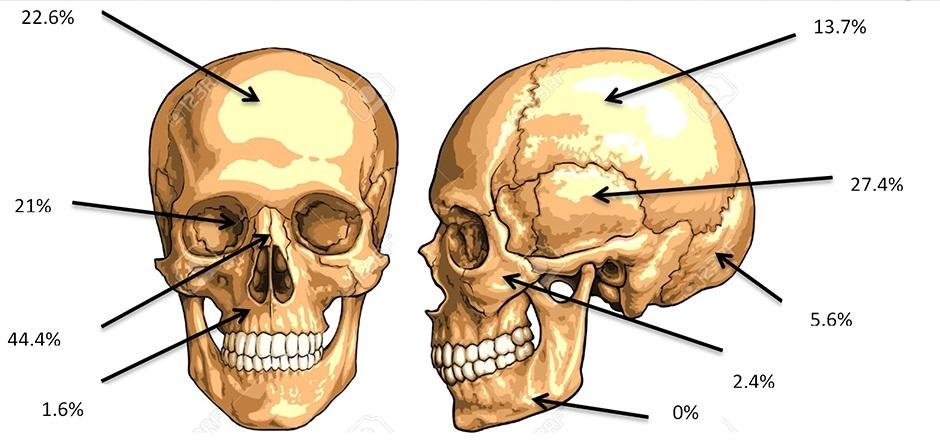
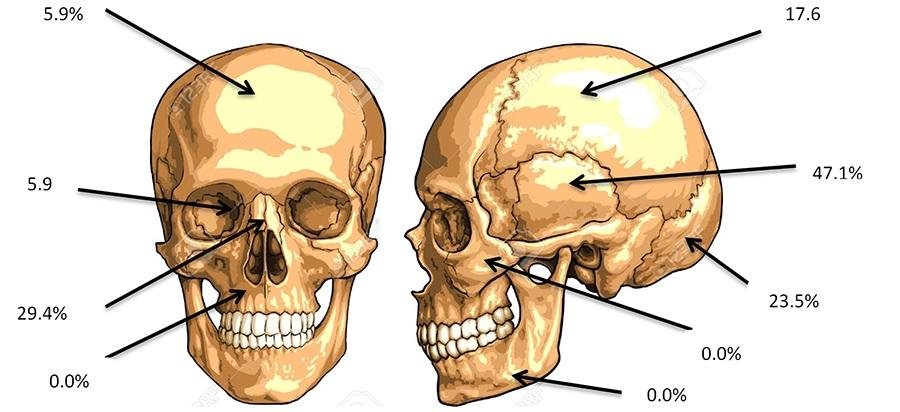
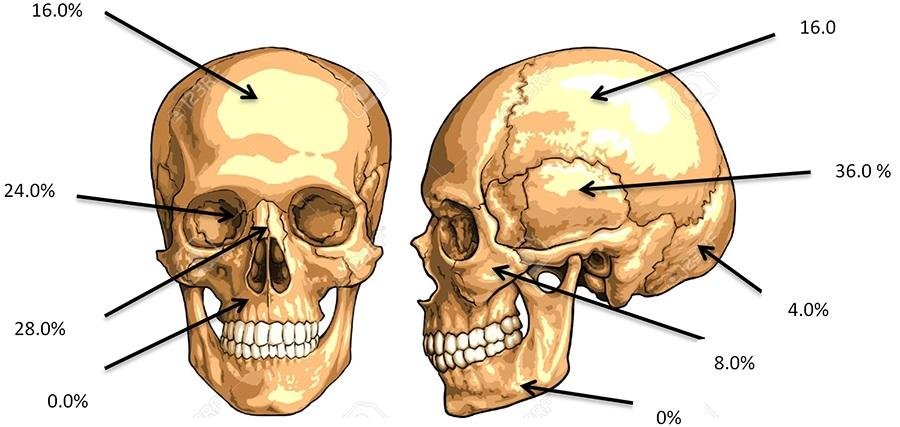
Evaluating the pattern of fractures showed that nasal, temporal and frontal fractures in males and temporal, nasal and occipital fractures in females had the highest frequencies, respectively (Figures 1 and 2).
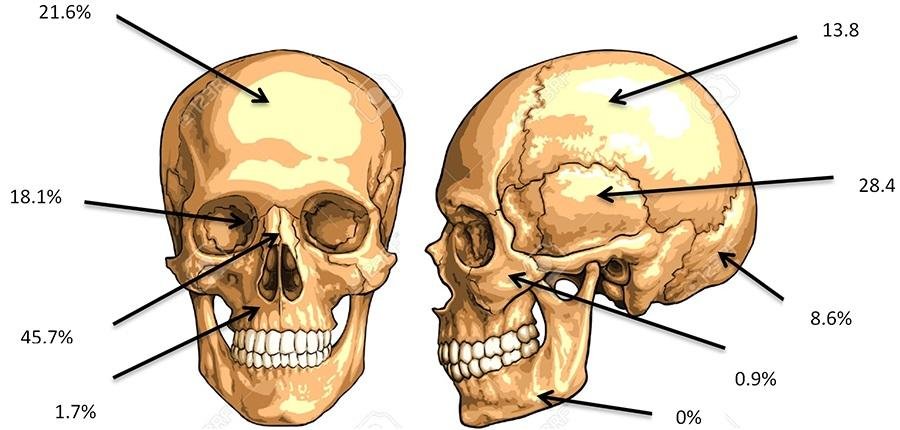
In the age group below 55 years old, the highest frequencies were observed in nasal, temporal and frontal fractures respectively; while, in the age group over 55 years old, temporal, nasal and orbital fractures were the most frequent ones, respectively (Figure 3 and 4). There was a significant difference between males and females regarding the frequency of temporal fracture (P=0.029); 23.5% of females vs. 5.6% of males had temporal fractures (Table 1 and 2).
| Anatomical Location of Fracture | Gender | P value* | ||||||||||||||||||
|---|---|---|---|---|---|---|---|---|---|---|---|---|---|---|---|---|---|---|---|---|
| Male | Female | |||||||||||||||||||
| (n=124) | (n=17) | |||||||||||||||||||
| Skull | Frontal bone | 28 | 22.6% | 1 | 5.9% | 0.093 | ||||||||||||||
| Temporal bone | 39 | 27.4% | 8 | 47.1% | 0.097 | |||||||||||||||
| Parietal bone | 17 | 13.7% | 3 | 17.6% | 0.663 | |||||||||||||||
| Occipital bone | 7 | 5.6% | 4 | 23.5% | 0.029 | |||||||||||||||
| Skull base bone | 26 | 21.0% | 1 | 5.9% | 0.119 | |||||||||||||||
| Face | Zygomatic bone | 3 | 2.4% | 0 | 0% | 0.678 | ||||||||||||||
| Mandibular bone | 0 | 0% | 0 | 0% | 1.000 | |||||||||||||||
| Maxilla bone | 2 | 1.6% | 0 | 0% | 0.773 | |||||||||||||||
| Nasal bone | 55 | 44.4% | 5 | 29.4% | 0.183 | |||||||||||||||
*Chi-Square and Fisher Exact test were done. Pvalue less than 0.05 are meaningful.
| Anatomical Location of Fracture | Age | P value* | ||||||||||||||||
|---|---|---|---|---|---|---|---|---|---|---|---|---|---|---|---|---|---|---|
| ≤ 55 year | > 55 year | |||||||||||||||||
| (n=116) | (n=25) | |||||||||||||||||
| Skull | Frontal bone | 25 | 21.6% | 4 | 16% | 0.376 | ||||||||||||
| Temporal bone | 33 | 28.4% | 9 | 36% | 0.301 | |||||||||||||
| Parietal bone | 16 | 13.8% | 4 | 16% | 0.491 | |||||||||||||
| Occipital bone | 10 | 8.6% | 1 | 4% | 0.384 | |||||||||||||||
|---|---|---|---|---|---|---|---|---|---|---|---|---|---|---|---|---|---|---|---|---|
| Skull base bone | 21 | 18.1% | 6 | 24% | 0.334 | |||||||||||||||
| Face | Zygomatic bone | 1 | 0.9% | 2 | 8% | 0.081 | ||||||||||||||
| Mandibular bone | 0 | 0.0% | 0 | 0% | 1.000 | |||||||||||||||
| Maxilla bone | 0 | 1.7% | 0 | 0% | 0.676 | |||||||||||||||
| Nasal bone | 53 | 45.7% | 7 | 28% | 0.079 | |||||||||||||||
*Chi-Square and Fisher Exact test were done. Pvalue less than 0.05 are meaningful.
Discussion
The results of the current study showed the importance of evaluating possible fracture sites in motor vehicle accidents. According to the results of the current study, young males included the majority of high risk group, which was inconsistent with the results of the previously performed studies.
The most common fracture in males occurred in frontal and nasal bones (8-12).
In a seven-year-study, La-Salete Alves et al. (8) evaluated the pattern of traumatic maxillofacial fractures. The majority of subjects were male (86%) and the highest frequency was observed in nasoorbitoethmoid (67.46%) and maxillary fractures, respectively.
Mechanisms of trauma in motor vehicle accidents can almost explain the above mentioned status. Knowing weak points on the cranium and face can be a good guide to employ protective methods for the victims of motor vehicle accidents.
According to the conducted studies, most of the craniofacial fractures are related to the motor vehicle accidents. Evaluating the pattern of craniomaxillofacial traumas in a 22-year-study in India showed that 86.4% of the cases were the victims of motor vehicle accidents (9). In a study by Ramezanian et al. (14), the pattern of maxillofacial traumatic fractures was evaluated in 302 patients that 50% of them were the victims of motor vehicle accidents among which 41% and 34% had mandible and midface fractures, respectively. From the subjects with mandible fractures, only 41% were motor vehicle accident victims.
Considering the difference in the frequency of frontal and occipital fractures between males and females and also within the age group below 55 years showed that the frontal cranial bone is one of the most vulnerable parts of head in young drivers.
Fraction in this bone indicates the severity of trauma as it leads to comminuted bones.
While in some cases the severity of trauma does not lead to fraction. This may result from the speed of motor vehicle or the intensity of accident; the risk of bone fracture increases by increasing the intensity of the accident.
Since males play the most important role in driving, not using safety belt by the driver may cause conflict between the steering wheel and driver, and also more injuries in the frontal bone. Educational policies and the traffic fines can play an important role to reduce such cases. Also, younger age of the victims may be due to less experience and knowledge in this group.
High rate of mortality in motor vehicle accidents of Iran (35 death vs. 10’000 motor vehicle) (6, 15) indicates the importance of injury prevention in fatal accidents. One of the main causes of death in the drivers is the damage of vital points such as craniofacial region. Results of the current study showed that the bone fracture in younger people usually occurs in craniofacial region, which may cause severe intracranial injuries and death.
Preventative actions may include individual training and proper traffic legislation such as newly passed laws in the recent years; for example, mandatory fastening the seat belt to prevent hitting head to the windshield and using helmets for the motorcyclists, which reduce mortality rate in victims (4, 15-17).
Knowing the vulnerable regions of head in the traffic victims may affect strengthening personal protective equipment or providing a low-risk region in vehicles. It can significantly reduce craniofacial injuries and consequently death in motor vehicle drivers.
Conclusion
It can be concluded that most of the fractures in motor vehicle accidents among male and young people usually occurred in nasal, frontal and temporal bones, respectively; while in females it mostly happened in nasal, temporal and occipital bones, respectively. In the elderly, the most frequent fractures were observed in temporal, nasal and cranium base bones, respectively.
Acknowledgments
There is no acknowledgment for the present study.
Funding
There is no support for this study.
Availability of data and materials
Please contact author for data requests.
Authors’ contributions
Sepehrdad Khalatbari and Kamran Aghakhani participated in the design of the study. Tayeb Ramim collected data and performed statistical analysis. Maryam
Ameri wrote the manuscript and revised and edited the manuscript. All authors read and approved the final manuscript.
Competing interests
The authors declare that they have no competing interests.
What is new in this paper?
Road Traffic accidents are the main cause of death among young people in Iran. There were a few studies evaluating the pattern of both cranial and facial fractures in our country. Knowing weak points of craniofacial bones, can be a good guide to employ suitable protective methods in victims. Furthermore, we can plan for proper laws to reduce the number of victims by these epidemiological studies. We have done another study about the mechanism of trauma and limb injuries in our country that has been published as a book by Lambert Academic Publishing. Proper planning with regard to frequency of traumas in the region, providing physical and therapeutic facilities, can improve our public health.
References
- Hejazi R, Shamsudin MN, Radam A, Rahim KA, Ibrahim ZZ, Yazdani S. Estimation of traffic accident costs: a prompted model. Int J Inj Contr Saf Promot. 2013;20(2):152-7. ↑
- Soori H, Hussain SJ, Razzak JA. Road safety in the Eastern Mediterranean Region--findings from the Global Road Safety Status Report. East Mediterr Health J. 2011;17(10):770-6. ↑
- Aggrawal A. Textbook of Forensic Medicine and Toxicology. 1st ed: Avichal Publishing Company; 2015. ↑
- Aggrawal A. Essentials of Forensic Medicine and Toxicology: Avichal Publishing Company; 2015. ↑
- Lankarani KB, Sarikhani Y, Heydari ST, Joulaie H, Maharlouei N, Peimani P, et al. Traffic accidents in Iran, a decade of progress but still challenges ahead. Med J Islam Repub Iran. 2014;28:96. ↑
- Hasanzadeh J, Moradinazar M, Najafi F, Ahmadi-Jouybary T. Trends of Mortality of Road Traffic Accidents in Fars Province, Southern Iran, 2004 - 2010. Iran J Public Health. 2014;43(9):1259-65. ↑
- Amponsah G, Gorleku PN. Bony Injuries in Trauma Patients Diagnosed by Radiological Examination. Ghana Med J. 2015;49(2):97-101. ↑
- Alves LS, Aragao I, Sousa MJ, Gomes E. Pattern of maxillofacial fractures in severe multiple trauma patients: a 7-year prospective study. Braz Dent J. 2014;25(6):561-4. ↑
- Gadre KS, Halli R, Joshi S, Ramanojam S, Gadre PK, Kunchur R, et al. Incidence and Pattern of Cranio-Maxillofacial Injuries: A 22 year Retrospective Analysis of Cases Operated at Major Trauma Hospitals/Centres in Pune, India. J Maxillofac Oral Surg. 2013;12(4):372-8. ↑
- Aggrawal A. Forensic Medicine and Toxicology for MBBS Avichal Publishing Company 2016. ↑
- Al-Qamachi LH, Laverick S, Jones DC. A clinico-demographic analysis of maxillofacial trauma in the elderly. Gerodontology. 2012;29(2):e147-9. ↑
- Aggrawal A. Forensic Medicine and Toxicology for Homeopathy: Avichal Publishing Company; 2016. ↑
- Aggrawal A. Forensic Medicine and Toxicology for Ayurveda: Avichal Publishing Company; 2016. ↑
- Ramezanian M, Mahmoud-Hashemi H, Vaezi T, Beshkar M, Hasheminasab M. The pattern of maxillofacial fractures: a study of 302 patients and a discussion of fracture classification. J Craniomaxillofacial Res. 2015;1(3):95-102. ↑
- Akbari ME, Naghavi M, Soori H. Epidemiology of deaths from injuries in the Islamic Republic of Iran. East Mediterr Health J. 2006;12(3-4):382-90. ↑
- Soori H, Nasermoadeli A, Movahedi M, Mehmandar M, Hatam Abady H, Rezazadeh Azari M, et al. The effect of mandatory seat belt use legislations on mortalities from road traffic injuries in Iran. Hakim Res J. 2009;12(1):48-54.
- Aggrawal A. Forensic Medicine and Toxicology for MBBS: Avichal Publishing Company; 2016.