




INTRODUCTION
Lead is represented with the chemical symbol Pb; it is a heavy metal. Rarely found in its metallic state it is more often found as organic or inorganic salts.[12]
People can be exposed to the metal in different ways which can lead to poisoning depending on time and amount of exposure. In this study we found both, occupational and non-occupational exposures. [1][8] [13].
Children may be more sensitive than adults to the exposure to lead and their bodies manifest more damage even at low concentrations. (Azcona-Cruz et al., 2000). One example of this is the increased absorption of lead by newborns due mainly to the immaturity of the gastrointestinal tract compared with the gastrointestinal tract of an infant and / or adult (Nordberg et al., 2007) The mechanisms by which the vulnerability to lead increases in children are not yet established.
For the assessment of such a damage some studies have measured the Intelligence Quotient IQ in children in order to check the intoxication effects of this metal on their neurobehavior. As a result of these studies it was concluded that a lower school performance and reduced intellectual development is a consequence of this intoxication [6]
The studies have also measured the effects on the hearing sensitivity, balance and motor skills.
Deficiencies that interfere significantly in adapting the child to performing daily activities such as running, throwing, drawing, writing, hearing, among others. [6]
Some authors claim than the age becomes a risk factor when dealing with lead exposure, beginning with the first year of life and reaching a peak of greater risk at 18 to 24 months of age. [5] They determined the types of lead sources to which the children are exposed. These can be industrial sources (battery production, casting batteries parts, recycling, etc.), environmental (studies have shown that you can have a major exposure even living in an area a kilometer away from a lead foundry) or domestic (containers poorly finished pottery, toys, etc.) [6]
The CDC estimates that 4 million households in the world have one children exposed to lead. This organization declares that actions on public health must be taken when these children have blood lead levels greater than 5 micrograms per deciliter (µg / dl). [7]
The appearance and manifestation of signs and symptoms in children depends on the age of the patient, the duration of the exposure and the concentration of lead in the blood. In acute exposure, often due to direct ingestion via contaminated food or inhalation of massive lead vapors, the child shows acute encephalopathy preceded by abdominal cramps or changes in behavior. [5] In lead poisoning or chronic exposure signs and symptoms are often nonspecific affecting the nervous, gastrointestinal, renal, hematopoietic and neuromuscular system. [5]
This paper makes a brief description of blood lead concentrations of 300 children hospitalized at Hospital la Misericordia located in the city of Bogota whose ages ranged from 3 months to 17 years old, providing tools for future research in order to develop studies focused on towns of greater presence of individuals concentrations above 2,50 µg/dL.
MATERIALS AND METHODS
Pattern
This study is transversal experimental, descriptive.
The blood samples used in the study were collected in a pediatric hospital in Bogotá, Colombia.
Target population
The study population consists of hospitalized children with ages ranging from 3 months to 17 years. Samples were collected in a three months period and these met specific quality standards. The inclusion criteria for this study were that the patient must be hospitalized and that the individual is between 3 months to 17 years old. Exclusion criteria was outpatients, emergency patients, patients subjected to blood transfusions, patients with transplants and patients with cancer.
Data processing and data collection
General patient data and relevant data from medical records were collected using an instrument developed for this purpose. These collected data and the data obtained from the assessment of blood lead are entered and processed in Excel 2007 program R version 3.2.2 the program was also used for the statistical treatment.
Sample analysis method
Biological samples were processed at the Laboratory of Toxicology of the Faculty of Medicine of the Universidad Nacional de Colombia. The lead content in the blood was determined by a validated methodology that uses the analytical technique of atomic absorption spectrophotometry with graphite oven in an Atomic Absorption Spectrophotometer Thermo iCE 3400 AA with Graphite oven GF95 and autosampler for graphite furnace FS95, cooling system, and Software for data analysis SOLAAR V 11.03. The validated methodology has an analytical range of 25,0 µg/L to 250,0 µg/L and a detection limit of 0,65µg/L. Samples were analyzed following quality lab analytical policies.
.
Information Analysis
A descriptive analysis that included socio-demographic characterization of the study population was performed and an analysis of the results of lead concentrations detected in laboratory tests of blood samples was undertaken.
Results
132 (44%) of the individuals participating in the study were female and 168 (56%) were male. The classification by age was as follows: 13% were children under 1 year, 43% children from 1 to 5 years, 32% children from 6 to 12 years and 12% children from 13 to 17 years.
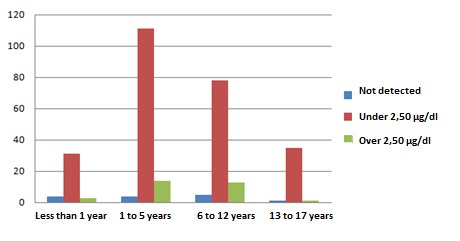
Table No. 1 and Graphic No. 1 shows the results of BLL in relation to the age classification.
None of the participants showed levels above those allowed by the CDC (5,0 µg/dL), 255 (95%) had Pb levels lower than the quantitation limit while 31 individuals had levels greater than 2,50 µg/dL. Only 14 children gave no detected.
| Concentration | Under 1 year- old | Between 1 to 5 years’ old | 6 to 12 years old | 13 to 17 years old | Total |
|---|---|---|---|---|---|
| Not detectable | 4 | 4 | 5 | 1 | 14 |
| Under than 2,50 µg/dL | 31 | 111 | 78 | 35 | 255 |
| Higher than 2,50 µg/dL | 3 | 14 | 13 | 1 | 31 |
| Total | 38 | 129 | 96 | 37 | 300 |
| Fontibón | -- | 1 | -- |
|---|---|---|---|
| Engativá | -- | 11 | 1 |
| Suba | -- | 3 | 1 |
| Barrios Unidos | -- | 2 | -- |
| Teusaquillo | -- | -- | -- |
| Los mártires | 1 | 2 | -- |
| Antonio Nariño | -- | 4 | -- |
| Puente Aranda | 1 | 7 | 1 |
| La candelaria | 1 | 2 | -- |
| Rafael Uribe | 1 | 17 | -- |
| Ciudad Bolívar | 2 | 17 | 1 |
| Sumapaz | -- | -- | -- |
| No information | 1 | 15 | -- |
| Total | 25 | 179 | 8 |
According to the place of origin, 93% of the samples corresponded to individuals who live in the central area of the country (71% belonging to Bogotá, 15% to Cundinamarca, 4% to Meta and 3% to Boyacá).
The remaining 7% of the individuals belonged to other regions of the country.
When looking at the children with results greater than 2,50 µg/dL 25 belonged to Bogotá, 4 to Boyacá and 2 to Cundinamarca.
The results for Bogotá are presented in table 2. The localities with Pb levels higher than 2,50 µg/dL were Usme, Bosa and Ciudad Kennedy.
| Locarion | Higher than 2.50 µg/dL | Under than 2.50 µg/dL | No detectable |
|---|---|---|---|
| Usaquén | 1 | 3 | -- |
| Chapinero | -- | -- | -- |
| Santa fe | 1 | 4 | -- |
| San Cristóbal | 3 | 17 | 1 |
| Usme | 4 | 27 | 1 |
| Tunjuelito | 1 | 6 | -- |
| Bosa | 4 | 17 | -- |
| Ciudad Kennedy | 4 | 24 | 2 |
DISCUSSION
Among the major industrial sources of the metal are batteries and plants of metal sheet. Other sources of chronic intoxication are: food (tinned food - contaminated with lead from solder), drinking water (water stored in lead cisterns), house dust from deteriorated lead paint, use cosmetics containing lead. [2]
The most frequently selected matrix for the evaluation of exposure to lead is blood because it provides the possibility of obtaining an average dose of exposure from previous weeks [4] and the results can be compared with other studies worldwide in order to assess possible contamination and / or exposure to heavy metals.
A global assessment of lead intoxication in children acquires great importance because the problems and harmful effects of the metal manifest themselves in organisms in their neurophysiological developmental stage. [5] The World Health Organization has stated that children are the most vulnerable social group to environmental threats due to their biological difference from adults mainly their still inmature body and cells (as in the case Central Nervous system). [9]
It is important to explain the age classification used in the study:
Under 1 year: It is the lactation stage. They may be children who are not directly exposed to a primary source of lead contamination, but their mother may be occupationally exposed to lead and through the mother's milk the metal can be transferred that baby´s digestive system. A study by Hermoza J. in 2006 determined in a population of lactating mothers from the Constitutional Province of Callo-Peru, an average concentration of lead in breast milk that exceeded by 433% the WHO-allowed values. [10]
Children from 1to 5 years: This period includes the crawling age, the exploration of new objects, the stage in wich the baby brings objects into his mouth and the stage of the Pica phenomena. Altough lead absorption is minimal by skin a dust source of the metal can bring it inside the blod system via a direct ingestion route. Thus children can get poisoned by chewing or licking lead objects or objects painted with lead formulations. [2][3]
Children from 6 to 12 years: This is the school stage group. It is the most studied group. These studies have reported cognitive deficiencies due to the metal.
Children from 13 and 17 years: It is the group where clinical manifestations of chronic intoxication can be evidenced (accumulation in bone tissue). According to Sanin, dental tissue was used for the first time in 1972 because it accumulates lead. Unfortunately it is not a practical biomarker because teeth are not always availabe and the concentration of lead in them varies throughout life [13]. Bone tissue then becomes the main mineral compartment and is taken as an important element in the study of cumulative exposure to lead. Chemical analyzes reveal that lead is stored in 70% of children's bones [13][2]
The analysis of blood lead becomes a fundamental tool for detecting intoxication by the metal since many of the symptoms are not specific when its concentration is low. Normal asymptomatic tissue levels are 20,0-50,0 µg/dL Blood lead levels greater than 10,0 µg/dL are considered toxic. [2]
Although the values of blood lead concentration obtained in this study are below the cutoff limit set by the CDC of 5,0 µg/dL it is worrying that in 95% of the individuals it was found some concentrations of lead and it is not discarded the possibility that these values manifest themselves in the future as a health problem affecting the hearing sensitivity, motor skills and decreasing the Intelligence Quotient of this children. This worry is sustained by some research studies such as the one conducted by Kyoung et al 2016 [8] between 2005 and 2010 where environmental risk factors and disorders at school age were investigated by assessing the concentration levels of lead in blood in association with screening tests and by applying an Autism Spectrum Screening Questionnaire (ASSQ). This study showed an association between the concentration of lead in blood in children 7-8 years old and autism behaviors according to the ASSQ evaluation.
Acknowledgment
The authors thank the Hospital la Misericordia, especially Alvaro Izquierdo MD, Gloria Uribe MD and Diana Beltran MD for his interest and collaboration for the development and completion of this project.
Conflict of interest
The authors declare no conflict of interest in the study.
Financing
This study was financed by the HERMES system support research at the Universidad Nacional de Colombia and had no funding from private enterprise.
References
- Abadin, H., & Ashizawa, A. (2007). Toxicological Profile for Lead. ATSDR.CDC. ↑
- Aggrawal, A. (2016). Forensic Medicine and Toxicology For MBBS. Avichal Publishing Company. Chapter 36. ↑
- Aggrawal, A. (2014). Textbook of Forensic Medicine and Toxicology. Avichal Publishing Company. Chapter Metallic Irritants. ↑
- Amador, L., et al (2015). Niveles de metales pesados en muestras biológicas y su importancia en salud. Revista Nacional Odontología . 11(21): 83:99. ↑
- Ascione, I. (2001). Intoxicación por Plomo en pediatría, 72(2), 133–138 ↑
- Azcona-cruz, M. I., C, M., Rothenberg, S. J., & Ph, D. (2000). Niveles de Plomo en sangre en niños de 8 a 10 años y su relación con la alteración en el sistema visomotor y del equilibrio, 42(4). ↑
- CDC, 2015. http://www.atsdr.cdc.gov/es/csem/plomo/es_pb-fisiologia.html ↑
- Ferrer, A. (2003). Intoxicación por metales Metal poisoning, 26(ext 3900) ↑
- Geney, C. et al (2016). Menores de 17 años con concentraciones de plomo por exposición ambiental en Bogotá. Univ Med. 57(2): 182-192. ↑
- Hermoza, J. (2006). Determinación toxicológica de Plomo en leche de madres lactantes del Cnetrol de Salud San Juan Bosco de la Provincia Constitucional del Callao. Universidad Nacional Mayor de San Marcos-Perú. http://cybertesis.unmsm.edu.pe/handle/cybertesis/1105 ↑
- Kyoung, K. (2016). Low Level lead exposure ans autistic behaviors in school-age children. Neurotoxicology. V53: 193-200.
- Nordberg G., Langard S., ( n.d. ). Metales, Propiedades Químicas y Toxicidad. Productos Químicos. Enciclopedia de Salud y Seguridad en el Trabajo. Consultado en http://www.insht.es/InshtWeb/Contenidos/Documentacion/TextosOnline/EnciclopediaOIT/tomo2/63.pdf ↑
- Sanin, L. H., Gonzalez, T., & Romieu, I. (1998). Acumulación de Plomo en los huesos y su efecto en la salud .Salud Pública de México, 40, 359–368. ↑
- Valdivia, M.. (2005). Intoxicación por Plomo Lead poisoning, Rev. Soc. Per. Med. Inter. 18(1) .