

INTRODUCTION
The Population Control Bill was enacted with an aim to control the population of India. In the Current stage, the total population of India is 1,367,017,897 as of Tuesday, May 21, 20191. India is the second-highest country in the world after China with such a huge population. As per the UN report, India is expected to surpass China’s in about seven years in terms of population by 20502. So, it’s really important for India to control the population. This was the reason why India during 1950s introduced the 5 year Family Planning Program to control the population of India. The Five year family planning program was introduced with an objective of “reducing birth rate to the extent necessary to stabilize the population at a level consistent with requirement of national economy”3. But the current population rate is the proof of the failure of this program in terms of population control. This was the reason that Government introduced this Population Control Bill, 2018.
The OBJECTS AND REASONS behind the Bill is “Rapid increase in the population has given rise to many socio-economic problems like poverty, food and housing shortage, unemployment, environmental degradation, etc. We are the most populous country after China. If the present trend continues, it will not be possible for us to tackle the growing socio-economic problems. It is, therefore, imperative that certain effective steps are taken to check the increasing growth of our population. Since our resources are limited, proper upbringing of children is possible only when we opt for small family norm. Despite existence of various birth control measures and various family planning programmes, the problem of overpopulation still remains. The Bill, therefore, seeks to promote voluntary sterilization among the married couples having two children and also provides for certain measures like fixing the minimum age for marriages, promoting small family norm, introduction of a compulsory subject on population control in the school curricula for promoting and inculcating small family norm in the future generation4”.
Here the Bill suggested to- 1) increase the age for marriage for maintaining a small family norm and 2) Population Control education subjects in Schools. Regarding the age of marriage, it was during 5th Five Year Plan (1974-1979) when the age for marriage was increased to 18 years from 15 for woman and for men it was 21 years5. In a petition filed by the BJP leader, Mr. Ashwani Kumar Upadhyay stated that “Fertility depends on the age of marriage. Therefore, the minimum age of marriage should be raised. At present, minimum age for marriage is 21 years for men and 18 years for women have been fixed by law. It should be 25 years and 21 years respectively. This law should be firmly implemented and people should also be made aware of this through publicity6”. So Government is trying every possible way to tackle the population of India. Population Control is the duty of the state as well as of the people. Any policy formulate by the Government will be successful only when citizens will show their interest in it or actively participate in it. Even to protect the environment from degradation population control is necessary. Even many jurists suggested to made amendments in the Directives principle by adding Article 40 A. The suggested language for the article will be “Article 41 A of the state shall make the citizens aware of dangers of increasing population and seek their cooperation in birth control. The state shall control the increasing population by framing and implementing policy, program and law7”. Even there is a need of new clause (k) in article 51-A i.e. Fundamental duty of the Constitution regarding population control. The language of the clause will be like “to cooperate the state in implementation of policy, program, and law for birth control of human population7”.
According to section 5 of the Bill “The appropriate Government shall introduce population control as a compulsory subject in all educational institutions for all children who have attained the age of fifteen years, irrespective of class in which they are studying and the course they are pursuing8”. Even in MC Mehta versus Union of India (1983) 1 SCC 4719 , Supreme Court held that the duty of the central government is to introduce compulsory teaching of lesson at least one hour in a week on protection of natural environment in all educational institutions of the country. Distribution of the textbooks on subjects is to be made free of cost. If children’s learn to protect the environment then they will also learn to control the population. As country development, environment protection and population control both are interlinked to each other. If you control the population then automatically country will developed and environment will also get protected.
According to Annie Besant “war, famine, disease, misery, starvation, overcrowding, preventable diseases, infanticide, baby-farming and all others horrors10” are the result of growing population. Even she believes that famines in India and China during 1950s were caused due to over population10.
Even in a report published by Forum for Learning and Action with Innovation and Rigour (FLAIR) 11, in India each year 50% of small children of the age group below 5 years die due to malnutrition. According to Dr Raj Bhandari, advisor-health & nutrition in Flair, “Unhygienic environment combined with high population density combined with high population density creates a perfect storm for diseases to thrive and malnutrition to flourish11”. He is also technical consultant to UNICEF11. Every year 3, 00,000 children die in India because of hunger12. Recently two children from the same family died in Andhra Pradesh after eating mud due to hungry13.
From the above discussion we find that it is important for the Government to tackle the population problem. This was the reason that the Government of India enacted Population Control Bill, 2018 which is still pending for its approval.
MATERIAL AND METHODS
This research is purely doctrinal in nature. Researchers have used both Primary and secondary sources available for this research like Gazettes of India, Acts, Books, Journals, and Newspaper etc. But to know about the drawbacks of current PCPNDT Act, field study has been done by visiting radiological center of Raipur, Chhattisgarh, India.
CRITICAL STUDY OF THE BILL
As already discussed earlier that this bill is enacted for the control of the population. But like any other law this Bill has also some drawbacks which need to be highlighted.
Section 1 of the Bill states that-
“(1) This Act may be called the Population Control Act, 2018.
(2) It extends to the whole of India except the State of Jammu and Kashmir.
(3) It shall come into force on such date as the Central Government may, by notification in the Official Gazette, appoint8”.
Now the question which comes here in our mind is that why this Bill is not applicable to Jammu & Kashmir. Whether it’s because of Article 370? Then let me explain here that The Census Act, 1948 which was amended in 1994 is applicable to the whole of India including Jammu & Kashmir. Hope we all know about the Census and it importance. Census means “Population Census is the total process of collecting, compiling, analyzing or otherwise disseminating demographic, economic and social data pertaining, at a specific time, of all persons in a country or a well-defined part of a country. As such, the census provides a snapshot of the country’s population and housing at a given point of time14”. For Population census, data from Jammu & Kashmir is collected for counting the total population of the state as well as for the whole country. Then here comes my question that why The Population Control Bill is not applicable to Jammu & Kashmir? As we all know that the Bill is enacted for the betterment of the society i.e. for population control and to protect our environment too. So the government should try to apply this law in all parts of the country including Jammu & Kashmir. Article 370 which gives special provisions to J&K should not be apply here as this Bill is for the social development of the human being. This bill will not only help in the control of population but it will also help in compacting all other issues related to population growth like poverty, crime etc.
According to section 3 of The Population Control Bill “It shall be duty of the Central Government to encourage, promote and motivate married couples to opt for small family norm with a view to control the rising population in the country15”. The Government in India in fact should create awareness among couples for having a balanced family16. Balanced family is a concept of having both male and female children in families in some parts of foreign countries like the US. Even Family Balancing is the term used for gender selection done for the purposes of achieving a more balanced representation of both genders in a family. Population experts and researchers have argued that if barriers to free choice to determine the size of the family are removed, the results will be smaller families and slower population growth to a rate that is more compatible with sustained and sustainable economic development17. Even G.Pennings in his paper “Ethics of sex selection for family balancing Family balancing as a morally acceptable application of sex selection18” has laid down certain proposed guidelines for sex selection are that: (i) it is not allowed for the first child; (ii) that it is not allowed when there is a gender balance in the family, although whether it should be permitted after the birth of the first child to prevent an imbalance in the family, or reserved for after the birth of the second child to correct any imbalance present, remains undecided, (iii) the sex selected can only be that of the less represented gender in the family; except when (iv) the prevention of the birth of a child of a certain sex is advisable on the basis of increased genetic risk18 . But as we know that in India any form of Sex selection is banned and has been made punishable offense under PCPNDT Act, 1991. Even if Government implements the two child policy here in India then there is a chance that India may face the same problem which China has faced once for implementing one child policy for controlling the population i.e. Female feticide. The Government should motivate the families to have small and balanced family. Educating families about the importance of small and balanced family will really help in curbing the population problem as well as it will help in improving the skewed sex ratio of India.
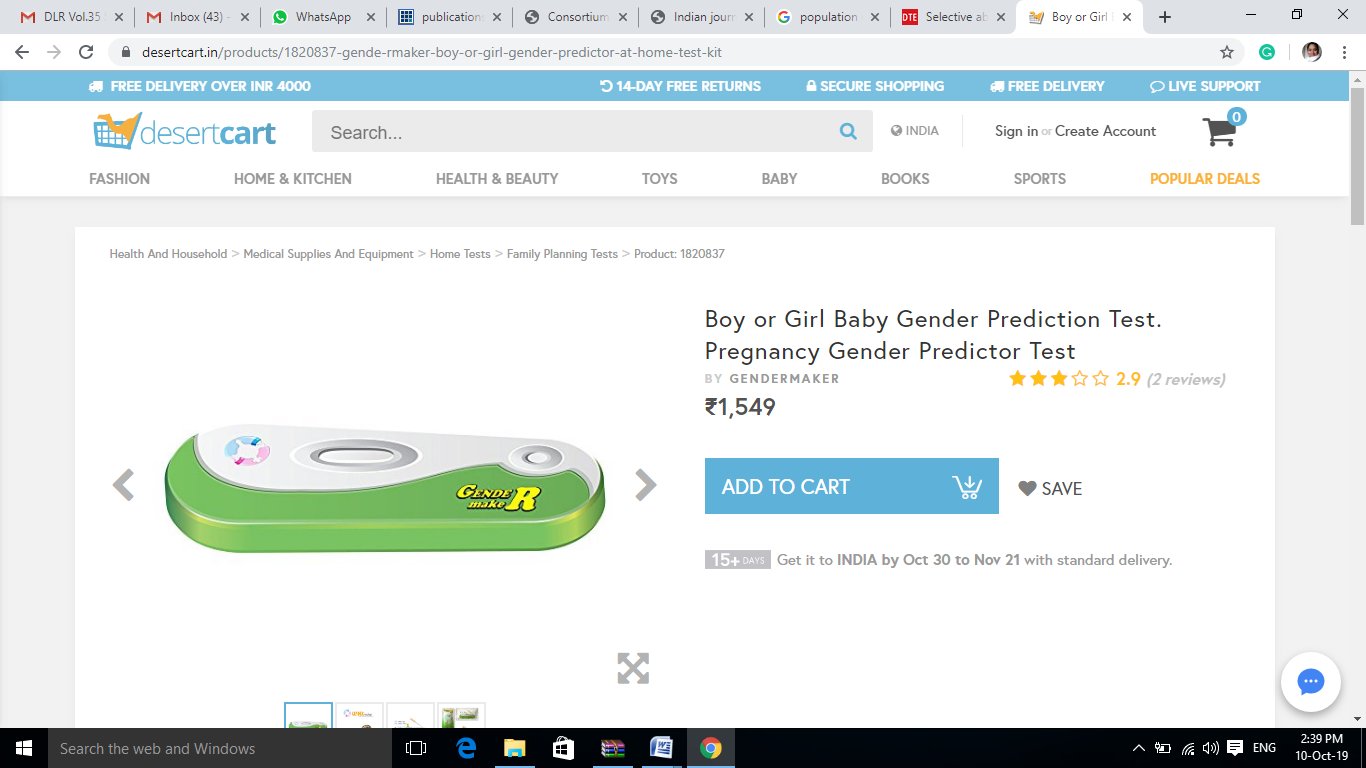
Even there is a tremendous chance of sex selective abortion, if the bill is introduced in India. The researcher during her study came across certain online marketing site where GENDER PREDICTOR TEST (See the pic. 1 below) kit is available in India. Anyone from India can order this test kit to check the gender of the fetus. If they consider the gender of the fetus suitable for them they can keep the baby and if they found it undesirable then they can abort in under Section 3 of MTP Act which says that married woman can go for abortion in case of contraceptive failure and for first 12 weeks only one doctor opinion is necessary. So this is the best way to check the sex of the fetus and then go for abortion if the sex of the fetus is not desirable and nobody will question you as under population control bill it is allowed to have only two kids and even if you conceived after having one or two kids, then you can go for abortion under MTP Act, 1971which is a valid ground for abortion. In safe simple way no one will be able to know about the crime behind such abortion as under Pre-Conception and Pre-Natal Diagnostic Techniques (PCPNDT) Act, 1994 its crime to check the sex of the fetus, but in online shopping the gender test kit is easily available in India. This bill will not increase the problem of sex selective abortion, female feticide but the women will be tortured by their family members by forcing them to undergo for number of abortion still the conceiving of male child. In India still no agency is created to check this site. As we all are aware of the fact that India is facing not only with the population problem but in the same time the male- female sex ratio is abnormal here. The researcher strongly feels here that if the Bill is introduced then India will face the same problem which once china has faced after introducing the one child policy.
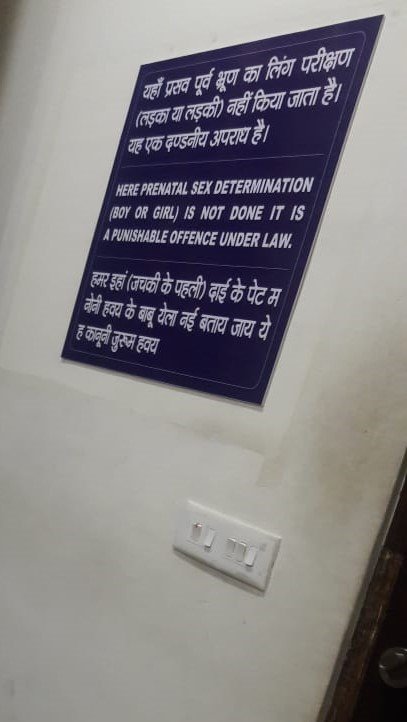
Even Pre-Conception and Pre-Natal Diagnostic Techniques Act, 1994 is silent about the definition of Pre-conception. One can find the definition of only Pre-Natal Diagnostic Procedures and Pre-Natal under section 2 of the Act. In most of the hospital, radiological center one can found the poster stating that “no prenatal test is done here for the detection of sex of the child.” The researcher has taken one picture from one of the reputed radiological center of Raipur, Chhattisgarh, during her research in this context, to show that how much this issue is serious. Lawbreakers can take benefits from such kind of loopholes. In such situation it becomes tough to punish the culprit who used these techniques for female feticide.
According to Section 4 of the Bill, “ If either the husband or the wife in case of a married couple, who have only two living children on the date of commencement of this Act, voluntarily undergoes sterilization, the appropriate Government shall provide them with the following benefits, namely:—
(i) free education including higher education to one child and to the second child, if any, born within one year from the date of commencement of this Act;
(ii) suitable employment to one child after he completes his education; and
(iii) such other benefits as may be prescribed19” .
Now here the important point of concern is that whether this section will be applicable for the persons who are employed in Pvt. Sector. As most of the time people working in Pvt. Sector didn’t get any benefit of Government schemes. One of the best examples to cite here is the Maternity benefit Act, 1961. As per the Maternity Benefit Act, women employee working in private sector will get the benefit of maternity benefit act. But in actual it was found that most of the private company provides maternity leave without pay. Also in recent amendment i.e. Maternity Benefit Act (amendment) Act, 201720 it has been asked by government to provide crèche facility where there is more than 50 women employee. But the question is how many departments have followed this instruction till now. There is no committee to check whether the government instruction was followed or not. Government Schemes or policy will not work if it is not properly executed. Many examples are there to show that how rights of woman are get violated even after having the Maternity Benefit Act. Case- In Mrs. Neera Mathur vs Life Insurance Corporation of India and Anr 1992 AIR 392, 1991 SCR Supl.(2)146 , Honorable SC not only reinstate Neera in her job (she was terminates from her job after delivery) but also directs LIC to delete those columns from its future questionnaires which Court considered this to be an invasion of privacy of a person and violative of Article 21, which guarantees right to life and privacy.
In another case one Indrani Chakraverty21, who had been working for a Delhi design firm has been sacked from her job after giving birth to her first child. She filed a criminal case before Delhi High Court for the violation of her right under Maternity Benefit Act, 1961 and awarded a monetary compensation of Rs. 7.5 lakhs as settlement money from the company.
Another concern regarding this is that if the private sector has to follow this law in that case whether government would bear the cost of the education or the company itself has to provide for the education of employee’s children’s.
One more important point to be noted here that in some cases of Assisted Reproductive Technology Cases or IVF (In Vitro Fertilization) there is a chance of conceiving triplets. So, in that case whether the couples will get the benefit of the provisions of section 4, because for having triplet’s kids one cannot blame the parents or deprive them from their rights. The same problem may arise in normal pregnancy also when after having one kid from first pregnancy if a family planned for second child and from that pregnancy if they had twin babies or triplets in that case also whether they will be deprived from the Government provisions as mentioned in the above section.
According to section 7 of the Population Control Bill, “No marriage shall be solemnized between a male who is less than twenty-seven years of age and a female who is less than twenty-two years of age22”. Now as per Section 5 of Hindu Marriage Act, 1955 and Section 4 of Special Marriage Act, Groom should be completed 21 years and bride should be of 18 years at the time of marriage. Under Muslim Law, in one of the case Justices S Ravindra Bhat and S P Garg stated that “according to Mohammedan Law a girl can marry without the consent of her parents once she attains the age of puberty and she has the right to reside with her husband even if she is below the age of 1823.” Even Supreme Court in several judgments on the issue of minor Muslim girl’s marriage said that “In a Muslim girl who has attained puberty i.e. 15 years can marry and such a marriage would not be a void marriage. However, she has the option of treating the marriage as voidable, at the time of her attaining the age of majority i.e. 18 years2. Now if the Population Control Bill fixed the age for marriage as mentioned in Section 7 of the same then in that case personal law has to be changed according to it or the Bill and the personal law will be in conflict with each other. Also according to Section 9 of the Bill states that “Any person who contravenes the provisions of section 7 shall be punished with simple imprisonment for a term which shall be not less than five years and with fine which shall be not less than rupees twenty thousand24 ”. So it’s necessary to change the marriage age in personal laws first before passing this Bill as it will make chaos among general public regarding the age for marriage.
Lastly according to section 8 of the Bill “(1) Any person who is serving in connection with the affairs of the Union Government or of the State Government or in any undertaking or organization under the control of the Central Government or the State Government, as the case may be, and,—
(a) who has only one living child or who has not procreated any child or who is unmarried on the date of commencement of this Act, shall give an undertaking that he shall not procreate more than two living children,
(b) who has two living children on the date of coming into force of this Act, shall give an undertaking that he shall not procreate any child one year after the coming into force of this Act25” .
Now this section is again in itself is conflicting in nature. If we go through the entire Act, then we will find that the Bill mostly speaks about the two child policy implementation. But Sec. 8 (b) of the Bill gives permission to have more than two children. Another loophole in this section is that this section is silent about the persons working in Private Sector. Section 8 of the Bill strictly speaks about the persons working under Union or state or any organization under the control of Central or state government.
SUGGESTIONS AND CONCLUSION
The following are the suggestions-
1. This act should be applied to all parts of India including J& K.
2. This act should be made applicable to Private sector employee to. Any benefits relating to this act should be available to all persons irrespective of the nature of jobs what they are performing.
3. This Act is silent about the couples who are in living relationship.
4. The Act is silent about the single parents.
5. There must be some agency to check the online site of selling gender prediction test kit in India.
6. PCPNDT Act should provide the definition of Pre conception.
7. There must me definition clause for child and Couples in the Bill.
8. Government should focus in maintaining small balanced family rather than in two Child policies.
9. Awareness program relating to population problem should be spread through mass media in rural areas.
10. NGO can play an important role here by visiting different villages and towns for creating awareness among families for maintaining small family. Specially those banjaras who leaves near road side and all the persons who are under the category of below poverty line. It’s really important to provide good medical as well as education facility to persons who belong to this category.
Awareness among citizens is very much important relating to population problems. When they will understand the gravity of population problem then automatically they will start thinking about the solution of it. Even no law will be effective until and unless the public accept it. Law and society both are interdependent to each other. To make the law effective, public have to know about the reasons and objectives behind the law. If they understand it, then they will accept it also. We can call The Population Control Bill, 2018 as Social welfare legislation because this law is drafted for the welfare of the society but there is also a chance that this bill will increase the crime against women making them victim once again like female feticide issue, forced abortion. It is also important for this law that every persons of this country should get the benefit from it. There must me some committee to check the application of law in all sects of the society and for its proper implementation. But prior to this, the criminal justice system should be strong enough to punish every culprit of the society and this will be possible only when we removed the drawbacks from the law leaving no space for the misuse of the provisions.
CONFLICT OF INTEREST
Pyali Chatterjee declares that there is no conflict of interest.
SOURCE OF FUNDING
No funding for this research.
ETHICAL APPROVAL
The study does not require the approval of Institutional Ethics Committee. As the study is the combination of socio-legal issue.
References
India Population (LIVE). [cited 2019 May 23] Available from:
https://www.worldometers.info/world-population/india-population/ ↑India to dethrone China as world’s most populated country in seven years, UN says, [cited 2019 May 23] Available from:
https://www.scmp.com/news/asia/east-asia/article/2099453/india-dethrone-china-worlds-most-populated-country-seven-years ↑- Drakshayani PK, Boodeppa GK. National Family Planning Programme – During the Five Year Plans of India. JEMDS. 2014; 3(19): 5172-5178 ↑
The Population Control Bill,2018, [cited 2019 May 25] Available from:
http://164.100.24.219/BillsTexts/LSBillTexts/AsIntroduced/1844LS%20AS%20INTRO.pdf ↑- Rao M. From Population Control to Reproductive Health: Malthusian Arithmetic. New Delhi: Sage Publications India Pvt. Ltd; 2004. 50p ↑
Mandhani A. Raise Minimum Marriage Age To 25 Years For Men And 21 Years For Women To Curb Growing Population: Petition In SC. [cited 2019 May 29] Available from:
https://www.livelaw.in/raise-minimum-marriage-age-25-years-men-21-years-women-curb-growing-population-petition-sc-read-petition/ ↑- Lai SK. Reconstitution of the Constitution of India. New Delhi: Deep and Deep publications pvt. Ltd; 2002. 66p ↑
- The Population Control Bill, 2016 (Bill No. 77 of 2016), s.1 ↑
- Lai SK. Reconstitution of the Constitution of India. New Delhi: Deep and Deep publications pvt. Ltd; 2002. 68p ↑
- Connelly MJ. Fatal Misconception: The Struggle to Control World Population. England: Belknap Press of Harvard University Press; 2008.19p ↑
- Dey S. India has highest number of deaths of children under five years of age, [cited 2019 May 30] Available from: https://timesofindia.indiatimes.com/india/India-has-highest-number-of-deaths-of-children-under-five-years-of-age/articleshow/46722307.cms ↑
Starvation deaths in 2018. [cited 2019 June 12] Available from:
https://indianexpress.com/article/opinion/columns/starvation-deaths-in-india-global-hunder-index-unicef-poverty-national-health-mission-5276194/ ↑Pavan P. Starvation deaths in Andhra Pradesh: Two kids die eating mud for food. [cited 2019 June 15] Available from:
https://bangaloremirror.indiatimes.com/news/india/starvation-deaths-in-andhra-pradesh-two-kids-die-eating-mud-for-food/articleshow/69150948.cms ↑- Office of the Registrar General & Census Commissioner, India[cited 2019 June 12] Available from: http://censusindia.gov.in/Census_And_You/about_census.aspx ↑
- The Population Control Bill, 2016 (Bill No. 77 of 2016), s.3 ↑
Family Balancing, [cited 2019 June 16] Available from:
https://www.givf.com/familybalancing/ ↑Edukugho E. Population Control: Balancing family size and available resources. [cited 2019 June 16] Available from:
https://www.vanguardngr.com/2012/07/population-control-balancing-family-size-and-available-resources/ ↑- Dawson K. Trounson A. Ethics of sex selection for family balancing: Why balance families?. Human Reproduction.1996; 11(12): 2577-2578 ↑
- The Population Control Bill, 2016 (Bill No. 77 of 2016), s.4 ↑
[cited 2019 June 17] Available from:
https://labour.gov.in/sites/default/files/The%20Maternity%20Benefit%20%28Amendment%29%20Act%2C2017%20-Clarifications.pdf ↑Ministry of Labour and employment, [cited 2019 June 19] Available from:
https://www.thehindu.com/features/metroplus/society/penalised-for-pregnancy/article4873867.ece ↑- The Population Control Bill, 2016 (Bill No. 77 of 2016), s.7 ↑
Muslim girl can marry at 15 if she attains puberty: Delhi high court. [cited 2019 June 20] Available from:
http://timesofindia.indiatimes.com/articleshow/13852822.cms?utm_source=contentofinterest&utm_medium=text&utm_campaign=cppst ↑- The Population Control Bill, 2016 (Bill No. 77 of 2016), s.9 ↑
- The Population Control Bill, 2016 (Bill No. 77 of 2016), s.8 ↑