
Review · Vol. 6, No. 1
Book Reviews: Technical Books Section
(Page 2 b - Review by Dr. Jason Payne-James, UK)

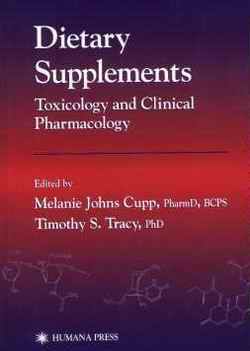
Dietary Supplements: Toxicology and Clinical Pharmacology, 1stEdition, Edited by Melanie Johns Cupp and Timothy S. Tracy. Hard Bound, 7" x 10".
Humana Press Inc.; Publication Date December 2002. 448 pages, ISBN 1-58829-014-X (acid-free Paper). Price $99.50
Official Site: Click here to visit
Click here to read a detailed table of contents.
 |
You can't escape dietary advice nowadays. The general public are bombarded with literature, assaulted by adverts in magazines and on radio and television, and junk emailed to oblivion by the manufacturers and distributors of a huge range of products referred to as 'dietary supplements'.
The editors state that the aim of the book is to 'present..objective information on. dietary supplements from the most reliable sources, with an emphasis on information not readily available elsewhere..'. In particular they identify this information adverse effects, pharmacokinetics and chemical and biofluid analysis.
In a detailed legal and regulatory section they clarify the status of dietary supplements - predominantly from the point of view of the USA, with passing reference in a few paragraphs to the situation in European countries. Within the US dietary supplements are defined as vitamins, minerals, herbs, botanicals, amino acids or dietary substances used by man to supplement the diet by increasing the total dietary intake. From the US view the Dietary Supplement Health and Education Act of 1994 permits dietary supplements to carry claims about their ability to affect the structure or function of the human body, or claims about a nutrient's relationship to a disease (i.e. a health claim), but does not permit promotion for the treatment or prevention of disease. And herein lies the problem, as clearly clever marketing will be able to circumvent the latter requirements relatively easily. Why is this important? The main significance is that dietary supplements do not have to be proven safe and effective for their labelled use prior to marketing - and thus the rigorous controls applied to established and new drugs do not apply. And perhaps more importantly 'standardization' applies to within batch consistency - not that the product meets a statutory standard.
This book is a companion volume to Toxicology and Clinical Pharmacology of Herbal Products (by the same first author) which focussed on herbal products and this volume focuses on nonherbal dietary supplements. Its chapter contents reflect the huge range of substances available including those which are instantly recognisable - for example Androstenedione and Other Over the Counter Steroids, Fish Oils, Dehydroepiandosterone, 5-Hydroxytryptophan to those less readily familiar to this writer - Huperzine, Germanium, Red Yeast Rice Extract. Each chapter concludes with a summary and these give very clear pictures of the current state of knowledge with regard to the different substances. The summary for Shark Cartilage which is promoted as ' a potent angiogenesis inhibitor and therefore a potential agent in the treatment of cancer' indicates that Shark Cartilage has been shown to inhibit angiogenesis in vitro and rates, that in a human experimental in vivo model of angiogenesis it appears to have an antiangiogenic effect; that human clinical trials have not demonstrated a positive effect on patients with cancer; that adverse effects are generally mild and usually involve gastrointestinal symptoms; a case of hepatitis has been reported. A Google search of Shark Cartilage produces 94,400 hits of which the top is an advert which gives the following information.
'The extraordinary activity of cartilage is a key to why sharks have survived since prehistoric times. The most promising research to date, including my work reported on TV's "60 Minutes", focused on dramatic benefits of shark cartilage protein. BeneFin shark cartilage is high in active protein. It also contains a number of nutrients such as calcium, phosphorus, zinc, glucosamine and chondroitin. LaneLabs calls BeneFin a natural wellness insurance policy. Benefin was developped by Dr. L. William Lane, biochemist, best selling author and father of shark cartilage.'
This information to those buying online doesn't seem to reflect the detailed information in the book. The book is to be recommended to all those working in the field - however the people who need to read it - the gullible souls who take the supplements for the wrong reasons - are the ones who really need to be aware of its contents.
 |
-Jason Payne James Dr. Jason Payne James is on the editorial board of Anil Aggrawal's Internet Journal of Forensic Medicine and Toxicology. Click image to have more information about him. |
Order Humana Press Books by clicking here.
or via or or
Request a PDF file of this review by clicking here. (If your screen resolution can not be increased, or if printing this page is giving you problems like overlapping of graphics and/or tables etc, you can take a proper printout from a pdf file. You will need an Acrobat Reader though.)