
Review · Vol. 6, No. 1
Book Reviews: Technical Books Section
(Page 2 a - Review by Dr. Setia and Dr. Gupta, India)


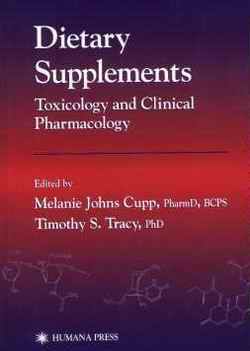
Dietary Supplements: Toxicology and Clinical Pharmacology, 1stEdition, Edited by Melanie Johns Cupp and Timothy S. Tracy. Hard Bound, 7" x 10".
Humana Press Inc.; Publication Date December 2002. 448 pages, ISBN 1-58829-014-X (acid-free Paper). Price $99.50
Official Site: Click here to visit
Click here to read a detailed table of contents.
 |
Dietary supplements are one of the few grey areas in the medical field. The pharmaceutical companies claim that they are very useful and so should be used. Many doctors say that since they don't cause any harm, they can be used. At best they will cause some benefit and at worst they will be just a placebo and will not cause any effect. So the present book can be regarded as a welcome addition as it can give some insights about the usefulness or otherwise of these supplements.
The book has been divided into two parts. Part one consists of one chapter titled 'Legal/Regulatory Aspects Of Dietary Supplements' and part two consists of the description of the twenty-three supplements in the form of twenty-three chapters. We are now going to discuss the two parts separately.
In part one the author starts off by giving the definition of drug. But the important thing that has been mentioned in this chapter (page 3) is the difference between a drug and a supplement. The knowledge about this difference is important as it is this difference that helps in knowing whether a particular product can be marketed as a dietary supplement or not. The next thing that has been mentioned is the ways in which a particular product can be marketed. This includes the things that can be mentioned on the labels, the claims that can be made about the product etc. The importance of these things lies in the fact that these claims decide whether the product can be marketed as a dietary supplement or not. Also mentioned is the role of dietary supplements in pregnancy. The problem in pregnancy is the teratogenic effects of the various drugs, including these supplements. This is a special problem and has been properly addressed by the authors.
The inclusion of the role of significant scientific agreement (SSA) and "Supplement facts" has given the book a look of completeness. These two standards and the way USP and NF work tells the reader about the amount of importance he can put on the various claims that have been mentioned about a product by the manufacturers.
The second part of the book describes the various supplements in detail. The authors have mentioned about the chemical structure of the drugs, their uses, source and chemical composition, and the physiologic role. Also mentioned about each supplement are the various clinical trials that have been conducted regarding each product. The inclusion of these clinical trials is an important point of the book. That's because they give the reader an idea about the research that has gone into the particular product and he can decide for himself if it is worth using or not. The inclusion of the adverse effects and toxicity of the supplements is also important, as it tends to belie the belief about the relative harmlessness of these dietary supplements.
In the end we would like to say that the present book is an important book in the sense that it gives the reader an idea about the various types of dietary supplements that are available and helps him in choosing the option that is best suited for him.
-Puneet Setia and Avneesh Gupta
Department of Forensic Medicine and Toxicology,
Maulana Azad Medical College,
New Delhi, India
|
Dr. Puneet Setia is working as a senior resident in the department of Forensic Medicine and Toxicology at Postgraduate Institute Of Medical Education And Research (PGIMER), Chandigarh. He did his graduation from Maulana Azad Medical College (MAMC), New Delhi. His research interests include Forensic Radiology, especially the use of radiology in demonstrating coronary narrowing at the post-mortem examination. He is associated with Anil Aggrawal's Internet Journal of Forensic Medicine and Toxicology as a writer and book reviewer. He can be contacted at puneetsetia@rediffmail.com |
|
|
Dr. Avneesh Gupta qualified as a forensic pathologist from India with honors and is now working as a fellow of forensic pathology in Wayne County, Detroit. He has to his credit a number of publications in leading journals around the world. His landmark thesis on "Cranial Cerebral Damage In Fatal Road Traffic Accidents With Special Reference to Circle Of Willis" can be accessed by clicking here. He is associated with Anil Aggrawal's Internet Journal of Forensic Medicine and Toxicology as a journal associate, writer and book reviewer. He can be contacted at avneeshgupta2000@yahoo.com. During his spare time, he enjoys meeting friends and traveling. |


Order Humana Press Books by clicking here.
or via or or
Request a PDF file of this review by clicking here. (If your screen resolution can not be increased, or if printing this page is giving you problems like overlapping of graphics and/or tables etc, you can take a proper printout from a pdf file. You will need an Acrobat Reader though.)