
Drug Index Terms
Vitamin B Complex
Medical Index Terms
Homicide; Water Sampling; Plastic Bottle; Color; Toxicology; Intoxication; Water Analysis; Spectrophotometry; Personality; Human; Male; Case Report; Adult; Article
EMBASE Classifications
049 - Forensic Science Abstracts; 052 - Toxicology
The Case
The department of Analytical Toxicology, Amrita Institute of Medical Sciences Cochin received a sample of potable water from Mangalore (a city several hundred kilometers way) by messenger, with a request to test it for "poison." It appeared that the water sample originated from a small transparent plastic bottle that was placed at the bedside of the person who had sent it, a couple of nights ago. This person, a 40 year old male, was in the habit of drinking a few sips of water every night at bedtime, and sometimes once or twice more during the course of the night. One morning, when he woke up, he happened to notice that the bedside bottle of water was uncharacteristically discolored. Since he had an ongoing enmity with a professional colleague that was escalating constantly, he feared that this was an attempt on his life, by way of poisoning his drinking water. The bottle of water in question had been placed on a side table that was situated close to an open window, and hence easily accessible from outside. In addition to the faint yellowish discoloration, the water also had an unusual odor. The "victim" contacted a forensic specialist who was a family friend, and he suggested that the water sample be analyzed for drugs or poisons.
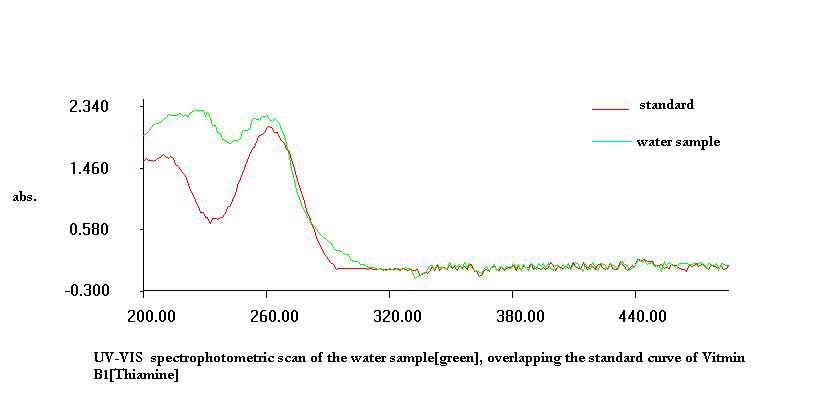
On receipt of the water sample in the department, we decided to begin with common chemicals and biological toxins that are popular as "ideal" homicidal agents1. The methods employed included color tests, chromatography, spectrophotometry and atomic absorption spectroscopy. Over a period of a few days, all common poisons had been tested, and the water sample did not show positive result for any of these. The list of possible agents was now extended to other less commonly employed "homicidal poisons," but this too did not provide conclusive results. It was now decided to look for pharmaceutical drugs, and we began by testing for the more hazardous agents, subsequently progressing to lesser toxic substances, and finally ending up with minerals and vitamins. It was then that we got a positive result. But it was something that no one had expected: B vitamins! Spectrophotometry had revealed a picture quite identical to that of multivitamin B preparations (Fig 1). While it is true that some of the B vitamins do have adverse effects on large overdose2-4, neither did this case involve a toxic dose, nor has it ever been reported that even a massive ingestion of any of the B vitamins has resulted in death. It was inconceivable that anyone would choose it for the purpose of committing homicide.
This unexpected result was communicated to the "victim," who was at first incredulous, and then on analyzing the incident carefully realized that the whole incident had been born out of baseless suspicion. It transpired that the person not only had a few sips of water at bedtime every night, but was also in the habit of taking a multivitamin B tablet along with it. On the night in question, it appears likely that in the process of consuming the vitamin tablet, he had inadvertently spilled the tablet into the bottle of water, and had only swallowed the water. Since it was dark, he did not notice what had happened. The tablet that had slipped into the bottle got dissolved during the course of the night, and when the person woke up, he discovered to his alarm that his bottle of water had mysteriously changed color. His paranoid personality then dictated the subsequent sequence of events.
This case is being reported on account of its rarity, being perhaps the first of its kind on attempted homicide with vitamins!
References
- Trestrail John H. Criminal Poisoning: An Investigational Guide for Law Enforcement, Toxicologists, Forensic Scientists and Attorneys. New Jersey, USA: Humana Press; 2002. ↑
- Marcus R, Coulston AM. Water soluble vitamins. In: Hardman JG, Limbird LE, Molinoff PB, Ruddon RW, Gilman AG, editors. Goodman & Gilman's The Pharmacological Basis of Therapeutics. New York: McGraw-Hill. 9th ed, 1996. p1555-1572. ↑
- Ellenhorn MJ. Over-the-counter drugs. In: Medical Toxicology: Diagnosis and Treatment of Human Poisoning. Baltimore, USA: Williams and Wilkins. 2nd ed, 1997. p971-1035 ↑
- Albin RL, Albers JW, Greenberg HS, Townsend JB, Lynn RB, Burke JM Jr, et al. Acute sensory neuropathy - neuronopathy from pyridoxine overdose. Neurology. 1987 Nov;37(11):1729-32 PubMed ↑