




Introduction
Asphyxial death due to sand, dirt, or mud aspiration commonly occurs in mass disasters such as landslides or tsunamis [1]. In the field of forensic medicine, autopsy cases of accidental sand or mud aspiration by playing or drowning are occasionally reported [2, 3]. Because airway obstruction is the most common finding, acute asphyxia causes a rapid death in these cases. However, a digestive tract filled with mud or sand is rarely seen in such cases.
Here, we describe an autopsy case of massive mud ingestion. The deceased was buried in mud and her entire digestive tract was filled with mud, whereas her larynx and trachea contained only a small amount. Although acute asphyxial death due to mud aspiration was suspected as the cause of death according to the deceased’s situation, the autopsy revealed continual mud ingestion resulting in a slow death.
Case report
A woman with dementia in her late 80s went missing from her house after dinner. Her family searched for her and reported her disappearance to the police. A week later, she was found dead in a prone position in a paddy field near her house. The whole body of the deceased, including the face, was buried in mud. To clarify the cause of death and to exclude the possibility of criminal involvement, a medico-legal autopsy was performed about 15 hours after the dead body was discovered.
Autopsy findings
The deceased was covered with mud and was moderately putrefied with dark purplish discoloration of the face. The palpebral conjunctiva was also putrefied, and therefore petechiae were not apparent. The body was 154 cm tall and weighed 38.6 kg. Postmortem rigidity was relaxed, while postmortem lividity was obscure. The nasal and oral cavities were filled with mud. No obvious signs of external trauma were observed.
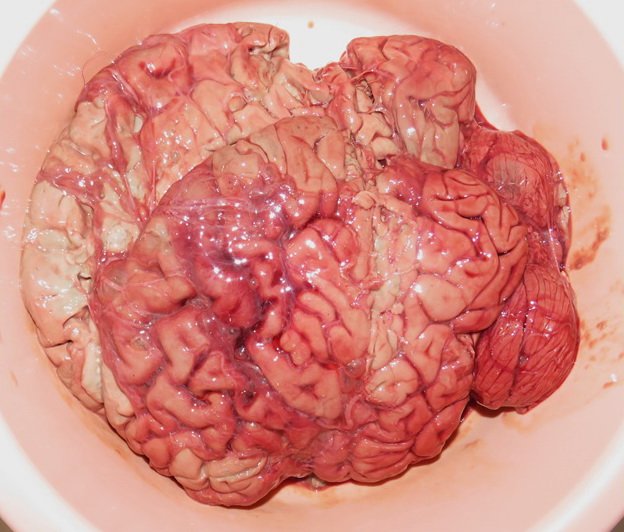
No bone fractures were found throughout the body. The brain had become soft without hemorrhage (Fig.1).
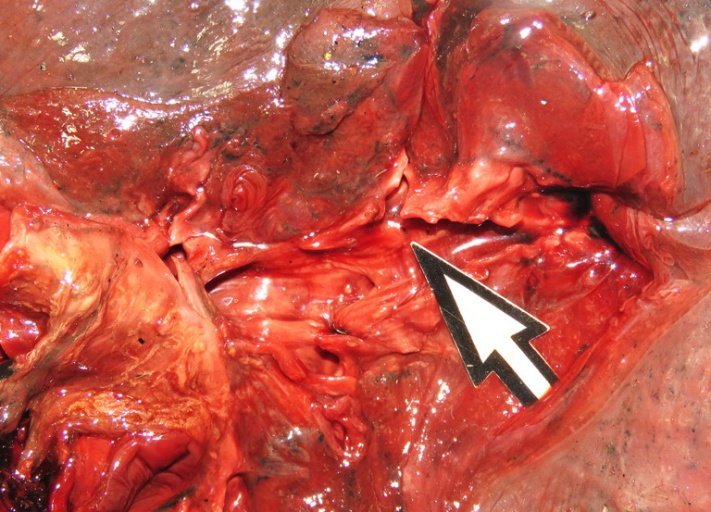
No signs of bleeding were found in the cervical muscles. The heart weighed 327 g and contained 230 mL of soft blood clots. The coronary arteries showed moderate calcification without thrombi. The left lung, which adhered firmly to the pleura, had shrunk and weighed 107 g. The right lung weighed 327 g, and the right pleural cavity contained 130 ml of reddish fluid. Although there were only small amounts of mud in the larynx and trachea (Fig. 2), granular mud was found in the deep bronchiole (Fig.3).
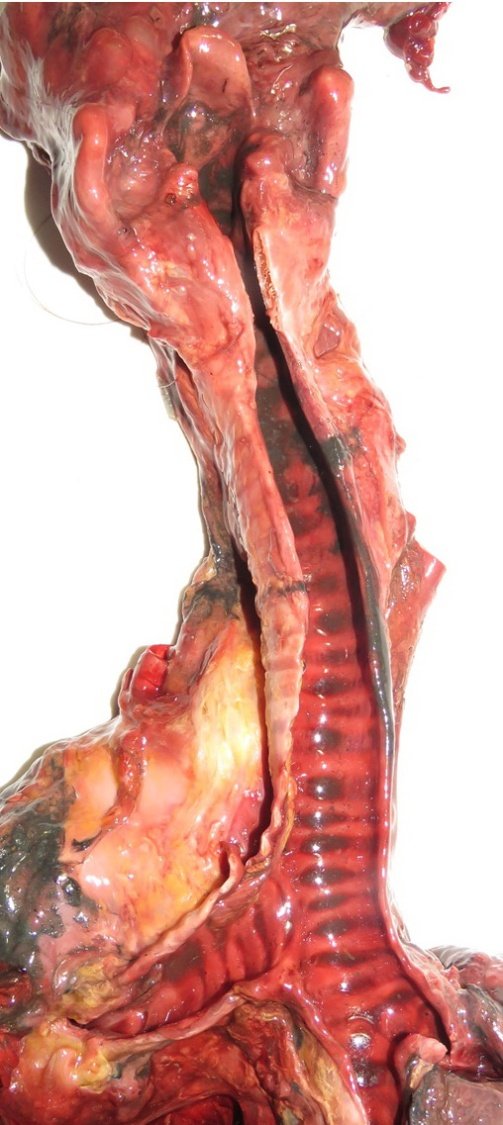
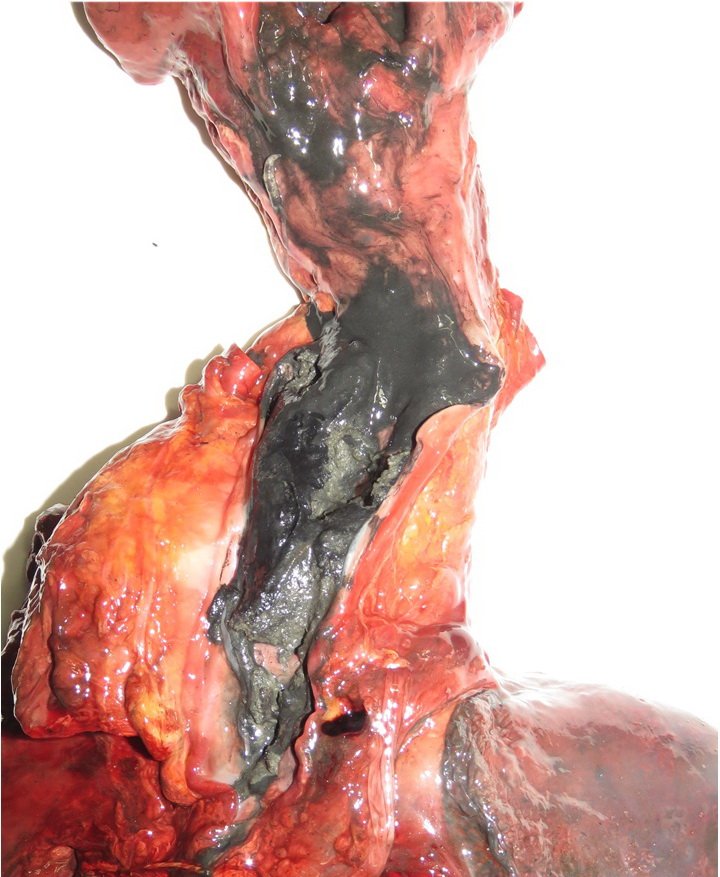
A large amount of mud was found throughout the entire digestive tract including the esophagus (Fig. 4), stomach, duodenum, and small and large intestines.
The stomach contained 65 mL of fluid mud without food residue (Fig.5).
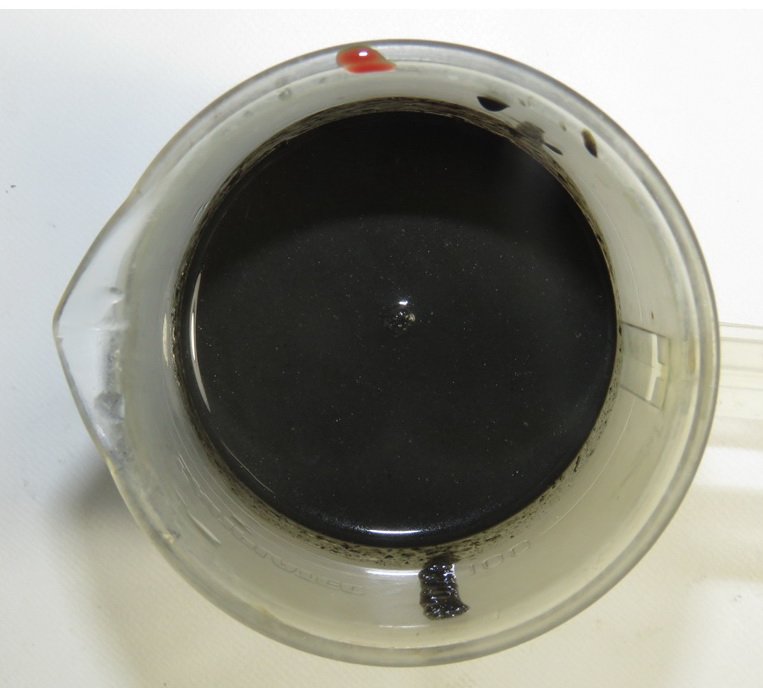
The mud had solidified as it moved down the digestive tract, so the large intestine contained many solid mud lumps (Fig.6).
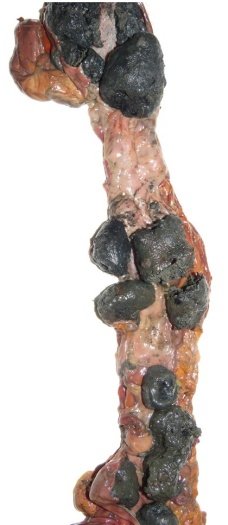
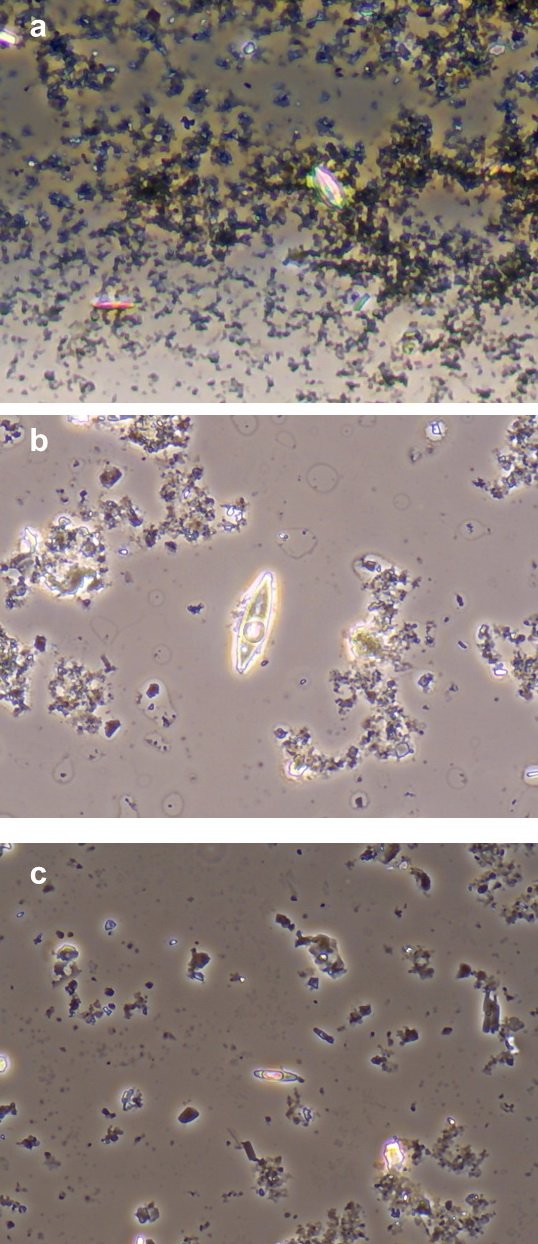
Her intestines did not show volvulus and were not necrotized. No other pathological lesions were found in the internal organs except for putrefactive change. Diatoms were detected in the lungs, liver, and kidneys (Fig.7).
Discussion
According to the death scene investigation by police, it seemed highly likely that the deceased wandered into the paddy field and bogged down in the quagmire. From the autopsy findings, we excluded the possibility of death from trauma and internal disease. Although the larynx and trachea were not obstructed with mud, the deceased’s face had sunk in the mud, and the nasal and oral cavities were filled with mud. The deep bronchiole also contained mud, although it was a small amount. Hence, we determined the cause of death was asphyxia due to naso-oral obstruction. The diatom detected from the greater circulatory system (liver and kidneys, Fig.6b and c) provided clear evidence of antemortem aspiration of mud.
The highly specific finding in the present case was the mud lumps that filled the entire digestive tract. As far as we know, such a case has not previously been reported. The deceased did not have a history of pica, i.e., the long-term compulsive ingestion of non-food material. Necrosis of the intestine, which is often observed in pica casualties, was not found [4]. Therefore, the deceased must not have eaten mud habitually but ingested mud only at the scene. Although it is heavily contingent on physical and mental status, the total gastrointestinal transit time is usually reported as about 40 hours [5], which means that the deceased had remained in the mud for at least a day. Although she must have stayed alive ingesting mud for one day, she gradually exhausted herself and lost the ability to ingestion. Accordingly, her nose and mouth were obstructed with mud and she finally died of asphyxia.
There are few cases of asphyxial death due to sand or mud aspiration. Kettner et al. reported a case of a 2-year-old boy who ingested sand while playing in a sandbox [2]. The boy tried to eat sand and died of airway obstruction in just a few minutes. Another report described a deferred death by drowning with mud aspiration [3]. In that case, an elderly man had presumably fallen into a dich and later died due to muddy water aspiration. In these cases, although sand or mud was found in the airway and esophagus, the stomach contained only a small amount of sand or mud, and no mud was found in the more aboral parts of the digestive tract. These reports suggest that a mud-filled digestive tract with a nearly empty airway is extremely rare regardless of whether death was deferred or not.
It is unclear why the deceased could not escape from mud. The autopsy did not reveal any external trauma or bone fractures. Because the deceased had dementia, she must have had impaired cognitive ability and judgment. She also might have lost consciousness for an extended period from falling. In either case, she would have exhausted herself during mud ingestion.
In conclusion, we experienced an autopsy case of a death with mud ingestion. Before the autopsy, we speculated that the cause of death was acute asphyxia due to airway obstruction with mud. However, contrary to our expectations, the autopsy revealed a mud-filled digestive tract with a nearly empty airway. This was an exceptionally rare case of a slow death.
Conflicts of interest: None declared.
Acknowledgement: The authors thank Ms. Ikuko Terazawa for her technical assistance with the post-mortem examinations.
References
- Pereira BM, Morales W, Cardoso RG, Fiorelli R, Fraga GP, Briggs SM. Lessons learned from a landslide catastrophe in Rio de Janeiro, Brazil. Am J Disaster Med. 2013;8(4):253-8. PMID: 24481889 ↑
- Kettner M, Ramsthaler F, Horlebein B, Schmidt PH. Fatal outcome of a sand aspiration. Int J Legal Med. 2008;122(6):499-502. PMID: 18546004 ↑
- Sato Y, Kondo T, Ohshima T. A case of deferred death from drowning of a man found dead in bed at home. J Clin Forensic Med. 1996;3(2):105-7. PMID: 15335618 ↑
- Byard RW. A review of the forensic implications of pica. J Forensic Sci. 2014;59(5):1413-6. PMID: 24975510 ↑
- Clarkston WK, Pantano MM, Morley JE, Horowitz M, Littlefield JM, Burton FR. Evidence for the anorexia of aging: gastrointestinal transit and hunger in healthy elderly vs. young adults. Am J Physiol. 1997;272:R243-8. PMID: 9039015 ↑