


Introduction
The burn is an injury to skin or deeper organic tissue, caused by heat, radiation, radioactivity, electricity, friction and contact with chemicals. Thermal (heat) burns occur when some or all of the cells in the skin or other tissues are destroyed by flames (flame burns), hot liquids (scalds) or hot solids (contact burns).1 Occupational burn injuries are those that occur “on-the-job.”2 Human being established the industries for production of various things which adds the comfort to life. Besides the industry gives many things to human being, risk to life of its workers persist in many forms, among which burns is the commonest health hazard. Numerous cases of burn related injuries reported yearly in India, in which majority were accidental followed by suicidal and rarely homicidal, but the occupational or industrial burns are almost always accidental. The occupational burns occur by various means such as, catching of fire by cloths, flash burns by electric current, blast of Furnace, burns by heated substance, burns by molten metal, burns by hot liquids, hot steam and vapors, burns by chemicals and chemical products, burns by radiations, and burns by industrial explosions as in fireworks.
Burn injury is the major global public health problem. According to WHO data, cases of death due to burns accounts for an estimated 265000 deaths annually and majority of them occur in low and middle income countries. Almost half of those cases occur in the South-East Asian region. The Indian ministry of health records 70 lakh people suffers from burn injury every year, of which 1.4 lakh people die. 70% of those cases belong to most productive age group of 15-35 years,3 this leads to big loss for a country because it is taking away the life of working youth population.
Exact data regarding the mortality and morbidity due to occupational burns is not available in developing countries including India; it may be due to underreporting of cases because of illiteracy, poverty, lack of medical attention and lack of record keeping facility leading to poor documentation. Cases with non-fatal and small surface area burns go unnoticed as they are not mentioned in medical records because they get treated on outpatient basis. Many of the patients get treatment in same hospital for treatment of employees; and fail to keep proper records and documentation. Under reporting of cases is not uncommon when it involves the domestic or undocumented immigrant workers.4,5 Instead of proper care and treatment those who died unfortunately are not brought for postmortem examination but directly taken for funeral by relatives. These all parameters contribute to lack of proper statistical data on occupational burns in developing countries.
An occupational or industrial burn is very serious issue because number of people working in high risk areas where the life is surrounded by dangerous zones of electric currents and high degree temperature of fires and flames, which may cause serious health hazards and even death, which is the most unacceptable end result of it but still a dark reality. The loss of a person is not only loss of one life but also a big loss to his family and dependent members. This topic is taken for discussion to analyse the pattern of burns at occupational or industrial site and to draw the utmost attention in the direction where most of the cases go unnoticed.
Case reports
Cases: 1.
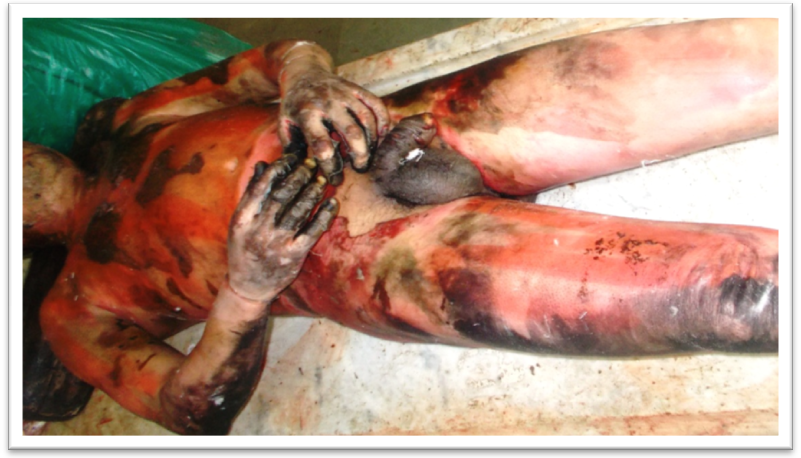
A corpse of a 26-year-old male was brought for an autopsy to the Department of Forensic Medicine, with history of burns while working at site in a private company with his co-workers. The fire suddenly explodes from metal furnace and three people get burnt in this mishap, all of sudden the other co-workers taken them to a private hospital. He was treated there for five days but died instead of adequate treatment; the life of other two people was saved.
Postmortem examination
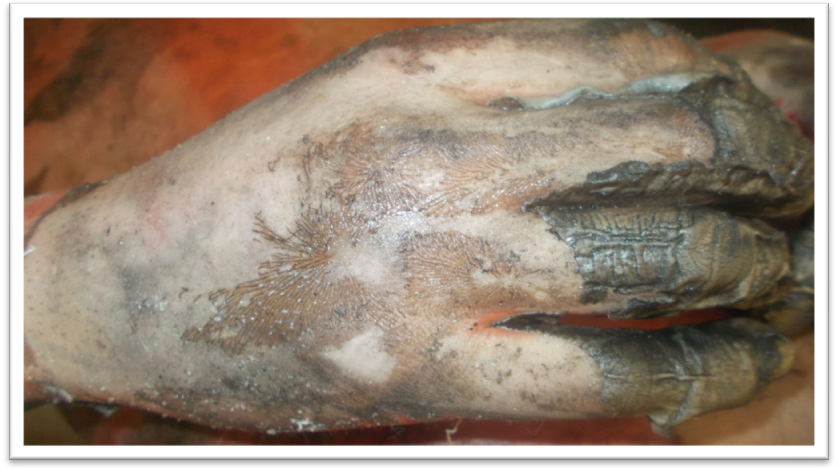
The body was brought by police constable on duty, wrapped in blanket and white bandage, on removing cloths it was a male corpse with burnt body surface area, rigor mortis was partially present, features natural, yellowish fluid oozing from mouth and nostrils, both limbs straight.
Mixed dermoepidermal burns present over the body surface area, as per rule of nine the total percentage of burnt was 83%, and distributed as head neck and face- 5%, upper limbs – right upper limb- 9%; left upper limb- 9%, right lower limb- 16%; left lower limb-16%, anterior aspect of trunk-18%; posterior aspect of trunk-10%. Spared area was vertex and back of head, dorsum and plantar aspect of foot and genitalia. Evidence of singeing of eyebrows and scalp hairs, metallic residues and particles on hands and body parts, reddish coloured medicated ointment is seen over the burnt body surface area.
Brain was edematous and congested, lungs was edematous and congested with patchy consolidation present over lower lobes of both the lungs. liver, kidney, spleen, pancreas was congested. The cause of death was given as “postmortem findings are consistent with death due to burns.”
Case: 2
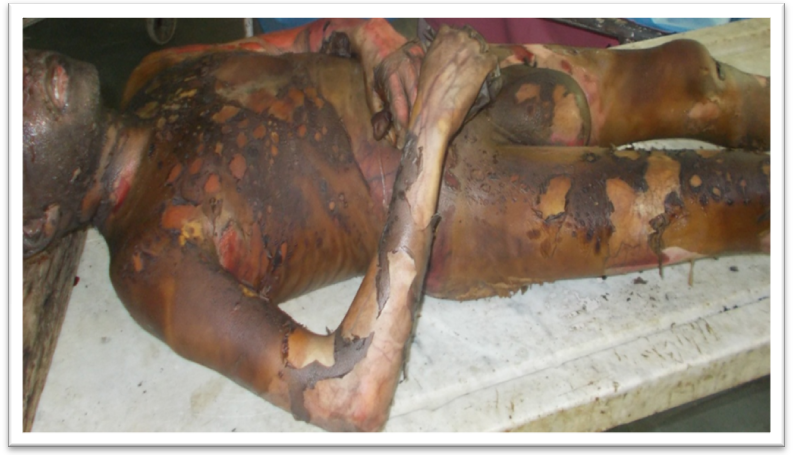
In this case the corpse of a male aged about 35 years was brought for an autopsy to the Department of Forensic Medicine, with history of burns while working in oil company, while doing the process called as “tire filling” in local language. When he opened the door of boiler chamber the fire flames suddenly blow out and cloths catched fire and body get burnt. All of sudden the co-workers taken him to the hospital, but he was declared brought dead in the casualty.
Postmortem examination
The body was wrapped in a blanket, on removing the cloths it was a male corpse, with burnt body surface area, rigor mortis was present and generalised, features natural, no oozing from mouth and nostrils, both limbs semiflexed.
Mixed dermoepidermal burns present over the body surface area and as per rule of nine the total percentage of burns was 83% and distributed as head neck and face - 6%, right upper limbs- 9%; left upper limb-7%, right lower limb -17%; left lower limb- 16%, anterior aspect of trunk- 15%; posterior aspect of trunk- 12%, Genitalia- 1%. Spared area was vertex and back of head, medial aspect of left arm, dorsum and plantar aspect of left foot, plantar aspect of right foot, patchy areas of trunk anteriorly as well as posteriorly. Evidence of singeing of eyebrow and scalp hairs and blisters was present at places. Brain and lungs was edematous and congested. Liver, kidney, spleen, pancreas were congested. The cause of death was given as “postmortem findings are consistent with death due to burns.”
Case: 3
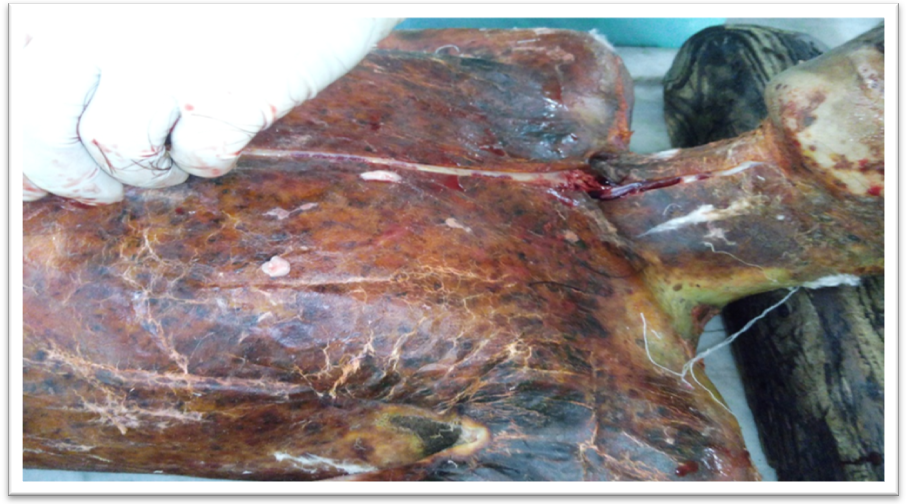
In this case the corpse of a male aged about 21-years old was brought for an autopsy to the Department of Forensic Medicine, with history of burns while working in a coal tar boiling site. While he was adding the wooden fuel for melting the coal tar there was sudden splashing of boiling coal tar on his body and suddenly his cloths catched fire. His co-workers poured water on his body and immediately taken to hospital, where he was treated for the period of 13 days, but instead of all adequate treatment he was died.
Postmortem examination
The body was wrapped in a bed sheet and white bandage, on removing cloths it was a male corpse, with burnt body surface area, rigor mortis was present and generalised, features natural, no oozing from mouth and nostrils, both limbs semiflexed. Mixed dermoepidermal burns present over the body surface area, greenish coloured pus pockets present at places, and application of reddish coloured medicated ointment is seen over the burnt body surface area and evidence of singeing of eyebrows and scalp hairs present. As per rule of nine the total percentage of burnt are 58% and distributed as, head neck and face is 4%, right upper limb- 6%; left upper limb- 7%, right lower limb- 8%; left lower limb-6%, anterior aspect of trunk- 18%; posterior aspect of trunk- 9%. Right arm, vertex and back of head, dorsum and palmar aspect of left hand, both lower limbs involved in patchy areas, lower back and genitalia was spared. Brain edematous and congested, pleural cavity contains 400cc yellowish fluid, lungs edematous and congested with patchy consolidation present over lower lobes of both the lungs. Liver shows yellowish discoloration, Subcapsular pus pockets over spleen surface, kidney and pancreas – congested. The cause of death was given as “septicemia due to burns.”
Disscussion
In the first case there were history of sudden explosion of fire out of metallic furnace, so the cloths of victim catched fire and simultaneously there were sudden splashing of molten metal over the body which caused severe mixed dermoepidermal burns. In second case the victim was working in oil industry then there were sudden explosion of fire and the cloths catched fire and the victim got burnt with body surface showing mixed dermoepidermal burns. There was evidence of oil and grease stains over the palms and soles. In third case the victim was boiling coal tar at working site and then suddenly that boiling coal tar splashed over his body, his cloths catched fire. He got burnt due to the effect of fire and boiling coal tar. The coal tar is black to brown paste with boiling point greater than 250 degree and its auto ignitable and combustible above the temperature of 500 degrees.
Eventhough the pattern of industrial burns and pattern of other types look similar but industrial burns is very extensive and occurred at such a high degree temperature and electric current. There were no much difference police history, history given by relatives and co-workers, and careful examination of body and cloths for presence of oil stains, grease stains, metallic residues and peculiar materials related to that particular industry reveal the cases of occupational or industrial burns. Septicemia is leading cause of death in admitted cases of burns because the main barrier of body is skin which is important in checking the infections and avoiding the access of microbes to body that get damaged due to burn injuries. And also in admitted cases of burns victims were prone to hospital acquired infections.
In all the three presented cases, workers were working at such a high degree temperature near boilers and furnaces but they had not used any fire safety measures like fire safety suit, fire protective shoes, helmets, eye protection goggles, gloves etc. which may help to control the extent of damage caused by burns and a life might be saved by preventing death but unfortunately. Such a protection is taken. It is the utmost role of employer to provide the safety equipments and make compulsory for employees to use it. When asked to the co-workers who came for Postmortem examination along the body they told that the company had not provided any safety equipments and not given any proper education and training about handling the equipments while working and especially to those workers who works on the daily wages, and not being the permanent employees of company.
Maintenance of fire safety and use of preventive measures is the key element for safe workplace for employees. Occupational burns are preventable with proper education worker training, personal protective equipment (PPE), engineering and administrative controls, and safe work practices. Despite the numerous safety measures and guidelines are formed, the burns in the workplace continue to account for a considerable proportion of all burns.2 still neither the protective measures and equipments are provided by the employer nor it is demanded by employees, thus most of the times safe work practices are neglected and not used by employees. The contributory factors to such a types of accidents are inexperience, failure to enforce safety regulations, inadequate training of employees with regard to handling bio-hazardous materials, and non-compliance of employees.
Hierarchy of hazard control is a system used in industry to minimize or eliminate exposure to hazards. It is a widely accepted system promoted by numerous safety organizations. This concept is taught to managers in industry, to be promoted as standard practice in the workplace. Various illustrations are used to depict this system, most commonly a triangle. The hazard controls in the hierarchy are, in order of decreasing effectiveness are Elimination, Substitution, Engineering, Administration, Personal protective equipment (PPE).6,7
In United States work related burn injuries are leading cause of occupational injury, among all hospitalized cases of burns 20-30% cases are occupational burns.2 this may be due to high level of industrialization. Mortality due to burns is higher in developing countries as compared to developed because lack of awareness among people and of unavailability of health care services. Cason JA reported three cases of chemical burns at the Birmingham Burns Unit, in 1959,first of cresylic acid burn, second of chromic Acid burn and third of nickel sulphate burns.8 Mian M. stated in his literature on workplace related burns in annals of burns and fire disasters that chemical burns are more frequent in industrial areas.9 A case was studied by Filiz Eren in Department of Bursa Morgue, Council of Forensic Medicine, Bursa, Turkey, where male worker aged of 30 years was died due to exposure to 2700°C molten magnetite in the melting pot of a Mineral Ore Processing Plant where he was working for.10 In India on 5 September 2012 the huge mishap was occurred in the town of Sivakasi, at Om Shakti Fireworks due to sudden explosion, Where 40 people were died and more than 70 injured severely. The tragedy occurred in a fireworks factory which did not have a valid license.
After the loss of number of lives the Burn injuries have finally got the Union health ministry of India got attention. The ministry has prepared Rs.2933-crore National programme against burn injuries. Around 150 government medical colleges and 492 district hospitals would be well equipped and trained effectively to treat burn cases and put in place treatment wards by the end of 2017.3
References
- Burns fact sheet, world health organization, updated April 2014, [retrieved on 10 august 2015] http://www.who.int/mediacentre/factsheets/fs365/en. ↑
- Putting data to work, Oregon worker illness and injury prevention program (owiipp) summer 2008, DHS: public health division. https://public.health.oregon.gov/healthyenvironments /workplacehealth/documents/edition5burns.pdf ↑
- Kounteya sinha, June 7, 2012, [retrieved on 17 august 2015] http://timesofindia.indiatimes. com/india/10-lakh-indians-suffer-from-burns-every-year/articleshow/13880849.cms ↑
- Smith GS, Wellman HM, Sorock GS. Injuries at work in The US adult population: Contributions to the total injury burden. Am. j public health, 2005;(95):1213-9. ↑
- Azaroff LS, levenstein C, Wegman DH. Occupational injury and Illness surveillance: conceptual filters explain underreporting: Am J public health,2002;(92):1421-9. ↑
- Hierarchy of hazard controls, Nycosh. [Retrieved 3 September 2015] Https://en.wikipedia. org/wiki/hierarchy_of_hazard control. ↑
- How the hierarchy of control can help you fulfill your health and safety duties, Oh & s Handbook. 2012-01-20. [Retrieved on 24 September 2015] https://en.wikipedia.org/wiki/ hierarchy _of_hazard_control ↑
- Cason JS. Report on three extensive industrial chemical burns Br. med journal, 1959;1(5125):827–829. ↑
- Mian MAH. Mullins RF, Brandigi B. Workplace-related burns Annals of burns and fire disasters,2011;(2):89-92. ↑
- Erena F, Inanira N, Fedakara R, Erena B;Serdar M. Molten magnesite burns Maedica- a journal of clinical medicine. 2015;10(1):52-54. ↑