
Introduction
Currently the integrated approach in teaching of forensic medicine is not in use hence it is said that undergraduates in MBBS are inadequately trained for medicolegal scenarios.(1)It is argued that topic like Injuries, sexual offence, Management of a Poisoning etc. can be better understood by integrated teaching methodology involving the corresponding clinical departments rather than by traditional forensic didactic lectures. Existing studies have laid stress on usefulness of integrated teaching in medical curriculum. (2,3) With this basis we planned to analyze the 2nd MBBS student’s perception towards integrated teaching in forensic medicine.
Materials and methods
This cross-sectional prospective questionnaire based study was done on 2nd year MBBS students after obtained ethics committee approval and informed consent from the participants. Detailed information sheet of study was provided to the 2nd MBBS students during the class and were also explained in detail about the study. All the available students in the lecture hall consented for participation and an integrated lecture in forensic medicine was conducted for topic on alcohol with department of medicine. After the class a questionnaire was given to them for data collection. The data was entered into MS excel and analyzed. The results were expressed as proportions and percentages.
Results
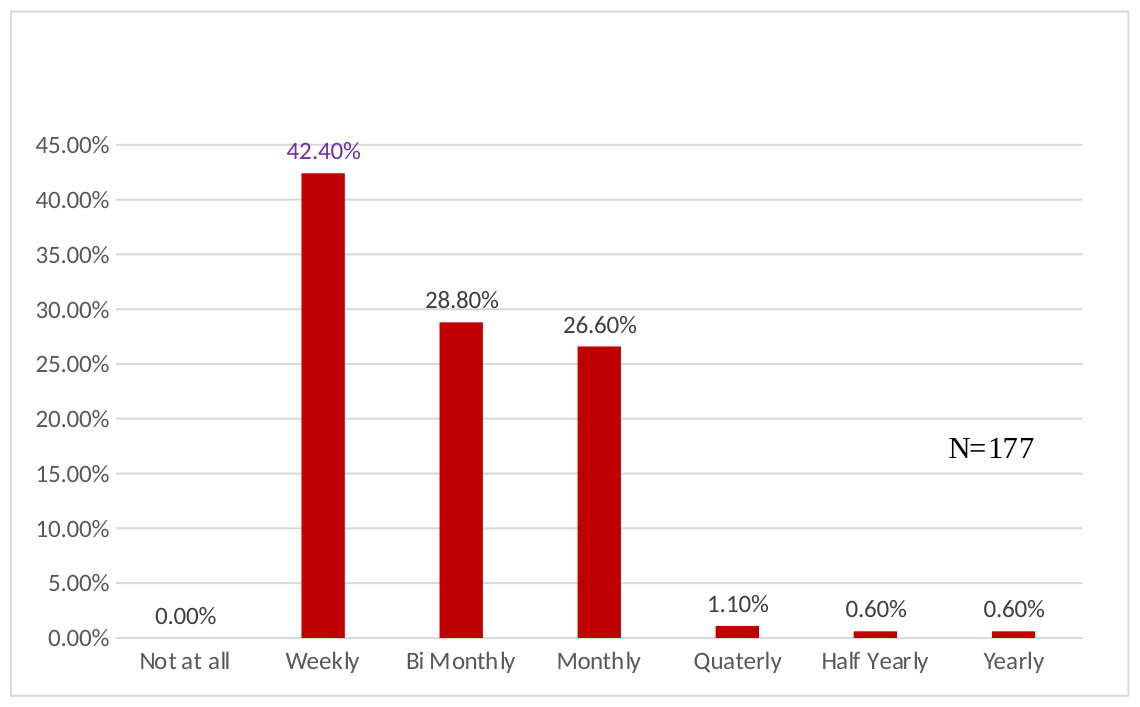
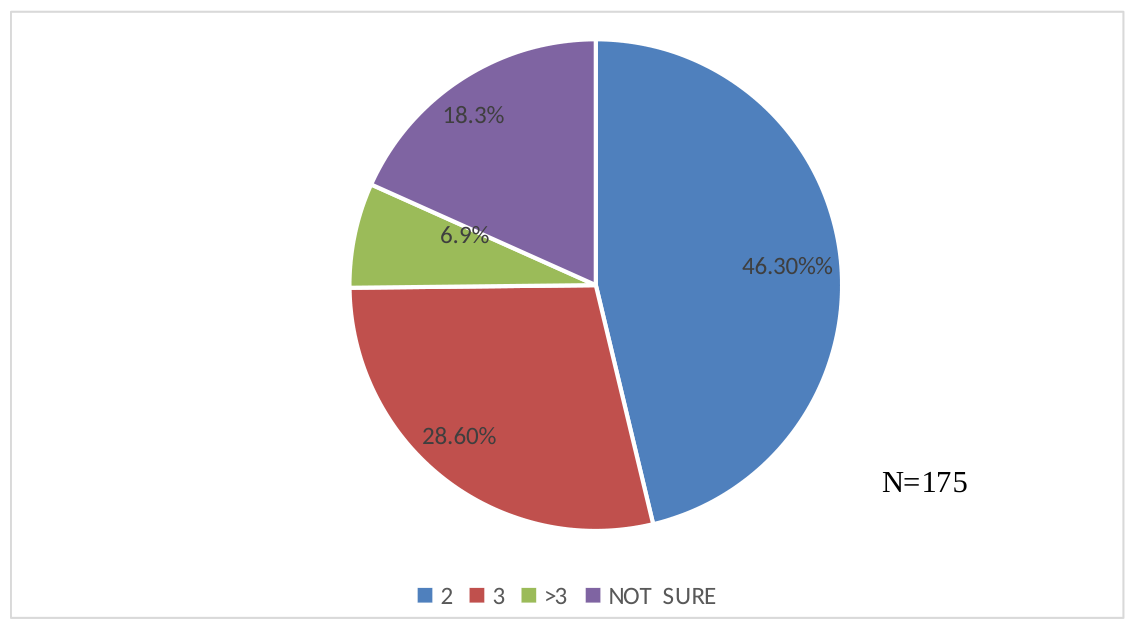
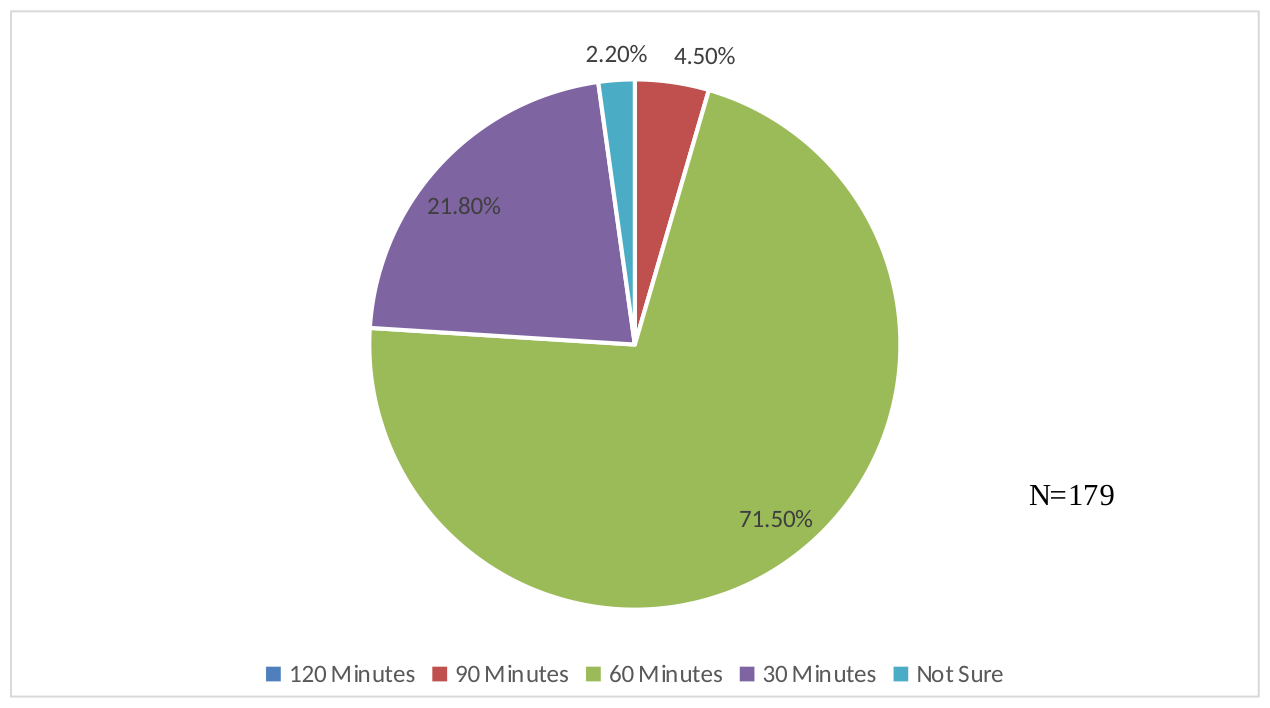
A total of 180 MBBS students participated in this study. Majority of the students (42.40%) were of the opinion that integrated classes should be held weekly followed by 28.80 % bi monthly and 26.60% monthly. (Figure 1) almost half of the participants were of the opinion that 2 departments are ideal for integration followed by 28.6% votes for 3 departments (Figure 2). Almost 3/4th of the participants were of the opinion that integrated classes should ideally be of 60 minutes duration. (Figure 3) Almost 50% of the participants preferred afternoon time to be ideal for such sessions with collective use of power point and blackboard as teaching tool (Table No. 1). Majority of participants opined that such lectures are useful for learning, useful for examination as well as are better than traditional teaching (Table No. 2).
Discussion and conclusion
According to participants integrated teaching is useful for learning and examination as it gives better understanding, broader prospective, better retention and recall, more interesting, less monotonous, more practically oriented as subject is taught by subject experts. It is better than traditional lectures as it gives systematic coverage, with holistic approach. Learning is facilitated as students get to hear views of subject experts in a single session with better correlation between pre-clinical, para clinical and clinical aspects. But on the other hand sometimes lectures becomes longer, and if there is lack of coordination between teachers and departments than it leads to confusion, discontinuity and content overlapping, in addition, there may be problems like time constraints. Also, another issue is that our exam patterns are still based on traditional teaching and this disparity leads to incoherence between integrated lectures and traditional examinations.
Majority of students feel that integrated teaching is a better option as compared to traditional learning, but for it to be useful there should be better coordination between departments and lecturers. Lectures should be short up to may be one hour, held frequently, with 2 departments being ideal at a time. It is better for learning and examination and should be preferred over traditional teaching. Instead of lectures integration in an hour better to keep an integrated week where a particular topic is taught with complete horizontal and vertical integration. Also examination patterns should be modified to match with the concept of integrated lectures.
| Mode of Presentation | Percentage (N=178) | Appropriate Time for Class | Percentage (N=179) |
|---|---|---|---|
| Power Point | 27.5 | Morning Hours | 16.2 |
| Black Board | 7.3 | Afternoon Hours | 49.2 |
| Both | 65.2 | Time Does Not Matter | 34.6 |
| Question | Yes | No | Not Sure |
|---|---|---|---|
Appropriate Topic Chosen (n=175) |
86.3% | 4.0% | 9.7% |
Useful for Learning (n=179) |
84.4% | 1.1% | 14.5% |
| Useful for Examination (n=180) | 58.9% | 7.2% | 33.9% |
| Better Than Traditional Teaching (n=180) | 68.9% | 2.8% | 28.3% |
Acknowledgement
Dean KMC Mangaluru, for permitting the study and Dept of Medical Education, St. John’s National Academy of Health Sciences , Bengaluru for guiding this project.
References
- Abla M. Sibai, Iman Nuwayhid, May Beydoun, & Monique Chaaya. Inadequacies of death certification in Beirut: who is responsible? Bull World Health Organ, 2002; 80 (7).
- Vyas R, Jacob M, Faith M, Isaac B, Rabi S, Sathishkumar S, et al. An effective integrated learning programme in the first year of the medical course. Natl Med J India 2008; 21:21–6.
- Kate MS, Kulkarni UJ, Supe A, Deshmukh YA. Introducing integrated teaching in undergraduate medical curriculum. Int J Pharm Sci Res, 2010;1:18–22.