
1. Introduction
Diatom word comes from Greek: (dia) = ‘through’ +(temnein) = ‘cut’, i.e. ‘cut in half’. Diatomsare microscopic unicellular eukaryotic algal planktonsranging in size from approximately 5 microns to 1000 microns. Firststudy of diatoms was carried out by an unknown
Englishman in 1703. During latter half of the 18th century, many studies on diatoms were carried out and diatoms were classified in to different genera and species.
Studies carried out during second half of the 19th century, revealedthat the diatoms are of great variety and beautifully ornamented unicellular structures having silica shells, In 1904, Hofmann and Roveenstoff detected diatoms from lung and used them as an evidence in solving a mystery of a case and Gregory Popp solved a court case utilizing geological make-up of the soils based on diatoms, in 1949, Tamasaka was the first to detect diatoms in bone marrow (Kumar et al.2011).Over 1 lakh species of diatoms organized to 200 genera have been reported(Round & Crawford ,1990).
In countries like Sri Lanka,U.S.A, California,Spain,France,Italyuse of diatoms in forensics has gainedpopularity. As regards India, the use of diatoms in forensic setup is very limited. A few forensic science laboratories like FSL Haryana, Rajasthan,
Hyderabad,Trivandrum,Punjab,Lucknow,Assam,Madhya Pradeshhave created facilities of forensic diatoms examinations.
For utilizing diatoms evidence effectively forensic investigations data base regarding the types of diatoms in different ecosystemsand seasons is required. Studies have been carried out earlier to generate database of the diatoms found in different water bodies in Karnal, Ambala, Kurukshetra, Jind, Hisar, Mewat, Mahendergarh, Rohtak,Bhiwani districts of Haryana.
In the present study diatoms have been studied in water bodies located in Bhiwani,Yammuna Nagar, Kurukshetra, Gurgaon,Sonipat, Faridabad, Karnal, Mahendergarh, Sirsadistricts of Haryana which were not covered in earlier studies.For this purpose water samples from 24 different water bodies including two rivers,thirteen canals, six ponds,twolakes, oneborewell were collected.
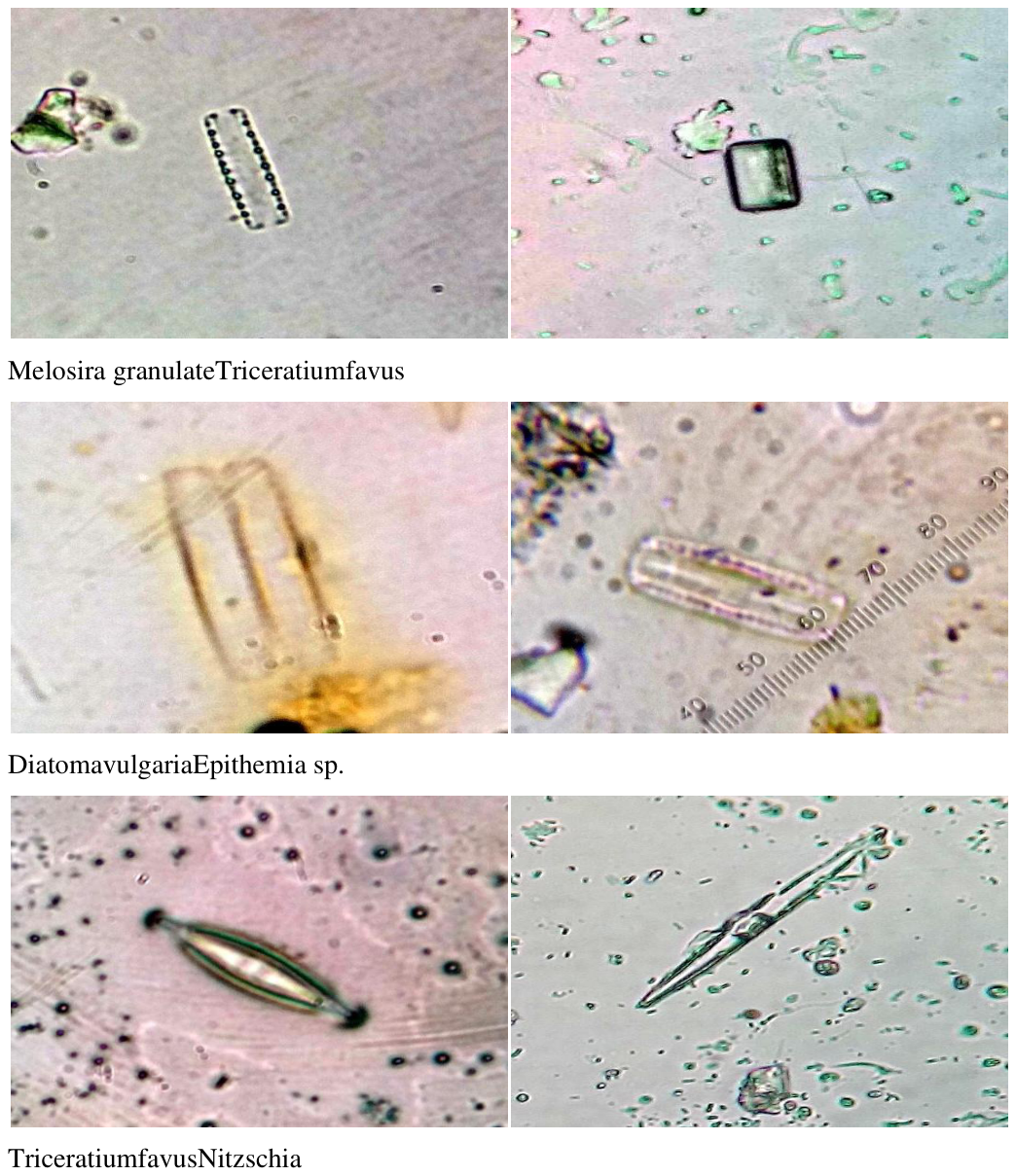
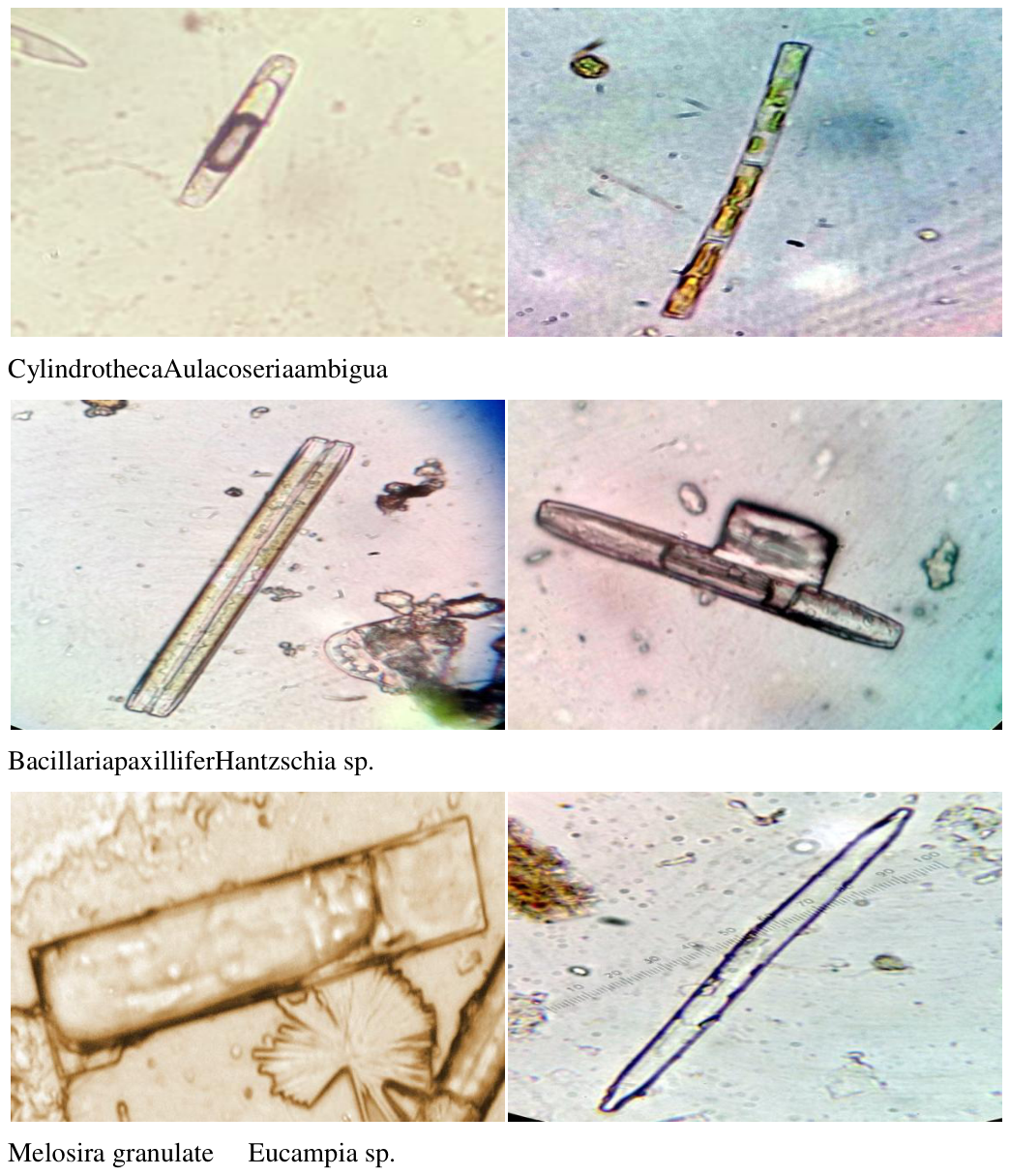
Diatoms were isolated and examined for their morphological types. Sixnew types of diatoms not reported in earlier studies and 33 types of diatoms reported in earlier studies were found.
2. Materials and Methods
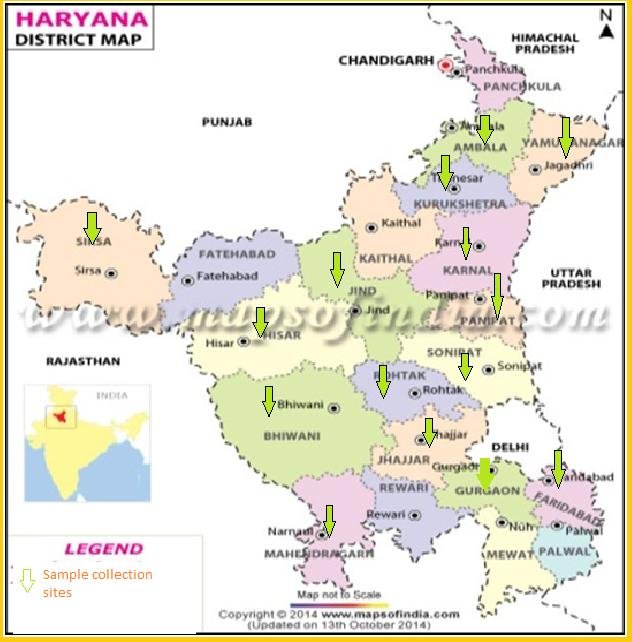
Haryana
Haryana is a northern state of the Indian Union carved out the state of Punjab on Ist November, 1966. Haryana is surrounded by the states of Punjab in the north-west, Rajasthan in the south-west , Himachal Pardesh in the north, Uttar Pardesh and Delhi in the east (Fig 1)
Geographical area and location
Haryana lies between 27.5 and 31 northern latitude and between 74.5 and 77.5 eastern longitude and has a total geographical areas of 42412 sq. km, which is 1.3 percent of the total area of the country.
Physiographic divisions.
Haryana is divided into three physiographic divisions namely ‘ Bagar’, ‘Bangar’ and ‘Khadar’.
The ‘Bagar‘region is the western tract along with yamuna river. The ‘Bangar‘ region is in between these two regions.
Administrative divisions
Administrative Haryana is divided in to two commissionaires namely Ambala and Hissar and 21 districts viz; Ambala, Kurukshetra, Karnal ,Sonipat, Gurgaon, Faridabad, Mahindergarh, Bhiwani, Rohtak, Jind, Hisar, Sirsa,Kaithal,Panchkula, Fatehabad, Jhajjar, Mewat, Palwal, Panipat, Rewari, Yammuna Nagar
Climate and rainfall
Haryana has sub-tropical continental monsoon climate in the Khadar and Bangar regions with average rainfall upto 90.6 cm, whereas in the Bangar region the climate is semi-arid type with average rainfall of 42.2cm.
2.3 Collection of water samples. One liter water from each of the 24 water bodies was collected in leaked proof plastic bottles from 6 cm deep from the surface of water by dipping the bottle in the water. The samples were collected during the month of January to March 2015.
2.4 Laboratory analysis 2.4.1 Treatment of the sample
One bringing the water samples to the laboratory, 10ml Lugol’s iodine solution was added to each sample and kept undisturbed at least over night or till analysis 2.4.2 Isolation of Diatoms
The iodine treated samples were centrifuge at 4000 rpm in 15 ml test tubes. The supernatantwas discarded after of each centrifugation. The sediments in each tube were pooled and again centrifuged. The supernatant was discarded and slides were prepared for each sample from the sediments.
2.4.3 Preparation of slides
A drop of diatom suspension followed by a drop of 10% ammonium chloride solution was placed on cleaned microscopic slide and covered with coverslip and kept in room temperature for drying overnight.
To remove excess moisture the slide was placed on a hot plate at 100°C for 5 minutes to drive off the excess moisture.
After cooling the coverslip was removed and a drop of DPX mount ant solution was placed onto the slide and covered with cover slip.
On drying (after 15-20 mints), the slides were examined at 40x and 100x magnifications.
Each slide was thoroughly examined moving horizontally and vertically and the different types of diatoms scene were photographed
| GENERA | REFERANCES |
|---|---|
| Cymbella,Coscinodiscus,Pinularia, Navicula, | Kumar et. al., 2012 |
| Aulacoseira, Cyclotella, Cymbella, Gonaphoneme, Synedraulna, Tabularia, Fragillaria, Placoneis | Vinayak et. al., 2012 |
| Achnanthes,Actinocydus,Aulacoseira,AmphoraAsterionella Brachysira,Caloneis,CapartogrammaCatenula,Cocconeis Coscinodius,Craticula,CyclotellaCymatopleura,Cymbella Denticula,Diatoma,Didmosphenia,Diploneis,Entomoneis Epithemia,Eunotia,Fragilaria,Frustulia,Gomphonema Gomphoocymbella, Gyrosigma,Hantzschia,Licmophora Luticola,MelosiraNavicula,Neidium,Nitzschia,Opephora Pinnularia,Surirella,Placoneis,Pseudostaurosira,Reimeria Rhoicosphenia, Rhopalodia,Sellaphora,Staurosira,Synedra Tabularia,Thalassionema,Thalassiosira | Vinayak et. al., 2013 |
| Achnanthes,Achnantheslanceolata,Achnanthessp.,Achnanthesandicola Aulacoseriaambigua,AsterionellopsIs,Actinocydus,Actinocylus,Bacillaria, Bacillariapaxillifer,Cocconeis,Cymbella,Cymbellasp.,Cymbellaaffinis Cylindrotheca,Cyanobacteriumanacystis,Chaetoceros,Diatomamesodon Diatomavulgeria,Diploneisfinnica,Eunitia,Eucampiasp.,Ellerbeckia Epithemiasp.,Hantzschiasp.,Melosira,Melosiragranulate,Navicula Naviculasp.,Naviculaoblonga,Nupela,Nupelafennica,Nitzschia Nitzschiacommunis,Nitzschiadubia,Nitzschiaoblonga,Opephorepacifica Pinnularia,Psammothediumdaonense,Reimersa,RhizasoleniaStephanocyclus Surirella,Triceratium,Triceratiumfavuas,Triceratium sp. | Present study 2015 |
| Aulacoseira,Amphora,,Asterionella,Brachysira,Caloneis, Capartogramma,Catenula,Coscinodius,Craticula,Cymatopleura, Didymosphenia, Entomoneis,Frustulia,Gomphonema, Gomphocymbella,GyrosigmaLicmophora, Luticola, ,Pseudostaurosira, Rhoicosphenia, RhopalodiaPlaconeis Sellaphora, | Diatoms not reported in present study. |
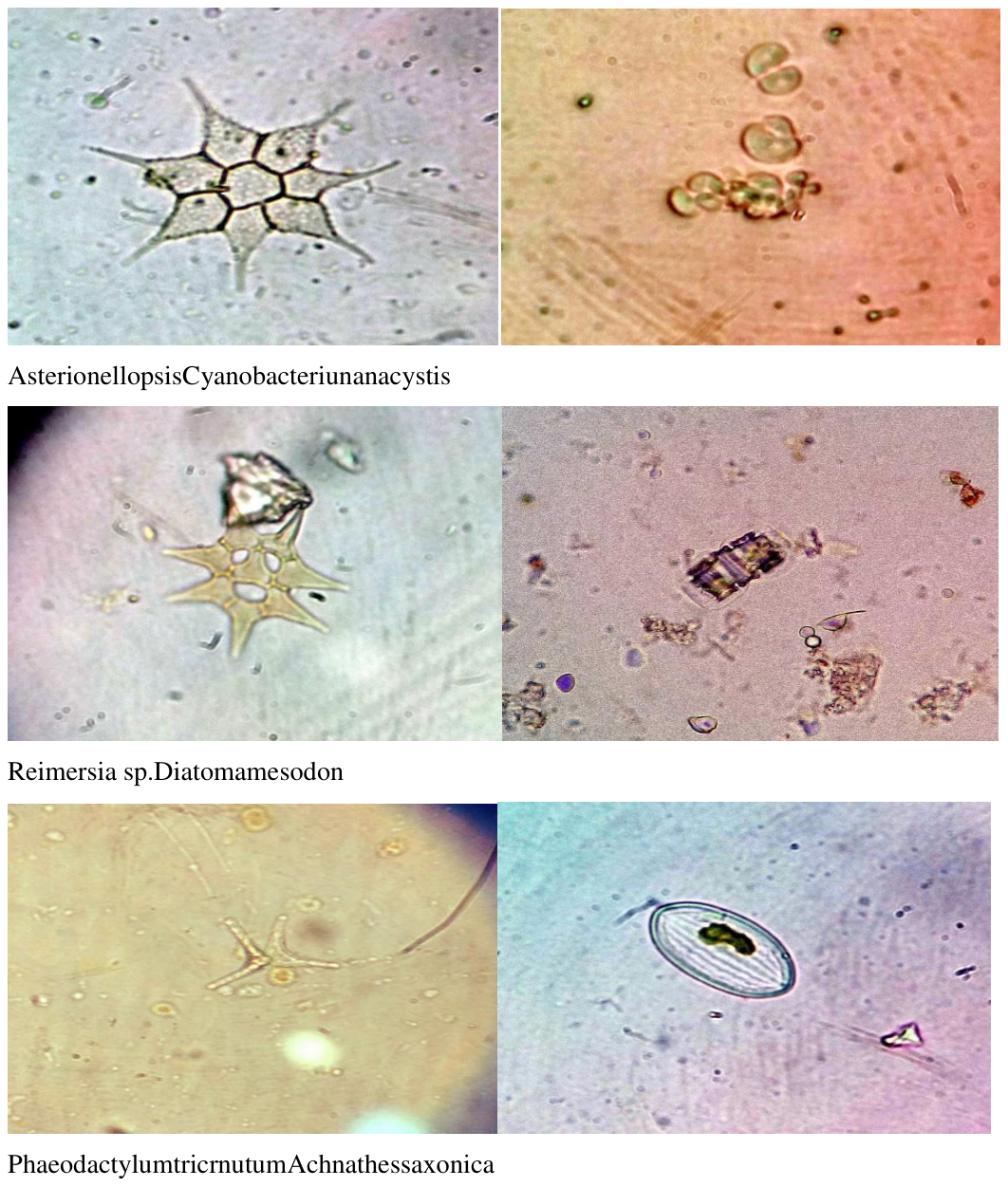
| Asterionellopsis,Cyanobacteriunanacystis, Reimersia sp., Diatomamesodon, Phaeodactylumtricrnutum, Achnathes saxonica | Diatoms not reported in earlier studies but discovered in present study |
Note (i)- Diatoms not discovered in present study are shown in bold letters
Note (ii) Diatoms shown in Italic letters were not reported in earlier studies and discovered in present study
| SR.NO | LOCATION | NO. OF DIATOMS DETECTD | REFERANCES |
|---|---|---|---|
| 1. | Barwasni | 8 | Present study |
| 2. | Malhana | 4 | Present study |
| 3. | Bala | 4 | Present study |
| 4. | Narela | 5 | Present study |
| 5. | Kakroi | 6 | Present study |
| 6. | Bawana | 4 | Present study |
| 7. | Sirsa | 6 | Present study |
| 8. | Saniana | 6 | Present study |
| 9. | YammunaNagar | 9 | Present study |
| 10. | MaanSarover (Kurushetra) | 7 | Present study |
| 11. | KhubruNehar(Ganur) | 5 | Present study |
| 12. | SanhitSarover (Kurushetra) | 9 | Present study |
| 13. | BhismaKund (Kurushetra) | 5 | Present study |
| 14. | Bragma Canal(Kurushetra) | 5 | Present study |
| 15. | Jyotiser (Kurushetra) | 5 | Present study |
| 16. | Damdma Lake(Gurgaon) | 15 | Present study |
| 17. | Mimarpur(Sonipat) | 9 | Present study |
| 18. | Agra Canal(Faridabad) | 4 | Present study |
| 19. | Sonipat pond | 4 | Present study |
| 20. | Sonipat ground water | 5 | Present study |
| 21. | Karnal | 6 | Present study |
| 22. | Bhiwani | 5 | Vinayak et. al., 2013 |
| 23. | Brahma Sarover (Kurushetra) | 12 | Vinayak et. al., 2013 |
| 24. | Mahandergarh | 4 | Vinayak et. al., 2013 |
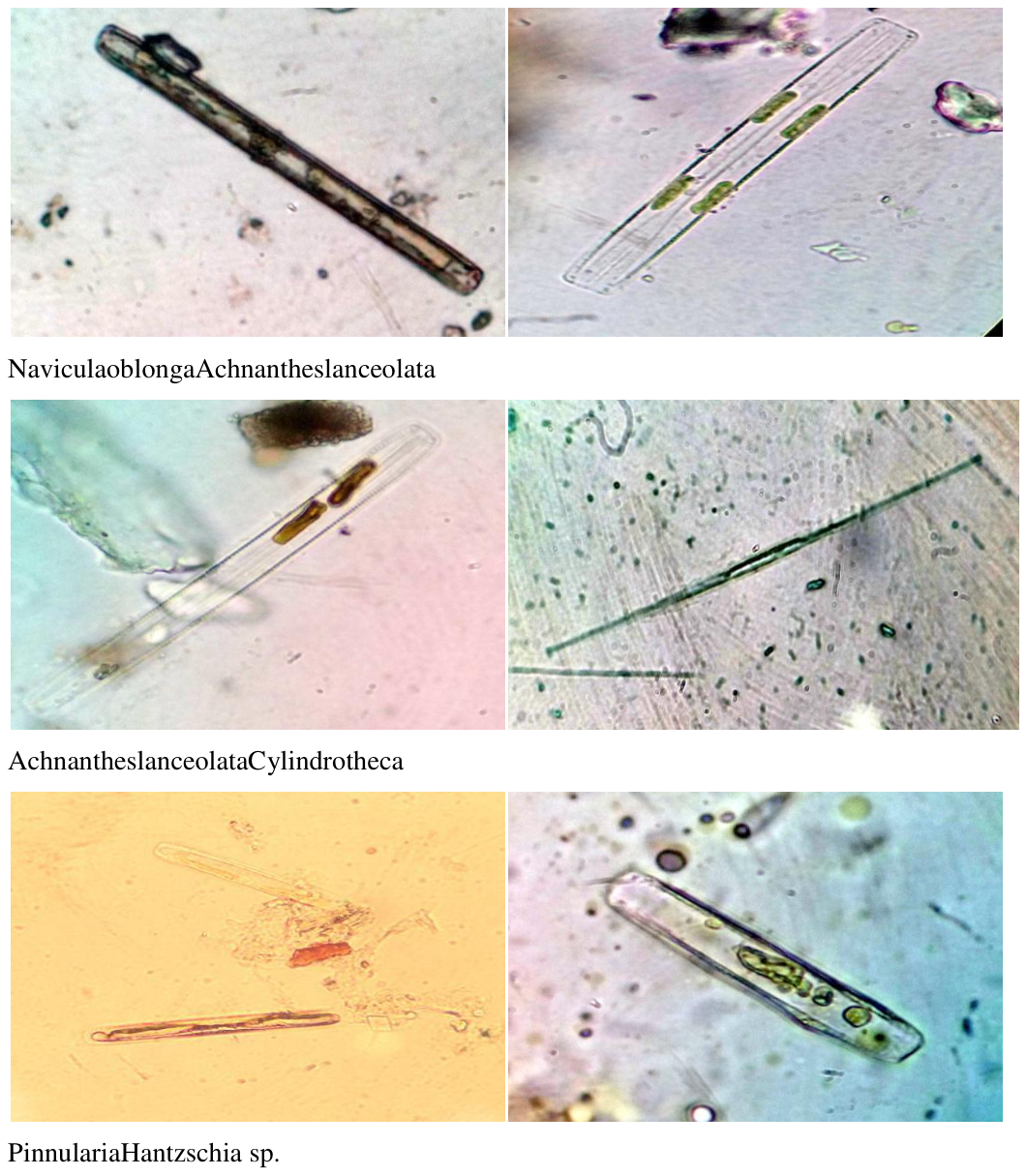
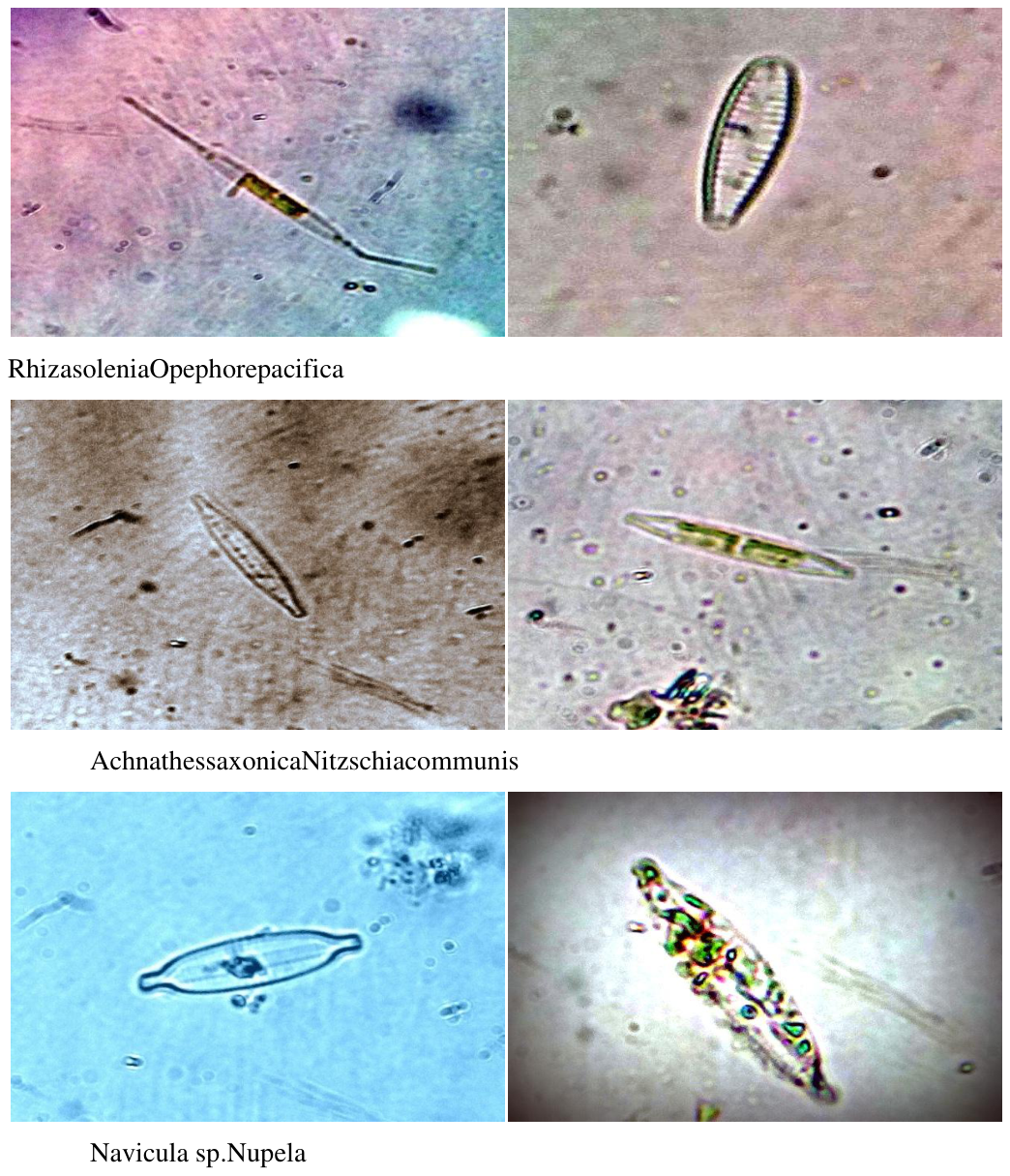
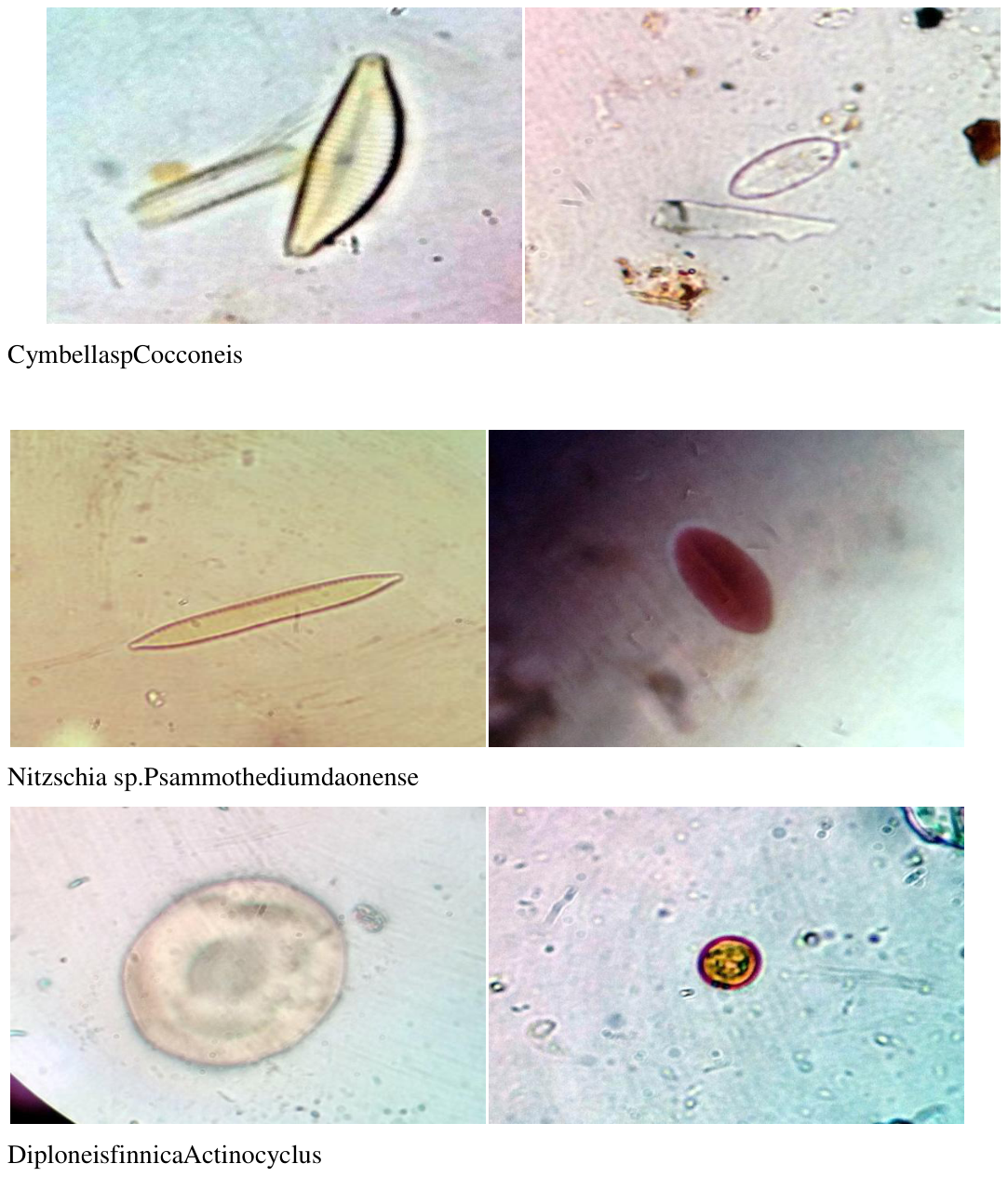
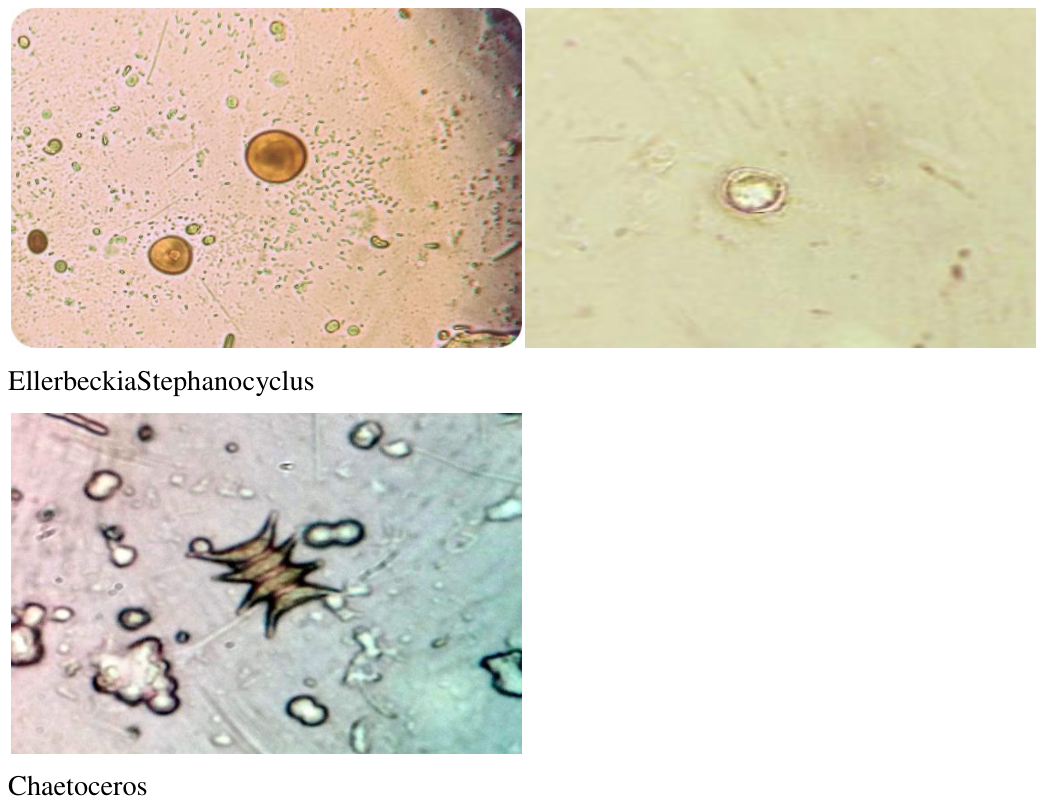
Results and Discussions
As shown in table 2,the number of different types of diatoms discovered in present study are varies from 4 to 15 where as in earlier studies this number varies from 4 to 12 (Vandna V2012,2013)It was also observed that diatoms found in lake water were different from those found in canal and other water bodies. It was further observed that diatoms composition at different sites of a canal differs.In canal the diatom belonging to genera Triceratium, Nupela, Navicula, Cylindrotheca, Cymbellaspwere in majority.These observations conforms that the types diatoms are site specific.
In all the water bodies studied the diatoms discovered belonged to order pinnate.
Around 60% of total diatom composition containedNavicula,Neidium, Cymbella types and only around 2% were Eunotia,Hantzschia,Surirella types.
Interestingly, six new types of diatoms belonging toAsterionellopsis,Cyanobacteriunanacystis,Reimersia sp., Diatomamesodon,
Phaeodactylumtricrnutum, Achnathessaxonicawere discovered in present study.Discovery of these new types of diatoms in present study extends furthers scope of diatom logical studies in other water bodies of Haryana and also in different seasons. Building up location wise and season wise diatom logical data would help in forensicanalysis and interpretation of the results.
Acknowledgements
We are thankful to Director and other senior authorities of LNJN NICFS for their kind permission to carrying out present study and allowing to use the laboratoryfacilities for the same.
References
- Kumar A, M. M. (2012). Reported Drowning Cases from Variouse Districts of State Haryana (India). New York Science Journal; , 5(2):39-44.
- Round, F.E., & Crawford,R.M.,(1990).. The Diatoms- Biology & Morphology of the genera, Cambridge University Press.Reprinted 2000.
- Vinayak V, Goyal M. K & Mishra V. (2012;). New Genus and Species of Diatom Endemic in Lake Rani of Haryana(India). Open Journel of Modern Hydrology , (2):9-105.
- Vinayak V, Mishra V, Goyal MK (2013) Diatom Fingerprinting to Ascertain Death in Drowning Cases. J Forensic Res 4: 207.