
Never doubt that a small group of thoughtful, committed citizens can change the world; indeed, it's the only thing that ever has.
— Margaret Mead
PROLOGUE
Chapter 1 : The Living Daylights
On the eve of new year, 31st Decemeber 2010, as I was celebrating a decent night waiting for 12 AM , I came across a new guest; a leading MBBS practitioner from my home town. Our routine introductions went well, and naturally as I was preparing for my Post graduate exams which were due next month, the gentleman asked me, what was the subject I would be opting for. Quite naturally I replied Forensic Medicine. He was quite surprised and strongly adviced me not to take it up as the medical council of India had released vision 2015 earlier in 2010, where they would scrape off Forensic Medicine from the Indian MBBS Undergraduate Curriculum. I gave him a smile and told him this is 2010 and we are still 5 years away from their vision. As our conversation proceeded, he hesitantly asked me “ Doctor, what is the meaning of Forensic? Does it mean Dead body ? I was dumb-struck with this first encounter in my life with such a senior Doctor. Who ever he was, he did scare The Living Daylights out of Me.
Chapter 2 : The Metamorphosis
From a batch of 100 that I studied during my MBBS days, I had set my priority to take up Forensic Medicine way back in 2007. And then invoked 4 others. This was the first time in the history of Medical colleges in my home town that 5 students chose Forensic Medicine. The question now arises as to why ? The five of us formed a team and named it The RAW-Medicos. In expansion Research Analysis Wing-Medicos. We conducted a survey from 200 students who were in their final year and third year. The question was a straight forward single question. What is the meaning of Forensic ? The survey was conducted at an instance without any time for them to think or google it on their phones. Statstical analysis came out as follows : ( The words at verbatim were analysed)
75 % - Post Mortem
10% - Legal
15% - DNA and lab tests
As one can notice, this is the status as of 2011 about the MBBS student’s understanding about the word “Forensic”. Needless to say or bother surveying in depth knowledge of rest of the subject. However, Metamorphosis has taken place from two ends. On one end the students have absolutely not comprehended the subject. On the other end a small group of 5 sprung transforming from decent human beings to Raging bulls, set out on a mission to uplift the subject by searching for the confounding factors that are leading to this drastic outcome.
Chapter 3 : The Departed
Not to be taken in its literal sense, but it is the only word that I can find apt. The dead speak a thousand words. But the living have not found even a hundred to teach the subject in a dynamic way. Hence I flambuoyantly pronounce that most of or so called Forensic Medicine Experts who are into teaching are the departed as they have failed to do their job. This failure has lead to a great decrease in number of graduates taking up this subject in India and thereby a severe shortage of qualified Forensic Pathologists.Having said so, the minds of the society have also departed. Flooding the minds of MBBS graduates about the social stigma, fear of not getting a bride and so on making them feel disgusted and imbibing the purposelessness of the profession. The other side of the coin are the people who take this subject in India just for fun as it is easy to clear the examinations and display an “MD” title. While in reality they are absolutely clueless of the subject and run their private hospitals or clinics , but are never around the Forensic side. This once again is adding up to the dearth we are facing in India and is quite rampant. This saga of the Departed will continue unless a giant step is taken to prevent this. So, how can we practically implement this? vide infra Chapter 6.
Chapter 5 : Jumping on the Band wagon
We have been reading all this while in India the conventional and highly popular books and considered the information to be the gospel of truth. As Osho Rajneesh quoted “A lie told over a million years becomes not just the truth,but the absolute truth”. Where as now people after being challenged on open forums are either not able to answer the questions put forward by a few challenging pathologists who were formely subdued or resort to forwarding the question to a Lawyer who will nail the question by providing references proving that our old conventional Indian Textbooks are conveying wrong information.The hilarious part is the so called new editions of these books are just a color change of their cover page. So it is time to Stop jumping on the band wagon and look at the newly releasing textbooks. The one especially by our Editor in Chief.
Chapter 6 : The League of Extraordinary Gentlemen
Let us now look at a few people who are genuinely trying to revive this subject in different angles. Firstly Dr.V.V Pillay whom I personally regard as the modern pioneer of toxicology in India. With constant effort he succesfully set up a Private Poison Control Centre in 2012 which provides not only telephonic advice with regard to treatment but also is equipped with a Chemical analysis Laboratory which the Poison Information centres lack in India. Further he successfully set up a Clinical Forensic Medicine unit which handles the Medicolegal cases. This CFMU was also implemented by Dr.K.Indrajith In Maharashtra, who gallantly exposed the wrong ways of medicolegal work carried out by Non-Medicolegal Experts. And after constant appeals with the high court got it implemented which revolutionized things. These Extraordinary gentlemen and a few more have saved our subject and successfully scraped off MCI’s Vision 2015. Keeping aside the Field agents, let us now focus on our very own extraordinary gentleman Dr.Anil Aggrawal, his website on side has provided so much useful information on various aspects and also the Internet Journal run by him. The point of highlight here is its available for the user for free without any hassles. These kinds of generous attempts keeps the lives of many thriving Forensic Pathologists progressive. And at the end of all this his Textbook of Forensic Medicine and Toxicology which was released in 2014 has again revolutionized the minds of traditional Forensic pathologists. The only book which has challenged all outdated information and covered the gray areas in particular which has shadowed most forensic fraternity ever since the release of Modi’s Text Book of Medical Jurisprudence. The List is merely endless and I salute them all for keeping the subject alive. If we join hands with these extraordinary gentlemen the subject will once again flourish and reach out deep into the minds of the people.
Chapter 7 : Strategic Approach to improvize the subject and ourselves
In 2011, Dr.V.V Pillay forwarded an excellent bill called the FRDA BILL in expansion Forensic Regulatory and Development Authority of India Bill 2011. The contents Briefly are as follows :
a. Ensuring effective and uniform training, especially at postgraduate level
b. Emphasis on knowledge, competence and skills (and not just qualifications,
seniority, or experience gained by seat warming)
c. Emphasis on accountability
d. Mandatory accreditation of institutes and individuals
e. Strict implementation of code of ethics
f. Penalty for negligence, malpractice and corruption
g. Availability of funds for upgradation of facilities
h. Grants for genuine research
In 2014 With the joint collaboration between National Action Committee for Progress of Forensic Medicine and Toxicology (NACPFMT) & Indian Academy of Forensic Medicine have proposed & Drafted a Minimun Standard Requirements, Graduate Medical Education Bill, Post Graduate Medical Education Bill for Forensic Medicine and Toxicology to the Medical Council of India, which is elaborated below
Undergraduate Medical Education Program in Forensic Medicine & Toxicology
Course Curriculum
Semester III (Total 30 hours)
Topics & Themes
I. Legal Procedures
• Define Courts in India and their powers: Supreme Court, High Court, Sessions Court,
Magistrate’s Court, Labour Court, Family Court, Executive Magistrate Court, Juvenile Court
• Describe Court procedures: summons, conduct money, oath, solemn affirmation, types of
witnesses, recording of evidence, conduct of medical practitioner/medical officer in witness box
• Outline offences in Court: perjury; court strictures vis-à-vis medical officer
• Demonstrate medical certification and drafting of medicolegal reports:
o maintenance of patient case records, discharge summary, prescribed registers to be
maintained in health centres
o maintenance of medicolegal register (e.g., accident register)
o issuance of wound certificate
o issuance of drunkenness certificate
o Issuance of sickness/ fitness certificate
o Procedure for issuance of death certificate: Medical Certification of Cause of Death -
Form No.4 and 4A
o Estimation of age by physical, dental and radiological examination, and issuance of
certificate
o Dying declaration
II. Identification
• Define ‘Identification’ and list the medicolegal aspects related to age
• Outline the principles involved in the methods of identification of an unknown living/ dead person
by age, sex, stature, scars, moles, tattoos, dactylography, foot prints, hairs, poroscopy, DNA
typing, photography and superimposition technique, dental examination including forensic
odontology
• Outline the procedure and medicolegal formalities of exhumation
• Develop skills in the examination of mutilated human remains and skeletal remains.
III. Death and its medico legal aspects
• Define death and its types: somatic, cellular and brain-death.
• Differentiate and list natural and unnatural deaths
• Explain issues related to sudden natural deaths; anaesthetic & operative deaths
• Outline the salient features of organ transplantation in relation to The Human Organ Transplant
Act 1994. Discuss ethical issues.
• Describe and exemplify the conditions of suspended animation.
IV. Postmortem changes
• Describe cooling of body, lividity, rigor mortis, cadaveric spasm, cold stiffening and heat stiffening
• Describe putrefaction, mummification, adipocere and maceration,
• Estimate time of death by various features and methods
V. Medicolegal autopsy
• Define medicolegal and clinical/pathological autopsies
• Describe the objectives, procedures and formalities of medicolegal autopsies, including the
National Human Rights Commission Protocol
Semester IV (Total 40 hours)
Topics & Themes
I. Medical law and ethics
• Medical Jurisprudence
o Definition and differentiation of forensic medicine and medical jurisprudence.
o Explain medical negligence: civil and criminal negligence, contributory negligence,
vicarious liability, res ipsa loquitor, prevention of medical negligence, and defence in
medical negligence litigations
o Explain Indian Medical Council (MCI) and State Medical Councils (SMC); Provisions of
the Medical Council of India Act 1956; Registration of a medical practitioner – procedure;
functions and disciplinary control of MCI and SMC.
o Describe the Consumer Protection Act, 1986; medical indemnity insurance; civil
litigations and compensations
o Describe the legal and ethical aspects of
• Euthanasia
• HIV and Law
• Stem cell research and cloning
• Social aspects and stress management in dealing with medicolegal cases
o Outline the social aspects of medicolegal cases with respect to victims of assault, rape,
attempted suicide, homicide, domestic violence, dowry-related cases
o Outline the challenges in managing medicolegal cases
• Develop skills in relationship management – human behaviour, communication
skills, conflict resolution techniques
• Outline the principles of handling work pressure – definition, types, causes,
sources and skills for managing pressures while dealing with medicolegal cases
by the medical practitioner/medical officer
• Bioethics
o Define medical ethics and outline its historical evolution
o Explain ethical principles: Respect for patient autonomy, non-malfeasance, beneficence,
justice
o Explain various Oaths – Hippocrates, Charaka and Sushruta; Modified Declaration of
Geneva and its relevance; Procedure for administration of Oath – Code of Medical Ethics
2002
o Describe codes of conduct, professional conduct, etiquette and ethics in medical practice
o Enumerate and explain the rights, privileges and duties of a registered medical
practitioner, disciplinary proceedings in professional misconduct, and penal erasure.
o Explain medical practitioner/medical officer-patient relationship: professional secrecy,
privileged communications
o Discuss the rights of a patient
o Explain the legal issues of informed consent:
• Types of consent and ingredients of informed consent
• Age in relation to consent
• Consent In relation to mental illness and alcohol intoxication
• Consent in emergency situations
o Ethical dilemmas in medical profession in relation to consent, treatment and death
• Clinical research & ethics
o Human experimentation, including clinical trials
o Constitution and functioning of ethical committees
o Ethical guidelines for biomedical research on human subjects & animals
II. Torture and Human Rights
• Define and explain issues relating to torture
• Identify injuries caused by torture and its sequelae
• Management of torture survivors
• Outline the National Human Rights Commission guidelines and protocols
III. Mechanical injuries
• Define, classify and differentiate – abrasion, contusion and laceration
• Differentiate simple from grievous injuries
• Describe stab wound, incised wound, defence cut, hesitation cuts, self inflicted injuries and
fabricated wounds
• Differentiate between accidental, suicidal and homicidal injuries.
• Identification of the weapon by interpretation of the wound
• Explain the causes of death in mechanical injuries
• Determine the age of injury
• Classify firearms and interpret the findings of firearm wounds.
• Explain the medicolegal aspects of wounds.
IV. Regional injuries
• Injuries of head, neck, thorax, abdomen, pelvis, genitalia, vertebral column and other bones
o Enumerate and describe types of skull fracture
o Explain coup and contre coup injuries, intracranial haemorrhages, and injury to brain
o Explain injuries to spine and spinal cord, thoracic, abdominal and pelvic viscera, bones
and joints, and their medicolegal importance
V. Transportation injuries
• Road, rail & aviation injuries
o State the importance of primary, secondary and tertiary impact injuries, crush syndrome
o Outline the medicolegal importance of investigation of road, railway and aircraft accidents
VI. Injuries/ death due to heat, cold, electricity, lightning, explosives & radioactive substances
VII. Medicolegal management of mass disasters including chemical and bioterrorism
Semester V (Total 40 hours)
Topics & Themes
I. Mechanical asphyxia
• Define, state causes, enumerate types and describe postmortem appearances and medicolegal
significance of hanging, strangulation, suffocation, traumatic asphyxia and drowning.
II. Virginity, pregnancy and delivery
• Describe sexual and reproductive rights of women in India
• Describe medicolegal aspects of virginity, pregnancy and delivery
• Explain legitimacy and medicolegal aspects of pregnancy and delivery, including in-vitro
fertilisation and surrogacy
• Outline medicolegal aspects of reproductive medicine
o Impotence
o Infertility – Male and Female
o Assisted pregnancies and legal problems, surrogate motherhood, hormone replacement
therapy and postmenopausal pregnancies
• Explain principles of protection of women from domestic violence with particular reference to the
Domestic Violence Act 2005
• Discuss principles of Pre-Conception and Pre-Natal Diagnostic Techniques (PCPNDT)
(Prohibition of Sex Selection) Act 2003
III. Sexual offences
• Describe the medicolegal aspects of sexual offences and outline sexual paraphilias
• Explain the objectives and procedure of examination of victim and accused in cases of sexual offence.
IV. Abortion
• Define and classify abortion.
• Describe Medical Termination of Pregnancy Act, 1971 with amendment.
• Enumerate complications of criminal abortion
• Outline investigative procedure in deaths due to criminal abortion
V. Infant and childhood deaths
• Define still-born, dead-born and live-born child
• Describe the signs of still-born, dead-born and live-born child
• Describe the estimation of age of foetus
• Describe sudden infant death syndrome
• Explain child sexual abuse and its medicolegal implications
VI. Laboratory investigations in medicolegal practice
• Different types of specimens and tissues to be collected in medicolegal cases for investigative
purposes from living persons/ dead bodies
o Body fluids - blood, urine, semen, vaginal smear, saliva, viscera, skull, specimens for
blood grouping & DNA analysis, specimens for histopathological examination
o Methods of sample collection, preservation, labelling, dispatch, and interpretation of
reports
VII. Emerging technologies in Forensic Medicine
• Outline the principles, reliability and medicolegal importance of:
o DNA typing
o Polygraph (Lie Detector)
o Narcoanalysis
o Brain mapping
o Digital autopsy
o Virtual autopsy
o Imaging technologies
VIII. Forensic Psychiatry
• Classify common mental illnesses including post traumatic stress disorder (PTSD) as per DSM or
ICD systems
• Define, classify and exemplify – delusions, hallucinations, illusion, impulse control and obsessive
compulsive disorders, delirium, lucid interval.
• Describe the civil and criminal responsibilities of a mentally ill person
• Differentiate true insanity from feigned insanity.
• Certification of ‘Insanity’
• Explain testamentary capacity and methods of restraint of an insane person.
• Outline the Indian Mental Health Act, 1987 with special reference to admission, care and
discharge of a mentally ill person.
Semester VI (Total 40 hours)
Topics & Themes
I. General Toxicology
• Describe the general principles of diagnosis and management of common poisonings
encountered in India
o General symptoms of poisoning, simple bedside tests to detect poison/drug in a patient’s
body fluids, basic methodologies in treatment of poisoning: decontamination, supportive
therapy, antidotal therapy, procedures of enhanced elimination, etc.
• Explain the medicolegal considerations in cases of suspected poisoning
o Procedure of intimation of suspicious cases or actual cases of foul play to the police,
maintenance of records, preservation and despatch of relevant samples for laboratory
analysis.
• Outline the general principles of analytical toxicology
o Brief description of common bedside tests in toxicology
II. Chemical Toxicology
• Describe the clinical features, fatal dose, management, postmortem appearances and
medicolegal aspects of poisoning by:
o Caustics
• Inorganic – sulphuric, nitric, & hydrochloric acids
• Organic – carbolic acid (phenol), oxalic, and acetylsalicylic acids
o Inorganic elements
• Phosphorus, iodine, barium
o Heavy Metals
• Arsenic, lead, mercury, copper, iron, cadmium, thallium
o Alcohols
• Ethanol, methanol, ethylene glycol
o Hydrocarbons and Pesticides
• Kerosene, petrol, benzene, methane, turpentine
• Organophosphates, carbamates, organochlorines, pyrethroids, paraquat,
aluminium and zinc phosphide
o Toxic Gases
• Ammonia
• Carbon monoxide
• Hydrogen cyanide & derivatives, methyl isocyanate, tear (riot control) gases
III. Pharmaceutical Toxicology
• Describe the clinical features, fatal dose, management, postmortem appearances and
medicolegal aspects of poisoning by:
o Antipyretics – paracetamol, salicylates
o Anti-Infectives: Common antibiotics – an overview
o Neuropsychotoxicology: Barbiturates, benzodiazepines, phenytoin, lithium, haloperidol,
neuroleptics, tricyclics
o Narcotic Analgesics, Anaesthetics, and Muscle Relaxants
o Cardiovascular Toxicology
• Cardiotoxic plants – oleander, odollam, aconite, digitalis
o Gastro-Intestinal and Endocrinal Drugs – insulin
IV. Biotoxicology
• Describe the clinical features, fatal dose, management, postmortem appearances and
medicolegal aspects of poisoning by:
o Poisonous Plants: Castor, croton, calotropis, abrus, datura, strychnos
o Food Poisoning & Food Adulterants: Bacterial, viral, chemical food poisoning, toxic
mushrooms and fish, argemone
o Venomous Bites and Stings: Snakebite, scorpion sting, bee & wasp sting, spider bite.
V. Sociomedical Toxicology
• Describe the clinical features, fatal dose, management, postmortem appearances and
medicolegal aspects of poisoning by:
o Substances of dependence and abuse: Tobacco, cannabis, amphetamines, cocaine,
hallucinogens, designer drugs & solvent abuse
• Salient features of NDPS Act.
Course duration
A total teaching time of 150 hours may be allotted for transacting Forensic Medicine &
Toxicology curriculum over 4 semesters (3rd to 6th semester)
Methods of assessment
Internal assessment programme:
1. Periodic objective/problem based tests – One at the end of each semester
2. Activity – Case studies/ Seminars/ Individual and group assignments
3. Practical Assessment
4. Structured Oral Viva Voce
5. Internal Assessments (a minimum of 3 in number) should be held ( I- end of 4th sem, II- end of 5th sem, Prelim-end of 6th sem)
Evaluation
At the end of the sixth semester of MBBS, two papers of University theory examination, one
practical examination and viva voce must be conducted.
Paper 1 – Forensic Medicine and Forensic Psychiatry – 3 hours
Paper 2 – Medical Jurisprudence and Toxicology – 3 hours
Details of Assessment: Marks
University Theory Paper 1 - 80 (Forensic Medicine 70 + Forensic Psychiatry – 10)
University Theory Paper 2 - 80 (Medical Jurisprudence 30 + Toxicology – 50)
University Practical Examination – 80 Viva Voce – 20
Internal Assessment - Theory 20 Practical 20
TOTAL 300
Assessment methods must include essay questions, short answer questions, MCQs,
problem solving exercises, objective and structured clinical examination (OSCE), objective and structured practical examination (OSPE), microscopic examination, records review, and structured oral viva voce.
In practical examination, the distribution of marks shall be as follows (each carrying 10
marks):
i Age estimation of subject or on the basis of X-rays & issuance of age certificate
ii. Examination and report on skeletal remains
iii. Medical certification of cause of death
iv. Sickness and fitness certification
v. Examination and certification of injured person
vi. Examination of a case of drunkenness
vii. Problem solving exercise based on medicolegal autopsy report
viii. Problem solving exercise of a case of poisoning
The marks obtained in the internal assessments should be considered along with the final marks obtained in the theory and practical examination.
A candidate must obtain 50 percent in aggregate, with 50 percent in Theory + Viva Voce
(minimum of 40% in theory), & 50 percent in practicals.
Internship
Compulsory internship posting of 15 days to the department of Forensic Medicine & Toxicology
The posting should include working in the mortuary, casualty, handling clinical forensic medicine
cases and attending court. During the posting, the candidate should assist minimum of TWO
medicolegal autopsies, and perform ONE medicolegal autopsy under guidance. Medical
colleges not having autopsy facilities can depute the interns to the nearest Govt Medical
College.
Post Graduate Medical Education program
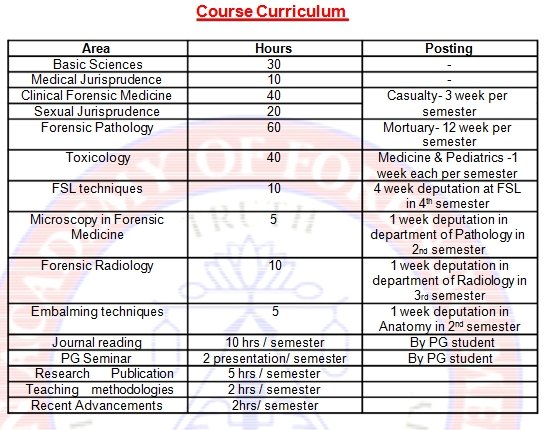
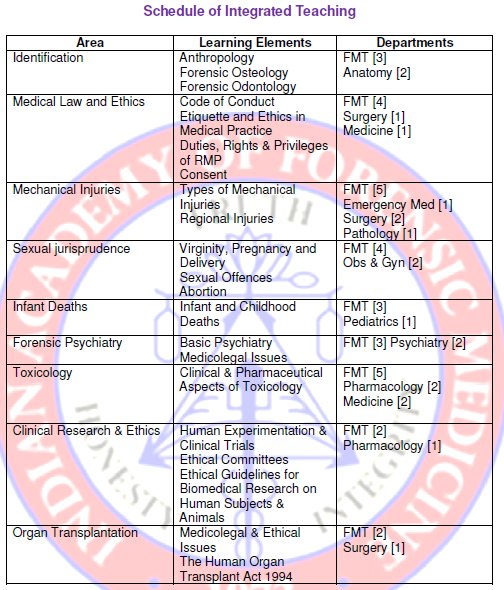
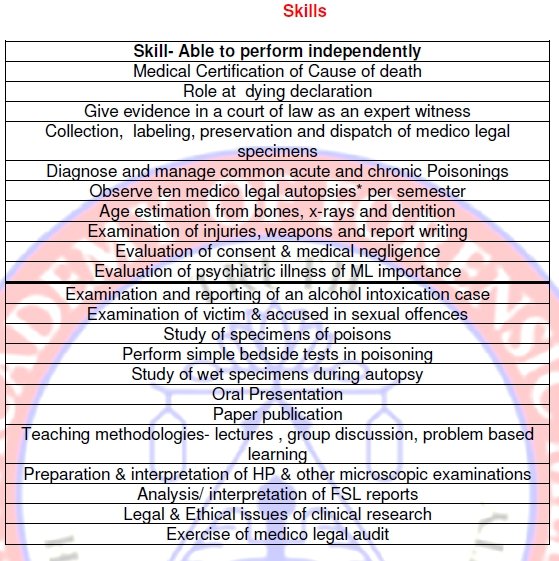
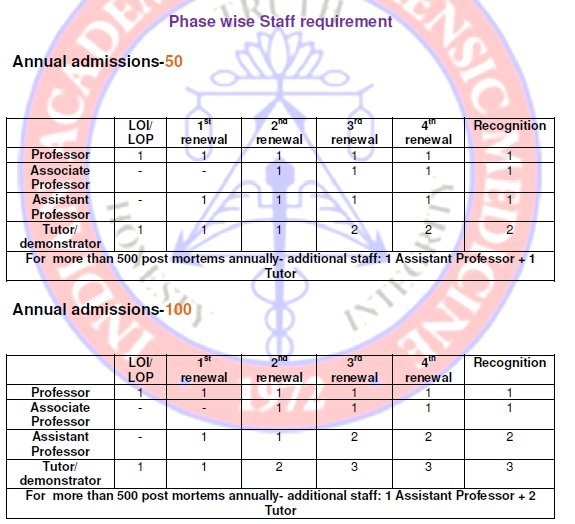
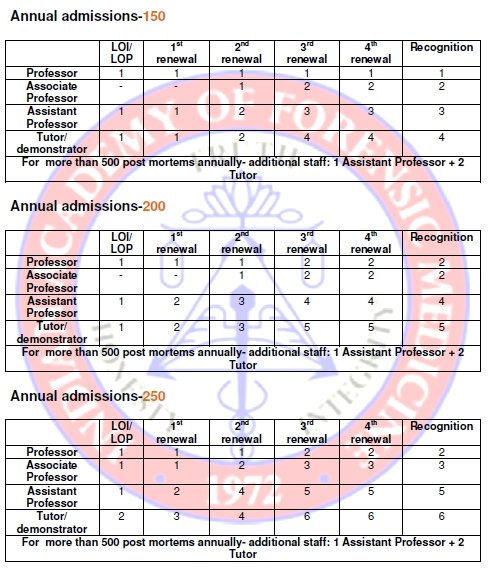
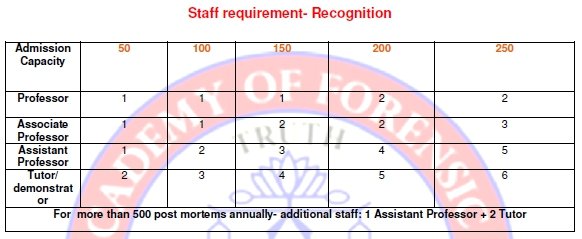
However these are yet to be implemented hopefuly by next year (2015) if the Medical Council of India considers this matter seriously.
Chapter 8 : Privatization of Medicolegal Work & Autopsies
A lot of controversy and confusion is always present amongst administrators regarding medico-legal work in the private medical set up. With the judgement by the Supreme Court in case of Pt. Parmanand Katara V/s Union of India and others (1989 AIR 2039) lot of dust has been settled about medico-legal examination of the injured person. Life saving is the pious and supreme duty of the doctors and medico-legal examination facilities cannot come in the way of treatment. To achieve this target even the private practitioners and hospitals must treat the case which has medico-legal implications. In this process requirement of medico-legal examination cannot hamper the life saving treatment which has the implication that medico-legal examination of the injured can be done by private practitioners or hospital or private medical colleges. In the judgement in the above said case it has been clearly emphasized in part 5 that no law or state action can intervene to avoid/delay the discharge of the paramount obligation cast upon members of the medical profession. The obligation being total, absolute and paramount, laws of procedure whether in statute or otherwise which would interfere with the discharge of this obligation cannot be sustained and must, therefore, give way.
Therefore any registered practitioner can and should start the treatment of the victim and just take care to inform the nearest police official the name, age, sex of the patient and time and place of occurrence of the incident. Report should be sent to the concerned police station or police official as soon as examination and treatment is over.
Keeping in view the above judgement medico-legal examination of injured is now being done in private sector and it has been well accepted by courts and there is nothing in the Cr.P.C. and other laws to prevent the doctors in the private set up not to do treatment and medico-legal examination of the injured.
In case of examination of rape victim a new section 164-A has been introduced in CRPc which clearly tell that it can be examined by a medical expert, such examination shall be conducted by a registered medical practitioner employed in a hospital run by the Government or a local authority and in the absence of such a practitioner, by even any other registered medical practitioner, with the consent of such woman or of a person competent to give such consent on her behalf and such woman shall be sent to such registered medical practitioner within twenty-four hours from the time of receiving the information relating to the commission of such offence. With this new insertion of amendment it has now been well accepted that even in medico-legal cases with serious implications role of private registered practitioner has been well accepted and all the investigations done in this process also stands validated.
It is very clear in the judgement that zonalisation was created to deal with medico legal cases brought by the police. In case of victim reporting directly to the hospital treatment cannot be denied to that victim even in medico-legal cases coming to hospital of their own and such cases should not be unnecessarily referred because of zonalisation. Cases should be referred only if facilities or expertise of treatment in that hospital does not exist.
In this judgement it was ordered to Medical Council of India to forward copies of this judgment to every medical colleges affiliated to it so that treatment is not denied to any victim which has the implication that if treatment cannot be denied and if medico-legal examination is required that will also have to be carried out. Because with the treatment the appearance of injuries will change and later on no useful inferences can be drawn once the wounds present on the body have been stitched which sometimes also require trimming of the edges of the wounds.
From the above mentioned discussion it is very clear that medico-legal examination of the injured can be done by any registered medical practitioner irrespective of being in govt. or private medical set up. The only precaution is that person dealing with medico-legal work must have the knowledge to do the medico-legal work properly. As forensic medicine is taught as a full subject to the medical students during their graduation like any other subject it cannot be an excuse that they do not know how to do the medico-legal work. If the authorities think that this teaching in Forensic Medicine is insufficient then government should pursue with the medical council of India to increase the teaching hours of this specialty and increase the practical exposure of the students to the case works. This can also be done by making internship duty in the forensic medicine mandatory rather than optional.
The second important part in medico-legal work is the post-mortem work. This is the state subject. Some states in India like Haryana and Karnataka are allowing post-mortem work in private medical colleges where as some states like Punjab are not allowing post-mortem work in private medical colleges.The Karnataka Medicolegal Society put an appeal and got permission from the high court for conducting medicolegal autopsies in the year 1990. Medical students in private colleges are being discriminated against medical students in government medical colleges. Medical council of India in their inspection sees to it that mortuary and other facilities are present for the conducting the autopsies but does not make it mandatory for the autopsies to be conducted in these mortuaries. Medical council of India must see to it that while giving permission to start the medical colleges that medical colleges get the permission to do the medico-legal autopsies. Otherwise the standard of medical students coming from the government and private medical colleges will become different.
It has been well accepted by governments that post-mortem work is a specialized field and it should be done by forensic medicine experts in medical colleges. That is why in all state medical colleges postmortem work is being done by forensic medicine experts. Though availability of forensic medicine experts is better in private medical colleges as compared to state medical colleges yet the post-mortem work is not being allotted to private medical colleges.
The fact is that the Government can authorise doctors under Section 174 of Criminal Procedure Code to conduct post-mortem examination in private medical colleges also, as is done in other States. Under this section a police can take the dead body to a civil surgeon or any other qualified medical man appointed by the state government, subject to state rules.
A frivolous objection sometimes is raised that such post-mortem reports may be manipulated by doctors working in private colleges. But most of the doctors in private medical colleges are working after rendering service in the government medical colleges and retiring unblemished from there. They have a great standing and they will maintain their reputation even in private set up. Many eminent retired government doctors have refuted the report that the proposal to allow post-mortem examinations in private medical college hospitals would create room for manipulation .Taking note of this Indian Academy of Forensic Medicine in its annual meeting in 2006 passed a resolution recommending the Medical Council of India and various state governments to take steps so that autopsy work can be started in private medical colleges.
There is great need that post-mortem services be started in the private medical colleges so that students and public get the benefit of forensic medicine experts. The quality of outcome of the investigations will be much better if they are handled by forensic medicine specialist as compared to no specialized medical doctors. Medical students will also be able to grasp the highly technical subject in a better way if they have more practical exposure which is possible only if they are exposed to postmortem work in their own institutions under the guidance of forensic medicine experts.
EPILOGUE
On The Path of Resurrection
Do not Scorn a Weak Cub, For he may become the Brutal Tiger
Mongolian Proverb
________________________________________________________________________
Dr.Viswakanth B
Assistant Profesor
Dept of Forensic Medicine
P.K Das Institute of Medical Sciences
Vaniamkulam, Kerala 679522
India
Email id : drviswakanth@gmail.com