
Review · Vol. 7, No. 1
Reviews: Forensic gadgets/toys/other tidbits section
|
|

Ultraviolet (UV) light pens produced by Ben Joseph
Official site: http://forensics.ca/phpcode/store/web/view_detail.php?product_id=10
Other products at: http://www.forensics.ca/phpcode/store/web/index.php
Available from: Ben Joseph - benj@forensics.ca
 |
The visible spectrum (or sometimes optical spectrum) is that portion of the electromagnetic spectrum which is visible to the human eye. Electromagnetic radiation in this range of wavelengths is called visible radiation, visible light or simply light. There are no exact bounds to the visible spectrum; a typical human eye will respond to wavelengths from 400 to 700 nm, although some people may be able to perceive wavelengths from 380 to 780 nm. Towards the lesser wavelength (400 nm) is the violet light and towards the bigger wavelength is the red light.
Electromagnetic radiation extends well beyond the visible spectrum. Beyond red is infra red or IR radiation (about 750 nm to 1,000,000 nm or 1 mm), and beyond violet is ultraviolet (UV). Traditionally both IR and UV radiations are divided into three subcategories each. IR is subdivided into near IR (750-5000 nm or 0.75-5 µm), mid IR (5000-30,000 nm or 5-30 µm) and long IR (30,000-1,000,000 nm or 30-1,000 µm). UV radiation is similarly subdivided into near UV (380-200 nm wavelength), far or vacuum UV (200-10 nm; abbrev. FUV or VUV), and extreme UV (1-10 nm; abbrev. EUV or XUV). While photons of infrared light are less energetic than photons of visible light, those of UV light are more energetic. Indeed UV light photons can disrupt living DNA, and hence UV light may even be carcinogenic.
Infrared radiation alone spans three orders of magnitude (i.e. the lowest range of wavelength 750 nm must be multiplied at least thrice by 10 to get to or near the uppermost range. Multiply 750 thrice by 10 and we get 750,000, which is near the upper wavelength of IR light). Taken together UV and IR radiation span 6 orders of magnitude (1 nm to 1,000,000 nm or 1 mm).
Both Infrared and ultraviolet light have a tremendous amount of application in forensic science. Infrared light is used by forensic scientists to decipher obliterated writings, to study the composition of street drugs, to see obliterated tattoos and to detect gunpowder residues, latent fingerprints and hidden bruises and bite Marks. Ultraviolet light is similarly used in a number of ways by forensic scientists. Document examiners know it well because it is used to detect counterfeit currency notes. It is also used to authenticate paintings and other fine art, authenticating signatures, illuminating latent fingerprints at crime scenes, examining questioned documents, examining trace evidence on clothing, analyzing ink stains, and revealing residual stains of body fluids.
 |
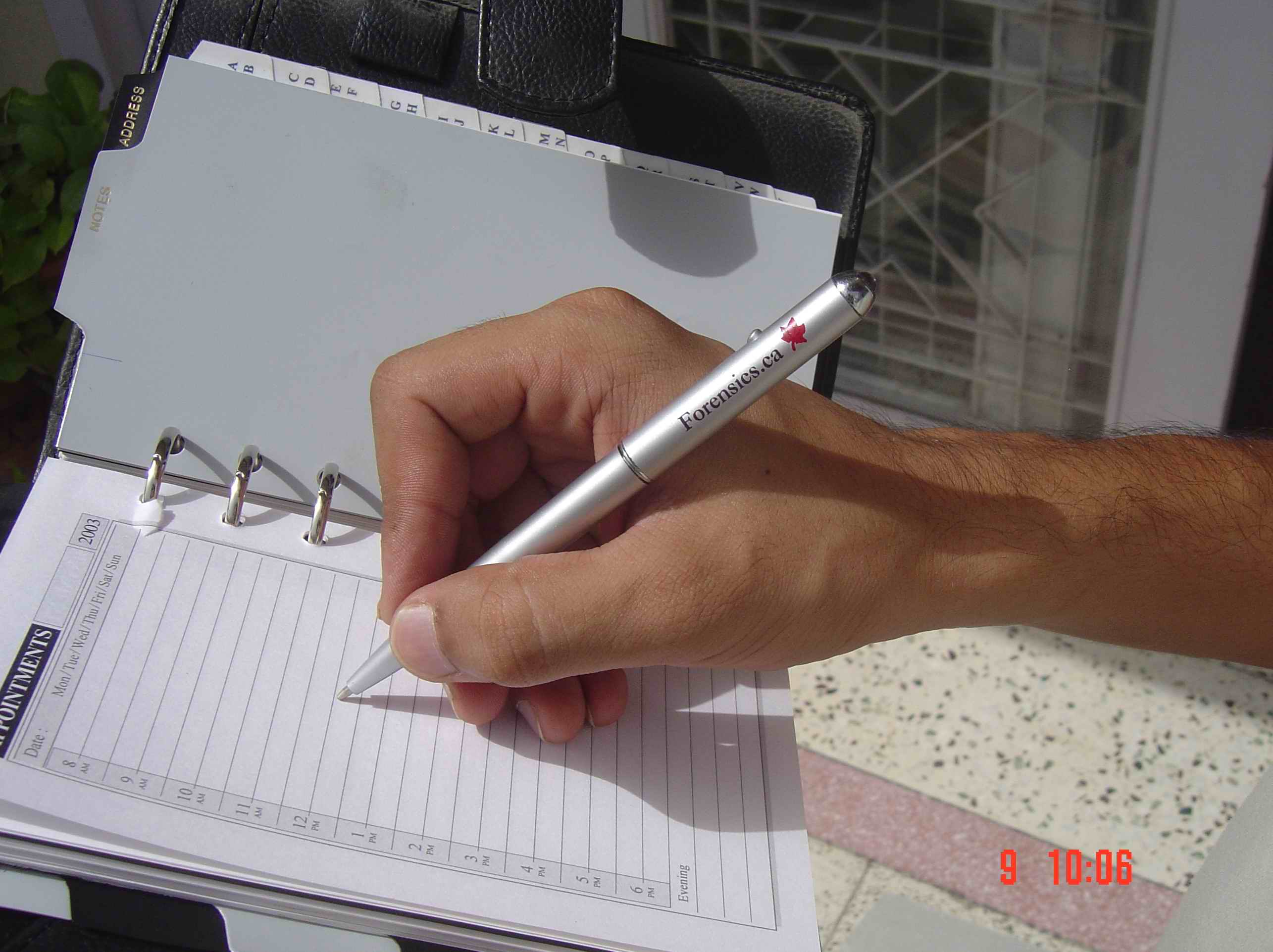
It is quite evident that forensic scientists would welcome a ready at hand source of these lights. It was not possible till recently, but now Ben Joseph of Canada has come up with remarkable pens, which double up as sources of UV light. Ben has been kind enough to send me a couple of these pens to examine, and I found them of great use. I have already used them to advantage in a case of sexual assault and murder where I used the light from these pens to detect seminal stains on the thighs of a murdered girl (I simply had to fish out the pen from my pocket!). One end of the pen is used for writing (an invisible writing which can only be seen in UV light!), while the other is used as a built in UV Light source (which can be used to see the invisible message written from the other end). These UV pens - to the best of my knowledge and belief - are the smallest UV light sources anywhere in the world. Messages can be written on paper, metal, plastic, even skin. These UV pens provide an economic and easy way of marking equipment with an invisible mark that only shows up under a UV light. They can be used to mark furnishings, clothing and private papers (such as confidential documents and agreements).
UV markings are not permanent. The mark is degradable over a period of about 12 months, particularly if situated in direct sunlight or by the heat generated by electrical equipment like computers. The marks should therefore be re-applied on a regular basis.
I have found these pens highly useful in my day-to-day work, and I would heartily recommend them to all forensic scientists. Even non-forensic scientists can make good use of them, simply because they are so much fun. I gave them to my son to play with and he showed me several security features of Indian currency notes with these lights! Highly recommended to one and all.
Acknowledgement
I am thankful to my son Tarun, who took photographs of these pens with his digital camera.Order these pens by Clicking here
Request a PDF file of this review by clicking here. (If your screen resolution can not be increased, or if printing this page is giving you problems like overlapping of graphics and/or tables etc, you can take a proper printout from a pdf file. You will need an Acrobat Reader though.)