
Review · Vol. 5, No. 2
Book Reviews: Technical Books Section
(Page 10 c - Review by Dr. Wayne Jones, Sweden)
|
|
|

Comprehensive Medical Toxicology, 1stEdition, by V V Pillay. Hardback, 11" x 8.5".
Paras Medical Publisher. Publication Date January 2003. 650 pages, ISBN 81-88129-86-0. Price Indian Rupees 750, US $40
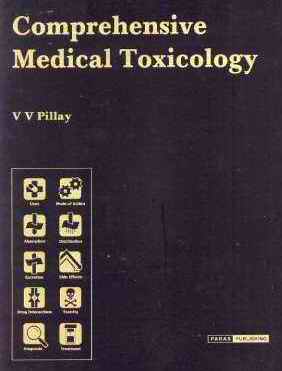 |
This cloth bound book measured 22 cm by 28 cm and weighed 1.8 kg. The book consisted of 649 printed pages of text subdivided into five sections. These sections were entitled General Toxicology (59 pages), Chemical Toxicology (156 pages), Pharmaceutical Toxicology (244 pages), Biotoxicology (118 pages) Sociomedical toxicology (172 Pages). A long list of drug trade or brand names, particularly those used in India, was included as an index along with a subject index.
Each section in the book was broken down into different chapters, which varied in length and covered specific topics within the sections. The chapters end with supporting literature references and the book as a whole apparently contains over 2000 citations.
Scattered throughout the book were a number of so-called text boxes, which provided interesting historical glimpses and information about events related to use of poisons and mass poisoning disasters. I particularly liked reading these "historical nuggets" as the author calls them. Indeed, it would have been better if these accounts (in boxes) had been given a separate contents page or index, which would make them easier to locate.
|
The first section in the book deals with general toxicology and contains chapters on the principles, and diagnosis and management of poisoning as well as a lot of information about antidotes. There is a short chapter about legal aspects of toxicology and the postmortem examination. Finally a chapter is devoted to analytical toxicology and this might have been enlarged upon appreciably. Qualitative assays were the major focus especially older spot tests and color reactions although these are rarely used today in most countries. The widely used quantitative assays including liquid chromatography (LC), gas chromatography (GC) and mass spectrometry (MS) were mentioned but not in any detail or depth. A sketch of a gas chromatograph was included but only 5 lines of text mentioned its application together with mass spectrometry. The advantage and power of combing GC and MS in analytical toxicology particularly the more sophisticated GC-MS-MS technology for unconditional screening of poisons in body fluids was not covered. Nor was the more recent LC-MS combination given any attention even though this technique is rapidly dominating the instrument park at forensic and analytical toxicology laboratories.
The second section of the book deals with chemical toxicology and includes chapters on caustics, inorganic elements, heavy metals, alcohols, hydrocarbons/pesticides and toxic gases. Under alcohol there was a box-text giving advice how to prevent and minimize the hangover.
The largest section in the book is devoted to pharmaceutical toxicology or aspect of overdosing with therapeutic drugs. These were divided into chapters of varying quality and length related to different drug classes although in my opinion too much emphasis was given to the plethora of brand names for drugs used in India. A single drug might have 20 or more trade names.
The penultimate biotoxicology section includes chapters about poisonous plants, food poisoning and venomous bites and stings. Obviously such information is more relevant for medical toxicologists working in tropical countries like India rather then UK or Western Europe where such cases of poisoning are not so frequently encountered. In this chapter the author included a number of coloured photographs of plants and snakes as well as sketches of poisonous mushrooms.
|
Finally, a section about social-medical aspects of drug dependence was presented including nicotine, cocaine and amphetamine-like designer drugs. Caffeine and alcohol could have been included in this section.
There was a lot of useful information in this book, which will probably appeal to medical students and physicians in some countries whenever diagnosis and treatment of poisoning is an issue. Although there were many tables of information in the book, I found only one graph or line drawing, namely a widely used nomogram for the elimination kinetics of paracetamol. More might have been included about biochemical mechanisms of toxicity and the potential for drug-drug and drug-alcohol toxic interactions.
My major criticism of the book is the total lack of any structural formulae or chemical reactions to illustrate the many drugs and toxins discussed throughout the book. In the preface, the author mentions that he was forced to learn word-processing during the writing of this book. He might also like to know that now there is computer software available for drawing chemical structures.
 |
-Professor A. Wayne Jones, PhD, DSc Department of Forensic Toxicology University Hospital 581 85 Linköping Sweden Professor Jones was born in Wales UK, but has lived in Sweden for the past 30 years. He is currently a senior forensic toxicologist and Professor in Experimental Alcohol Research at the University Hospital in Linköping, Sweden. Readers wishing to contact Dr. Jones may want to the linked page (mailto:wayne.jones@rmv.se?subject=Read about your review of Pillay's CMT in Anil Aggrawal's Internet Journal of Forensic Medicine and Toxicology&bcc=toxicology@medical.amrita.edu&bcc=vvp7447@yahoo.com&bcc=poisonunit@aimshospital.org&bcc=dr anil@hotmail.com&bcc=anil.aggrawal@gmail.com) |
Review 3 by Wayne Jones, Sweden
Review 4 by John Trestrail, USA
Order this book by clicking here.
Request a PDF file of this review through the contact page. (If your screen resolution can not be increased, or if printing this page is giving you problems like overlapping of graphics and/or tables etc, you can take a proper printout from a pdf file. You will need an Acrobat Reader though.)
[ Cumulative reviews of Software/Multimedia | Books on CD/Audio tapes ] [ contact us ]