
Review · Vol. 3, No. 2
Book Reviews: Popular Books Section
(Page 6c - Review by Jay Levinson, Israel)
|
|

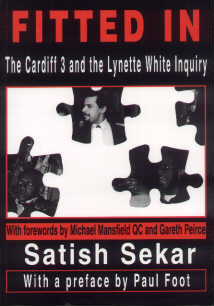
Fitted in: The Cardiff 3 and The Lynette White Inquiry by Satish Sekar (co-editors: Andy Soutter and Michele Bailey)
The fitted In Project, c/o Satish Sekar: 294 Pages: Publication Date - 1997, ISBN 0 - 9527325 - 0 - 5. Price: £10.99
 |
Lynette White, a known prostitute, was found brutally murdered in the apartment of Learnne Vilday. It was in that apartment in a sleazy section of Cardiff that she handled customers. There apparently had been a struggle connected with her murder.
This book is a recounting of the police investigation and subsequent trials. The aim is to show that through a series of mistakes wrongful convictions were obtained in the murder of Lynette. The author, however, substitutes personal involvement and emotional vocabulary for sound and objective analysis. With the aid of not sourcing his material he succeeds in weaving a hard-to-follow and even harder-to-believe tale of constant mistakes by virtually everyone involved. This hyperbole of guilt challenges the reader to find a line of objectivity in the writing. The reader is also confronted by overly complicated sentence structure, errors of syntax, and non-standard punctuation that detract from the text and its content.
In this case there definitely was a miscarriage of justice. The Court ultimately upheld appeal of the mistaken verdict. From reading this book, however, it is hard to pinpoint the exact failures. Sekar writes of specifics. It would have been much more constructive to work on conceptual lines so that lessons could more easily be applied to other jurisdictions.
Sekar points to excessive police tactics aimed at charting a preconceived interpretation of the crime. A standard police procedure is to examine initial evidence, estimate how the crime was probably committed, then to follow that line of investigation. The key, evidently missed in this case, is to exercise the flexibility to change direction rather than to force facts to ostensibly fit an inappropriate model.
Many a civil libertarian is appalled when a police interrogator even raises his voice let alone intimidate the person being questioned. Yet unsolved crimes invite an uproar from the public. If Sekar is accurate in his un-footnoted allegations, the police overstepped the bounds of propriety and possibly law in exaggerating the nice guy / bad guy interrogation procedure. It also seems that at least some policemen replaced quest for the truth with a goal to convict. If a constructive conclusion is to be found, it is that the police role is to solve a crime. The facts uncovered in that search to accurately reconstruct events will ultimately be the evidence brought to court by the prosecution, whose job it is to obtain convictions. There is a very gray line separating investigation from prosecution. Even so, the difference between investigation and prosecution functions must always be maintained.
Sekar is certainly right in explaining that the individuals connected to this case are of a social group totally foreign to most of us. The suspects and witnesses involved in this murder lived in a world of crime and unstable personal relationships. Truth and honesty were not hallowed virtues; rather, they were flexible tools allowing one to cope with life, support friends of the moment, and fend off adversaries. It was in this context that investigators had to evaluate testimony regarding the nitty-gritty details of a bloody killing and the complex inter-personal relationships of the suspects.
If the author's account is to be taken at face value, there was barely a person involved whose testimony did not waver like a flag in the wind. This was a clash of cultures. For those testifying, inconsistency was an accepted norm of life. That, however, is not the model upon which the criminal justice system is based. It is difficult to fathom how any prosecuting authority could base a large part of a case (in fact, any part of a case) on constantly changing declarations, where truth is elusive and often a matter of conjecture.
In his zeal to show misdoing, Sekar sloughed over several interesting issues. On page 104, for example, the issue of voice recognition was noted in the testimony of Mark Grommek. This reviewer would like to have seen professional comments concerning its probability of accuracy and validity.
Blood at the murder scene provided an interesting question regarding the role of a forensic scientist. One scientist testified that a possible explanation for the blood was a "cocktail," a mixture of the blood of more than one person. ("Cocktail" is a much less professional word than "mixture" --- typical of the author's choice of vocabulary.) It is this reviewer's opinion that an expert witness should apprise the court of all explanations technically possible. A forensic scientist should not chose that explanation most easily suiting the needs of the prosecution. Due to the lack of direct quotations and footnoting, it is difficult to objectively evaluate the testimony involved, particularly regarding probabilities.
There is also the question of advances in forensic science. The technology of DNA was much less developed in 1989 than it was later during the court cases. Beyond that, in 1989 there was much less awareness of DNA --- in evidence collection, amongst lawyers, and in the court. What seems to us "only natural" today was not the norm then. It is certainly to the benefit of justice that later advances in science were applied to earlier cases, and those jailed were freed. This, however, should not be seen as yet another of the system failures that Sekar lists. If anything, the redressing of a wrong is the triumph of justice.
In summary, the author has done a laudable job in championing the cause of people wrongfully convicted. This is an issue that goes well beyond the Lynette White murder trial. Mistakes in justice gnaw at our social conscience. His presentation of the case, however, is lacking. Perhaps this book should be seen not as a professional analysis, but as a written tale containing all of the problems involved in oral histories. A detached and properly documented analysis of the case is certainly wanting.
-Jay Levinson
P.O. Box 23067, Jerusalem 91230 Israel , Dr. Jay Levinson is a well-known forensic expert based in Israel. He is also the author of best-selling book "Questioned Documents: A Lawyer's Handbook" published by Academic Press (An imprint of Elsevier). |

Order this Book by clicking here
Or by contacting the author personally at:
Satish Sekar,
8 Ridding Lane,
Greenford, Middlesex,
UB6 0JY,
UK
There have been many Developments in the Lynette White Inquiry, since Sekar wrote his book. Readers wanting to read about them may want to click here.
Request a PDF file of this review through the contact page. (If your screen resolution can not be increased, or if printing this page is giving you problems like overlapping of graphics and/or tables etc, you can take a proper printout from a pdf file. You will need an Acrobat Reader though. You can also create a pdf file yourself by clicking here.)
To read the review of another book exposing a scandal, please the linked page (page004).