
Review · Vol. 3, No. 2
Book Reviews: Popular Books Section
| OTHER REVIEWS IN THIS ISSUE [Technical Books Section] Pages: |1| 2| 3| 4| 5| 6| 7| 8| 9| 10| 11| 12| 13| 14| 15| 16| 17| 18| 19| 20| [Popular Books Section] Pages: |1| 2| 3| 4| 5| 6| [Books on CD/Audio Tapes] Pages: |1| [Software/Multimedia] Pages: |1| [Online Courses] Pages: |1| REVIEWS IN THE PREVIOUS ISSUE | NEXT ISSUE |
|
|

Skulls and Skeletons by Christine Quigley
McFarland & Company, Inc. Publishers, Box 611, Jefferson, North Carolina 28640, USA. : viii + 263 Pages: Publication Date - 2001, ISBN 0-7864-1068-X, (illustrated case binding: 50# alkaline paper): Price $39.95
 |
 |
Study of bones is an indispensable requirement of all forensic professionals, especially forensic anthropologists. Every other day a forensic pathologist is presented with a bundle of bones - certainly in this country - with a request to find out the identity of the person/s involved and other identification features such as his age, sex, height and possibly even his profession and cause of death. Forensic anthropologists employ a number of techniques to solve these questions.
A number of books are available on forensic anthropology and forensic osteology. But this reviewer is aware of none, which caters to the needs of general public. The present book comes as a succor to such people. Author Christine Quigley in her inimitable style discusses not just forensic issues, but all possible issues related to bones. To be sure, she has dwelt not so much on forensic issues, as on more general issues such as celebrated accumulations and collections of bones, excavations, curation related to bones, repatriation of bones, and even how bones have been used for decoration. Precisely such discussions make this a great book for forensic anthropologists like me, because we do not get to read such issues in more "regular" texts.
When discussing accumulations, Quigley discusses the famous catacombs of Rome and Paris and several ossuaries namely the St. Catherine's Monastery, Sinai, Bone house, Ripon Cathedral, England, Capuchin crypt and Invention of the Croos Church at Brno, Czech Republic, Catacombs at St. Stephan's Cathedral, Vienna, Medieval Ossuary at Wamba, Valladoid, Spain, Crypt of St. Leonard's Church in Hythe, Kent, England and Native American Ossuaries in the United States. She even talks of mass graves such as those created during the oppressive regime of Pol Pot in Cambodia in the seventies and that created just after the famous Battle of Towton. Battle of Towton - one of the several battles of the War of the Roses - was fought on March 29, 1461 between the Houses of Lancaster (Red rose) and York (White rose). This was the bloodiest of all battles fought on the British soil. More than 3% of Britain's population of 3 million fought at Towton, and the casualties suffered were enormous. At a rough estimate, between 22,000 and 28,000 men were speared, axed, and crushed to death on the battlefield of Towton. Many of these were buried on the spot.
 |
The skeletons of the victims of this war were accidentally unearthed in the summer of 1996, when builders working on an extension, uncovered 37 skeletons piled one on top of the other. This was obviously a war grave. It has been described as "one of the great finds of the century". Quigley describes in great detail how these skeletons were carefully unearthed, and how a number of important pieces of information not only about the war, but also about the life style of individuals living in those times were deduced from the skeletons.
When dealing with excavations, Quigley discusses the famous story of the Peking man, and how it got lost during 1940s, when the Japanese overran China. Some still believe (Quigley certainly does), that Peking man is still hiding in some museum somewhere, and it didn't get accidentally sunk in the Yellow sea as is classically believed. There are discussions about such famous excavations as the iron age remains in Denmark; early Hawaiians of Oahu; Kolomoki Mounds in Blakely, Georgia and the Dickson Mounds near Lewistown, Illinois.
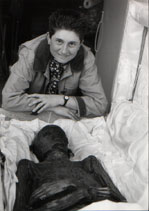
Each section in each chapter is fortified with great quotes related to bones. This reviewer thoroughly enjoyed reading them. A number of good quality black and white photographs accompany each chapter.
This book should be very interesting for forensic anthropologists like me. But surely it is also an absolute must for all lay people - not only those who have an interest in anthropology and osteology - but also those who are interested in the grisly and the bizarre. I thoroughly enjoyed reading this book, and it is going to my prized possession for the rest of my life.
Order this Book by clicking here
Request a PDF file of this review by clicking here. (If your screen resolution can not be increased, or if printing this page is giving you problems like overlapping of graphics and/or tables etc, you can take a proper printout from a pdf file. You will need an Acrobat Reader though. You can also create a pdf file yourself by clicking here.)