Book Reviews · Book Review · Vol. 11, No. 2
Cross-walks ICD-10 – DSM-IV-TR: A Synopsis of Classifications of Mental Disorders
Ref:
Devgun, M. Cross-walks ICD-10 – DSM-IV-TR: A Synopsis of Classifications of Mental Disorders edited by Michael Schulte-Markwort, Kathrin Marutt, Peter Riedesser, Hogrefe & Huber Publishing, 2003 (Book Review).
Anil Aggrawal's Internet Journal of Book Reviews [serial on the Internet]. 2012; Vol. 11, No. 2 (July - December 2012): [about 6 p]. Available from:
; Published July 1, 2012. (Accessed:
Email Ms. Devgun by clicking here
Editor’s recommendation — this book carries the editor’s “must buy” recommendation.
Cross-walks ICD-10 – DSM-IV-TR: A Synopsis of Classifications of Mental Disorders, 1st edition, edited by Michael Schulte-Markwort, Kathrin Marutt, Peter Riedesser, Spiral Bound, 11.1” x 8.2” x 0.4".
Hogrefe & Huber Publishing, Cambridge Office. Publication Date December 2003. 80 pages, ISBN-10: 0889372683. ISBN-13: 978-0889372689. Price $24.95
Official site of this book: Please Click here to access
Buy this book from Amazon by clicking here
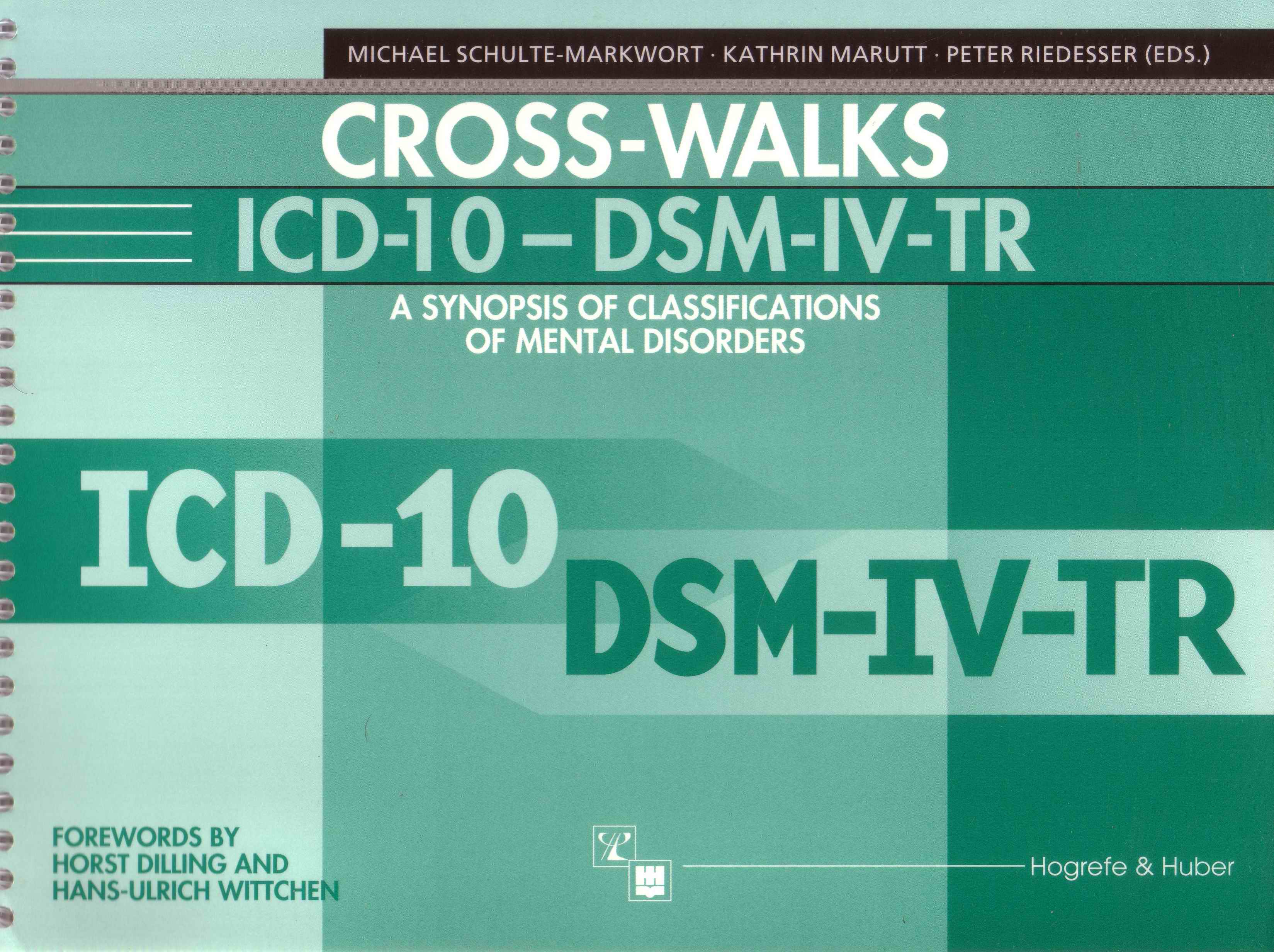 |
The approach taken by the authors (Michael Schulte-Markwort, Kathrin Marutt & Peter Riedesser) of Cross-Walks ICD-10 – DSM-IV-TR happens to make it a quite useful, comprehensive, and a practical resource for mental health professionals, students of psychiatry/psychology as well as research purposes.
Cross Walks ICD-10 – DSM-IV-TR: A synopsis of classifications of Mental Disorders, as the name implies, basically focuses on the differences between the classification systems used for mental disorders between the two internationally established diagnostic manuals for mental disorders, namely, ICD-10 (International Classification of Diseases-10) published by the World Health Organization in 1992 and DSM-IV-TR (Diagnostic & Statistical Manual for mental disorders, 4th Edition, Text revised) published by the American Psychological Association in 1994.
This book provides an overview of the comparisons between the diagnostic criteria used by ICD-10 & DSM-IV-TR in a very clear and concise manner by giving the information in a well organized tabled format. It serves to be a time saving tool as it walks you through the differences between the ICD-10 & DSM-IV-TR which are intelligently divided into two parts; where in the first part ICD-10 criteria for a diagnosis are given in contrast with the DSM-IV-TR and in the second, the opposite. Through the use of simple language, tables, and directions for use of the tables, it becomes very easy for the reader to quickly go through the significant contrasts between the two classification systems.
Although this book provides a clear and concise overview of the differences between the two classifications, it holds back when it comes to giving more information about the differences between the developmental phases and the multiaxial diagnosis approach of both the classification systems. The structural & paradigmatic differences between the two systems have only been skimmed through without providing an elaborate description of how the features of the two systems differ from one another. A lack of bibliography might prove as a disappointment to researchers as the references are cited nowhere in the book.
Even though Cross Walks ICD-10 – DSM-IV-TR has its shortcomings but unlike other books which generally don’t even emphasize on the differences between the two systems, but on the structures and criteria required for the diagnosis of a mental disorder, this book at least fulfils the goal of covering the significant differences between the diagnostic criteria for all the mental disorders during adulthood as well as childhood and by doing that it proves to be more helpful than disappointing for all mental health or health professionals and especially the students of clinical psychology.
 |
-Meetali Devgun Meetali Devgun is currently pursuing her masters in clinical psychology, and interning side by side in a clinical setting as an assistant psychologist for over 2 years. Her areas of interest are parapsychology, paraphilias, criminal psychology, & personality psychology. She likes reading, writing and watching movies, and is also a junior level handwriting analyst. Ms Devgun is associated with this journal as a resource person. |
-Editor-in-Chief