
Book Reviews · Book Review · Vol. 4, No. 2
Technical Books Section
Ref:
Aggarwal N, Bhobhiya K. Chemical Reaction Engineering, 3rd Edition by Octave Levenspiel, John Wiley & Sons, (Book Review).
Anil Aggrawal's Internet Journal of Book Reviews, 2005; Vol. 4, No. 2 (July - December 2005):
; Published December 21, 2005, (Accessed:
Email Mr. Aggarwal by clicking here
|
A USEFUL RESOURCE ON CHEMICAL REACTION ENGINEERING
|
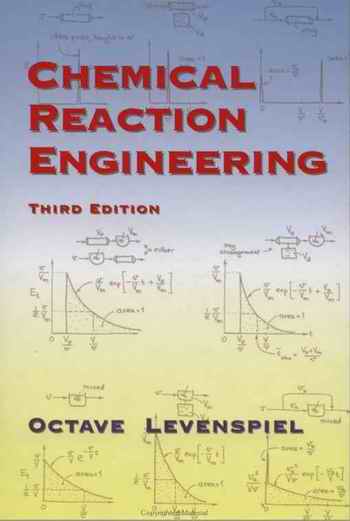
Chemical Reaction Engineering, 3rd Edition by Octave Levenspiel. Softcover, 10.3 x 7.3 x 1.3 inches.
John Wiley & Sons. Publication Date August 13, 1998. 688 pages, ISBN 047125424X. Price $128.95
Official site of this book: http://he-cda.wiley.com/WileyCDA/HigherEdTitle/productCd-047125424X.html
Buy from Amazon by clicking here.
 |
The number of books dealing with the subject of chemical reaction engineering is voluminous. Chemical reaction engineering is the area which clearly distinguishes chemical engineering from other engineering streams. For the student or researcher in the field of chemical reaction engineering this book presents a broad spectrum of problems for the design and operation of chemical reactors. This book is targeted at the undergraduate students and researchers at the cutting edge of investigations into the fundamental design procedure of chemical reactors. The aim of this book is to develop a strong intuitive sense for good design and then reinforce the formal methods.
The author attempts to identify how to deal with a design problem by emphasizing on qualitative arguments, simple design methods and graphical procedures. The effect of various design parameters on reactor design has also been discussed very clearly and quantitatively. This can help the engineers in optimization of the reactor's design. The book also presents a view on selection of reactor type in different practical situations. The text has been explained through well thought examples and umpteen diagrams which clearly establish the idea that the author wants to put across the mind of the reader.
This book is divided into five parts. Each part is fragmented into different chapters starting with very basics and then moving into deeper concepts hence providing a strong foundation. Also each chapter is clearly and professionally written and the overall impression is of a high quality monograph prepared with great care. Introductory comments in each chapter nicely establish the broader relevance and prospective and each chapter provides a well-written and often fascinating overview of practical applications of the concepts.
In the first part, the author has discussed the homogeneous reactions in ideal reactors. This concept has been developed by first discussing the kinetics of homogeneous reactions, following with introduction to reactor design and then discussing the design procedure for various types of reactions. After introducing ideal reactors, the author moves his discussion towards 'the non ideal flow patterns and contacting' which comprises the second part of the book. In the consequent parts the author has discussed the reactions catalyzed by solids, non-catalytic systems and an introduction to the biochemical reaction systems. By going through these parts, the reader can well establish an approach to solve umpteen problems in these areas. Also the mathematical background required to use this book is quite minimum (only elementary calculus is required) which makes it easily readable and immediately useful.
In general the book serves three needs. First, the current material is used as a text for undergraduate and graduate level chemical reaction engineering course. Second, the author gives very clear introductory insight into biochemical reaction systems. And third, it serves as a refresher for all engineers interested in chemical reactor design.
Overall the book effectively presents the current theoretical approaches to understand several fundamental aspects of chemical reaction engineering and this book is a must for any institutional library.
-Nitin Aggarwal and Kuldeep Bhobhiya
|
Nitin has completed his B-Tech in Chemical Engineering from the Indian Institute of Technology, Roorkee. He has been offered a Fellowship from the New Jersey Institute of Technology, USA and will be pursuing his PhD in Biochemical Engineering over there. Nitin has a great appetite for original research in Chemical Engineering and related fields. During his undergraduate studies he had also written a paper on "Optimization of Double pipe heat exchangers" which is currently being reviewed for publication in the Journal of Heat and Mass Transfer. His immediate objective is to pursue a career in research and experience the excitement and satisfaction of being at the forefront of the vast expanding field of Chemical Engineering. He can be contacted at nitinrocks@rediffmail.com |
|
|
Kuldeep has completed his B-Tech in Chemical Engineering from the Indian Institute of Technology, Roorkee. He has been offered a job in Schlumberger, world's leading supplier of technology, project management and information to the oil and gas industry. Kuldeep has received various laurels in Chemical Engineering during his undergraduate studies. He possesses excellent writing skills and has been the editor of the annual college magazine. He has also won several prizes in paper presentations in the Technical Festival of IIT Roorkee. His immediate aim is to pursue his MBA from the Harvard University. |

Order this Book by clicking here.
-Editor-in-Chief