
Book Reviews · Featured Book Review · Vol. 2, No. 1
Eternal Treblinka
(Review 7 - by Jill May, USA, North America)
|
|


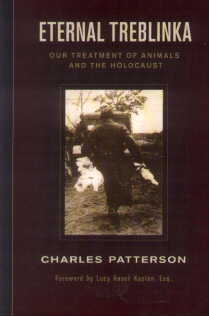
Eternal Treblinka: Our Treatment of Animals and the Holocaust by Charles Patterson, Paperback, 6" x 9"
Lantern Books. Publication Date 2002. xvi+296 pages, ISBN 1-930051-99-9. Price $20.00
 |
Dr. Charles Patterson has written a compelling book about how our mistreatment of animals parallels the treatment of Holocaust victims, about how our degradation of animals compares to the Nazis' dehumanization of Jews. Patterson heightens our awareness page by page. He builds his case brilliantly. It is hard to argue with the fact that our degradation of other races is comparable to how we have treated animals, most especially farm animals. Whether it's human animals, or non-human animals, in order for man to commit mass-murder, man must first mentally demote and degrade his victims to justify his actions and quell his conscience.
Patterson's theory seems (to me) divinely conceived. In fact, I believe a transformation occurs just by reading "Eternal Treblinka." Memories from my own childhood came to mind as I read interviews with Nazi survivors as well as the recollections of some German citizens during the war. As a child, I fretted over the welfare of all animals. I disliked meat, but was forced to chew it until it became like a lump of flavorless gum inside my mouth. I wasn't mistreated, of course. Like any good parent, my parents had only been worried that I wouldn't get enough nourishment if I didn't eat meat. In "Eternal Treblinka," I found a similar sentiment among those involved as adults in animal rights. I felt like ET, phoning home, landing a clear connection.
I started reading "Eternal Treblinka" near the beginning of hunting season in Michigan, during which time we lose half our work force at the construction site where I sell new homes. The traffic heading to the UP (upper peninsula) rivals rush hour in New York. Hoards of men scurry to the woods to kill for sport. I thought of my last visit to our picturesque northern peninsula when I encountered a herd of deer crossing a dirt path. I called to them softly. They stopped and turned inquisitive eyes at me, the same way a baby looks when you grab their attention and make them smile-trusting, wide-eyed, delicate innocents. And I wondered then and I wonder now how anyone can find sport in such an easy hunt? And yet we are made to feel abnormal-even guilty-for having those feelings. From the womb to the hunt, to me, is not a natural progression.
Hitler's favorite theory, "might makes right" was responsible for such atrocities to man of which the sane and solemn mind has great difficulty comprehending. But with Dr. Patterson's deft guidance, you see the story unfold anew. You know the outcome already. But what you didn't know (what you could never make peace with) was how others let it happen. You can almost visualize yourself in those days, and you can almost understand how citizens of Germany turned a blind eye. The devaluation of the Jewish people convinced non-Jews to look the other way. Not only did they turn a blind eye, but many also learned to hate and to sanctify genocide. Patterson shows us the similarity in our treatment of farm animals as they are led truckload-by-truckload, cramped ear-to-ear, to slaughterhouses. They yelp and plead and shiver in abject terror. It lends a new meaning to the phrase "huddled masses yearning to be free." A final painful blow eventually ends their life. In reading the slaughterhouse segments, I finally understood why so many German's looked away. And it wasn't just the Germans.
I was born and raised in the Detroit area, and as a former Ford employee, I was bewildered to read about our Motor City hero, Henry Ford. I found that chapter most especially illuminating. Patterson's extensive knowledge of history is supported by hundreds of endnotes. In this section, we learn that Henry Ford found inspiration for the assembly line from his visit to a Chicago slaughterhouse. In 1920, Henry Ford's weekly publication, "Dearborn Independent" launched a brutal anti-Semite campaign. I was surprised to learn that Hitler was inspired by and even idolized Detroit's own-Henry Ford.
Like a sharp investigator, Patterson delves into the vortex (of minds) before the fury was unleashed. Eugenics emerged in the late 1800's. Basically, eugenics was the study of genetics. Many well-respected scientists believed that genes were the only factor in a child's development. By 1933, America led the way in sterilizing over 15,000 people. Hitler watched closely. When he gained power, he was finally able to do something about the feebleminded, the depraved, the handicapped, and so on. He began implementation of his euthanasia program in 1939 by killing children who were wards of state hospitals. They were either starved to death, drugged with pills or lethally injected. Hitler had great plans. And sin by sin, he accomplished much of his delusional design. All great sins as well as all great triumphs begin with a benign baby step.
An entire chapter is devoted to the life and works of Nobel Laureate, Isaac Bashevis Singer (1904-91). Patterson's title, "Eternal Treblinka" is borrowed from one of Singer's stories, "The Letter Writer." In Singer's story, a man befriends a mouse. Every night he leaves it a piece of cheese and some water until he loses his job and takes ill. On his deathbed, he worries what will become of his little friend. Nursed back to health, he finds that his mouse miraculously survived the weeks of neglect when he was even too ill to think about his tiny little friend. In Singer's writing, we come to love that same fictional mouse that his character adored.
In "Eternal Treblinka," Patterson transforms the unutterable into a readable life lesson in humanity. If we treasure life, we should take a hard look at what is truly hard to look at. "Eternal Treblinka" has the power to influence, if not change, one's life. And in this writer's opinion, Isaac Bashevis Singer is smiling down on Dr. Charles Patterson's truly remarkable baby step.
-Jill May
 |
-Jill May Jill May resides in Novi, Michigan, where she's currently pursuing her own writing career. She achieved outstanding marks for her short stories in Creative Writing at Schoolcraft College in Livonia, MI, and was subsequently invited to join a group of talented and successful writers. She also won praise for one of her short stories from Detroit native, Jim Daniels. She can be contacted at jillmay@teleweb.net. More information about her can be had by clicking here. |
Order this Book by clicking here.
Interview with Charles Patterson.
-Editor-in-Chief
of Volume 2, No. 1 (January - June 2003)