


Introduction
For a considerable time, the issue of End-of-Life Care (EOLC) has been a significant topic of conversation among both medical professionals and the public. With advancements in medicine enabling the extension of life for terminally ill patients and those in a persistent vegetative state, ethical concerns have been raised regarding its practice. In India, there was a lack of clear policy on this matter, leading to its resolution through the legal system. In 2018, the Supreme Court of India provided directives on End-of-Life Care and later amended on January 24, 2023. Despite this legal clarification, many remain unfamiliar with terms such as "Euthanasia," "Do Not Resuscitate," "End-of-Life Care," and "Advance Directive," as well as their legal status within India.1
End-of-life care is defined as the type of healthcare a person with any terminal condition that has become advanced, progressive and/or incurable requires. It involves making various decisions, which include considerations of palliative care, respecting patients' rights to decide their treatment and life choices, evaluating medical experimentation, assessing the ethical and practical aspects of extraordinary or risky medical procedures, and examining the effectiveness of ongoing routine medical interventions. Additionally, end-of-life care often addresses issues of resource allocation and rationing within both hospital settings and national healthcare systems. These decisions are influenced by technical and medical factors, economic considerations, and bioethical principles. Furthermore, end-of-life treatments are carefully weighed in terms of patient autonomy.2
An Advance Directive (AD) is a legally binding document containing written instructions from an individual regarding their healthcare preferences in the event that they become unable to make decisions due to illness or incapacity. If an individual hasn't created an Advance Directive for themselves, another person can act as a Surrogate Decision Maker to carry out their wishes and execute on behalf of the patient. In India, requesting actions such as Do Not Resuscitate (DNR), Do Not Intubate (DNI), or withholding medical treatment to sustain life (Passive Euthanasia) in an Advance Directive is considered legal. Doctors will not face legal repercussions such as charges of murder (Section 302 IPC) or culpable homicide not amounting to murder (Section 304 IPC) for carrying out these directives.3
In 2018, the Supreme Court of India legalized EOLC under the category of Advance Directives. Advance directives are also referred to by various synonyms, including: a) Advance Healthcare directive (AHCD) b) Living Will c) Personal Directive d) Advance Medical directive (AMD).4
In 1994, the Supreme Court of India declared Section 309 IPC (Attempt to Commit Suicide) unconstitutional in the case of P. Rathinam Vs Union of India, stating that it contravened Articles 14 and 21 of the Indian Constitution. The ruling affirmed that just as individuals have the ‘Right to live’ under Article 21 of the Indian Constitution, they also possess the ‘Right to choose not to live’.5
In 1996, in the case of Gian Kaur Vs State of Punjab, the Supreme Court ruled that while the Right to Life is a fundamental natural right under Article 21. However, abetment of suicide should not be equated with the right to choose an unnatural death. Consequently, the Court upheld Section 306 IPC as constitutional, emphasizing that physician-assisted termination of life is not permissible.6
In the year 2011, in the case of Aruna Shanbaug Vs Union of India, the Supreme Court legalized Passive Euthanasia in India specifically for cases of Permanent Vegetative State (PVS), allowing for the withholding of medical treatment.7
In 2014, in the case of 'Common Cause Vs Union of India', arguments were presented in the Supreme Court regarding whether the Right to Life encompasses the Right to Die with Dignity, the permissibility of Passive Euthanasia based on an individual's living will, and the right of individuals to refuse medical treatment, including the withdrawal from life-saving devices. Nearly four years later, in 2018, the Supreme Court declared that the Right to Life indeed includes the Right to Die with Dignity. It affirmed that passive euthanasia can be permitted for terminally ill and PVS patients, and individuals have the right to refuse medical treatment continuation of life. These legal precedents led to the enactment of Advance Directives or Living Will in India on March 9, 2018.8
One year after the 2018 verdict, The Living Well Survey was conducted jointly by HealthCare at HOME (HCAH) and the End-of-Life Care in India Task Force (ELICIT), involving over 2,400 urban Indian participants from seven major cities of India to assess their awareness of the existence, attitude and perception towards AD. This initial study revealed that 88% desired autonomy in deciding their medical care during their final days. However, only 27% were familiar with the concept of a living will, and merely 6% of this subset had actually drafted one. In the subsequent ‘follow up survey’ revealed that 76% of participants regarded the concept as highly relevant to their own situations. Meanwhile, 15% felt they required further information before deciding to draft a living will, while 9% viewed living wills as irrelevant and morally objectionable. Of those who deemed living wills pertinent, 91% indicated a preference to discontinue life support if they were declared terminally ill and dependent on artificial life support with minimal or no chance of recovery.9
Need for ‘this’ study
It was evident through both the initial and follow up Living Well survey that the awareness of the existence of AD is not adequate. Also, it appears that their attitude and perception towards AD requires more clarity. Amidst this, the Indian Society of Critical Care Medicine appealed to the supreme court on 18th January 2023 in which a constitution bench headed by Justice K M Joseph reviewed the execution process of AD and stated that it too cumbersome. On January 24, 2023, the Supreme Court hence revised the guidelines for the preparation of Advance Directives established in 2018.10
As this concept of AD is relatively new in India, not many studies are existing like the Living Well survey. Given the aforementioned scenario, there is a need for conducting more such studies in different parts of India.
Such studies not only are essential for understanding the knowledge, attitudes, and perceptions on AD but also serves as a platform for educating Indian citizens on this concept.
Keeping these things in mind, the authors of this article, first decided to conduct a study on the medical students to know their knowledge and attitude towards AD as they are existing within a health care set up compared to the general population.
Methodology
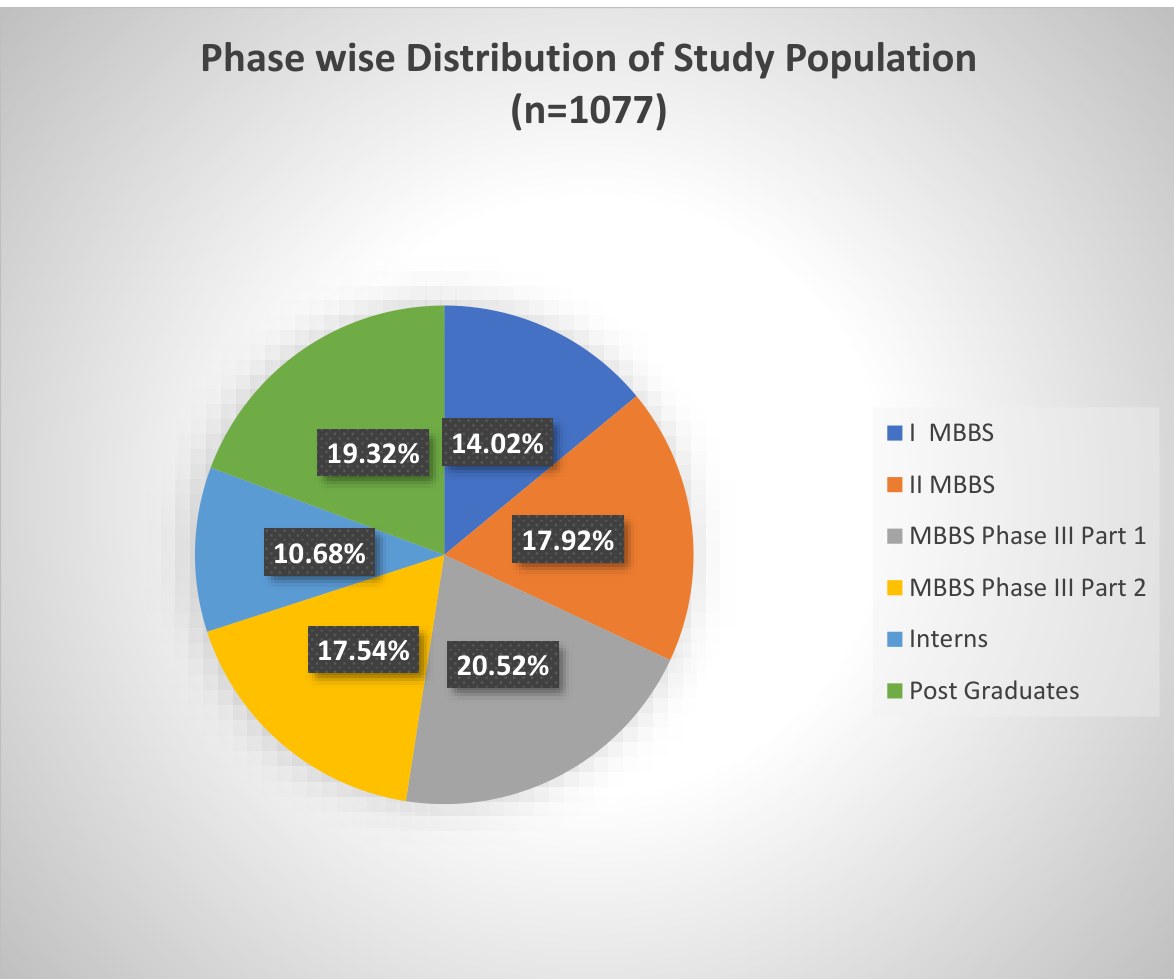
The present study was conducted after receiving SMC Institutional ethical committee clearance between January 2024 to April 2024, making it a period of four months. The total study participants were 1077 of which 151 students belonged to 1st year MBBS, 193 students belonged to 2nd year MBBS, 221 students belonged to MBBS phase III part I, 189 belonged to MBBS phase III part II, 115 were medical interns and 208 were Postgraduate students of Saveetha Medical College which was the study place setting. [Fig 1]
It was made sure that all the participants were above the age of 18 years. The study design was a cross-sectional questionnaire based observational study. Informed consent forms were provided to and obtained from 1077 participants assuring confidentiality and explaining the objectives. This was followed by preparing a structured, self-administered questionnaire containing 18 questions related to knowledge and attitude towards AD and EOLC. Since this was a newly formed questionnaire, it was pretested and validated by submitting it to the in-house Forensic Pathologist and Critical Care Medicine specialist for a review, who after perusal made appropriate suggestions which were duly obliged and adhered to.
This questionnaire was then computed into a google form and sent to all the participants to their official email address.
The questionnaire consisted of 18 questions related to Knowledge and Attitude towards AD and EOLC. The responses were to be simply given as YES or NO or NOT SURE. [Table 1]
| Q. No | Questions | Yes (No. & Percentage) | No (No. & Percentage) | Not Sure (No. & Percentage) |
|---|---|---|---|---|
| Q1 | Have you heard of Advance Directives (AD*)? | 41(3.8%) | 1036(96.2%) | 0 |
| Q2 | Are you aware that AD (living wills) is legalized in India? | 24(2.2%) | 1036(96.2%) | 17(1.6%) |
| Q3 | Do you think there is adequate promotion of AD in the Medical Colleges? | 38(3.5%) | 1012(94%) | 27(2.5%) |
| Q4 | Have you made an AD already? | 0 | 1077(100%) | 0 |
| Q5 | Do you think AD is a reasonable thing to exist? | 338(31.4%) | 256(23.8%) | 483(44.8%) |
| Q6 | Do you think the AD should be made compulsory to all citizens of India? | 114(10.6%) | 147(13.6%) | 816(75.8%) |
| Q7 | Did you know that passive euthanasia and DNR are a part of AD in India? | 114(10.6%) | 305(28.3%) | 658(61.1%) |
| Q8 | Did you know that following DNR orders without an AD is illegal in India? | 20(1.9%) | 864(80.2%) | 193(17.9%) |
| Q9 | Did you know that anyone above 18 years can make an AD in India? | 38(3.5%) | 1039(96.5%) | 0 |
| Q10 | Did you know that a surrogate can make an AD for you, if you are incapable of it? | 38(3.5%) | 1012(94%) | 27(2.5%) |
| Q11 | Do you know the process of making an AD? | 0 | 1077(100%) | 0 |
| Q12 | If you know the process of making an AD, do you feel it is too tedious to make one as per 2018 SC ** guidelines? | 0 | 0 | 1077(100%) |
| Q13 | Did you know that SC modified the AD guidelines in 2023? | 0 | 1077(100%) | 0 |
| Q14 | Do you feel the process of making of an AD is easier after 2023 SC modifications? | 0 | 0 | 1077(100%) |
| Q15 | Will you execute an AD when you are physically and mentally healthy? | 732(68%) | 310(28.8%) | 35(3.2%) |
| Q16 | Will you execute an AD when you are at a terminally ill stage but conscious? | 997(92.6%) | 24(2.2%) | 56(5.2%) |
| Q17 | Would you be comfortable if your relative executes an AD for you when you are terminally ill and unconscious? | 813(75.5%) | 231(21.4%) | 33(3.1%) |
| Q18 | Would you be comfortable executing an AD for your relative who is unconscious and terminally ill? | 289(26.9%) | 669(62.1%) | 119(11%) |
*Advance Directives
** The Supreme Court of India
Apart from the main questionnaire, a few sociodemographic parameters pertinent to the study such as sex, religion, phase of study and health insurance were inserted. [Table 2].
| Characteristics | Frequency | Percentage | |
|---|---|---|---|
| Gender | Male | 419 | 38.9 |
| Female | 658 | 61.1 | |
| Others | - | - | |
| Religion | Hindu | 722 | 67.1 |
| Muslim | 149 | 13.8 | |
| Christian | 206 | 19.1 | |
| Other religion | - | - | |
| Covered by Health Insurance | Yes | 425 | 39.5 |
| No | 652 | 60.5 | |
Once all the responses were obtained, statistical calculations were made using appropriate tools such as Microsoft excel 2019 and Statistical Package for Social Sciences (SPSS) software, IBM manufacturer, Chicago, USA, version 21.0 and results were thereby drawn.
Results
In this study, majority of the respondents were females amounting to 61.1% (n=658) and males being 38.9% (n=419). Most of the respondents identified themselves as Hindus’ amounting to 67.1% (n=722), followed by Christians being 19.1% (n=206) and Muslims being 13.8% (n=149). Majority of the study population (60.5%) claimed that they are not covered by any health insurance.
Regarding Advance Directives (AD), 96.2% of participants were unaware of its existence or legalization in India. None had created an AD, with 94% citing the lack of promotion in medical schools as the primary reason. 31.4% of the population found the existence of AD reasonable, 75.8% of them were uncertain about whether it should be made mandatory for all citizens of India.
80.2% were oblivious that adhering to Do Not Resuscitate (DNR) orders without an AD is illegal in India, while 61.1% were uncertain whether passive euthanasia and DNR are components of an AD in India.
More than 90% of the population lacked awareness regarding the legal age for drafting an AD or the involvement of a Surrogate in its preparation. Nobody was familiar with the process of preparing an AD or the modifications made in 2023 by the Supreme Court of India on AD.
For Q15, majority of the study population (68%, n=732) responded that they are willing to make an AD for themselves when physically and mentally healthy.
For Q16, majority of the study population (92.6%, n=997) responded that they would execute an AD if at all they become terminally ill while remaining conscious.
For Q17, majority of them (75.5%, n=813) responded that they would be personally comfortable if their relatives execute an AD for them when they become terminally ill and unconscious.
While observing the responses for Q18, majority of the study population (62.1%, n=669) responded that they were not comfortable to execute an AD for their relatives in an eventuality where they become terminally ill and unconscious.
Discussion
In this section, the authors aim to contrast this study with prior research. There is scarcity of KAA studies on the same subject and to our knowledge, only one study (survey) exists within the Indian legal context on advance directives. Having said so, this serves as a basis for further exploration, indicating potential for researchers to conduct additional studies in this area.
Following the 2018 Supreme Court judgment, Healthcare at Home (HCAH), a healthcare service provider, conducted a "Living Well Survey" (LWS). This survey was facilitated by the End-of-Life Care in India Task Force (ELICIT), which comprises members from the Indian Association of Palliative Care, the Indian Society of Critical Care Medicine, and the Indian Academy of Neurology. Among its objectives, the survey aimed to raise awareness about the concept of AD.
The LWS spanned across the seven cities of India namely Delhi, Mumbai, Kolkata, Hyderabad, Bengaluru, Chandigarh, and Jaipur, with a sample size ranging from 350 to 400 per region.
Their study involved 2400 Indian respondents, while ours included 1077 Indian respondents. Additionally, our study was limited to the city of Chennai. The LWS revealed that only 27% of the participants were aware of the existence of AD which was in contrast to our study where 41% participants demonstrated awareness of them. This variance could potentially be linked to the participants' affiliation with the medical field.
76% of respondents of LWS considered the concept of AD to be highly pertinent to their own circumstances, while 15% felt they needed further information to decide on drafting one. Another 9% of respondents deemed advance directives irrelevant and morally objectionable, citing concerns about potential misuse and the inability to personally dictate the course of their final moments. In contrast, our study revealed that 31% of participants perceived advance directives as reasonable to exist, with 45% expressing uncertainty about their relevance and 24% finding them irrelevant. This could possibly be attributed to the dilemma faced by the medical professionals, who are bound by the Hippocratic oath that puts a moral and professional duty upon a doctor to do everything possible, till the last attempt, to save the life of a patient.
The LWS indicated that a mere 6% of the study population had executed an AD for themselves, aligning with the current study where none of the participants had done so. Additionally, in the LWS, 26% of respondents reported having medical insurance covering both themselves and their family members, while in our study, this proportion among participants was approximately 40%. It is quite painfully interesting to note that in a systematically reviewed study from the data collected between 2011 to 2016 in the United States, the cost burden to individuals and families were found to be considerable. In 20% of cases, a family member had to quit work; 31% lost all or most of their savings despite having Medical Insurance and 20% lost their major source of income.4
68% of the respondents in our study showed willingness to execute an AD when they were physically and mentally healthy (as the study population ranged from 18 years to 32 years) whereas 85% of participants of LWS expressed a desire to minimize mental and financial distress for their family during their final days. The LWS revealed that 91% of respondents favored discontinuing life support systems if declared terminally ill through an advance directive. This finding concurs with our study, where 92.6% of participants indicated willingness to execute an advance directive in an eventuality that they become terminally ill.
Conclusion
In conclusion, this study sheds light on the knowledge and attitude and willingness of medical students and postgraduates towards preparing an AD and EOLC within the Indian context, particularly in the city of Chennai. The findings highlight a significant lack of awareness regarding AD among the study population, with only a minority having prior knowledge or considering them relevant. This disparity is evident when compared to the Living Well Survey (LWS), which had a broader scope and sample size.
Factors such as lack of promotion regarding EOLC and AD in medical schools, concerns about misuse, and the complex ethical considerations surrounding end-of-life care contribute to this disparity.
Moving forward, there is a clear need for increased education and promotion of AD, both within the medical community and general population.
Further research in this area is warranted to explore the factors influencing individuals' attitudes towards AD and to develop strategies for improving awareness and uptake keeping in mind about the financial burden too. By addressing these issues, we can strive towards a healthcare system that respects individuals' autonomy, and ensures their wishes are honored, even in the most challenging of circumstances.
Ethical committee clearance
Obtained [011/06/2023/IEC/SMCH, dated: 20-06-2023]
Conflict of interest
None
Source of funding
Self
Acknowledgements
The authors wish to express their heartfelt thanks to the younger son of [Late] Prof Dr. Venugopala Rao B for his support [Name not disclosed as per his request].
References
- Biswas G. Recent advances in Forensic Medicine and Toxicology.1st ed (Vol 3). New Delhi: Jaypee Brothers Medical Publishers (P) Ltd.; 2022. p. 35. ↑
- Wikimedia Foundation Inc. (2020). End-of-life care. en.wikipedia.org [Internet]. San Francisco: Wikimedia Foundation Inc.; c2004-2020 [cited 2020 Nov 19]. [Internet] Available from https://en.wikipedia.org/wiki/End-of-life_care [Last accessed June,2024]. ↑
- Mahanta P. End-of-life: 'do not resuscitate', 'do not intubate' and 'allow natural death'. Int J Health Res Medico Leg Prae.2018;4(2):1-2. Available from https://doi.org/10.5958/0974-4487.2019.00001.4 [Last accessed June,2024]. ↑
- Aggarwal A. Injuries-Forensic and Medicolegal aspects.1st ed. APC India (P) Ltd.; 2021. p.660-2. ↑
- Indian law portal. (1994) P Rathinam vs Union of India 1994 AIR 1844, 1994 SCC (3) 394. [Internet] Available from https://indiankanoon.org/doc/542988/ [Last accessed June,2024]. ↑
- Indian Legal Solution. (2017). Gian Kaur vs State of Punjab 1996 AIR 946, 1996 SCC (2) 648. [Internet] Available from https://indiankanoon.org/doc/217501/ [Last accessed June,2024]. ↑
- Supreme Court of India. (2011). Aruna Ramchandra Shanbaug vs Union of India & Ors (2011) 4 SCC 454. [Internet] Available from https://indiankanoon.org/doc/235821/ [Last accessed June,2024]. ↑
- Supreme Court of India. (2018). Common cause (A Regd. Society) vs Union of India on 9 March, 2018.indiankanoon.org [Internet] Search engine on internet [cited 2020 Nov 19]. [Internet] Available from https://indiankanoon.org/doc/184449972/ [Last accessed June,2024]. ↑
- Sharma P. A Year after SC verdict on right to living will, 73% Indians are unaware. Business Standard. 2019 Jun 03. [cited 2020 Nov 19]. [Internet] Available from: https://www.business-standard.com/article/current-affairs/a-year-after-sc-verdict-on-right-to-living-will-73-indians-are-unaware-119060300074_1.html [Last accessed June,2024]. ↑
- Supreme Court of India. (2023). Common Cause (A Regd. Society) vs Union of India (A) Ministry of Health and Family welfare and Indian Society of Critical Care Medicine (2023) 1699 Of 2019 In Writ Petition (Civil) No. 215 of 2005, [Internet] Available from https://indiankanoon.org/doc/55919876/ [Last accessed April,2024]. ↑