



INTRODUCTION
In December 2019, the world learnt about a new viral infection (COVID-19) which rapidly spread across the world leading to a pandemic. This global pandemic has altered every aspect of our lives. Large gatherings, travel, etc. are associated with rapid spread of the disease; hence there are guidelines for restricting crowds and travel with strict recommendations for social distancing. This has led to people having to work from home and children attending online classes. Medical education too had to adapt to the challenges posed due to the pandemic. To prevent unnecessary gatherings and meetings, all physical lectures, bedside clinics, patient interactions, small group sessions, etc. were suspended. Since medical training could not be suspended indefinitely, there was a shift towards using online platforms to continue the curriculum. Slowly but steadily almost all medical training colleges across the world adapted to online teaching. The shift to online teaching of medical curriculum has been fraught with its own challenges.
Though medical science has evolved by leaps and bounds over centuries, the primary principle for training in medicine has fundamentally remained the same.
Medical skills are primarily learned by observation followed by practice under the watchful eyes of the teacher. It’s hard to recall a time when medical education was predominantly based on discourses. 1
There has been a drastic shift in teaching modalities across all fields; and medical education is not exempt to this transition.
This shift from traditional teaching to other modalities like online, e-learning or distance learning modules now seems definite. 2 E-learning is defined as “the use of electronic technology and media to deliver, support and enhance both learning and teaching and involves communication between learners and teachers utilising online content”. 3 Online learning can benefit students as there is easy access to vast information, greater variety, repeatability with the convenience of time. 4 There are several advantages to online learning such as transcending time and geographical boundaries, ample opportunity for self-directed learning and customizability to address the specific needs of the learners.
Even before the medical curriculum was compromised due to COVID-19 pandemic, the experience of most clinicians with online teaching was incredibly limited to primarily uploading their lecture content for the students. In the current scenario, as medical graduates are expected to be competent physicians, it is crucial that medical educators are familiar with various online solutions that can be utilized for effective medical teaching.
Some universities have migrated to a blended method of learning, in which portions of traditional teaching are replaced with online learning. However, due to the prevailing pandemic, the only way to teach and assess the students while they are at home is by using an online platform. 6-8
METHODS
Due to the unprecedented COVID-19 pandemic, the classes for first clinical year students at Christian Medical College Vellore had to be switched to online classes mid-course. Thus, the students completed part of the course as physical classes and part of it as online classes.
Students completed their course in the subject of Forensic Medicine and Toxicology over eighteen months.
Students’ feedback regarding their experience with the online classes and assessments was then collected anonymously through a questionnaire on Google Forms. Total of 98 first clinical year medical students gave their feedback about using online vivas, Google Forms and Microsoft Forms for assessments and using Microsoft Teams for learning Forensic Medicine and Toxicology.
Additionally, a focus group discussion was organized, and students discussed their experience over the duration of the entire course. At the end of the course, the marks scored by the students during the physical and online assessments were compared.
RESULT
A total of 98 students were given a questionnaire that included 35 questions regarding their perception of online teaching and assessment in Forensic Medicine and Toxicology.
| S. No | Question | Strongly Disagree (%) | Disagree (%) | Neutral (%) | Agree (%) | Strongly Agree (%) |
|---|---|---|---|---|---|---|
| 1. | Online classes facilitate better teacher-student interaction than classrooms | 14.3 | 35.7 | 22.4 | 18.4 | 9.2 |
| 2. | Online classes allow me to study at my own pace and customize my learning needs than compared to classrooms | 2 | 7.1 | 23.5 | 43.9 | 23.5 |
| 3. | It is more difficult to ask questions and get clarifications during online classes than classrooms | 7.1 | 27.6 | 26.5 | 27.6 | 11.2 |
| 4. | Online classes ensure fewer distractions and allow better focus on the content being taught than classrooms | 16.3 | 28.6 | 24.5 | 12.2 | 18.4 |
| 5. | I have faced technical issues during online classes | 2 | 9.2 | 11.2 | 50 | 27.6 |
| 6. | Technical difficulties during the online classes negatively affected my learning | 3.1 | 21.4 | 35.7 | 34.7 | 5.1 |
| 7. | Learning resources/study materials are more easily accessible for online classes than traditional classes | 1 | 6.1 | 25.5 | 43.9 | 23.5 |
| 8. | Forensic Medicine online viva sessions helped me study the subject better | 0 | 0 | 10.2 | 35.7 | 54.1 |
| 9. | Online Forensic Medicine practical classes can replace traditional practical classes | 18.4 | 37.8 | 22.4 | 14.3 | 7.1 |
| 10. | Forensic Medicine faculty provided timely feedback after the tests | 3.1 | 1 | 15.3 | 51 | 29.6 |
| 11. | Feedback provided by the Forensic Medicine faculty was useful and helped me improve academically | 1 | 3.1 | 21.4 | 45.9 | 28.6 |
| 12. | Online classes are more convenient than traditional classroom sessions | 16.3 | 28.6 | 23.5 | 21.4 | 10.2 |
DISCUSSION
The second-year medical students in our institute started the course in Forensic Medicine and Toxicology in September 2019. By March 2020, COVID-19 was spreading rapidly in the country and the Government had to impose a lockdown to contain the spread. The restrictions imposed by the Government to contain the pandemic along with the directive to medical colleges to continue teaching the medical students created an unprecedented situation for the medical teachers across the country.
Our institute had purchased an institutional licence for Microsoft Teams prior to the first wave of the pandemic to enhance teaching. Thus, when the first wave of the pandemic hit India hard in March 2020, our institute was able to quickly roll out online classes for the students. To accomplish this, user IDs were created for all faculty and students and training on using Microsoft Teams was given to all. The unique selling point or USP of Microsoft Teams is that it includes all the security features from Microsoft in addition to seamless integration with Office 365. Microsoft Teams is cross platform compatible and is available on Microsoft Windows, Android, and iOS platforms. It can also be accessed from any browser without the need to download and install an app.
Microsoft Teams gives the user the ability to share files of various types from the device as well as online resources such as videos. It also has built in options for conducting polls and surveys, giving, and receiving assignments, scheduling of classes, using collaborative notepads, whiteboard etc. Assignments, tests, or exams can also be scheduled and can be set to open and close at specific times. Theory exams, MCQ tests and vivas were conducted using Microsoft Teams. For MCQ tests, the examiner has the option of shuffling both the questions and the options for the participants. Questions based on photographs can also be asked, however we noticed that some participants faced issues with loading of the photographs during the test. Since the tests were timed, long loading time for the photographs led to some students not being able to attempt the question. As an alternative, Google Forms was used for some tests with photograph-based questions and the students had a better experience with regards to loading of photographs.
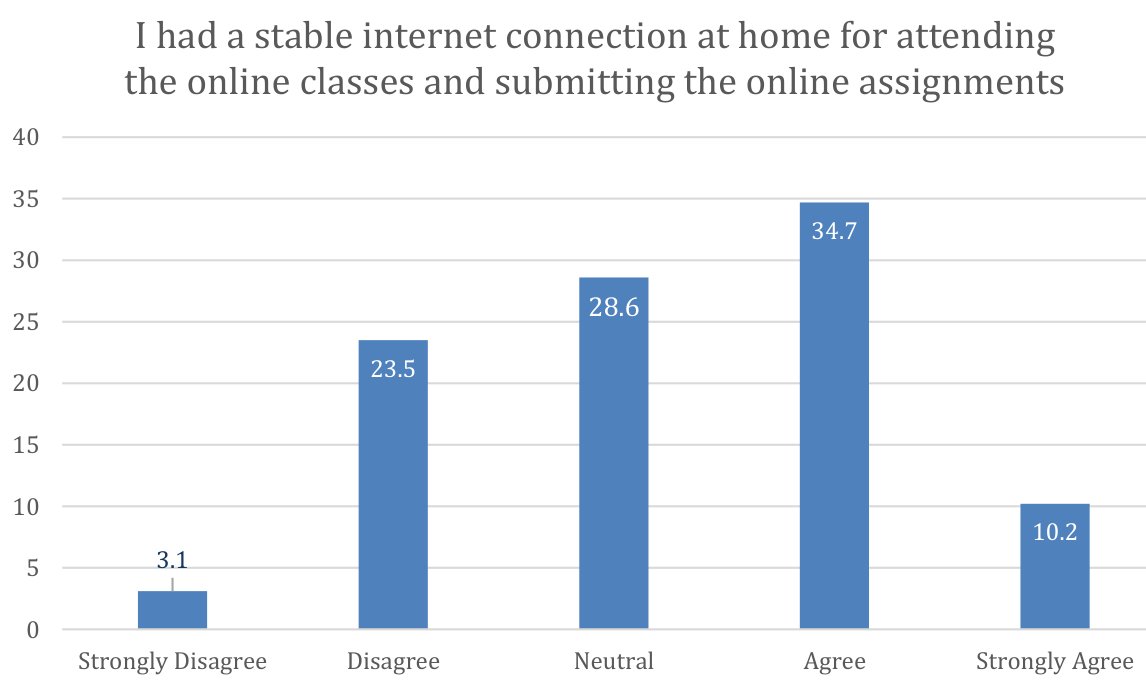
Feedback from the students revealed that almost all the students used their smartphones to access online classes and assessments. Although more than half the students (53.1%) were comfortable with the online platform, only a third (31.6%) of the students felt these classes were more convenient than traditional classes It is likely that the students found online classes less convenient as more than half of them (55.1%) had unstable internet connection at home. Stable internet connection is essential for attending the online classes and submitting the online tests or assignments. Poor internet connectivity could be very frustrating to students as they would not be able to participate in classes, tests, or assignments. Additionally, during the lockdown, when the students needed to print the provided content, only 38.8% of them had access to a printer.
Almost all the students (85.7%) felt that interaction between teacher and students is important for effective learning, however they felt that online teaching was not as effective as face-to-face sessions.
Half the students thought that online classes didn’t facilitate good teacher-student interaction. Teachers strive to engage students during classes using different methods. Many studies have explored the efficacy of various strategies to engage students online, such as using audio visual tools or asking students to respond to questions, etc. 9,10 For some topics, it may be better to record a lecture and share it with the students. Thus, students could watch these recorded lectures anytime. Physical classes where possible, should be more activity or discussion based rather than a lecture and should have good interaction between the students and teacher.
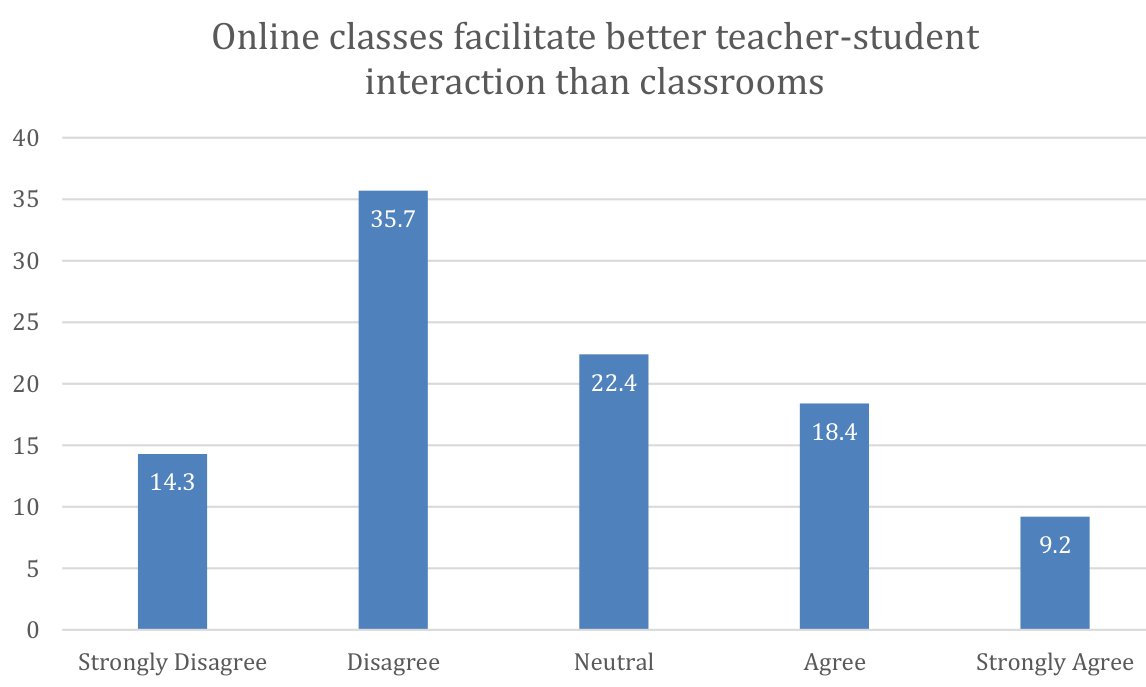
Almost two-third of the students felt that online classes did not facilitate better communication of students with teachers.
During an online class, the teacher should make attempts to engage as many students as possible. The teacher could randomly call out names of students and ask questions, opinions, etc. 11 The chat box and the breakout rooms on Microsoft Teams can also be used for the discussions during class. 12
Additionally, smaller groups of students for online teaching sessions would ensure better interaction and participation by the students. This could be done by using the breakout rooms feature on Microsoft Teams. 13 Before the session starts, the teacher can create multiple breakout rooms for activities in smaller groups. The teacher can enter any breakout room at any time, thus allowing the teacher to monitor the groups’ activity. The chat box and notepad features can facilitate discussions both among students and with the faculty.
The teacher could even use the online platform for Flipped classes. To facilitate good and effective flipped classes, the students should be given reading materials and assignments well in advance. 14 Almost three fourth of the class (72.4%) found it easy to access and complete the online Forensic Medicine assignments, and 87.8% of the class found the faculty’s instructions to be clear.
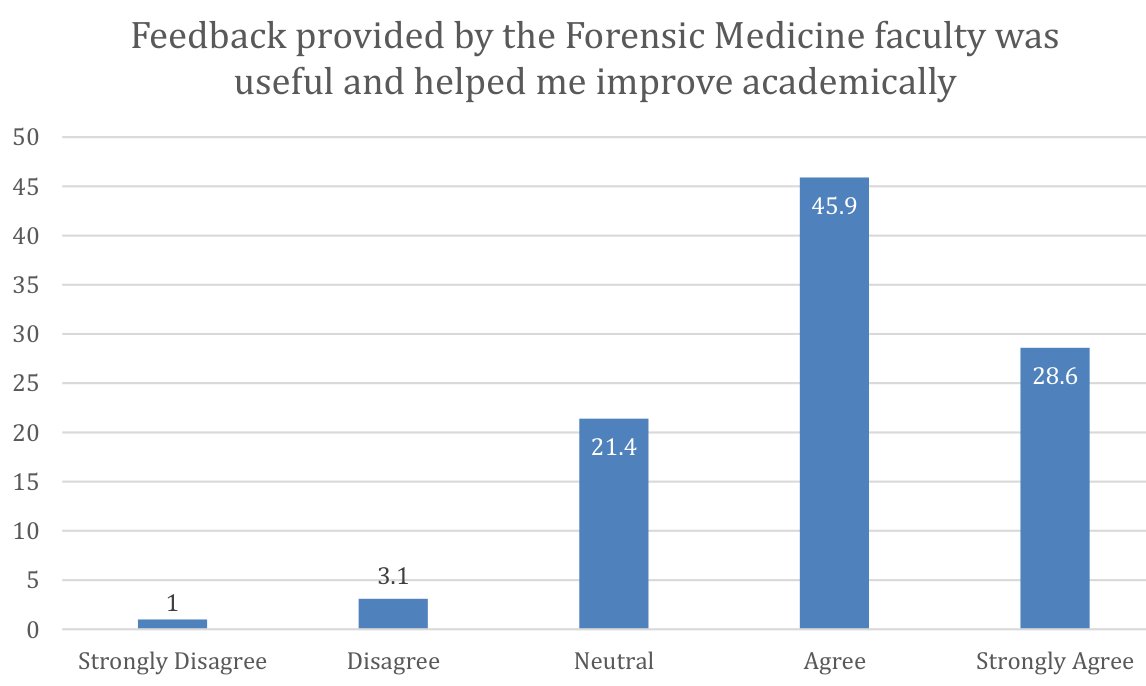
Microsoft Teams also have provisions for giving feedback to the students. Each student can be given individual written feedback on their assignments or test submissions. Students should be given timely feedback on their performance during the online teaching session and on their overall progress. 15 Majority of the surveyed students (80.6%) felt that the Forensic Medicine faculty provided timely feedback after the tests. Nearly three-fourth of the students (74.5%) believed that feedback provided by the Forensic Medicine faculty helped them improve their academic performance.
To make the teaching program more robust, feedback should be taken from the students regarding the teaching session, materials, and engagement methods.13 Of the students surveyed, 67.4% felt that the learning resources and study materials are more easily accessible for online classes than the traditional classes. Majority of the students (79.6%) agreed that the study material and resources for Forensic Medicine online classes was well organized; and 64.3% thought it was easy to participate in the Forensic Medicine online tests.
Numerous vivas were conducted for the students over the duration of the online course. Majority of the students (89.8%) felt that the vivas were helpful in learning the subject. At the end of the course, 12 students participated in a focus group discussion. All these students stated that the multiple vivas conducted helped them study the subject better. The students felt that they were graded accurately in each of the vivas. They also appreciated the individual feedback that was provided at the end of each viva to each student. It helped them correct their mistakes and clear any doubts.
The feedback given by the teachers helped them understand how to answer questions and how to read from the textbooks. The students also strongly felt that the mock practical exams helped them prepare for the exams well. The students found the video recording of various topics very useful. The students also appreciated that the vivas were coordinated with the previous assignments, tests, etc. However, the students felt that the correction of assignments and tests should have been lenient.
According to the teachers, of all the assessment methods used, vivas conducted via video calls were the most authentic assessment. It allowed them to truly assess the level of understanding a student had of the topic in question. After each viva, the teacher was able to discuss the performance with the individual student during feedback and offer suggestions for areas that needed improvement. The teachers felt that more weightages should be given for marks scored on viva than marks scored by online tests and assignments. The students scored an average of 29.13% marks for offline tests as compared to an average of 64.24% for online tests. In comparison, the students scored an average of 71.47% on the vivas. The discrepancy in the online and offline marks for the students can be due to the change in the pattern of tests.
The online tests were predominantly MCQ based tests while the offline tests included essay and short note type questions.
The teachers felt that they required more time to prepare for online classes and that it was challenging to convert each class to an online model. It was also difficult to keep all the students engaged during a session. Once the students were accustomed to communicating with the teacher via the chat function, there was markedly increased participation during class. The teachers also expressed that they were often uncertain if a student attending the session was paying attention. They also felt that there is scope for blended learning and asynchronous learning, and these should be explored in the future. One of the major issues faced by the teachers was limitations in bandwidth, signal drops or loss, etc. which disrupted the flow of the sessions.
Online classes often have technical glitches which is a major pitfall. About 77.6% of the students experienced some form of technical problems over the course of the online classes. More than a third of the students (39.8%) felt that technical difficulties they faced during the online classes negatively affected their learning.
Adopting any new technology can always be daunting, similarly using online teaching programmes can be challenging for novice users. The faculty need to be trained to use the various online tools available. As educators, we should be mindful that internet connectivity in various parts of our country is not the best and as a result there can be a lag, dropped signals, failure to share screen, poor audio and or video quality, etc. When asking a question, we should take a longer pause than we do in face-to-face sessions to allow for the students to unmute and respond or type in the chat box. This allows all the students time to hear and respond to the question.
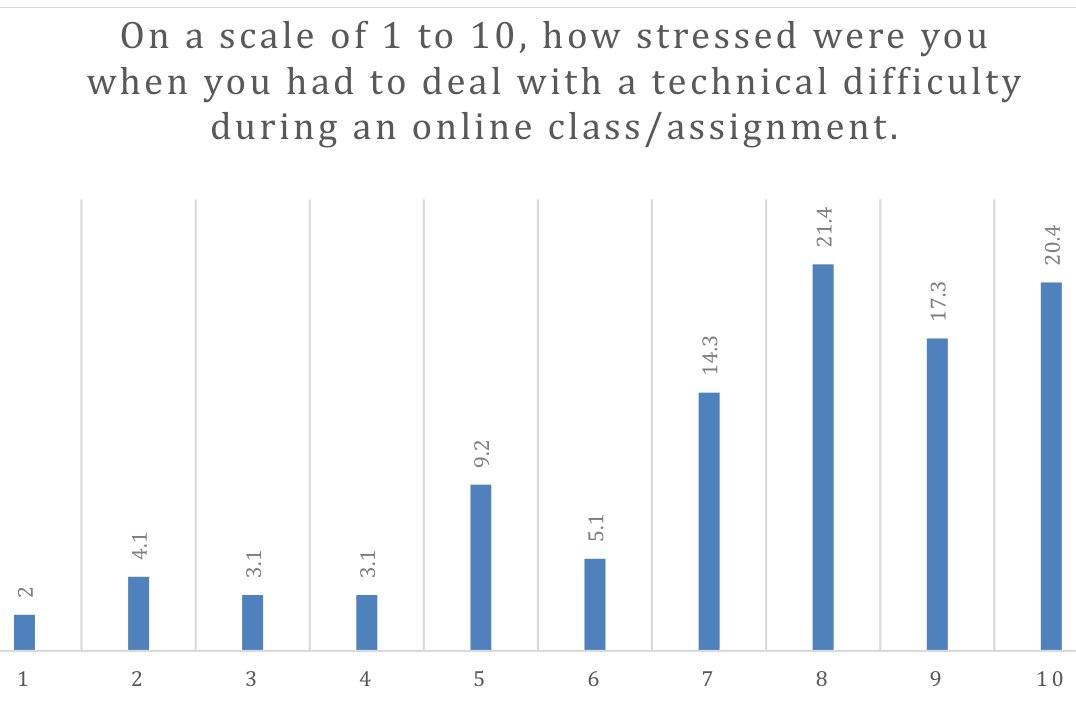
Students have also expressed concern regarding getting adequate practical or clinical exposure through an online platform. On analysing the feedback, 56.2% firmly believe that online Forensic Medicine practical classes cannot replace traditional practical classes.
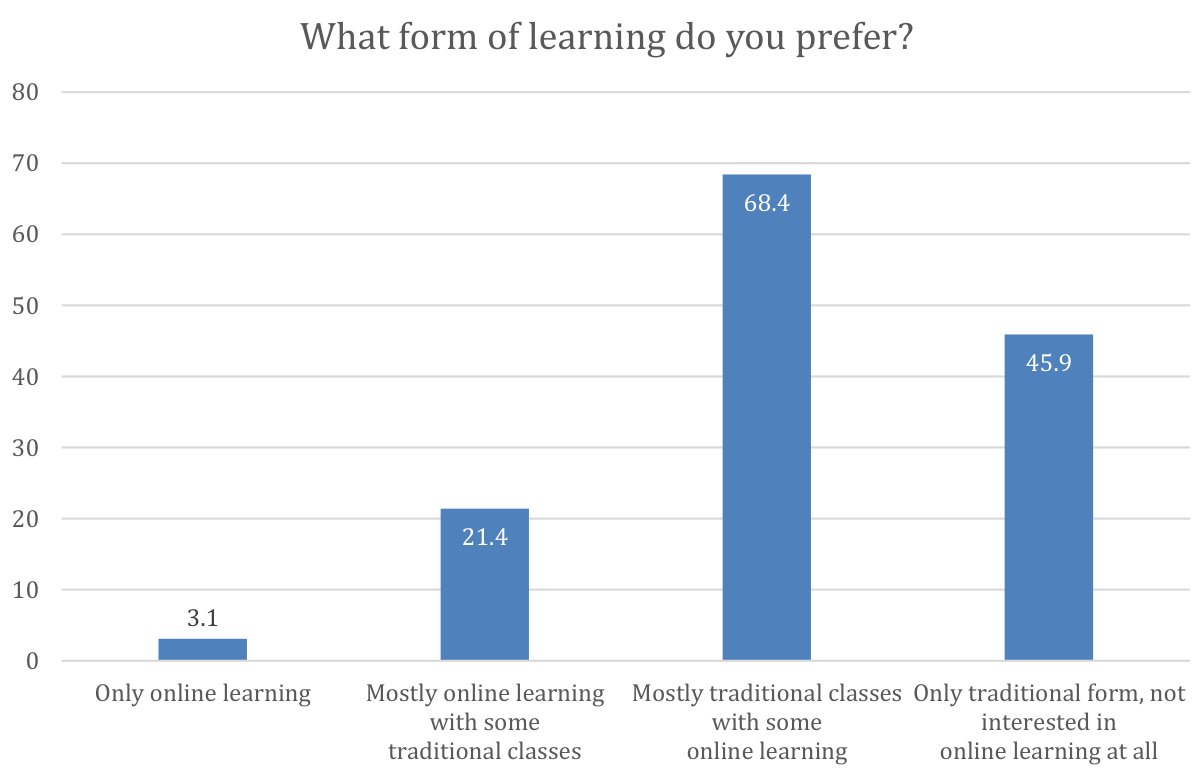
As teachers, it is also useful to employ a variety of activities to engage students so that they remain engaged over the duration of the course. A teacher can include snippets of videos, polls, and surveys, and use white boards, annotation functions, word clouds, social media and gamification techniques to engage students. Despite use of a variety of online tools, less than half (46.9%) were satisfied with online learning experience. 68.4% of the class still preferred traditional classes but would like it to be combined with some online learning as well. In contrast, more than a fifth of the class (21.4%) considered mostly online learning with some traditional classes to be ideal.
CONCLUSION
This study highlights the impact of shifting to online teaching for undergraduate medical students due to the COVID-19 pandemic. A myriad of technical issues may prevent our teachers and students from completely embracing this modality.
The benefits of online teaching like convenience and versatility of options will likely see it being used in teaching medical students long after the pandemic is over.
Technological issues can plague any planned online session, and this may be frustrating and disheartening. We should always keep these possibilities in mind and prepare a backup plan.
Online teaching does not mean that we should expect less from students. We should constantly innovate and consider alternative ways for students to demonstrate their knowledge and skills through the online platform. There are lots of tools being constantly developed to address the challenges of teaching many skills and competencies remotely using digital resources. Faculty should try to stay abreast with these new developments and utilize them where feasible to teach and engage with the students.
Limitations of the study
Since the feedback was anonymous, statistical correlations of variables could not be done. The assessment methods used during the offline and online parts of the course were different and hence direct comparison of student performance could not be done.
ACKNOWLEDGMENTS
The authors would like to thank Dr. Priyanka Daniel for her valuable insights and critical inputs.
Source(s) of financial support: None
Ethical Committee Clearance: Not applicable
Declaration of interests
We declare no conflicting interests
References
- Albarrak A. Education in a technological world: communicating current and emerging research and technological efforts [Internet]. 1st ed. Formatex Research Center; 2011. Available from: http://www.formatex.info/ict/book/147-153.pdf ↑
- Shachar M, Neumann Y. Differences Between Traditional and Distance Education Academic Performances: A Meta-Analytic Approach. IRRODL [Internet]. 2003 Oct 1;4(2). Available from: http://dx.doi.org/10.19173/irrodl.v4i2.153 ↑
- Howlett D, Vincent T, Gainsborough N, Fairclough J, Taylor N, Cohen J, et al. Integration of a Case-Based Online Module into an Undergraduate Curriculum: What is Involved and is it Effective? E-Learning and Digital Media [Internet]. 2009 Jan 1;6(4):372–84. Available from: http://dx.doi.org/10.2304/elea.2009.6.4.372 ↑
- Mooney GA, Bligh JG. Information technology in medical education: current and future applications. Postgrad Med J. 1997 Nov;73(865):701-4. PMID: 951918 ↑
- Saiyad S, Virk A, Mahajan R, Singh T. Online Teaching in Medical Training: Establishing Good Online Teaching Practices from Cumulative Experience. Int J Appl Basic Med Res. 2020;10(3):149-155. PMID: 33088735
- Orlearns M: Cases on Critical And Qualitative Perspectives in Online Higher Education. DeMarco A, Wolfe K (ed): IGI Global, Hershey, PA; 2014. ↑
- Edginton A, Holbrook J. A blended learning approach to teaching basic pharmacokinetics and the significance of face-to-face interaction. Am J Pharm Educ. 2010;74(5):88. PMID: 20798797 ↑
- Rajab MH, Gazal AM, Alkattan K. Challenges to Online Medical Education During the COVID-19 Pandemic. Cureus. 2020 Jul 2;12(7):e8966. PMID: 32766008 ↑
- Britt M. How to better engage online students with online strategies. Coll Stud J 2015; 49:399–404. ↑
- Ozogul G. Best Practices in Engaging Online Learners Through Active and Experiential Learning Strategies. Interdisciplinary Journal of Problem-Based Learning [Internet]. 2018 Mar 9;12(1). Available from: http://dx.doi.org/10.7771/1541-5015.1764. ↑
- Gill D, Parker C, Richardson J. Twelve tips for teaching using videoconferencing. Med Teach. 2005 Nov;27(7):573-7. PMID: 16332546 ↑
- Ellaway R, Masters K. AMEE Guide 32: e-Learning in medical education Part 1: Learning, teaching and assessment. Med Teach. 2008 Jun;30(5):455-73. PMID: 18576185 ↑
- Piotrowski A, Robertson M. Engagement Across the Miles: Using Videoconferencing With Small Groups in Synchronous Distance Courses. J Empower Teach Excell 2017; 1:8. Available from: https://digitalcommons.usu.edu/jete/vol1/iss2/8. ↑
- Moffett J. Twelve tips for "flipping" the classroom. Med Teach. 2015 Apr;37(4):331-6. ↑
- Junco R. The relationship between frequency of Facebook use, participation in Facebook activities, and student engagement. Computers & Education [Internet]. 2012 Jan;58(1):162–71. Available from: http://dx.doi.org/10.1016/j.compedu.2011.08.004 ↑