
Introduction
Millions die every year and many of them undergo a postmortem examination or autopsy [1]. In the UK, 79,400 deceased underwent a postmortem examination in the year 2020 which accounted for 39% of all deaths [1]. Forensic autopsy is an essential part of medicolegal death investigation which are conducted by pathologists. There is a shortage of forensic pathologists worldwide. For instance, in the United States, the National Research Council identified a shortage of forensic pathologists. The similar finding from UK as royal college of pathologist reported shortage in forensic pathologist in 2017 [2, 3].
There is a huge need to develop advanced methods to enhance the practice of autopsy, reduce workload, and increase the quality [4]. Different novel tools are proposed and implemented to enhance the quality of autopsy. However, most of these tools focus on decreasing invasive nature of the traditional or conventional autopsy or as an ancillary to the traditional autopsy. One such good example is the introduction of computed tomography (CT) enhanced autopsy practices [5, 6]. The present proposal focusses on a grossing workstation for autopsy with many advantages.
Significance of the present proposal
The value of autopsy is immense for medicolegal death investigation. During the autopsy, the forensic pathologist needs to examine, measure, weigh, photograph the body organs and cavities to document presence or absence of disease or trauma.
Dissecting or grossing organs is an essential step during the autopsy which should be documented as evidence. These steps may increase significant amount of time of the autopsy procedure as pathologist needs to enter the data, measure and weigh organs, and photograph the organs and cavities while removing and replacing gloves or with the assistance of another personnel.
Photographing during autopsy is essential to document the evidence. Number of technical challenges include proper framing, background color, inclusion of scale, case number or identifier.
Photographs of internal organs carries more technical difficulties because of light reflections, and correct exposure [7]. In addition to the substantial amount of time taken during the grossing phase, one of the difficulties is getting photographs of the specimens. This is usually either taken by the forensic pathologist who takes time to adjust the angle and focus, or with the help of a photographer. Besides, there is a risk of missing the chain of custody and mixing specimens and organs of the deceased with others. Therefore, the forensic pathologist adopts to inserting the case number in front of the specimen during photographing.
Afterall, the forensic pathologist may skip or may not complete all steps during the examination. Recording the data on dimensions or measurements also may add to the time hurdle.
The proposed grossing workstation for autopsy
In light of the aforementioned difficulties faced while conducting the autopsy, a new proposal is being made where the technology based grossing workstation (Figure 1) comprising of camera, electronic scale (for measurements and weight), ultrasonic transduce, computer device to store data, screen to show and connect the case number to the specimen and time of the examination is used [8].
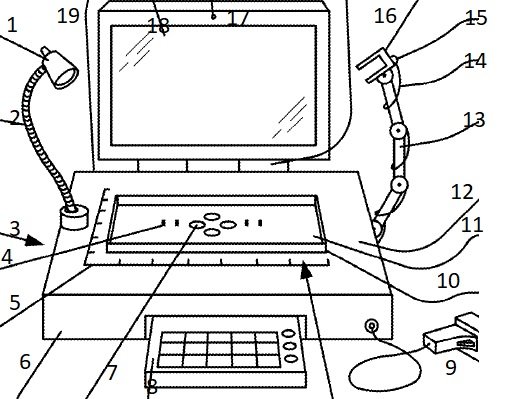
1: Light · 2: Flexible arm · 3: Scale · 4: Electrode · 5: Metric ruler · 6: Front Side · 7: Ultrasonic transducer · 8: Button panel · 9: Barcode Scanner · 10: Side edge · 11: Pan · 12: Top side · 13: Supported arm · 14: Cable · 15: Automatic imaging button · 16: Camera holder · 17: Microphone · 18: Screen · 19: Back side
The stations are flexible for free movement, adjusting angles for appropriate photographs and examination. In addition to the light source, this arrangement enhances examination and photographing.
The workstation can be enhanced by adding voice recorder (dictating), sensors, thermometer, barcode reader, connected to the network to save the data on the clouds [8].
Advantages of the proposed grossing workstation
The proposed arrangement of a grossing workstation for autopsy has the following advantages:
• Keeps safe the chain of custody; as barcode reader will identify the deceased and record all data in the related files in the memory.
• Using visual aid and photographs in reliable approach would aid the presentation at the courts. Digital connection of all photographs recorded at a specific time and date with the deceased file would prevent missing or exchange of photographs.
• Electronically recording information and storing data would prevent loss of papers, etc.
• Avoids missing any part of the postmortem examination. All integrated services would promote the examination by recording and reminding of completing all steps.
• Reduce time to conduct postmortem examination is one of the major advantages for a forensic pathologist.
• Digital manner of measuring, weighing, adjusting angles for pathologists would enhance the quality of examining and photographing the organs.
• Handling devices between pathologists, technicians, photographer and camera that moves out of the mortuary for photograph download would increase the exposure to biohazards.
All built in workstation would decrease exposure to biohazards.
• Decreases the need for extra personnel or photographer.
Conclusion
The present proposal of a grossing workstation uses technology to primarily enhance the practice of autopsy. It will decrease the need for extra personnel and photographers and decreases the chances of exposure to biohazards in addition to other advantages. I recommend further studies to validate and experiment proposed device to conclude valid result and possible use in future.
More research to utilize technology in practice is recommended.
Mohammed Madadin
References
- Ministry of Justice, United Kingdom. Coroner’s statistics 2020: England and Wales. 2021. https://www.gov.uk/government/statistics/coroners-statistics-2020/coroners- statistics-2020-england-and-wales (Accessed 20 September 2021). ↑
- Scientific Working Group for Medicolegal Death Investigation. Increasing supply of pathologists in the United States. 2012. https://www.nist.gov/system/files/documents/2018/04/24/swgmdi_increasing_the_supply_of_forensic_pathologists_in_the_us.pdf (Accessed 21 September 2021). ↑
- The Royal College of Pathologists. https://www.rcpath.org/discover- pathology/news/college-report-finds- severe-staff-shortages-across-services-vital-to-cancer-diagnosis.html (Accessed 30 November 2021). ↑
- Lathrop SL, Nolte KB. Utility of postmortem x-ray computed tomography (CT) in supplanting or supplementing medicolegal autopsies. 2016. https://www.ojp.gov/pdffiles1/nij/grants/249949.pdf (Accessed 18 September 2021). ↑
- Langer R, Trohler A, Schnuriger B, Trippel M, Blank A, Banz Y, et al. Implementation of modern tools in autopsy practice: the way towards contemporary postmortal diagnostics. Virchows Arch 2019;474:149-158. ↑
- Weiss D, Mcleod-Henning D, Waltke H. Using advanced imaging technologies to enhance autopsy practices. NIJ Journal 279, 2018. https://nij. gov/journals/279/Pages/using-advanced-imagingtechnologies-to-enhance- autopsy.asp. Accessed 30 August 2021. ↑
- Sadler D. Better clinical and post mortem photography: a crash course in ten technical tips. J Forensic Leg Med 2019;67:49-60. ↑
- Madadin M. Grossing workstation with electronic scale. United States Patent No. US 11,099,057 B2. 2021. ↑