



Introduction
A person has legal existence between recorded time of birth and death. Apart from this legal Importance, recording of births and deaths creates vital basic data about the population group. As per Registration of Birth and Death Act (RBD Act) – 1969, registrations of these events are mandatory.1 Registration of not only the occurrence of death but its cause is equally important. Statistical analysis of cause of death certificates generates important mortality and morbidity statistics which is the backbone of National Health Policy and Planning.
The RBD Act, 1969 has a provision for Medical Certification of Cause of Death (MCCD) under Section 10(2), section 10(3) and section 17(1) (b). The MCCD scheme is basically a part of International Statistical Classification of Diseases and related health problems (ICD) formulated by WHO. As such, the causes of deaths are classified according to ICD and MCCD (form no. 4/4A of RBD Act).
It is envisaged with the implementation of RBD Act that the cause of death of an individual would be followed within the system. However, it is apprehended that the implementation and coverage of MCCD scheme is not uniform at all levels. The reasons may range from lack of knowledge to indifference and Ignorance. India is suffering from this drawback since quite decades and a reformation needs to be in order.
The need of the hour is therefore to focus on efforts by way of imparting training to medical personnel and subsequently generating quality data of utmost importance and also extending a helping hand in implementing the MCCD scheme in true sense. Therefore this study intend to scrutiny the deficiencies in the filled up MCCD forms of a tertiary care center in central Gujarat.
Aim
To appraise the deficiencies in filled up MCCD forms
Objectives
To identify the inaccuracies in MCCD forms
To identify and focus on the inaccuracies while imparting training through dedicated workshop
Material and Methods
The study had been conducted at Department of Forensic Medicine, in a tertiary care hospital of Central Gujarat, after sanction of approval from the Institutional Ethics Committee. Permission from Medical record section of the institution had also been obtained to collect dully filled MCCD forms of past three consecutive months. The forms were scrutinized for deficiencies/discrepancies according to preformed data collection sheet. One hundred and fifty MCCD forms of past three months were scrutinized in terms of accuracy of all vital data. The collected data were transferred to spread sheet of Microsoft Excel and analyzed in percentage of discrepancies found.
Further, one workshop had been organized for 57 resident doctors to impart proper knowledge pertaining to correct filling of MCCD forms. A pre and post test was also conducted through a validated questionnaire. The data obtained was analyzed using Microsoft excel and expressed in percentage, reflecting correct and incorrect answers.
Result
| Sr. No. | Column in MCCD | Discrepancy Found in the MCCD forms | Discrepancy Found (%) | |
| 1 | Type of form used (Form 4/4a) | 61 | 38.1 | |
| 2 | Name of the hospital | 63 | 39.4 | |
| 3 | Date & Time of death | 8 | 5 | |
| 4 | Name of the deceased | 40 | 25 | |
| 5 | Age at death | 76 | 47.5 | |
| 6 | Sex | 101 | 63.1 | |
| 7 | Cause of death | Cause of death column left blank | 9 | 5.6 |
| Cause of death illegible | 31 | 19.4 | ||
| Chain of events incorrect | 76 | 47.5 | ||
| Cause of death is written in abbreviation | 76 | 47.5 | ||
| Multiple causes mentioned in single line | 115 | 71.9 | ||
| Modes of death stated as cause of death | 80 | 50 | ||
| 8 | Time interval between cause & death | 149 | 93.1 | |
| 9 | Manner of death | 56 | 35 | |
| 10 | Detail of female death | 70 | 43.8 | |
| 11 | Name and signature of RMP | 71 | 44.4 | |
| 12 | Date | 68 | 42.5 | |
| 13 | Death slip detached | 19 | 11.9 | |
As per the data depicted in table no.1, approximately 38% of MCCD forms were “Form 4A” instead of “Form 4” even if they belonged to tertiary care hospital deaths. Discrepancies were found in name of the hospital as to render it difficult to identify. Names of the deceased were written either in short forms or only first/last name mentioned. Date and time of death as well as age and sex of the deceased were not written in accordance with the statutory guidelines in 5%, 25%, 47.5% and 63.1% forms respectively. Discrepancies were found in columns of “cause of death” ranging from 5% to 50% of the total MCCD forms in context to column left blank or filled with illegible hand writing or cause of death mentioned in abbreviation as well as incorrect chain of events. It was also observed that 72% of the forms were showing multiple causes of death entered in single line. Modes of death for example cardio respiratory failure or multi-organ failure were mentioned without mentioning underlying actual cause of death in 50% of the cases. Approximately 93% of the forms did not mention time interval between onset of conditions leading to death and the time of death. Discrepancies were found in manner of death, details of female death, date, name-signature of RMP in the form of columns left blank or incompletely or incorrectly mentioned. Only 12% of the forms were showing detachment of the death slip rest of all were still having death slip attached.
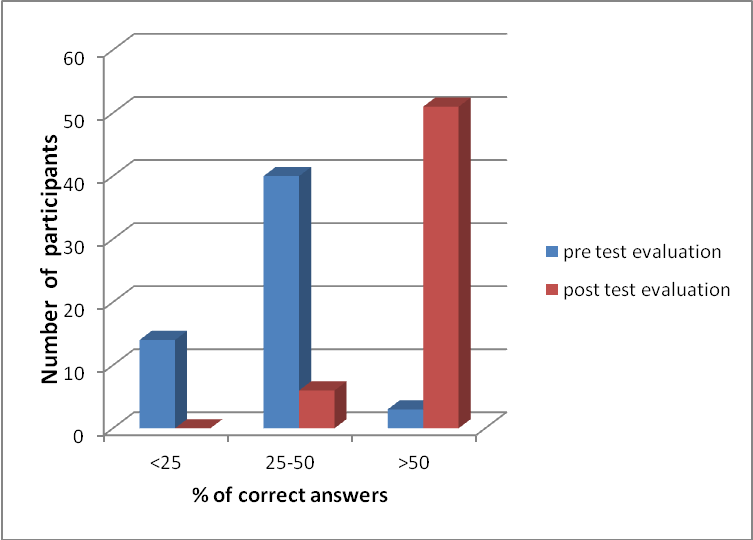
It has been observed that in pre test evaluation (consisting of 20 questions pertaining to MCCD form) 14 participants could answer only 5 questions correctly. 40 participants could answer correctly in range of 6-10 questions and only 3 participants could answer more than 10 questions correctly. However, post test evaluation was showing 51 participants obtaining more than 50% marks (more than 10 questions answered correctly), 6 participants obtained marks in between 25 to 50% and none obtained marks less than 25%.
Discussion
As per section 8.1b & section 10.3 of the Registration of Births and Deaths Act, 19691 in the event of the death of any person, who was attended by a medical practitioner during his last illness, the medical practitioner is bound to issue a death certificate mentioning the cause of death in the prescribed form stating to the best of his knowledge and belief. If the medical practitioner fails to do so, he would be liable for punishment under section 23.3 of the act. A standard format for MCCD is prescribed and discussed in detail by office of the Registrar General of India in physician manual on MCCD,2 which is periodically revised.
In a study conducted by Agarwal et al.3, modes of death mentioned as immediate cause of death in 86% while in present study it is in 50% of the MCCD forms. Same study found manner of death incorrectly filled in 44% of the forms while it was 35% in the present study. Data in regards to female deaths were found incorrect in 40% whereas in present study it is found in approximately 44% of the forms. An important component of MCCD form which carry great statistical importance, i.e. time interval between onset of conditions leading to death and time of death were incorrectly filled in 63%, however in present study it is filled with discrepancies in 93% of the forms.
In yet another study by Jain et al.4, terms used to describe modes of death like cardiac arrest, cardiac shock, sudden cardiac failure, respiratory failure, respiratory paralysis, respiratory arrest etc. were mentioned in 82.2% cases, while in present study it is found in 50% of the cases. The interval between onset and terminal event of various conditions was written in 7.2% cases, while in present study it is not filled or filled with discrepancies in almost 93% of the cases.
On comparison with Ganasva et al.5 study, mechanism of death was written in 69.6% certificates, while in present one it is written in only 50% of the certificates. Improper sequences of events were mentioned in approximately 18% of the forms, whereas in present study it is found in 47.5%. Approximately 4% of the forms did not mention any cause of death in any line of medical part of MCCD form, while in present study 5.6% of the forms were found with cause of death column left blank. Use of abbreviations as a means of identifying diseases were found in 37.2% of the forms, while in present study it is found in 47.5% of the forms. Illegible writing was found in 44.3% of the forms, while in present study it is found in 19.4% of the forms.
All the above comparative analysis reveals that apart from minor details, crucial part of MCCD forms like cause of death, time interval and manner of death is also shirked in major proportion by certifying medical practitioners. This neglectfulness may lead to incorrect, misleading or incomprehensive morbidity and mortality statistics. And the positive outcome of the workshop tests indicates that proper measures may improve the attitude, knowledge and skill in this regard.
Conclusion
Filling of the MCCD form still carry astonishing degree of inaccuracies even after multipronged rigorous efforts taken by the concerned bodies. It will certainly have a negative impact on the very cause of this scheme. The scale of declining inaccuracies after a dedicated workshop, reflected by pre and post test is a good omen. Present study may generate a stimulus to realization of the sorry state and necessity to adopt reformulation in its execution. The study may bring to a close that painstaking efforts must continue for the successful implementation of MCCD scheme at all levels.
References
- Govt. of India. Ministry of Home Affairs; The registration of Birth and Death Act, 1969. Section 10(3) ↑
- Physician’s manual on Medical Certification of Cause of Death. Vital statisticsDivision,Office of the Registrar General, India. Ministry of Home Affairs, NewDelhi, 4th edition. ↑
- Agarwal SS, Kumar V, Kumar L, Bastia BK, Chavali KH. A study on appraisal of effectiveness of the MCCD scheme. ↑
- Jain K, Bala DV, Trivedi K, Chandwani H. Situational analysis of medical certification of cause of death (MCCD) scheme in municipal corporation of Ahmedabad. Indian Journal of Forensic and Community Medicine. 2015 Apr;2(2):95-9. ↑
- Ganasva AS, Bariya BR, Damor JR, Mazumdar V. Accuracy in completion of death certificate in Vadodara Municipal Corporation of Gujarat, India. Int. J. Med. Sci. Public Health. 2016;5(6):1148-52. ↑