


Introduction
Forensic limnology involves the study of freshwater ecology and the diatoms are especially useful in linking suspects and victims to crime scenes in or around fresh water [1-13]. Diatoms are unicellular algae with a unique two-part, glass-like wall of hydrated silica. Diatom species are easily identifiable due their characteristic shape of the cells and unique refractive pattern caused by the silica in the cell wall [1]. Diatom tests are used routinely in the diagnosis of drowning [6] and in estimating the post-mortem interval, or time since death [7, 14]. Drowning is distinguished from many other violent causes of death since the pathology of drowning does not correlate with the manner of death. Unlike manual strangulation, multiple gunshot wounds, and multiple blows to the head which are almost always homicidal, the postmortem findings in homicidal and accidental drowning are indistinguishable [8-9, 15]. This matter is further complicated by considering the more general case of a dead body recovered from water. In principle, a body recovered from water does not mean drowning as the cause of death even if the death occurred in water [10].
Diatom tests are performed for investigation of drowning related cases mainly in two ways- either internal organs/tissue of the dead body or the physical evidences recovered from drowning cases [11-13]. In India, diatom tests are performed from internal organs/tissue of the dead body but efficacy of physical evidences for diatom test related to drowning cases are not considered or used in any forensic investigations. The frequency of drowning cases is very high in West Bengal, India due to high incidence of homicidal, suicidal, and accidental drowning. Diatoms may not always present in all the drowning cases but if they are retrieved from body parts of the deceased or from any object related to victim or assailant they may act as a tool in solving drowning related crimes. So, the present experiment was chosen with an aim to check the potential of fresh water diatoms to associate victim, suspect and objects with aquatic crime scenes using physical evidences like shoes, cloths, hair, rope etc.
Materials and methods
An experimental mock case was designed at Ballygunge campus pond (Ballygunge Science College) of University of Calcutta, India (22°31' N, 88°21' E). One volunteer acted as a “victim” and another as an “assailant”. In the experiment, the “victim” was bound with rope and dragged into the pond by the “assailant”. The victim somehow managed to free himself and complained against the assailant. To link the assailant with the aquatic crime scene, several items were collected as physical evidences (fragment of rope near the scene of crime; mud encrusted shoes and water soaked clothes of the victim, the prime suspect and also two unknown suspects). 5 reference samples were collected (pond sediments and pond water) from the experimental pond (DEP 1, 2, 3, 4 and 5) and 5 samples each from three other ponds as reference from the adjoining places viz., Baruipur (DPB-1, 2, 3, 4 and 5) (22°22' N, 88°26' E), Garia (DPG-1, 2, 3, 4 and 5) (22°27' N, 88°23' E) and North Dumdum (DPN-1, 2, 3, 4 and 5) (22°38' N, 88°24' E) of West Bengal, India. Details of evidentiary and control samples collected for limnological study are mentioned in Table 1.
| Sl. No. | Sample Nos. | Type of samples | Location of sample collection | Latitude | Longitude | |||||
|---|---|---|---|---|---|---|---|---|---|---|
| 1 | DEP - 1 | Soil and water | Experimental pond at Ballygunge campus, University of Calcutta | 22°31'N | 88°21' E | |||||
| 2 | DEP -2 | Soil and water | Experimental pond at Ballygunge campus, University of Calcutta | 22°31'N | 88°21' E | |||||
| 3 | DEP -3 | Soil and water | Experimental pond at Ballygunge campus, University of Calcutta | 22°31'N | 88°21' E | |||||
| 4 | DEP -4 | Soil and water | Experimental pond at Ballygunge campus, University of Calcutta | 22°31'N | 88°21' E | |||||
| 5 | DEP -5 | Soil and water | Experimental pond at Ballygunge campus, University of Calcutta | 22°31'N | 88°21' E | |||||
| 6 | DPB - 1 | Soil and water | Pond at Baruipur | 22°22' N | 88°26' E | |||||
| 7 | DPB – 2 | Soil and water | Pond at Baruipur | 22°22' N | 88°26' E | |||||
| 8 | DPB -3 | Soil and water | Pond at Baruipur | 22°22' N | 88°26' E | |||||
| 9 | DPB -4 | Soil and water | Pond at Baruipur | 22°22' N | 88°26' E | |||||
| 10 | DPB -5 | Soil and water | Pond at Baruipur | 22°22' N | 88°26' E | |||||
| 11 | DPG -1 | Soil and water | Pond at Garia | 22°27' N | 88°23' E | |||||
| 12 | DPG -2 | Soil and water | Pond at Garia | 22°27' N | 88°23' E | |||||
| 13 | DPG -3 | Soil and water | Pond at Garia | 22°27' N | 88°23' E | |||||
| 14 | DPG -4 | Soil and water | Pond at Garia | 22°27' N | 88°23' E | |||||
| 15 | DPG -5 | Soil and water | Pond at Garia | 22°27' N | 88°23' E | |||||
| 16 | DPN - 1 | Soil and water | Pond at North Dumdum | 22°38' N | 88°24'E | |||||
| 17 | DPN -2 | Soil and water | Pond at North Dumdum | 22°38' N | 88°24'E | |||||
| 18 | DPN -3 | Soil and water | Pond at North Dumdum | 22°38' N | 88°24'E | |||||
| 19 | DPN -4 | Soil and water | Pond at North Dumdum | 22°38' N | 88°24'E | |||||
| 20 | DPN -5 | Soil and water | Pond at North Dumdum | 22°38' N | 88°24'E | |||||
| 21 | DV | shoes and clothes of victim | Experimental pond at Ballygunge campus, University of Calcutta | 88°21' E | 88°21' E | |||||
| 22 | DPS | and clothes of prime suspect | Experimental pond at Ballygunge campus, University of Calcutta | 88°21' E | 88°21' E | |||||
| 23 | DS -1 | shoes of unknown suspect - 1 | Unknown | - | - | |||||
| 24 | DS -2 | shoes of unknown suspect -2 | Unknown | - | - | |||||
| 25 | DR | rope | Experimental pond at Ballygunge campus, University of Calcutta | 88°21' E | 88°21' E |
Collection of evidentiary items
Different evidentiary items were collected around the experimental pond, such as, fragment of rope (DR) near the pond that was used to bound the victim, water soaked clothes and mud encrusted shoes of the “victim” (DV) and the “prime suspect” (DPS). After the complaint of the “victim” against the suspected “assailant”, we preferred him as the “prime suspect” of the crime to check the alibi of the victim as true or false.
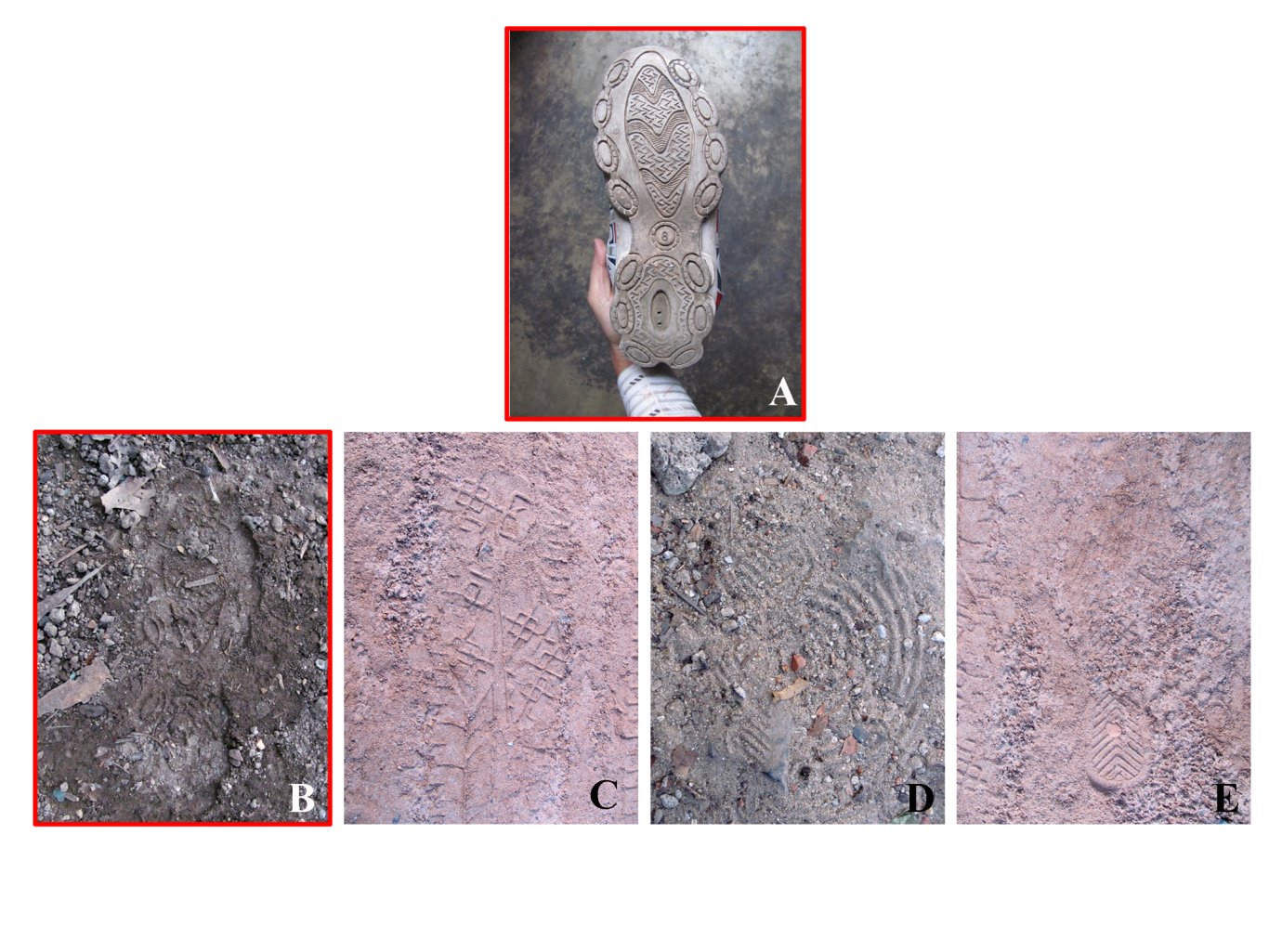
Mud encrusted shoes of two other volunteers acting as Suspect-1 (DS-1) and Suspect-2 (DS-2) were also collected. Soil and water samples from the experimental pond were collected as control. To check the differences in the diatom assemblage of different ponds from adjacent localities, soil and water samples from ponds of three different locations of Kolkata (Baruipur, Garia and North Dum Dum), West Bengal were also collected as reference samples. Some shoe impressions were found around the experimental pond after the experiment. So, the photographs of shoe impression of all types of shoes around the said experimental crime scene were taken as physical evidence (Fig 1). The study aims to correlate the “victim”, the “prime suspect” and the experimental pond using diatom assemblages as well as all possible physical evidences including the shoe prints found at the crime scene. Later, the shoe impression patterns of the “victim”, the “prime suspect” and other two suspects (DS-1 and DS-2) were recorded (Fig 1). Samples for diatom extraction were collected in sterilized plastic bags and then analyzed in the laboratory.
Extraction of diatoms
The methodology for extraction of diatoms from the evidentiary and control water and soil samples were followed as proposed by Siver et al. [10] with some modifications.
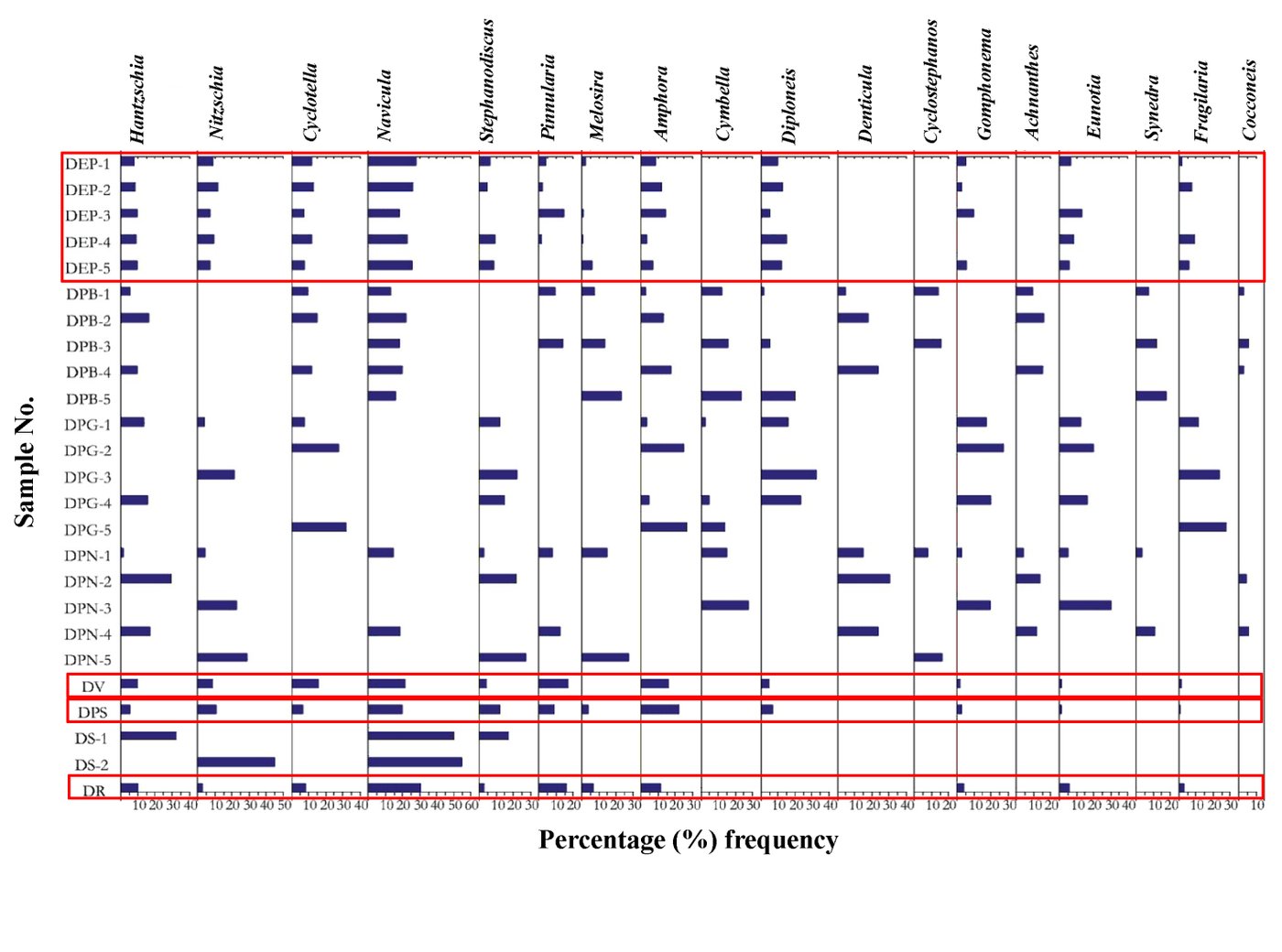
Soil from the shoes and clothes of the “victim” and “prime suspect”, soil from DS-1 and DS-2 and rope were removed by scrapping. Collected soil samples from shoes and clothes were placed into individual glass beakers. Sulfuric acid and potassium dichromate were added to each beaker and the resultant slurries were allowed to settle for 24 hours. Slurries were then transferred to a centrifuge tube, placed into a water bath and boiled for one-hour in order to complete the oxidation of organic matter [16]. After oxidation, each sample was rinsed several times in distilled water and centrifuged at 3000 r.p.m. An aliquot of each resulting mixture was dried onto a glass cover slip and mounted onto a glass slide using polyvinyl alcohol and Euperol. Finally, Qualitative and quantitative analyses of diatoms were conducted (Fig 2).
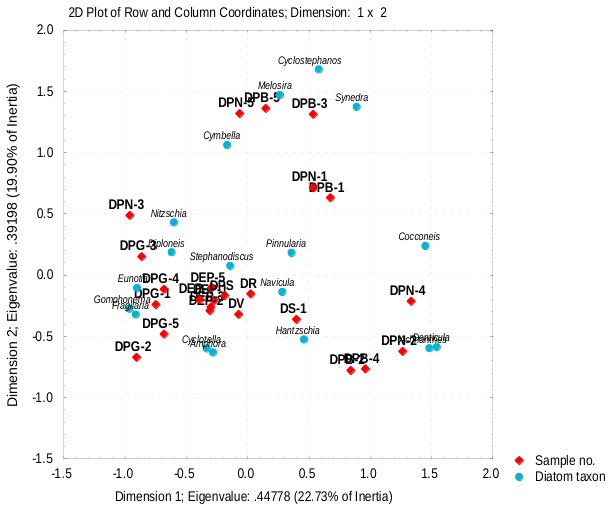
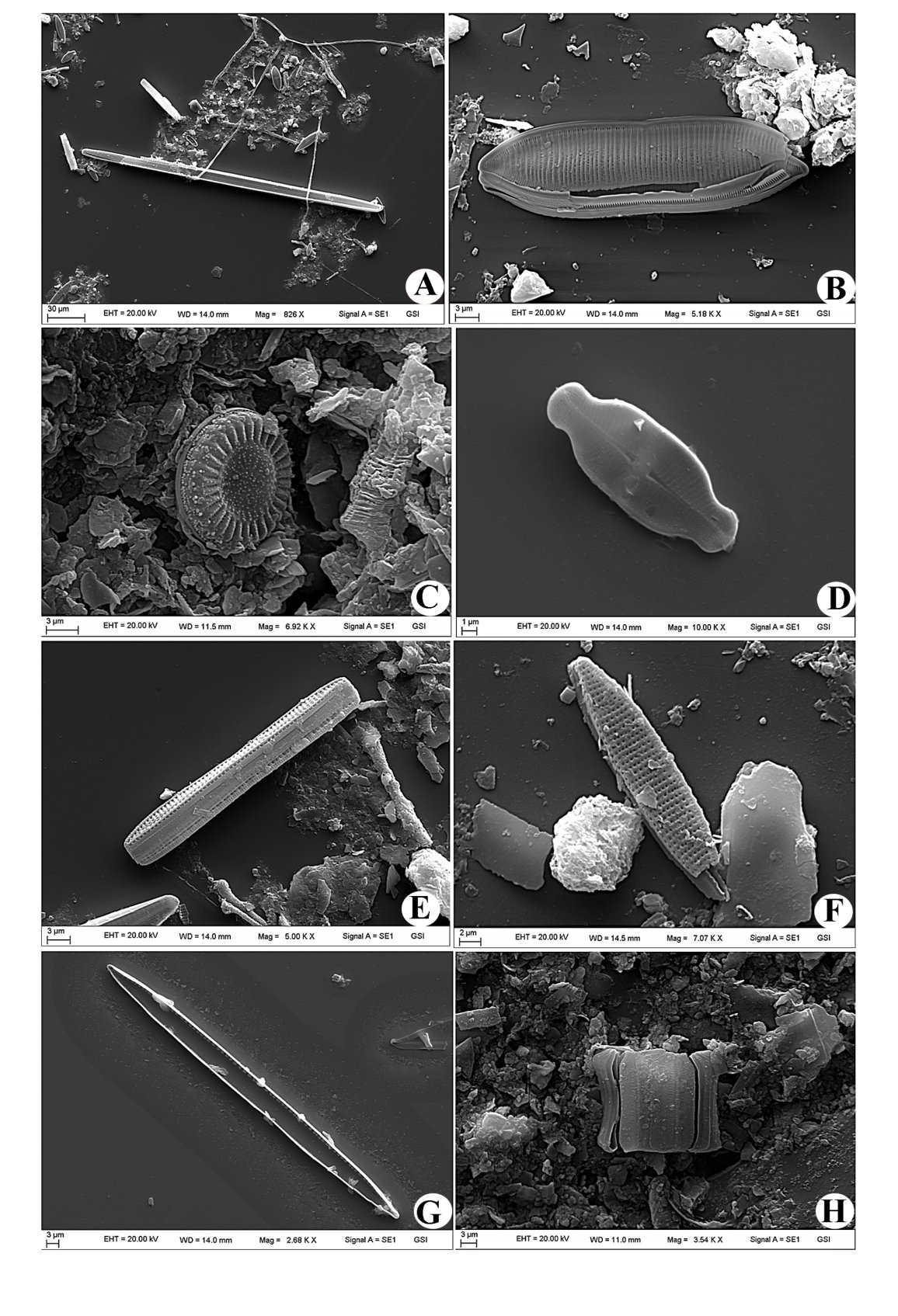
Correspondence Analysis (CA) was performed with the diatom data (Fig 3) retrieved from the studied reference pond samples (water and soil) and evidentiary samples (rope; shoes and clothes of the “victim”, and the “prime suspect”; shoes of DS-1, DS-2). Ultra structural details of fresh water diatoms were studied and photographed by Scanning Electron Microscope (Carl Zeiss EVO 40) at Geological Survey of India, Kolkata (Fig 4). Prepared samples and microscopic slides are deposited in the repository of Palaeobotany- Palynology Laboratory, Department of Botany, University of Calcutta.
Results and discussion
Significant frequencies of diatom assemblages were retrieved from the evidentiary and reference samples of the experimental mock case and frequency diagram was prepared using TILIA and TILIAGRAPH software [17]. The victim’s shoes and clothes (DV) were rich in Hantzschia sp. (9.45%) - Bacillariaceae, Nitzschia sp. (8.54%) - Bacillariaceae, Cyclotella sp. (15.63%) - Stephanodiscaceae, Navicula sp. (21.63%) - Naviculaceae, Stephanodiscus sp. (3.93%) - Stephanodiscaceae, Pinnularia sp. (16.96%) - Pinnulariaceae, Amphora sp. (15.67%) - Catenulaceae, Diploneis sp. (4.56%) - Bacillariaceae, Gomphonema sp. (1.63%) - Bacillariophyceae, Eunotia sp. (0.98%) - Bacillariophyceae and Fragilaria sp. (1.02%) - Fragilariaceae diatom assemblages. Hantzschia sp. (9.98%), Nitzschia sp. (2.51%), Cyclotella sp. (7.98%), Navicula sp. (30.76%), Stephanodiscus sp. (2.77%), Pinnularia sp. (15.87%), Melosira sp. (6.76%), Amphora sp. (10.98%), Gomphonema sp. (3.65%), Eunotia sp. (5.76%) and Fragilaria sp. (2.98%) were recovered from the rope (DR) collected near the experimental pond (Fig 2).
Samples (soil and water) collected from the Ballygunge campus pond (DEP) have yielded the fresh water diatoms like Hantzschia sp. (DEP1-7.44%; DEP2- 8.41%; DEP3- 9.43%; DEP4- 8.98%; DEP5- 9.45%), Nitzschia sp. (DEP1- 8.87%; DEP2- 11.73%; DEP3- 7.51%; DEP4- 9.46%; DEP5- 7.43%), Cyclotella sp. (DEP1- 11.48%; DEP2- 12.98%; DEP3- 7.32%; DEP4- 11.54%; DEP5- 7.92%), Navicula sp. (DEP1- 27.98%; DEP2- 25.89%; DEP3- 17.98%; DEP4- 22.78%; DEP5- 25.76%), Stephanodiscus sp. (DEP1- 6.32%; DEP2- 4.64%; DEP4- 8.89%; DEP5- 8.41%), Pinnularia sp. (DEP1- 3.68%; DEP2- 1.87%; DEP3- 14.89%; DEP4-1.72%), Melosira sp. (DEP1- 1.92%; DEP3- 0.98%; DEP4- 0.38%; DEP5- 5.98%), Amphora sp. (DEP1- 8.34%; DEP2- 11.83%; DEP3- 14.11%; DEP4- 3.43%; DEP5- 6.57%), Diploneis sp. (DEP1- 9.87%; DEP2- 12.55%; DEP3- 5.32%; DEP4- 14.65%; DEP5- 11.78%), Gomphonema sp. (DEP1- 5.28%; DEP2- 2.46%; DEP3- 9.72%; DEP5- 5.43%), Eunotia sp. (DEP1- 6.78%; DEP3- 12.74%; DEP4- 8.66%; DEP5- 5.54%) and Fragilaria sp. (DEP1- 1.98%; DEP2- 7.64%; DEP4- 9.51%; DEP5- 5.73%)(Fig 2).
Hantzschia sp. (DPB1- 5.59%; DPB2- 16.45%; DPB4- 9.63%), Cyclotella sp. (DPB1- 9.34%; DPB2- 14.98%; DPB4- 11.58%), Navicula sp. (DPB1- 12.76%; DPB2- 21.87%; DPB3- 17.83%; DPB4- 19.76%; DPB5- 15.63%), Pinnularia sp. (DPB1- 9.54%; DPB3- 13.87%), Melosira sp. (DPB1- 7.56%; DPB3- 13.76%; DPB5- 23.54%), Amphora sp. (DPB1- 2.87%; DPB2- 12.87%; DPB4- 17.43%), Cymbella sp. (DPB1- 11.98%; DPB3- 15.89%; DPB5- 23.57%), Diploneis sp. (DPB1- 1.71%; DPB3- 5.26%; DPB5- 19.78%), Denticula sp. (DPB1- 4.98%; DPB2- 17.94%; DPB4- 23.78%), Cyclostephanos sp. (DPB1- 13.87%; DPB3- 15.72%), Achnanthes sp. (DPB1- 9.48%; DPB2- 15.89%; DPB4- 14.93%), Synedra sp. (DPB1- 7.54%; DPB3- 11.78%; DPB5- 17.48%) and Cocconeis sp. (DPB1- 2.78%; DPB3- 5.89%; DPB4- 2.89%) were recovered from the pond at Baruipur (DPB) (Fig 2). Whereas, Hantzschia sp. (DPG1- 13.32%; DPG4- 15.89%), Nitzschia sp. (DPG1- 3.96%; DPG3- 21.56%), Cyclotella sp. (DPG1- 7.89%; DPG2- 27.93%; DPG5- 31.87%), Stephanodiscus sp. (DPG1- 11.76%; DPG3- 22.20%; DPG4- 14.84%), Amphora sp. (DPG1- 3.37%; DPG2- 24.88%; DPG4- 4.09%; DPG5- 26.78%), Cymbella sp. (DPG1- 2.67%; DPG4- 4.98%; DPG5- 13.78%), Diploneis sp. (DPG1- 15.89%; DPG3- 32.57%; DPG4- 23.76%), Gomphonema sp. (DPG1- 16.76%; DPG2- 27.56%; DPG4- 19.87%), Eunotia sp. (DPG1- 12.65%; DPG2- 19.63%; DPG4- 16.57%) and Fragilaria sp. (DPG1- 11.73%; DPG3- 23.67%; DPG5- 27.57%) were found in the pond at Garia (DPG) and Hantzschia sp. (DPN1- 1.72%; DPN2- 29.56%; DPN4- 16.87%), Nitzschia sp. (DPN1- 4.65%; DPN3- 22.89%; DPN5- 28.78%), Navicula sp. (DPN1- 14.87%; DPN4- 18.56%), Stephanodiscus sp. (DPN1- 2.87%; DPN2- 21.63%; DPN5- 27.22%), Pinnularia sp. (DPN1- 7.98%; DPN4- 12.62%), Melosira sp. (DPN1- 14.87%; DPN5- 27.44%), Cymbella sp. (DPN1- 15.21%; DPN3- 27.56%), Denticula sp. (DPN1- 14.85%; DPN2- 30.68%; DPN4- 23.67%), Cyclostephanos sp. (DPN1- 7.98%; DPN5- 16.56%), Gomphonema sp. (DPN1- 2.46%; DPN3- 19.45%), Achnanthes sp. (DPN1- 3.98%; DPN2- 13.67%; DPN4- 11.53%), Eunotia sp. (DPN1- 4.98%; DPN3- 30.10%), Synedra sp. (DPN1- 3.58%; DPN4- 10.99%), and Cocconeis sp. (DPN2- 4.46%; DPN4- 5.76%) were retrieved from the pond at North Dum Dum (DPN) (Fig 2).
When the shoes and clothes of the “prime suspect” (DPS) were investigated for diatom study it yielded very interesting results. Hantzschia sp. (5.41%), Nitzschia sp. (10.54%), Cyclotella sp. (6.83%), Navicula sp. (19.54%), Stephanodiscus sp. (12.09%), Pinnularia sp. (8.67%), Melosira sp. (3.89%), Amphora sp. (22.09%), Diploneis sp. (6.76%), Gomphonema sp. (2.87%), Eunotia sp. (0.75%) and Fragilaria sp. (0.76%) were significantly present in the shoes and clothes of the prime suspect. Whereas, Hantzschia sp. (32.52%), Navicula sp. (50.14%) and Stephanodiscus sp. (17.34%) were recovered from the shoes of DS-1 and Nitzschia sp. (45.13%) and Navicula sp. (54.87%) were recovered from the shoes of DS-2 (Fig 2).
Here CA was applied to the percentage frequency data of the 18 diatom taxa from 25 evidentiary and reference samples using the statistical program Statistica 6 (Fig 3). A single cluster consisting of reference samples of the experimental pond (DEP-1, DEP-2, DEP-3, DEP-4 and DEP-5), samples collected from the victim’s shoes and clothes (DV), samples from the prime suspect’s shoes and clothes (DPS) and the fragment of rope (DR) collected near the experimental pond along with the diatom taxa Hantzschia sp. (1), Nitzschia sp. (2), Cyclotella sp. (3), Navicula sp. (4), Stephanodiscus sp. (5), Pinnularia sp. (6), Amphora sp. (8), Diploneis sp. (10), Gomphonema sp. (13), Eunotia sp. (15), Fragilaria sp. (17) is observed in the CA biplot with variance of 22.73% and 19.90% for axis 1 and 2 respectively (Fig 3). Although, ponds at Baruipur, Garia, North Dum Dum and the experimental pond had few diatom taxa in common, but they all had their unique diatom assemblages as reflected in their frequency percentage (Fig 2). This phenomenon has been successfully represented in the correspondence biplot graph with the diatom data of the present experimental case study.
The reference samples at Baruipur (DPB-1, DPB-2, DPB-3, DPB-4 and DPB-5), Garia (DPG-1, DPG-2, DPG-3, DPG-4 and DPG-5) and North Dum Dum (DPN-1, DPN-2, DPN-3, DPN-4 and DPN-5) have showed scattered distribution in the biplot. Diatoms of Suspect-1 (DS-1) and Suspect-2 (DS-2) were also showed scattered distribution.
Interestingly, the frequency diagram (Fig 2) clearly indicates that diatom assemblages of the experimental pond resembling with the diatom assemblages of the clothes/shoes of the victim, fragment of rope and the shoes of the prime suspect. Whereas, diatoms of other reference ponds (Baruipur, Garia and North Dum Dum) shows different types of assemblages.
Again, in the correspondence biplot graph the reference samples of the experimental pond, the “victim”, fragment of rope and the “prime suspect” were plotted in a single cluster along with Hantzschia sp., Nitzschia sp., Cyclotella sp., Navicula sp., Stephanodiscus sp., Pinnularia sp., Amphora sp., Diploneis sp., Gomphonema sp., Eunotia sp. and Fragilaria sp. that strongly correlates the samples with a particular aquatic location. But the reference samples from the ponds of Baruipur, Garia and North Dum Dum have showed scattered distribution in the biplot that differentiates them from the other physical evidentiary samples as well as the experimental pond (Figs. 2, 3 and 4).
Conclusion
Present study indicates that diatoms are excellent forensic tool in associating victims, suspects and objects with aquatic crime scene. Each and every pond has its unique characteristic diatom population which can be used to pinpoint the location where the drowning has occurred. Even in the same locality different ponds and lakes have their distinct diatom communities which may be similar but not identical. The diatom assemblages from the mud of prime suspect’s shoes were significantly similar to diatoms observed in victim’s shoes, rope and experimental crime pond samples (Figs 2 and 3). Pond samples from Baruipur, Garia and North Dum Dum showed three different diatom assemblages that differ from the experimental crime pond. No such significant diatom taxa were found from the shoes of two volunteers who were chosen as unknown suspects (DS - 1 and DS - 2) proving that they were not present at the crime scene (Fig 2). Although, Indian judiciary system does not utilize physical evidences as the potential tool for drowning related cases, the present study strongly insists that physical evidentiary items viz., clothes, shoes, hair, ropes etc. might be effective in solving drowning cases in future forensic investigations in India.
Conflict of Interest
The authors declare that they have no conflict of interest.
Ethical approval
All procedures performed in studies involving human participants were in accordance with the ethical standards of the institutional and/or national research committee and with the 1964 Helsinki declaration and its later amendments or comparable ethical standards.
Informed consent: Informed consent was obtained from all individual participants included in the study.
Acknowledgement
The first author gratefully acknowledges financial support from University Grants Commission (UGC), New Delhi, India in the form of RFSMS Fellowship (Research Fellowship in Science for Meritorious Students) [Grant No.UGC/105/Jr. Fellow (RFSMS), Dated- 24.03.2008]. The authors acknowledge the kind help of Dr. Soma Roy, Senior Scientific Officer, Biology Division, Central Forensic Science laboratory, Ministry of Home Affairs, Government of India for helpful discussion during the tenure of present work and Dr. Ruby Ghosh, Scientist B, Birbal Sahni Institute of Palaeobotany, Lucknow, India for her help during statistical analysis of data. Authors also acknowledge Dr. S.K. Bharti, Palaeontology Laboratory, Geological Survey of India, Kolkata, for necessary help during SEM photography.
References
- Coyle HM, Ladd C, Palmbach T, Lee HC. The Green Revolution: botanical contributions to forensics and drug enforcement. Croat Med J. 2001; 42: 340-5. ↑
- Timperman J. The diagnosis of drowning – a review. Forensic Science, 1972; 1: 397-409. ↑
- Ludes B, Coste M, Tracqui A, Mangin P. Continuous river monitoring of the diatoms in the diagnosis of drowning. J Forensic Sci. 1996; 41(3): 425-428. ↑
- Kobayashi M, Yamada Y, Zhang WD, Itakura Y, Nagao M, Takatori T. Novel detection of plankton from lung tissue by enzymatic digestion method. Forensic Sci Int.1993; 60: 81-90. ↑
- Faegri K, Iverson J, Krzywinski K. Textbook of pollen analysis. 4th edition. John Willy & Sons: New York; 1989. ↑
- Matsumoto H, Fukui Y. A simple method for diatom detection in drowning. Forensic Sci Int. 1993; 60: 91-95. ↑
- Casamatta DA, Verb RG. Algal colonization of submerged carcasses in a mid-order woodland stream. J Forensic Sci. 2000; 45(6): 1280-1285. ↑
- Peabody AJ. Diatoms and Drowning: A Review. Med Sci Law. 1980; 20(4): 254-261. ↑
- Peabody AJ. Forensic Science and Diatoms. In: Stoermer EF, Smol JP eds. The Diatoms: Applications for the Environmental and Earth Sciences. Cambridge, UK: Cambridge University Press, 1999; 413-418. ↑
- Siver PA, Lord WD, Mccarthy DJ. Forensic Limnology: The Use of Freshwater Algal Community Ecology to Link Suspects to an Aquatic Crime Scene in Southern New England. J Forensic Sci. 1994; 39: 847-853. ↑
- Pollanen MS. The Diagnostic Value of the Diatom Test for Drowning 2. Validity: Analysis of Diatoms in Bone Marrow and Drowning Medium. J Forensic Sci.1997; 42: 286-290. ↑
- Krstic S, Duma A, Janevska B, Levkov Z, Nikolova K, Noveska M. Diatoms in forensic expertise of drowning – a Macedonian experience. Forensic Sci Int. 2002; 127: 198-203. ↑
- Cameron NG. The use of diatom analysis in forensic geosciences. In: Pye K, Croft DJ eds. Forensic Geoscience: Principles, Techniques and Applications. London: Geological Society, 2004; 277-280. ↑
- Geissler U, Gerloff J. Das Vorkommen von Diatomeen in menschlichen Organen und in der Luft. Nova Hedwigia. 1966; 3-4: 565-577. ↑
- Foged N. Diatoms and drawing - once more. Forensic Sci Int. 1983; 21: 153-159. ↑
- Battarbee RW. Diatom analysis. In: Berglund BE ed. Handbook of Holocene Palaeoecology and Palaeohydrology. Wiley & Sons Ltd., 1986; 527-569. ↑
- Grimm E. TILIA: a pollen programme for analysis and display. Springfield: Illinois State Museum; 1993. ↑