


Introduction
The state of Himachal Pradesh has a big trap of rivers, lakes and other types of water bodies, which enhances the rate and scope of drowning cases. State is dominated by mountains and their associated rivers and lakes and is demarcated from the plains of Himachal and Punjab by the Shivaliks. Himachal has five mighty rivers namely the Chenab, Ravi, Sutlej, Beas and Yamuna flowing through it; 24 Lakes and has 3 Reservoirs. Every year heavy rainfall (the average rainfall is 152 cms or 60 inches) takes place which results in a large number of accidental drowning in the area (Ahluwalia, 1998). Therefore, Drowning is a one of the leading cause of death in the state of Himachal Pradesh (Srivastava et al., 1987). Patterns of drowning vary from one geographic area to other, depending on the local physical and social environment (Warneke et al., 1994).
Drowning, it is one of the types of asphyxial death in which the respiration is inhibited by submersion in a fluid such as water, irrespective of whether the fluid is aspirated into the lungs or not. Large number of cases related to drowning has been reported every year in Himachal Pradesh. Earlier various studies have been conducted by various scientists like Walker and Crawford,1968; Park et al.,1974; Srivastava et al., 1987; Howland et al., 1996; Joseph et al., 2003 and Lunetta et al., 1998 and 2004 have also analysed drowning to determine their relationship with age, race, alcohol, pre-existing disease and other factors. Stevenson and Rimajova, 2003 attempted to investigate the causes of child drowning and revealed that 50 children of 5- years drowned in private swimming in Australia during 12-year observational period starting from 1998 to 2000.
The present work has been undertaken to study the most vulnerable drowning areas existing in the state of Himachal Pradesh. Similar attempts has already been made earlier by Thakar et al. (2009) by collecting data of drowning cases happened in Punjab state from (2005-2006) and studied various parameters on which they choose five different water bodies for Diatomological mapping of Punjab, which were reported to be most common site of drowning. About 536 cases of drowning were reported in Punjab from 2005 to 2006 and about 80% of the drowned victims were reported to be males while remaining 20% were found to be females, whereas District Roopnagar was reported to be distressed with maximum number of drowning cases.
This study examines annual counts of deaths from Himachal Pradesh data for a period 5 years i.e. from 2006 to 2010. This study has provided potentially useful data concerning victims and circumstances of drowning in Himachal Pradesh. The present study is based on the observation taken from the score of variables that includes type of drowning site, nature of drowning, Age groups, and gender type of drowned victim. Significant seasonal drowning patterns were found in all of the age and cause of death groups. This 5- yearly study has revealed some important facts about drowning cases occurred in Himachal Pradesh. This effort is supposed to be of immense help in various medicolegal studies related with drowning cases but need for more valid information and for further studies along various lines is also emphasised.
Methodology
Collection of Data
The data regarding drowning cases were collected from the various district offices of Senior Superintendent of Police through RTI and the crude information was framed into fruitful information, which can further help in sorting drowning issues. The study has been based on the interpretation of the data related to drowning cases recorded by the district police offices during five years i.e. 2006-2010.
Himachal Pradesh has the following twelve (as shown in a map of Himachal Pradesh) districts:
Bilaspur
Chamba
Hamirpur
Kangra
Kinnaur
Kullu
Lahaul Spiti
Mandi
Shimla
Sirmaur
Solan
Una
Interpretation
After the collection of data from the various districts of Himachal Pradesh through RTI, it was subjected to interpretation in terms of the following five selected variables to generate the baseline data. District wise data has been prepared separately (individually for every year) and collectively for the five years i. e. from 2006 to 2010.
Variables Selected to generate baseline database are as follows:-
Total no. of drowning cases happened in Himachal Pradesh in the five years (2006-2010) as shown in table no.- 1
Individually for every year
Collectively for five years
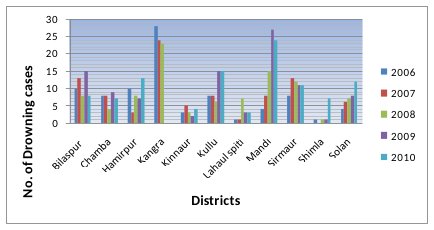
District wise percentage of Drowning (showing maximum or the minimum number of drowning cases took place as depicted in Histogram no. 1)
-
Districts with highest percentage i.e. the district in which maximum drowning took place in the years 2006-2010 (both individually for every year and collectively for the five years).
-
District with lowest percentage i.e. the district in which minimum drowning took place in the years 2006-2010 (both individually for every year and collectively for the five years).
Gender ratio (the ratio involved or suffered drowning among males and females) is shown in table no. 2
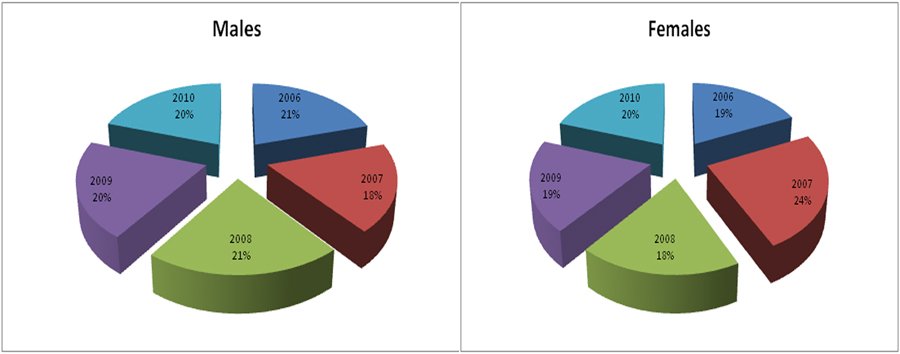
Among males and females (Percentage of maximum or minimum number of males or females involved in every year (Individually) and collectively for all the five years) has been shown in Pie chart 1.
4. Mode of drowning (Individually for each year & collectively for all the five years) as shown in table no. - 3
Whether the mode of drowning was Suicidal;
or it was Accidental or;
It was a case of Homicidal drowning;
Or it was Unknown (where it was not able to establish the actual mode of drowning)
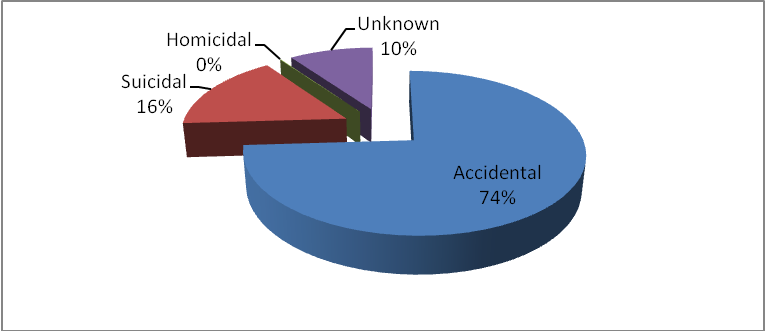
5. Manner of Drowning (whether it was Accidental, Suicidal, Homicidal or it was Unknown in all the districts individually for each year and collectively for every year both among the males and females) as shown in table no.4 and Pie chart 2.
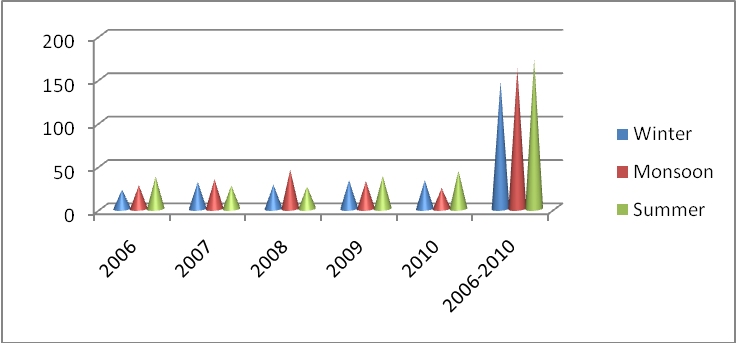
6. Season more prone to Drowning (the season in which maximum drowning cases took place and the season where minimum drowning cases took place, both individually for every year and collectively for all the years) has been shown in table no. 6 and Peak chart-1.
-
Winter
-
Monsoon
-
Summer
Age group of drowned victims
The data was separated on the basis of age (as shown in table no. 5) and divided in to three categories, which is as follows:
Adolescent (Age 1-14 years) as shown in table no. 5 (I) -- Category: A
-
Teenage (Age 15-25 years) as shown in table no. 5 (II) -- Category: B
Adult (age more than 25 years) as shown in table no. 5 (III) -- Category: C
Type of Water Bodies Drowning site (the site that was more prone to drowning)
Rivers
Canals
Wells
Ponds
Tables
| S.No. | District | 2006 | 2007 | 2008 | 2009 | 2010 | Total 2006-2010 |
|
| 1. | Bilaspur | 10 | 13 | 8 | 15 | 8 | 54 | |
| 2. | Chamba | 8 | 8 | 4 | 9 | 7 | 36 | |
| 3. | Hamirpur | 10 | 3 | 8 | 7 | 13 | 41 | |
| 4. | Kangra | 28 | 24 | 23 | --- | --- | 75 | |
| 5. | Kinnaur | 3 | 5 | 3 | 2 | 4 | 17 | |
| 6. | Kullu | 8 | 8 | 6 | 15 | 15 | 52 | |
| 7. | Lahaul spiti | 1 | 1 | 7 | 3 | 3 | 15 | |
| 8. | Mandi | 4 | 8 | 15 | 27 | 24 | 78 | |
| 9. | Sirmaur | 8 | 13 | 12 | 11 | 11 | 55 | |
| 10. | Shimla | 1 | NIL | 1 | 1 | 7 | 10 | |
| 11. | Solan | 4 | 6 | 7 | 8 | 12 | 37 | |
| 12. | Una | 5 | 9 | 13 | 9 | 8 | 44 | |
| TOTAL | 90 | 98 | 107 | 107 | 112 | 514 | ||
| Percentage | 17.5 | 19.0 | 20.8 | 20.8 | 21.7 | |||
(---): Data not provided.
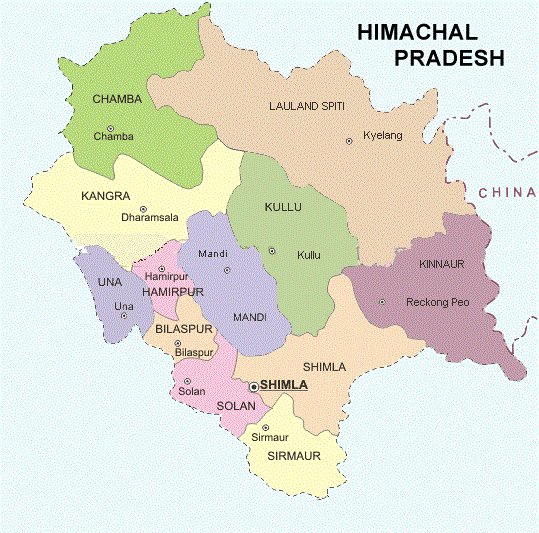
Map of Himachal Pradesh showing various Districts
| Year | Males | Percentage | Females | Percentage | Total |
| 2006 | 67 | 76.13 % | 21 | 23.86 % | 88 |
| 2007 | 67 | 68.36 % | 31 | 31.63 % | 98 |
| 2008 | 81 | 77.14 % | 24 | 23.85 % | 105 |
| 2009 | 79 | 75.23 % | 26 | 24.76 % | 105 |
| 2010 | 83 | 74.10 % | 29 | 25.89 % | 112 |
| 2006-2010 | 377 | 74.21 % | 131 | 25.78 % | 508 |
| Accidental | Suicidal | Homicidal | Unknown | ||||
| 379 | 84 | 1 | 50 | ||||
| M | F | M | F | M | F | M | F |
| 298 | 82 | 48 | 35 | - | 1 | 37 | 13 |
| 73.9 | 16.1 | 0.1 | 9.7 | ||||
*Symbols-(M-Male, F- Female)
Table 4: Showing number and manner of drowning among males and females collectively
(2006-2010)
| District | Accidental 2006-2010 |
Suicidal 2006-2010 |
Homicidal 2006-2010 |
Unknown 2006-2010 |
||||
| Males | Females | Males | Females | Males | Females | Males | Females | |
| Bilaspur | 34 | 5 | 4 | 4 | - | - | 5 | 2 |
| Chamba | 22 | 5 | 4 | 4 | - | - | - | 1 |
| Hamirpur | 25 | 8 | 4 | 3 | - | - | 1 | - |
| Kangra | 31 | 5 | 9 | 4 | - | - | 19 | 7 |
| Kinnaur | 7 | 4 | - | - | - | - | 5 | 1 |
| Kullu | 31 | 8 | 6 | 7 | - | - | - | - |
| Lahaul spiti | 8 | 3 | - | 4 | - | - | - | - |
| Mandi | 48 | 12 | 7 | 4 | - | - | 5 | 2 |
| Sirmaur | 41 | 11 | 1 | - | - | - | 2 | - |
| Shimla | 7 | 3 | - | - | - | - | - | - |
| Solan | 27 | 7 | 3 | 0 | - | - | - | - |
| Una | 17 | 11 | 10 | 5 | - | 1 | - | - |
| Total | 298 | 82 | 48 | 35 | - | 1 | 37 | 13 |
(-): no case reported
Table-5 -: Showing Age group of drowned victims in the state of Himachal Pradesh (Individually & collectively)
Category- A
(Age 0-14 years)
| Age Group | 0-14 years | |||||
| District | 2006 | 2007 | 2008 | 2009 | 2010 | 2006-2010 |
| Bilaspur | - | 2 | - | 1 | - | 3 |
| Chamba | - | - | 1 | - | - | 1 |
| Hamirpur | - | - | - | - | 1 | 1 |
| Kangra | 4 | 3 | 2 | - | - | 9 |
| Kinnaur | - | - | - | - | - | - |
| Kullu | - | - | - | - | 2 | 2 |
| Lahaul spiti | - | - | 3 | - | - | 3 |
| Mandi | - | 1 | 1 | 4 | 1 | 7 |
| Sirmaur | - | 4 | - | - | 1 | 5 |
| Shimla | - | - | - | - | 2 | 2 |
| Solan | 1 | - | 1 | 2 | 3 | 7 |
| Una | - | 1 | 3 | 2 | 2 | 8 |
| Total | 5 | 11 | 11 | 9 | 12 | 48 |
Category- B
Age 15-25 years
| Age Group | 15-25 years | |||||
| District | 2006 | 2007 | 2008 | 2009 | 2010 | 2006-2010 |
| Bilaspur | 1 | 3 | 5 | 3 | 4 | 16 |
| Chamba | 3 | 4 | 1 | 3 | - | 11 |
| Hamirpur | 4 | 1 | 2 | 2 | 6 | 15 |
| Kangra | 8 | 3 | 7 | - | - | 18 |
| Kinnaur | 1 | 1 | 1 | 1 | 1 | 5 |
| Kullu | 3 | 3 | 1 | 5 | 3 | 15 |
| Lahaul spiti | - | - | 2 | - | - | 2 |
| Mandi | 1 | 7 | - | 9 | 7 | 24 |
| Sirmaur | 5 | 5 | 1 | 3 | 1 | 15 |
| Shimla | 1 | - | - | - | - | 1 |
| Solan | - | 1 | 1 | - | 5 | 7 |
| Una | 1 | 3 | 4 | 5 | 2 | 15 |
| Total | 28 | 31 | 25 | 31 | 29 | 144 |
III) Category- C
(Age more than 25 years)
| Age Group | More than 25 years | |||||
| District | 2006 | 2007 | 2008 | 2009 | 2010 | 2006-2010 |
| Bilaspur | 4 | 6 | 1 | 8 | 4 | 23 |
| Chamba | 5 | 4 | 2 | 5 | 7 | 23 |
| Hamirpur | 5 | 2 | 6 | 4 | 6 | 23 |
| Kangra | 14 | 17 | 12 | - | - | 43 |
| Kinnaur | 2 | 4 | 2 | 1 | 3 | 12 |
| Kullu | 4 | 4 | 5 | 9 | 10 | 32 |
| Lahaul spiti | 1 | 1 | 2 | 3 | 3 | 10 |
| Mandi | 3 | 7 | 7 | 14 | 16 | 47 |
| Sirmaur | 2 | 3 | 7 | 7 | 8 | 27 |
| Shimla | - | - | - | 1 | 3 | 4 |
| Solan | - | 1 | 2 | 4 | 3 | 10 |
| Una | 4 | 5 | 6 | 2 | 3 | 20 |
| Total | 44 | 54 | 52 | 58 | 66 | 274 |
Table- 6 Showing Season Most Prone to Drowning
|
Histogram-1 Showing No. of drowning cases in various districts
of Himachal Pradesh
Pie chart-1 showing Percentage Male and Female Drowned in
Himachal Pradesh
Piechart-2 Showing Percentage of Manner of Drowning collectively in
Himachal Pradesh
Peak chart 1 -: Showing seasons prone to drowning in the state of
Himachal Pradesh both (individually and collectively)
Results and Discussions
In the present study an attempt has been made to study the emerging pattern of deaths due to drowning in the state of Himachal Pradesh for the period of 2006-2010. During these five years total 514 cases of drowning have been registered in the state of Himachal Pradesh (table-1). It is evident from table-1 that there is a constant increase in the rate of drowning cases during these periods i.e. 2006 (90), 2007(98), 2008(107), 2009(107) and 2010(112) respectively (Histogram - 1). But the data of Kangra district for the year 2009-2010 was not reported by the police officials due to lack of information (table-1). The rising figures of drowned victims in the succeeding years brought a thought to take preventive measures so that drowning figures could be controlled. The data obtained in the present study was then organized in a proper sequence to study various variables (as mentioned above in method and material) such as age, sex, cause of drowning and seasons prone to drowning of victims etc. to generate useful information for the forensic scientists working in the field. It is evident also from Histogram-1 and table-1 that maximum number of drowning cases was registered in Mandi district (78) followed by Kangra (75) district and least number of cases have been registered in the Himachal Capital Shimla (10). Table -2 and Pie chart-1represent the differences in the percentage ratio between males and females both year wise individually and collectively from 2006 to 2010, it was found that 74.2 % of the drowned deceased were males while 25.7% were females in the five years. Most of the drowning occurred in rivers and its tributaries while a few cases have reported to occurred in the wells and ponds as well.
Table -3 illustrates the percentage of the pattern of drowning in Himachal Pradesh i.e. accidental, suicidal or homicidal. From the data analysis it can be safely observed that most of the cases (73.9%) reported due to drowning are of Accidental while suicidal and Homicidal are 16.1% and 0.1% respectively (Table-3 and Pie chart-2), Among accidental cases reported Males were 298 as compared to Females (82). Similar trend has been observed in suicidal (16.1%) mode of drowning, in which maximum numbers was males (48) as compared to females (35). But only one case of Homicidal (0.1%) drowning (1female) was reported which is almost negligible when compared to other mode of death due to drowning.
The details of the manner of drowning among males and females in various districts of Himachal Pradesh state has been give in Table-4. It has also been observed from the data analysis that maximum accidental drowning is reported in Mandi district which includes 48 males 12 female, whereas minimum accidental drowning cases was reported in Shimla district, which includes 7 male and 3 females from 2006 to 2010. Maximum suicidal cases of drowning have been reported in Una district (includes 10males and 5females) whereas minimum suicidal drowning cases was reported in Solan district (3males and surprisingly no female). No case of suicidal drowning was reported in Kinnaur and Shimla district during 2006-2010. Only one case of female homicidal drowning was reported from Una district.
In total 37 cases of male drowning and 13 of female, exact mode of drowning is unknown which is 9.7% of total drowning cases (Table-3). Maximum cases (26) of Unknown mode of drowning were reported from Kangra district which includes males (19) and females (7) followed by Hamirpur (01) and Chamba district (01).
Table- 5 shows details about the various age groups which was grouped into three following Categories:
Adolescent (1-15 years) -- Category - A
Teenage (15-25years) -- Category - B and
Adult (25 and above) -- Category - C
It was also observed that Maximum number of drowning cases reported belongs to adult age group (274) out of total 514 cases (table-5, Category-C). It is evident from (table-5, Category-C) that maximum drowning cases reported from Mandi district (47) followed by Kangra district (43).
In teenage group, total number of cases reported was 144 (table-5, Category-B) with maximum number of drowning cases reported in Mandi district (24) followed by Kangra district (18).
In case of adolescent age (table-5, Category-A), total number of 48 cases of drowning were reported with maximum number of cases reported from Kangra district (9) followed by Una district (8).
Results of Seasons most prone to drowning have been given in table- 6. It shows that maximum numbers of drowning cases reported in Summer Season (172) followed by Monsoon (162) and then 147 in winter season (Peak chart-1 and table- 6).
To summarise the trend in the state of Himachal Pradesh, the Mandi district is seems to be more prone to drowning deaths whereas the Shimla district is comparatively safer. Accidental drowning cases reported have been found to be more as compare to other mode of drowning; it might be attributed to non-regularisation and protection of the sites around the rivers and their tributaries. People try to be adventurous because of which very recently 24 young students from Hyderabad College drowned in Beas River near Thalaut in Mandi district after large quantity of water being released from Larji reservoir without any prior notice.
Conclusion
The interpretation of this elaborate data of the drowning cases reported in the state of Himachal Pradesh from year 2006 to year 2010 have provided us with very relevant information related to different variables selected for the present study and showed variations in the drowning frequencies related to sex, age, and season of drowning. The baseline data has been generated for five years(2006-2010) and very fruitful information has been drawn; such as the maximum number of drowning cases occurred in summer season and the manner of drowning was reported to be accidental which included mainly male; and about the pattern of drowning. The study was carried as a preliminary work based on the information given by the police officials through RTI. It was a five year data only; the study can further be extended by adding data of more years into it.
The conclusions drawn out of this elaborate data expected to be helpful to the various Law Enforcement agencies in general and to the Forensic community in particular.
Acknowledgements
We are thankful to Himachal Pradesh Police authorities for providing us with this valuable information to generate the baseline data and which will be further helpful in conducting research works.
References
- Ahluwalia, M. S. (1998). Social, cultural and economic history of Himachal Pradesh. New Delhi: Indus Publishing Company. ↑
- Dietz, P. E., & Baker, S. P. (1974). Drowning “epidemiology and prevention”. American Journal of Public Health, 64(4): 303-312.
- Howland, J., Hingson, R., Mangione, T. W., Bell, N. & Bak, S. (1996). Why are most drowning victims' men? Sex difference in aquatic skills and behaviours. American Journal of Public Health, 86(1):93–96.
- Joseph, A., Abraham, S., Muliyil, J.P., George, K., Prasad, J., Minz, S., Abraham V.J. & Jacob, K S (2003). Evaluation of suicide rates in rural India using verbal autopsies, 1994-9. BMJ, 326:1121-1122.
- Lunetta, P., Penttila, A0. & Sarna, S. (1998). Water traffic accidents, drowning and alcohol in Findland, 1969-1995. International Journal of epidemiology, 27:1038-1043.
- Lunetta, P., Smith, G. S., Penttila, A. and Sajantila, A. (2004). Unintentional drowning in Findland 1970-2000: a population-based study. International Journal of epidemiology, 33: 1053-1063.
- Srivastava, A.K., Tripathi, C.B., Das Gupta, S.M., & Gupta, R.K. (1987). A study of fatal drowning cases in Varanasi. Indian Journal of Forensic Science, 1: 127-31. ↑
- Stevenson, M. R. & Rimajova, M. K. (2003) Childhood Drowning: Barriers Surrounding Private Swimming Pools, Pediatrics, 111(2):115-119. ↑
- Thakar, M. K., Sahota, S. S. & Singh, R. (2009) Death due to drowning in Punjab- A survey [2005 to 2006]. Medico-Legal update, 9(1):18-22. ↑
- Walker, J. & Crawford, I. (1968). An interstate drowning study. American Journal of Public Health, 58(12): 2275-2289. ↑
- Warneke, C. L. & Cooper, S.P. (1994). Child and adolescent drowning in Harris Country, Texas, 1983 through 1990. American Journal of Public Health, 84(4): 593-598.