

Brief History: - The alleged victim, being religious after praying in a temple, returning his home on one late evening in the month of March 2012; he hired an auto rickshaw in which three persons including a female were the occupants. In the meantime, one more passenger also joined in. One of these people sitting along with the driver demanded his purse. When he refused, the rickshaw stopped and driver along with his companions started manhandling with him and tried to snatch his purse. When he offered resistance a revolver was put on his forehead by one of them, meanwhile the female passenger intervened in between and caught hold his hand but all of a sudden a shot was fired at him. He observed bleeding from his head. In this mille, the auto-driver and his fellow companions ran away in the auto-rickshaw after throwing him on the road. He went to the nearby police station to lodge his complaint. He was taken to the hospital by the police and he was medico-legally examined in the nearby Govt. Hospital but the medical officer was not in a position to opine about the nature of injury for want of radiological investigation and surgeon’s opinion although he has declared the injury caused by blunt weapon.
First hand Examination at primary care centre: -The medical officer noted down in his medico-legal report two superficial reddish abrasions of size 1cm x 0.2cm & 3cm x 2cm present on the upper aspect of right side of forehead having clotted blood along with diffuse swelling, pain and tenderness. The patient was otherwise stable. The nature of injury was kept under observation for want of report of radiological and surgeon’s opinion but the kind of weapon used by the accused was labelled as blunt.
Police version: - On the observations of first hand examination by the medical officer and taking in to account the alleged history of use of a Country made pistol stated to have been recovered from the accused along with fired cartridge case recovered from the place of occurrence the investigating officer was not satisfied and requested the authorities for an opinion from the board of medical experts.
Re-medical examination by the Board at primary care centre: - Subsequently, on the third day after the incident a medical board of three doctors was constituted who made a note that the injury was about three days old with scab formation, it was difficult for them to ascertain the kind of weapon used therefore the patient was referred to the department of Forensic Medicine at PGIMS Rohtak (tertiary care centre) for expert opinion regarding the nature of weapon used.
Examination at tertiary care centre: - The injured was brought to the department of Forensic Medicine at PGIMS Rohtak for re-medical examination. On general physical examination the vitals were found to be stable. The following injuries were observed:-
A dark brownish scabbed abrasion of size 4x2.5cms was present over the right upper outer frontal region of the scalp situated 2.5cms from the midline and 5.5cms from the right supra- orbital ridge. Clotted dark brownish blood streaks were found spreading from its front inner side going towards left side in the hairs and reaching just above the hair line with blood stains on and near the right temporal region. Fine pin head to pin point scattered scabs were found present in an area of 2x1cms on the lower back region of this partially scabbed wound.
Mopping with wet gauze piece with a little pressure was carried out of these scabs that got separated leaving demarcated designs appearing to be as of tattooing (Fig.1). This gives an indication about the directions of the discharge of the firearm. The hairs around the wound were of small size in comparison and appear to be singed and having swollen tips at places (Fig.2). These articles were sent for ballistic expert opinion.
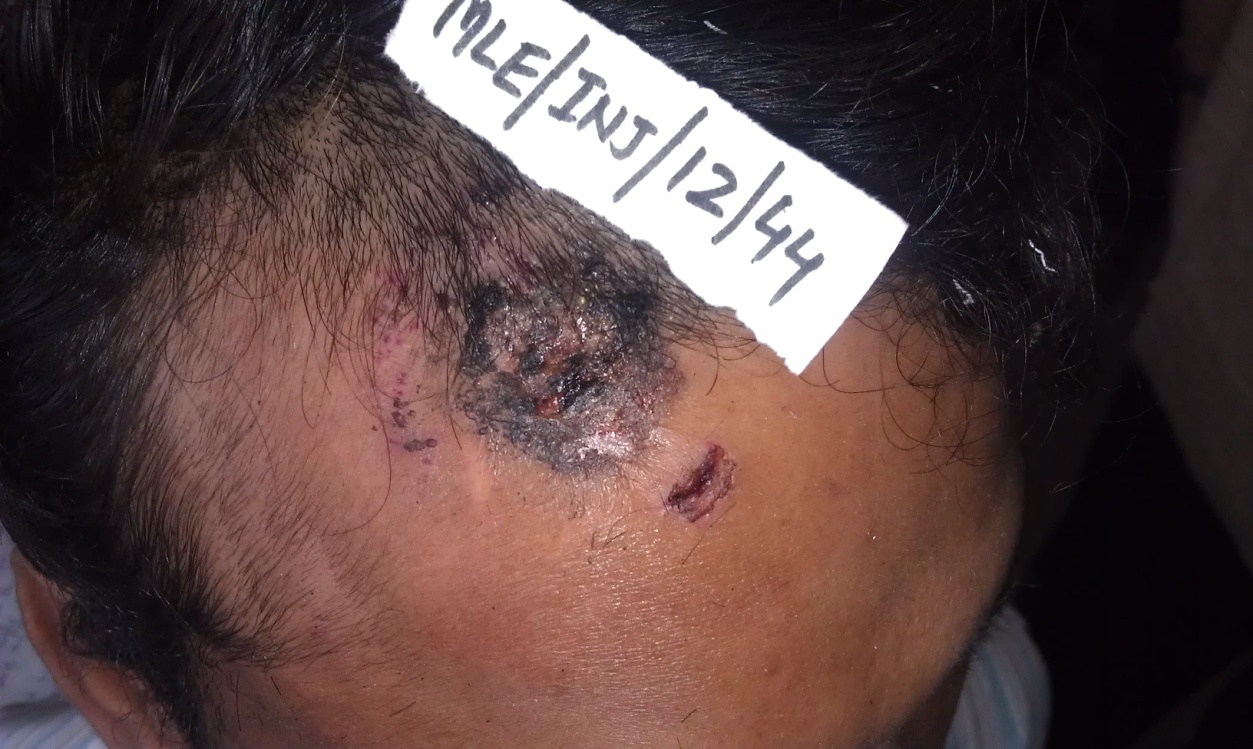
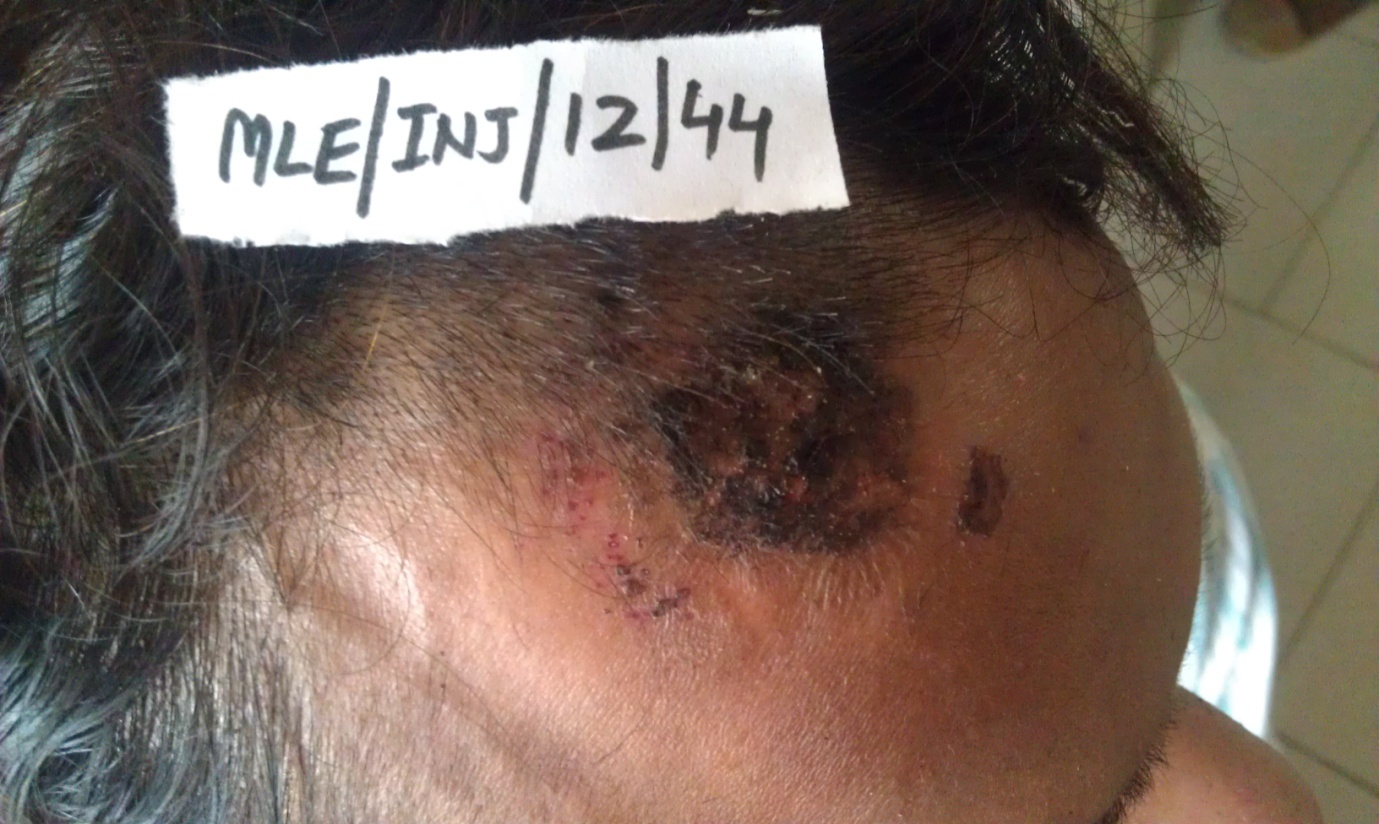
A dark brownish scabbed abrasion of size 0.5x0.5cm was present over the right frontal region of the scalp situated 2.5cm from the midline and 1cm in front of injury no.1 with clotted blood stains around it.
On radiological examination of the skull, no bony injury was appreciated.
On the basis of appreciable tattooing and the singed hairs; the injuries were declared to be caused probably by discharge of firearm weapon. On reconstruction the direction of the firearm was obliquely downward from back to front and from right to left side of the victim. However, for confirmation the sample of the hair and mopped gauge pieces from the surrounding areas of the wound were preserved for the analysis of residues of gun powder, if any.
Ballistics Expert Opinion: - The three articles, namely, fired cartridge case recovered from the place of occurrence, one country-made pistol recovered from the accused by the police and the swabs preserved by the instant board were sent to the Forensic Science laboratory for analysis. After analysis the results speaks that the country made pistol is a firearm as defined in Arms Act 54 of 1959 with its firing mechanism in working order, Cartridge case has been fired from this country-made pistol and not from any other firearm even of same make and bore/calibre because every firearm has got its own individual characteristic marks and Gunshot discharge residues were present on the swabs and hairs sent from our department. These results confirm our opinion about the use of a firearm weapon in this case.
Discussion
We have encountered with many referred cases involving the issues of the nature of injury, kind of weapon, duration and lastly the manner of their production whether self inflicted / suffered and sometimes fabricated with expert hands; but probably it was the first time that a case with alleged superficial abrasion with alleged history of firearm had been referred for expert opinion. This wound was partially scabbed and the first question in mind was whether this is a victim of firearm as alleged by police? The typical findings of firearm namely singeing, blackening, tattooing etc. were not appreciable on primary examination as well as by the board of medical officers at primary care centre probably due to its presence on the scalp under the hairs and smudged with clotted blood stains around it. Although the typical findings of tattooing was appreciated only when it was partially healed and looking in the form of pin point to pin head scabs on the inner upper aspect of the wound along with singeing of hairs in the form of appreciable shortening of the same with swollen tips1. But these findings were not sufficient under the circumstances when the earlier medical officers were not clear about them. So it was deeming fit to do something that confirm the alleged history of firearm so the moping of the area of the tattooing as well as singed scalp hairs were preserved for their chemical analysis. It is well said that if a firearm is discharged very close to the body, the skin is usually scorched and blackened by smoke and tattooed with un-burnt grains of gunpowder or smokeless propellant powder.2 Gunshot residue (GSR) consists of particles composed of antimony, barium and lead that arise from the condensation of primer vapours and also soot debris consisting of carbon and metallic fragments from the bullet and cartridge case.3
Conclusion
In fact, it was not a case of atypical firearm but the medical officers at primary care centre had either lack of knowledge / unskilled observation or intentionally did not note down the typical findings of firearm or took measures to rule out the same in spite of the alleged history of use of firearm by the accused as observed by the present board and that was subsequently confirmed during our examination (supra). Therefore the message that we want to convey through this paper is simple and clear that a medical officer must observe even the minute findings that may help to come to a conclusion about the opinion of the injuries to not only solve a case but also to help the society by bringing on justice to somebody. Had the tattooing and singeing of hairs been noted down at the primary and secondary care levels the unnecessary referral to tertiary care centre been avoided and the clue to the investigating agency was provided in time and the harassment of the victim would have been prevented.
References
- Rao NG. Textbook of Forensic Medicine & Toxicology. 2nd ed. Jaypee Brothers Medical publishers (P) Ltd: Bengaluru; 2012.p.280-1. ↑
- Mathiharan K, Kannan K. Modi A Text Book of Medical Jurisprudence and Toxicology. 24th ed. Lexis Nexis Butterworths Wadhwa:Nagpur;2012.p.540-3. ↑
- Cecchetto G, Amagliani A, Giraudo C, Fias P, Cavarzeran F, Montisci M et al. Micro CT detection of gunshot residue in fresh and decomposed firearm wounds. Int J Legal Med. 2012;126:377-83. ↑