

AIM
The aim of the study is to identify the Prevalence of fifth variety of lip print and the sub-group of fifth variety.
.
OBJECTIVES
Selection of individuals number 3911 as per statistical calculation who are free from diseases of lip.
Tracing of lip print using lip-stick and tracing paper.
Recording the lip prints and establishing the different varieties of lip prints as per
Yasuo Tsuchihashi classification.
Identifying the Prevalence of fifth variety of lip print and it sub-groups.
Establishing the Prevalence of fifth variety of lip print and the sub-group with classical characterization.
Recorded message of fifth variety may be propagated to use in Forensic Odontology.
INTRODUCTION
Le moyne Synder1 a Forensic expert in California in early 1950s reported that lip-prints are normal lines and fissures of the lips are an individual characteristic much same as the finger ridges and can be used as a method of identification
Earlier research studies conducted to prove the significance of lip prints in personal identification and criminalization revealed that lip prints are unique and no two individuals have the same type of lip prints. It is also proved that there are no alteration of lip print during the lifetime and the lip print present at the end of fully matured lip remains as it is throughout the life. Since the lip prints remain as a permanent anatomical structure, it can be definitively used as evidence in personal identification.
Lip prints can be left at crime scene which when traced properly provides a direct link to the suspect. Kasperazak 2 stated that lip-prints can be traced from crime scene lip prints from materials used by the criminals such as drinking glass, cigarette butts, cutlery. Edmond Locard3 the was one of the France’s greatest criminologists who first recommended the use of lip prints in personal identification and criminalization.
In sexual harassment cases lip prints can be traced from clothing and skin, although these lip prints are invisible on inspection, they can be lifted using materials such as aluminum powder and magnetic powder. The edges of the lip have sebaceous glands with salivary glands in between, the secretion of oil and moisture from these enable the development of latent lipprints,analogous to latent finger prints as stated in the study of Ball4
The classification devised by Yasuo Tsuchihashi5 in 1974 is taken as the standardized classification, in which lip prints are classified as Type I,II,III,IV,V. In this classification Type V is described as a type that do not fall into Type I –IV and cannot be differentiated morphologically.
The present research is carried out to analyze the different types of lip prints and the fifth type is selected and studied in depth to find whether it is single or multiple pattern.
MATERIALS AND METHODS
A total number of 3911 of which 1939 are males , 1972 females of age-group 11-60 years were examined among the out-patients who attended the Oral-Medicine department .Subjects were grouped in the age-groups 11-20,21-30,31-40,41-50 and 51-60 years.
The classification formulated by Yasuo Tsuchihashi5 in the year of 1974 is followed.
TYPE I : Clear cut grooves running vertically across the lip.
TYPE I’ : The grooves are straight but disappear half way instead of
covering the entire breadth of lip.
TYPE II : Grooves fork in their course.
TYPE III : Grooves intersect.
TYPE IV: Grooves are reticulate.
TYPE V : Grooves do not fall into any Type of I- IV and cannot be differentiated morphologically
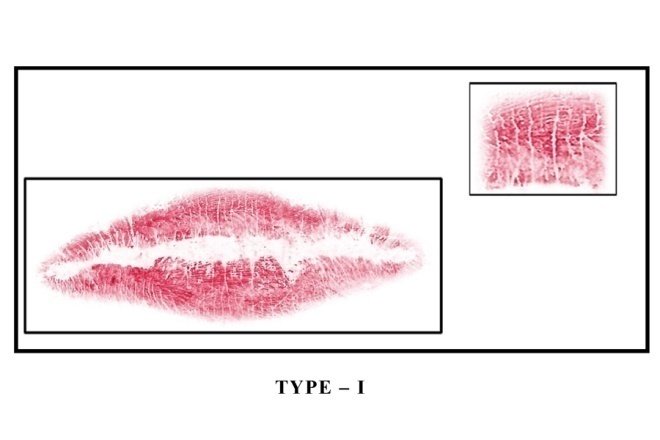
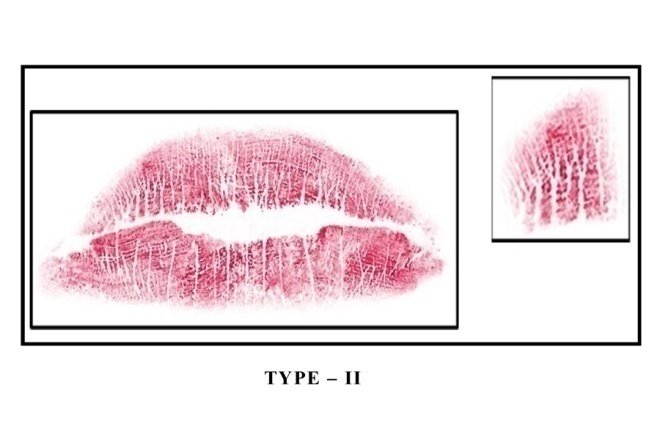
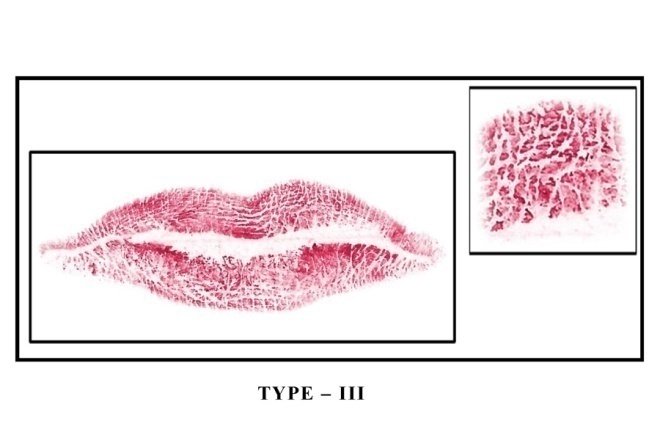
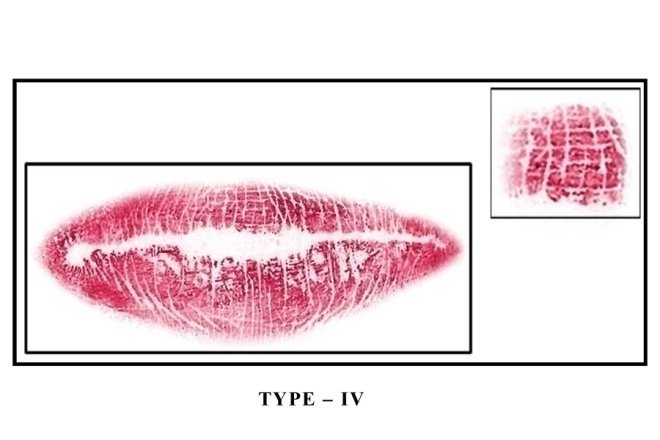
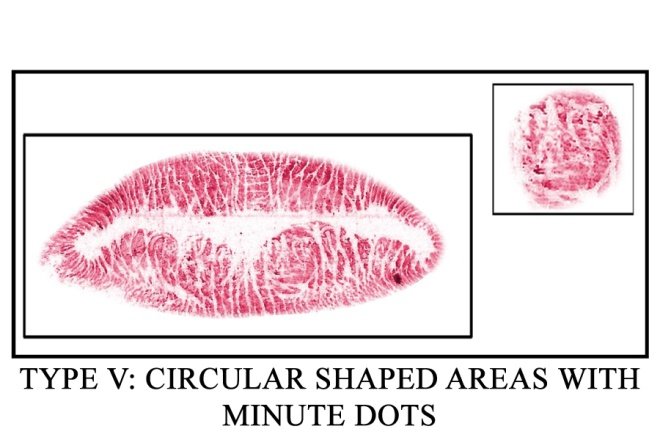
TYPE-V
In the present study as we have very minimum type of Type I’ group , the Type I and Type I’ have merged as Type I group.In each individuals lips were cleaned by normal saline using cotton and it was dried with dry gauze and exposed to air for complete drying.Lip-stick was placed over the lips and spread throughout the lip area using cotton. Within 1 minute, tracing paper prepared in rectangular shape was placed over the lip and the patient was instructed to relax the lip and paper was uniformly pressed covering the lip-print area and it was removed. The removed paper was dried and preserved by pasting it in a thin card-board. After tracing all the required number, the lip prints were separated for males and females and with sub-division of age-group. Each lip-print was carefully analyzed by magnifying glass with reference to individual compartments in upper and lower lip. Analysis of lip-print as Type I,II,III,IV,V as per Tsuchihashi’s5 classification .Fifth variety of lip prints were separated and using the magnifying-glass each fifth variety was examined and sub-groups were prepared.
RESULTS
In 3911 subjects 1939 (49.58%) were males and 1972 were females.
| S.NO | AGE GROUP | TOTAL | MALES | FEMALES | |||
|---|---|---|---|---|---|---|---|
| NO. | % | NO. | % | NO. | % | ||
| 1 | 11-20 YRS | 2101 | 53.72 | 1461 | 75.35 | 640 | 32.45 |
| 2 | 21-30 YRS | 1095 | 28.00 | 408 | 21.04 | 687 | 34.84 |
| 3 | 31-40 YRS | 476 | 12.17 | 57 | 2.94 | 419 | 21.25 |
| 4 | 41-50 YRS | 176 | 4.50 | 8 | 0.14 | 168 | 8.52 |
| 5 | 51-60 YRS | 63 | 1.61 | 5 | 0.26 | 58 | 2.94 |
| TOTAL | 3911 | 1939 | 49.58 | 1972 | 50.42 | ||
Chi-Square analysis = 857.033745 df = 4 P - value = 0.000000
Among the total individuals of 3911 it is recorded that 778 (19.89%) had Type I, 1001 (25.59%) had Type II, 376 (9.61%) had Type III, 11 (0.28%) had Type IV and 1745 (44.62%) had TypeV. In 3911 individuals the other variety was found to be maximum (44.62%) and type IV was found to be minimum (0.28%). It is statistically significant that there is association between different age groups and different types of lip prints in both males and females (P - value = 0.000000)
| S.NO | AGE GROUP | TOTAL | DIFFERENT TYPES OF LIP PRINTS | ||||||||||
|---|---|---|---|---|---|---|---|---|---|---|---|---|---|
| I | II | III | IV | OTHERS | |||||||||
| NO | % | NO | % | NO | % | NO | % | NO | % | NO | % | ||
| 1 | 11-20 | 2101 | 53.72 | 508 | 65.29 | 656 | 65.53 | 149 | 39.63 | 3 | 27.27 | 785 | 44.98 |
| 2 | 21-30 | 1095 | 28.00 | 175 | 22.49 | 223 | 22.28 | 130 | 34.57 | 8 | 72.73 | 559 | 32.03 |
| 3 | 31-40 | 476 | 12.17 | 63 | 8.10 | 85 | 8.49 | 67 | 17.82 | 0 | 0 | 261 | 14.95 |
| 4 | 41-50 | 176 | 4.50 | 26 | 3.34 | 28 | 2.80 | 14 | 3.72 | 0 | 0 | 108 | 6.81 |
| 5 | 51-60 | 63 | 1.61 | 6 | 0.77 | 9 | 0.90 | 16 | 4.25 | 0 | 0 | 32 | 1.83 |
| TOTAL | 3911 | 778 | 19.89 | 1001 | 25.59 | 376 | 9.61 | 11 | 0.28 | 1745 | 44.62 | ||
Chi-Square analysis = 217.956178 df = 16 P - value = 0.000000
Three different varieties in this type was observed in both males and females in different age groups. Three different varieties are as follows.
V-1 - Circular shaped area with minute dots.
V -2 - Oval shaped area with horizontal lines.
V-3 - Small leaf like structure with a central line from branching lines are seen.
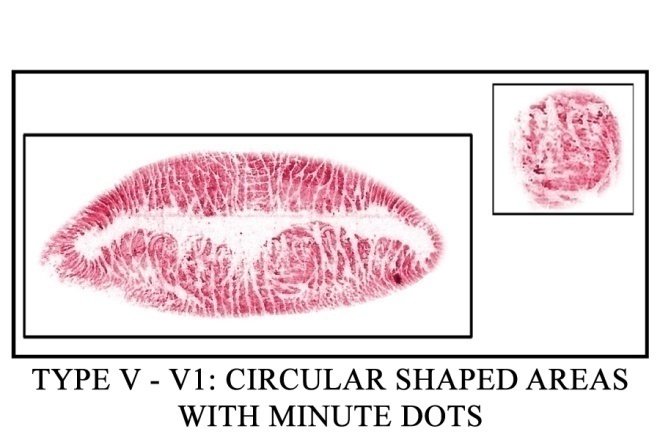
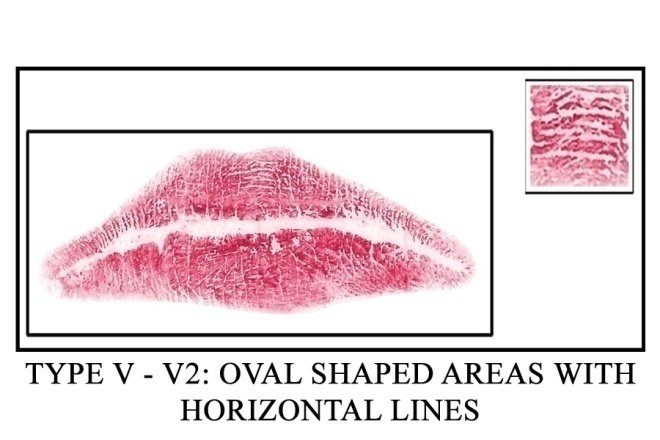
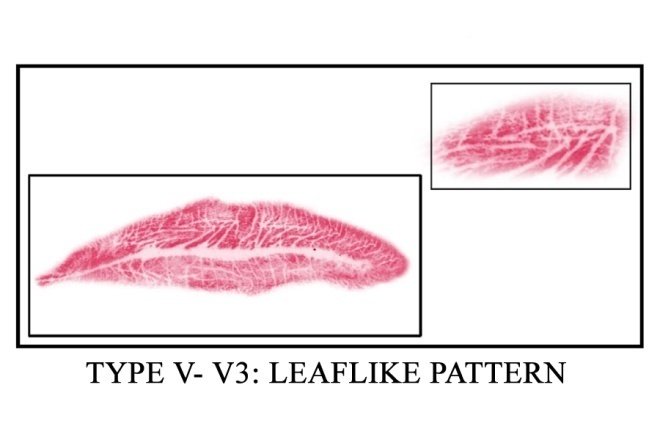
Among 1745 individuals having Type V lip prints 1470 (84.24%) had V-1, 272 (15.59%) had V-2, 3 (0.17%) had V-3. The present study revealed that there are three varieties found in the Type V lip print in which V1 was found to be maximum (84.24%) and V3 was found to be minimum (0.17%) among the 1745 individuals having Type V lip prints. It is statistically significant that there is association between type of lip print and different age groups in both males and females.
GRAPH – 1
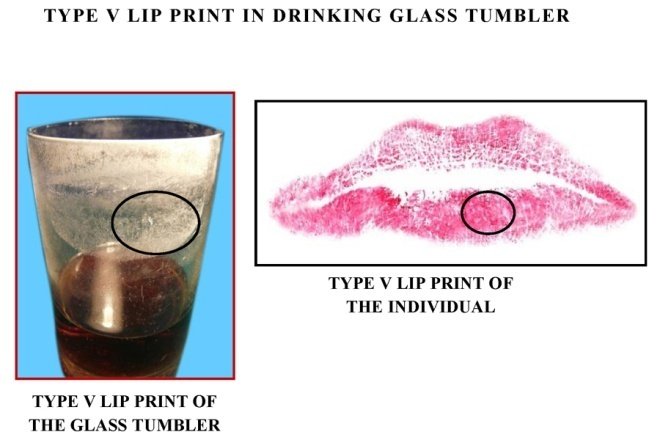
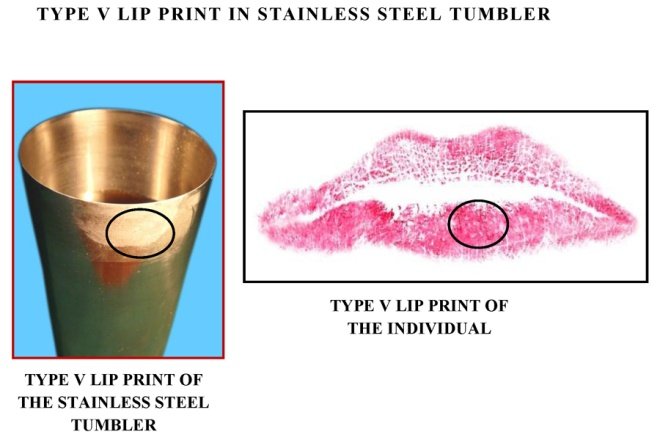
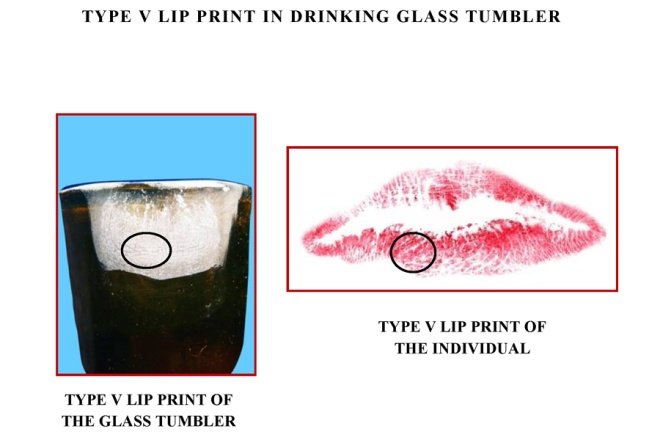
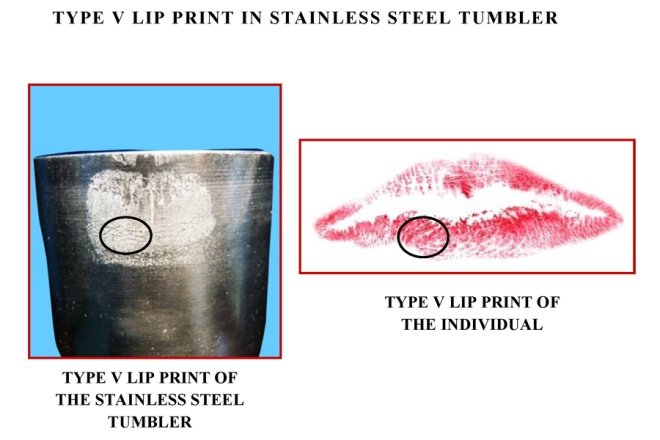
Individuals having Type V lip-prints traced in drinking glass and stainless- steel tumbler using finger-print powder found to be identical with that of the lip-print of these individuals traced in tracing paper using lip-stick. Thus the present study proves that Type V lip-prints can be traced in non-biological materials just like finger-prints.
DISCUSSION
Identification of humans is one of the challenges faced by the investigating team in Forensic Science. Traditional methods of personal identification include anthropometry, dactyloscopy, DNA fingerprinting, sex determination, estimation of age , measurement of height, post mortem reports and differentiation by blood groups 6
Types of lip-prints are in conformity with the previous study of Yasuo Tsuchihashi4.Types of lip print in the present study have no specific change in male and female and hence lip-print cannot be used to identify sexual dimorphism. This observation contradicts to previous study of Vahanwala and Parekh 7 The classification of types of lip-print was proposed by many authors like Santos8 but the classification by Yasuo Tsuchihashi5 1974 was taken as a basis for classifying the type of lip-print because of its simplicity and also the observation of our pilot study of hundred samples are in consistent with the observation of Yasuo Tsuchihashi5
Lip prints are different in different parts of the lip, hence the present study has recorded the different types of lip print in 12 compartments of lip as per the study done in 750 samples by Uma Maheswari9 .The methodology of the present study differs from the study conducted by Preeti Sharma10 in which the lip prints were recorded in 100 subjects only in the middle part of the lower lip.
The present study have established the percentage of Type V lip-print is 44.62% which is more in comparison with the study conducted in 1364 Japanese subject by Yasuo Tsuchihashi4,who has established that Type V is 14.9%.The reason for which could be most probably the Indian population may have more Type V than Japanese population.Three varieties among the fifth variety have been recorded.. Among three types V-1 =84.24% V-2=15.59% V-3=0.17% .The third type is very minimum.
The varieties of TypeV lip prints were also traced in glass and stainless steel tumblers which proves the significance of varieties of Type V lip prints in identification of criminals involved in theft, robbery and sexual harrassement cases
CONCLUSION
The present study has established the fifth variety appears to be more in the present sample and two types are more , third type is less. This could be used for identification in criminalization.Thus present study have overcome the lacunae of unidentified fifth variety by Yasuo Tsuchihashi research study.
References
- Caldas IM, Magalhaes T, Alfonso A. Establishing identity using cheiloscopy and palatoscopy. Forensic Science International 2007:165(1);1-9 ↑
- Kasperazak. J. Possibilities of chelioscopy. Forensic Science International 1990; 46: 145-151. ↑
- Aggrawal A. The importance of lip prints. Web Mystery Magazine. 2004; 11(2): http://lifeloom.com//II2 Aggarwal.htm. Visited 20.8.2011 ↑
- Ball .J. The Current status of lip prints and their uses of identification. Journal of Forensic Odontostomatology 2002; 20(2): 43-46. ↑
- Tsuchihashi Y. Studies on personal identification by means of lip print. Forensic Science International 1974; 3: 233-248 ↑
- ShaileshM.Govindkar, AtulIndurkar, ShirishDegwekar et al. Cheiloscopy for sex determination. Journal of Forensic Dental Sciences 2009; 1(2): 56-60. ↑
- Dr. Vahanwahala S.P and Dr. Parekh D.K. Study of lip prints as an aid to Forensic Methodology. Journal of Indian Dental Association 2000; 71: 269- 271. ↑
- Santos M. Queiloscopy -A Supplementary Stomatological means of identification. International Microform J. Legal Medicine 1967; 2. ↑
- T.N .Uma Maheswari and N. Gnanasundaram, Role of Lip prints in Personal Identification and Criminalization. Anil Aggarwal’s Journal of Forensic Medicine and Toxicology [serial online], 2011; Vol.12, No.1 (January –June 2011). ↑
- PreetiSharma , Susmita Saxena , VanitaRathod Comparitive reliability of Cheiloscopy and Palatoscopy in human identification. Indian Journal of Dental Research 2009; 20(4): 453-457. ↑