
Review · Vol. 12, No. 1
Book Reviews: Technical Books Section
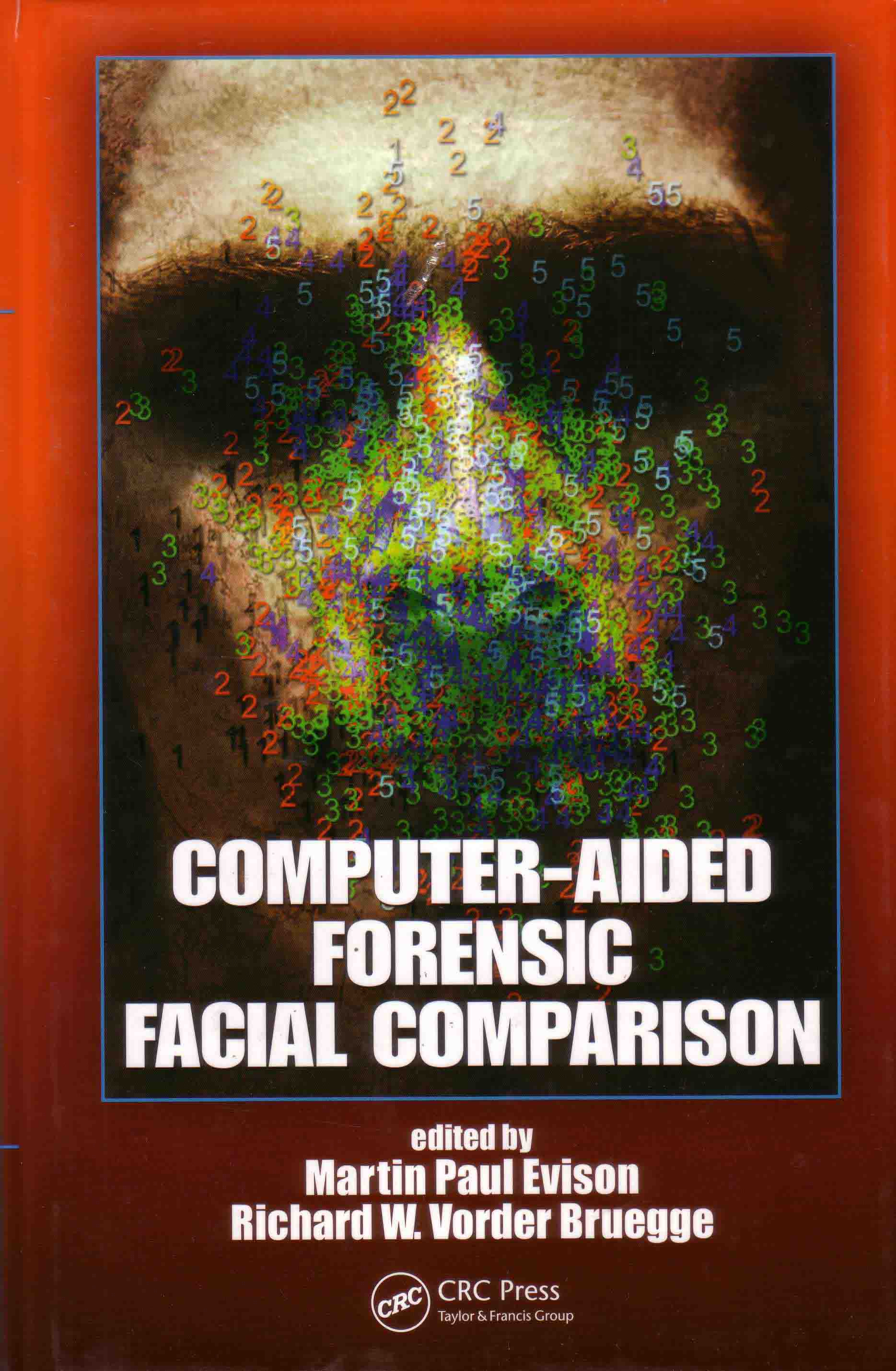
Computer-Aided Forensic Facial Comparison, 1st Edition, edited by Martin Paul Evison and Richard W. Vorder Bruegge. Hard Bound, 9.3” x 6.1” x 0.8”.
CRC Press LLC. Publication Date March 26, 2010. 209 pages, ISBN-10: 1439811334; ISBN-13: 978-1439811337 (alk. paper). Price: $159.95.
Visit the Official site of this book by clicking here
Buy from Amazon by clicking here.
 |
 |
 |
Imagine this scenario. A bank is robbed in the night and in the morning the surveillance video systems secretly installed at various locations in the bank show some fuzzy, grainy pictures of a two robbers. A few suspects are caught, of whom two are known bank robbers. Most police officers insist that the two they have apprehended are the ones seen in surveillance video systems, but many members of the general public are not so sure. A judge who sees the video himself thinks the same as the general public. Does any foolproof “scientific” method exist which can confirm or deny positively – with zero percent rate of error – the presence of those two suspects? Something like fingerprinting or DNA profiling? To put it in a more technical sense, does a system of facial identification exist which satisfies the so called “Daubert Criteria” set out in Daubert v. Merrell Dow Pharmaceuticals, 509 U.S. 579 (1993). Unfortunately at present, the answer is “no”. The book under review is a summarization of an attempt to develop such a system.
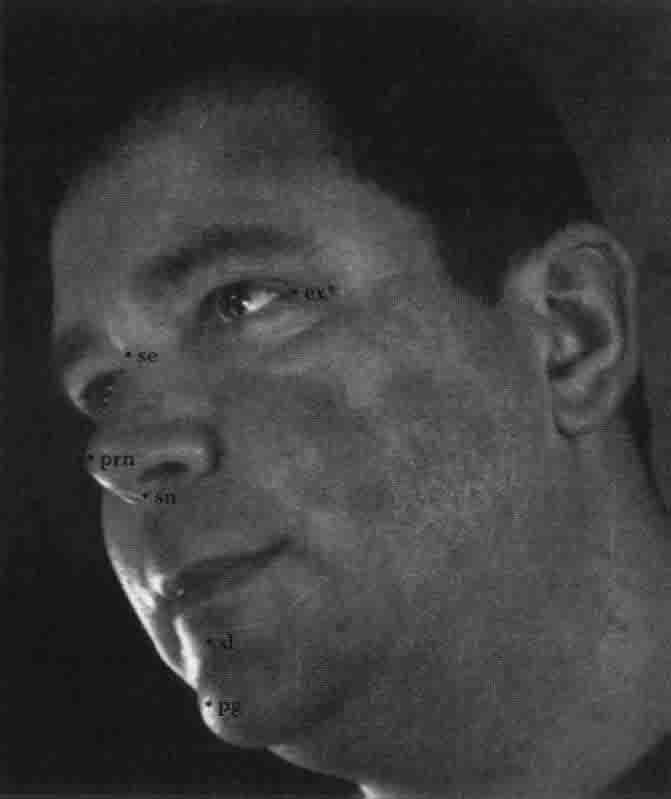 |
The book is edited by two well-known workers in the field - Martin Evison, an associate professor of anthropology at the University of Toronto and director of the University’s Forensic Science Program, and Richard W. Vorder Bruegge, whose work has involved analyzing film, video, and digital images relating to crime and intelligence matters. They have taken facial pictures from more than 3000 volunteers (page 6) and have assigned seven landmarks to each face in an attempt to provide some objectivity to facial identification. These landmarks are seen in the adjoining figure. Five of these are in the midline. From above downward they are – Sellion (se), pronasale (prn), subnasale (sn), sublabiale (sl) and pogonion (pg). Two are on the lateral sides – exocanthion left (ex l) and exocanthion right (ex r).
 |
Chapter 2 evaluates the instruments for 3D face capture; chapters 3 and 4 investigate the anthropometric shape variation in 3D and collection of a large database sample of 3D faces; chapter 5 investigates landmark variation in 2D; chapter 6 and 7 discuss wider issues of landmark visibility in 3D, and error due to the influence of lens and perspective; chapters 8 and 9 explore more theoretically orientated avenues of related research and chapter 10 introduces the fundamental issue of courtroom admissibility.
The book comes with two DVDs which contain the raw 3D landmark datasets for 3000 faces, additional datasets used in 2D analysis, and computer programs and spreadsheets used in analysis and in the development of prototypic applications software.
Overall this book is a very good attempt to explore an area hitherto untouched. It throws light into dark niches and corners of the new science of forensic facial comparison. To my mind this book would stimulate further research in this field. This book should be read by all forensic scientists.
Request a PDF file of this review by clicking here. (If your screen resolution can not be increased, or if printing this page is giving you problems like overlapping of graphics and/or tables etc, you can take a proper printout from a pdf file. You will need an Acrobat Reader though.)
Editor's recommendation. This book is recommended by the editor.