
Review · Vol. 11, No. 2
Book Reviews: Popular Books Section

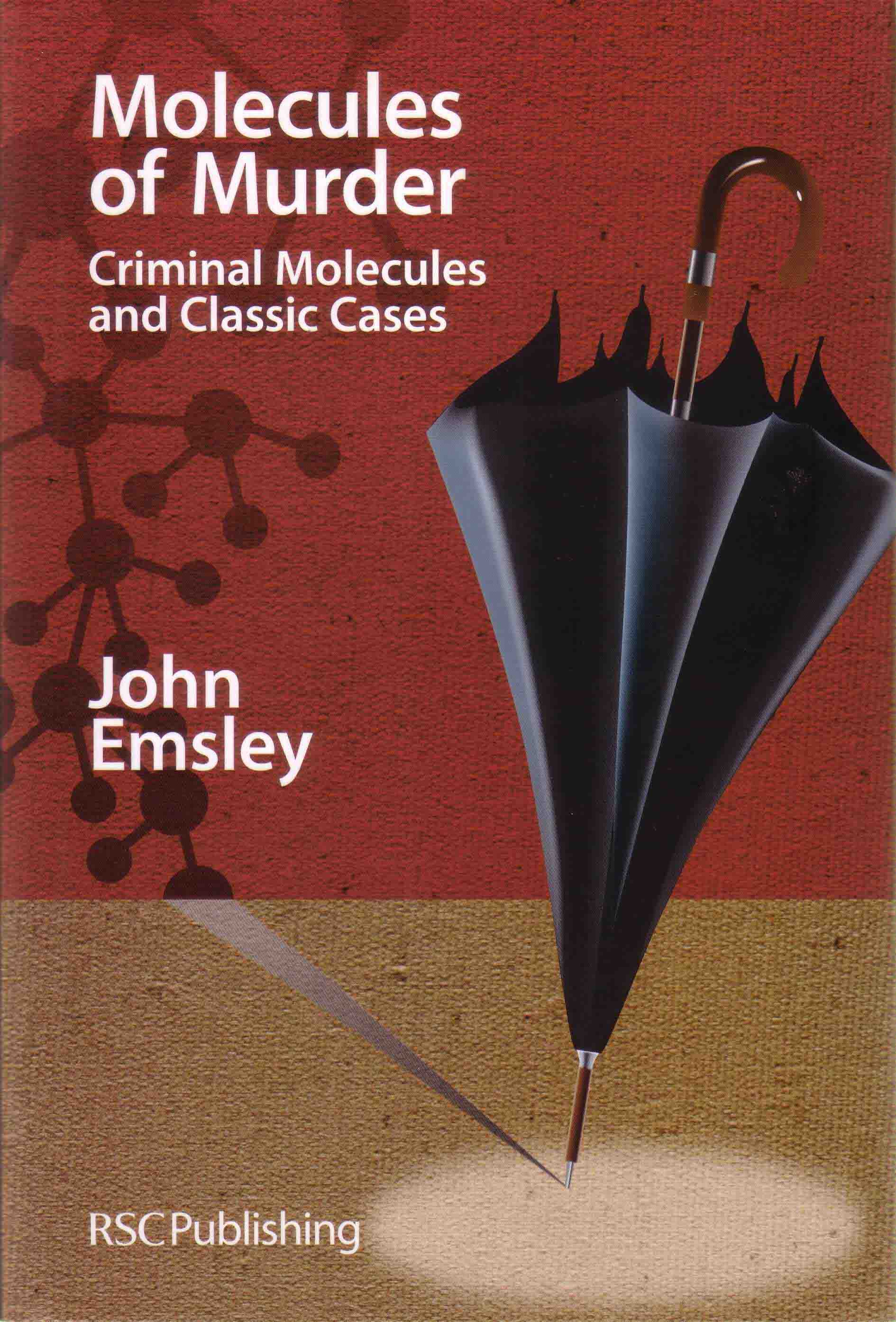
Molecules of Murder: Criminal Molecules and Classic Cases by John Emsley. Hardcover, 9.5” x 6.3” x 0.9”.
The Royal Society of Chemistry. Publication Date September 24, 2008. 242 pages, ISBN-10: 0854049657, ISBN-13: 978-0854049653. Price $24.95 (UK Sterling Price: £14.95, € 17.99, ¥2,249)
Official site of this book: Click here to visit
Amazon Link: Click here to visit
 |
Our good old friend Emsley has done it again! He has come out with yet another gem – one which everyone will find hard to resist. In one of our previous issues, we had reviewed his excellent Elements of Murder. Naturally I was expecting something as exciting as that book, and I was not disappointed. Emsley once again charms us with a number of true astounding crime stories, each associated with a particular poisonous chemical. Every crime story not only tells us about an extraordinary crime, but teaches us a lot about the particular chemical (or “molecule” as our chemist friend Emsley likes to call it), with which that murder was committed. Emsley deals with ten such molecules in this book – Ricin, Hyoscine, Atropine, Diamorphine, Adrenaline, Chloroform, Carbon Monoxide, Cyanide, Paraquat and Polonium.
As a professor of Forensic Toxicology, I used to think that I knew every “good story” that was there to know on forensic toxicology. But as I opened the book, I realized, how hopelessly wrong I was. I did know some of the stories (for instance the murder of Georgi Markov by ricin), but I did not know many. I started the book with Paraquat (chapter 9) mainly because only a day back I had finished my undergraduate lecture on agricultural poisons (paraquat was a part of it), and I wanted to know, if I had left out any good story. And lo! I come up with at least one good story, that I had missed – murders committed by Steven David Catlin (of his own step parents and at least two of his wives). There is another good true story, that of Susan Barber killing her husband Michael Barber with the help of her boy friend Richard Collins. Both these murders were committed with paraquat, and it is extremely interesting to read the fascinating accounts Emsley gives us.
One good feature of the book, that I appreciated is that Emsley starts each chapter with a very detailed story about the molecule itself – how it was discovered, or synthesized, who were the major actors involved and a number of good juicy stories about the molecule. In the chapter on Paraquat, for instance, we learn such interesting facts that shaking a half full bottle of reduced paraquat would make it colorless (because it oxidizes to the colorless oxidized version). Or that Paraquat remained a best selling herbicide, until glyphosate came onto the scene. Or that US agencies used paraquat to destroy marijuana plantations in Mexico, and then instilled an additional fear in the minds of users by disseminating a false propaganda that their sprays had rendered marijuana unsafe to smoke. Or that infinitesimally small amounts of paraquat have caused sickness at such large levels that the syndrome could only be explained as a “mass hysteria”. During October 2002, in Dominican Republic, a small amount of herbicide spray drifted into a textile factory and about 150 workers fell ill. So little paraquat was involved that the sickness could only be explained as a mass hysteria.
|

A number of such interesting, fascinating, amazing stories await us at every chapter. I read with fascination, the murder committed by Adelaide Bartlett of her husband Edwin with Chloroform. She is supposed to have first administered lead acetate (sugar of lead) to him and when he was besieged with stomach colics (typical of lead poisoning), gave him another poison – brandy laced with chloroform – to finally dispose him of. Surprisingly her defense lawyer Edward Clarke QC put up such strong defense that she was acquitted. He could convince the jury that Edwin couldn’t have taken brandy laced with chloroform, because it would have been extremely unpalatable. Emsley informs us, that this could not be the case. The brandy would have tasted to him just as if nothing had been added to it. Even today – Emsley informs us – there are over the counter medicines which contain chloroform and we take them regularly without burning our throats.
In the chapter on adrenaline, we get to read, how the suave nurse Kristen Gilbert killed at least 50 of her patients with adrenaline (reminded me immediately of Genene Jones, The Death Nurse, who killed about a dozen children with succinylcholine. We hope Emsley deals with this molecule in a sequel to this book!)
Overall, a great book to read. It is a coffee table book, leisure reading, pleasure reading, text book and an informative book, all rolled in one. I as a professor of forensic toxicology, enjoyed every story, especially the vast treasure house of information Emsley gives at the beginning of each chapter on every molecule he deals with. I would also be freely using a number of his stories to pep up my classes, and keep the students awake. Don’t worry if you are not a professor of forensic toxicology; the book is written for a layman and you would enjoy each story as much as I did.
Order this Book by clicking below.
Request a PDF file of this review by clicking here. (If your screen resolution can not be increased, or if printing this page is giving you problems like overlapping of graphics and/or tables etc, you can take a proper printout from a pdf file. You will need an Acrobat Reader though.)