
BOURNEMOUTH UNIVERSITY
SCHOOL OF CONSERVATION SCIENCES
AN ASSESSMENT OF AVIAN AND OTHER SCAVENGING OF AN ANIMAL CARCASS AT KATERNIAGHAT WILDLIFE SANCTUARY, DISTRICT BAHRAICH, UTTAR PRADESH – INDIA, AND ITS FORENSIC IMPLICATIONS.
A DISSERTATION SUBMITTED AS PART OF THE REQUIREMENT FOR THE DEGREE OF MASTER OF SCIENCE IN
FORENSIC ARCHAEOLOGY: CRIME SCENE AND INTERNATIONAL INVESTIGATIONS
By
SHAMSHAD (ROMA) KHAN
FEBRUARY 2006
| CHAPTER 3 – MATERIALS AND METHODS |
3.0. Introduction
In principle the methodology for this research was observational. The objective was to create a field experiment in order to record the actual events and actors involved in the taphonomic processes effecting an exposed animal carcass in an outdoor scenario. The study was initially driven by the proposed field procedure but had to be sufficiently flexible to be in compliance with the nature of actual conditions. The study was conducted between 18th August 2005 and the 24th August 2005 in North-east India. The carcasses of a goat (Capra hircus) and an Asian water buffalo (Bubalus bubalis) were used at two sites, Nishangara (site A) and Chehalva (site B) respectively, i.e. within the buffer zone of Katerniaghat Wildlife Sanctuary, India, (see Figure 3.1 and Figure 3.3). The distance between the two sites is of one kilometre, (see Figure 3.3). The research comprised of observation and recording of actual events that occurred as they happened. A detailed explanation, of which is documented later in this chapter. An observational study of this kind can be conducted as a pilot study to inform further study research.
3.1. Geographical context of the sites
The basic requirement pertinent to the aim was to locate a site with a healthy vulture population. After the desk-based analysis focussing on the above criteria and looking at the feasibility of the experiment, KWLS1 situated in North-east India, was selected as the experiment site, (see Appendix 5). The required permission to conduct the experiment in the buffer zone of the sanctuary was obtained from the Office of the Chief Wildlife Warden Forest Department, Uttar Pradesh, Lucknow – India, (see Appendix 6).
3.2. Location
This study was conducted in the buffer zone of KWLS, located at 81°11' N and 28°15' E (Birdlife, 2005) in Bahraich District, Uttar Pradesh State situated in North-east India. Bahraich has an international border with Nepal on the Northern side. Figures 3.1 to 3.3, place the site of the experiment in its geographical context.
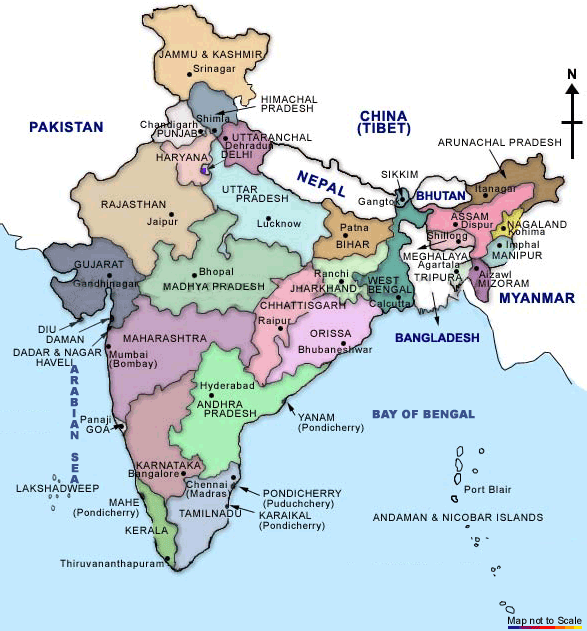 |
| KWLS |
| Figure 3.1: Site in Uttar Pradesh State in India, taken from website http://www.unitexindia.com/state_map.asp |
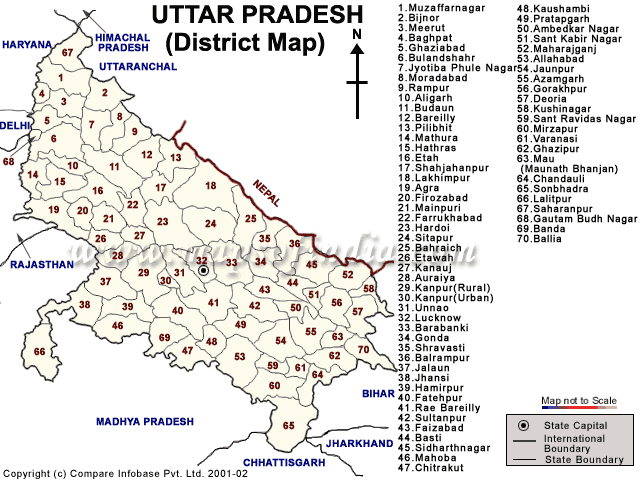 KWLS |
| Figure 3.2: Map of Bahraich District in Uttar Pradesh State taken from Survey Map of India, 2005 |
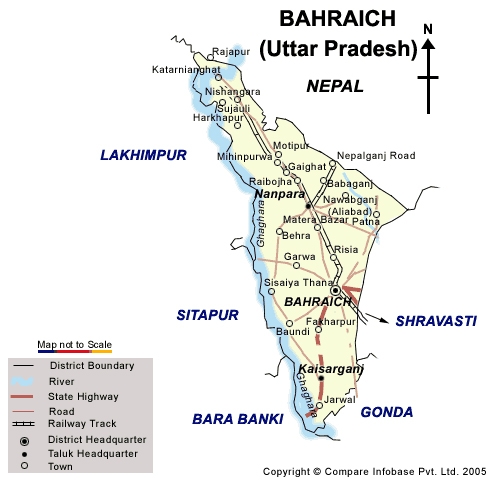 Chehalva Site B - Chehalva Site A - Nishangara |
| Figure 3.3: Location of site in Bahraich District taken from Survey Map of India, 2005 |
3.3. The climate
Climate of the district is hot and humid and falls under semi-arid type (Pande, 1988). The average rainfall is 1125 mm while temperature variation is minimum 5°C to maximum of 44°C (ibid). The average temperature ranged from minimum 24.7°C to a maximum of 29.6°C and the humidity was between 68% - 94.7% during the study period. Being the rainy season, light showers were consistent almost throughout the study period.
3.4. Soil
The soil in the District Bahraich is fertile. The four associations of soil families that can be found in the area are loamy clay, loamy sand, clayey loam and sandy loam, depending on texture (Negi, 1996). The average soil depth is 150 cm (Bali, 1994). Due to fertile nature of the land vegetation is spread throughout the district (Pande, 1988).
3.5. Flora and fauna
The sanctuary was established in 1976 and harbours trees such as Teak (Tectona grandis), Sal (Shorea robusta), Shisham (Dalbergia sissoo), Semal (Bombax ceiba), Haldu (Haldina cordifolia), Mango (Mangifera indica) and Guava (Psidium guajava). Wheat, rice, sugarcane, pulses such as beans, grams, soy, and mustard are the major crops grown around and in the buffer-zone by the local inhabitants (Pande, 1988).
The fauna includes Tiger (Panhera tigris), Leopard (Panthera pardus), Indian One-horned Rhinoceros (Rhinoceros unicornis), Indian Elephant (Elephas maximus), Swamp Deer (Cervus duvauceli), Barking Deer (Muntiacus muntjak), Black Buck (Antelope cevicapra), Spotted Deer (Axis axis), Sambar (Cervus unicolor, Blue Bull (Boselaphus tragocamelus), Common Fox (Vulpes begalensis), Wild Boar (Sus scrofa), Sloth Bear (Melursus ursinus), Gharial (Gavialis gangeticus) and Marsh crocodile (Crocodilus palustris) in addition to the Gangetic River Dolphins (Platanista gangetica) that live in the Gerua and Ghaghra rivers as well as their tributaries (Yadav, 2004). In a survey carried out by the Forest Department officials of the sanctuary, 575 vultures in total were recorded in 2002. These included the five species of vultures such as; Long-billed (Gyps indicus); Eurasian griffons (Gyps fulvus); White-backed (Pseudogyps bengalensis); King (Sarcogyps calvus); and Egyptian (Neophron percnopterus). The report also recorded 31 nests of the White-backed vultures.
3.6. Risk assessment
Risk Assessment was undertaken prior to the fieldwork and their hazard, degree of potential risk and appropriate mitigations was identified, applied and recorded, (see Appendix 7). Both sites were in the buffer zone of the forest which was infested with wild animals and had a recent report of a fatal tiger attack killing a young male working in the nearby field. The area was also frequented by terrorist groups from a neighbouring country, i.e. Nepal. Logistically, the site was inconvenient and unsafe to travel to during early hours and late evenings as the social infrastructure was poor.
3.7. Study area
3.7.1. Site A
The site is a field of an area approximately 70 metres x 40 metres situated to the end of a village - Nishangara. It is located nine kilometres towards South East from KWLS, (see Figure 3.3). Figure 3.4 shows sketch of site A. There are three trees within the field: a Sal (Shorea robusta), a Mango (Mangifera indica) and a Guava (Psidium guajava). The field was covered with wild shrubs of about fifteen centimetres in height and some local vegetation (cabbage, spinach and beetroot). This field lies in between sugarcane field towards the west and a routinely used gravel track pathway used by the locals towards the east.
| N | ||||
| Sugar cane Field | ||||
| Sal Tree | Mango Tree | Shed | ||
| Field | House of the owner | |||
| Guava Tree | ||||
| Gravel Pathway | ||||
| Figure 3.4: Site A. (Not to scale) | ||||
The owner of this field lived alongside this field towards the north. Near the Mango tree there is a shed for his cattle. At the time of the experiment, there were 18 individuals of Asian White-backed Vultures roosting on trees such as Semal (Bombax ceiba) and Haldu (Haldina cordifolia) within a distance of 50-200 meters of the experimental site.
3.7.2. Site B
The site is an abandoned, sandy ramp-like patch of land of area approximately 150 metres x 6 metres, closed to the public, in a village - Chehalva and is located eight kilometres south-east of KWLS. Figure 3.5 shows sketch of site B. The entry to the ramp is from the east and it lies between sugar cane fields its either side and a dense forest towards the west. The irrigation canal lies adjacent on the three sides. Site B showed presence of three Marsh Crocodiles and two Asian White-backed Vultures roosting on Semal and Haldu trees. These were at a distance of 30-70 metres of the experimental site.
| N | ||||
| Dense Forest | ||||
| Irrigation Canal | ||||
| Irrigation Canal | Irrigation canal | |||
| Common Path | ||||
| Figure 3.5: Site B (Not to scale) | ||||
3.8. Specimen
This study was constructed to attempt to replicate the decay of a human cadaver using an animal carcass. Using human cadavers in such experiments is not considered ethical and a surrogate carcass must be utilised (Patten et al., 1974). Various taphonomic experiments have been conducted using animal carcasses such as: hare; rabbit; sheep (Denno et al., 1976); rodents (Haglund, 1992); pigs (Payne et al., 1968; Mann et al., 1990; Hewadikaram et al., 1991; Komar et al., 1998a). Domestic pigs (Sus scrofa) have been used extensively as models for human decomposition as they have relatively hairless skin similar to humans and are omnivorous with equivalent digestive tract fauna (Anderson et al., 1996; Dillner, 1996). Reflecting on ethical and religious concerns (King et al., 1995), in addition to availability, it was decided to use the most readily available carcass.
3.8.1. Goat
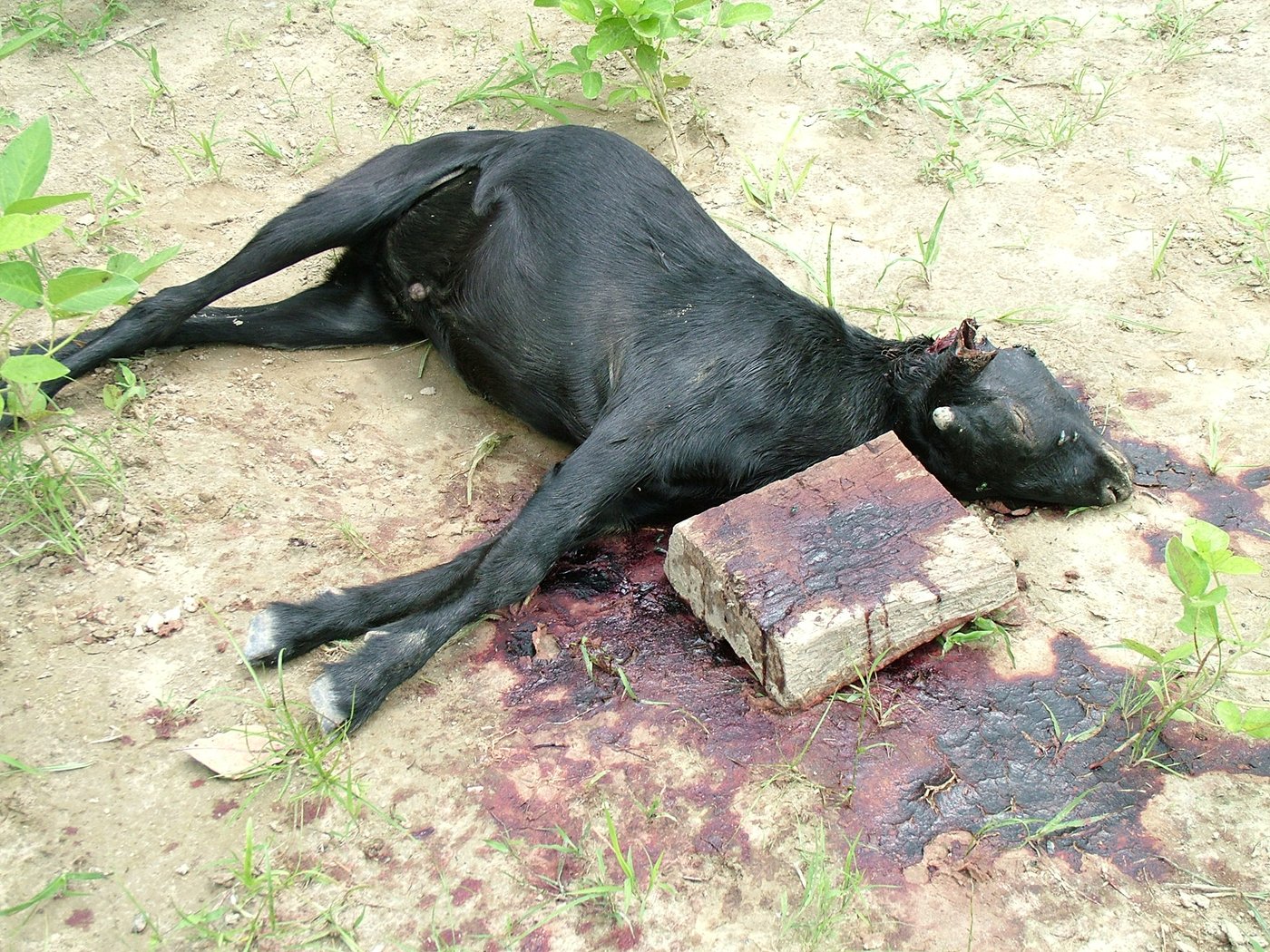
The goat utilised was a one year old male, black in colour, height of 0.8m and 16 kgs in weight. It was supplied by a local farmer as the goat was suffering from a deformity in both the eyes which was causing pain and reducing its quality of life. Death was by a slit in the throat using a sharp knife at the site A on the day the study commenced, i.e. 18th August, 2005, (see Figure 3.6).
3.8.2. The Asian Water Buffalo carcass
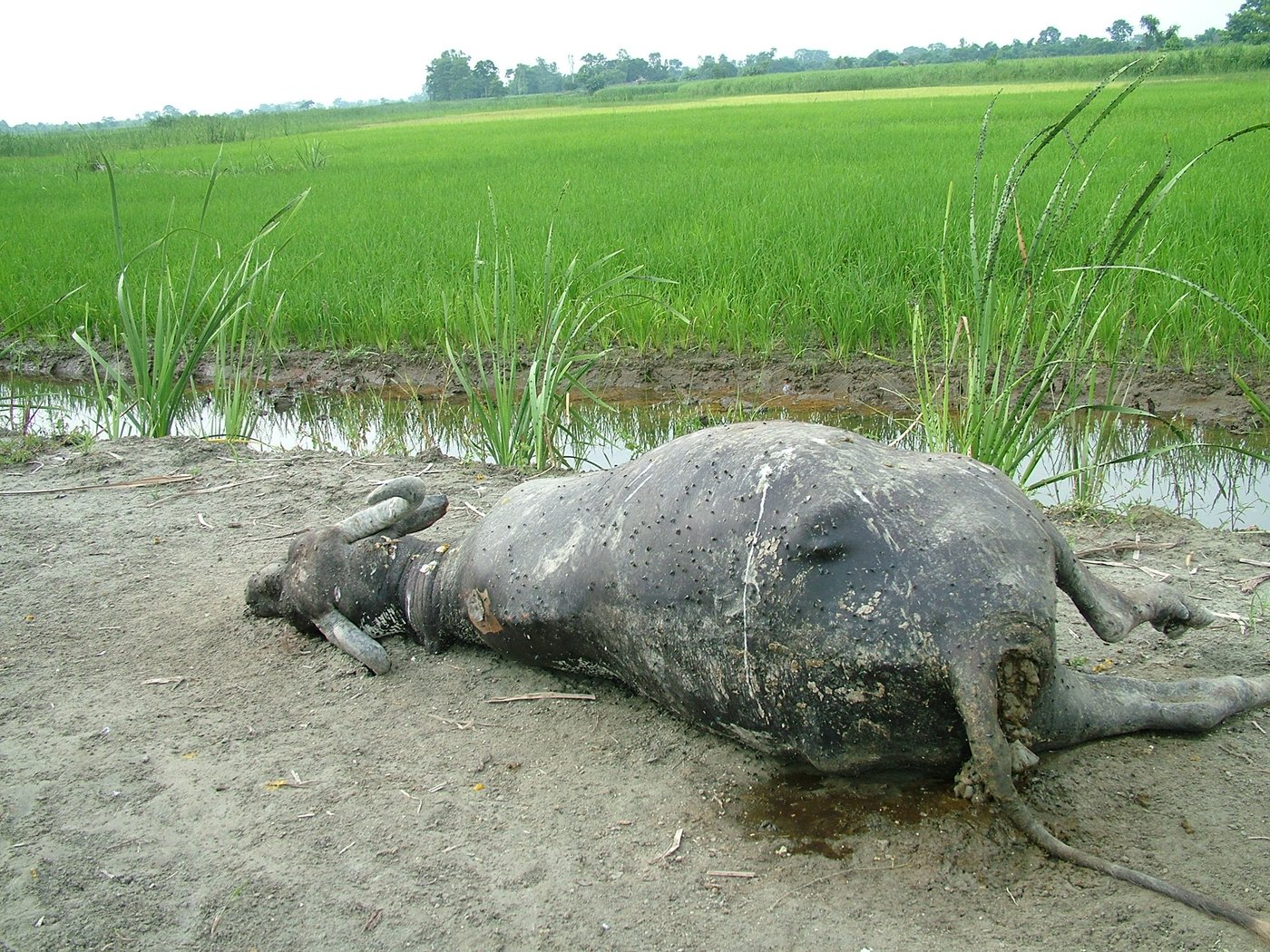
The Asian Water Buffalo carcass was that of an adult male of approximately 9 - 10 years of age, of 1.3 metres in height and approximately 400 kgs in weight. Anecdotal evidence from a witness revealed the availability of the buffalo carcass at site B on 18th August 2005, (see Figure 3.7). The witness informed the author that the buffalo was beaten to death by the owner for refusing to pull the sand cart on 17th August 2005 at around 1700 hours, at the site B, a day before the study commenced.
Methodology
3.9.1. Setup
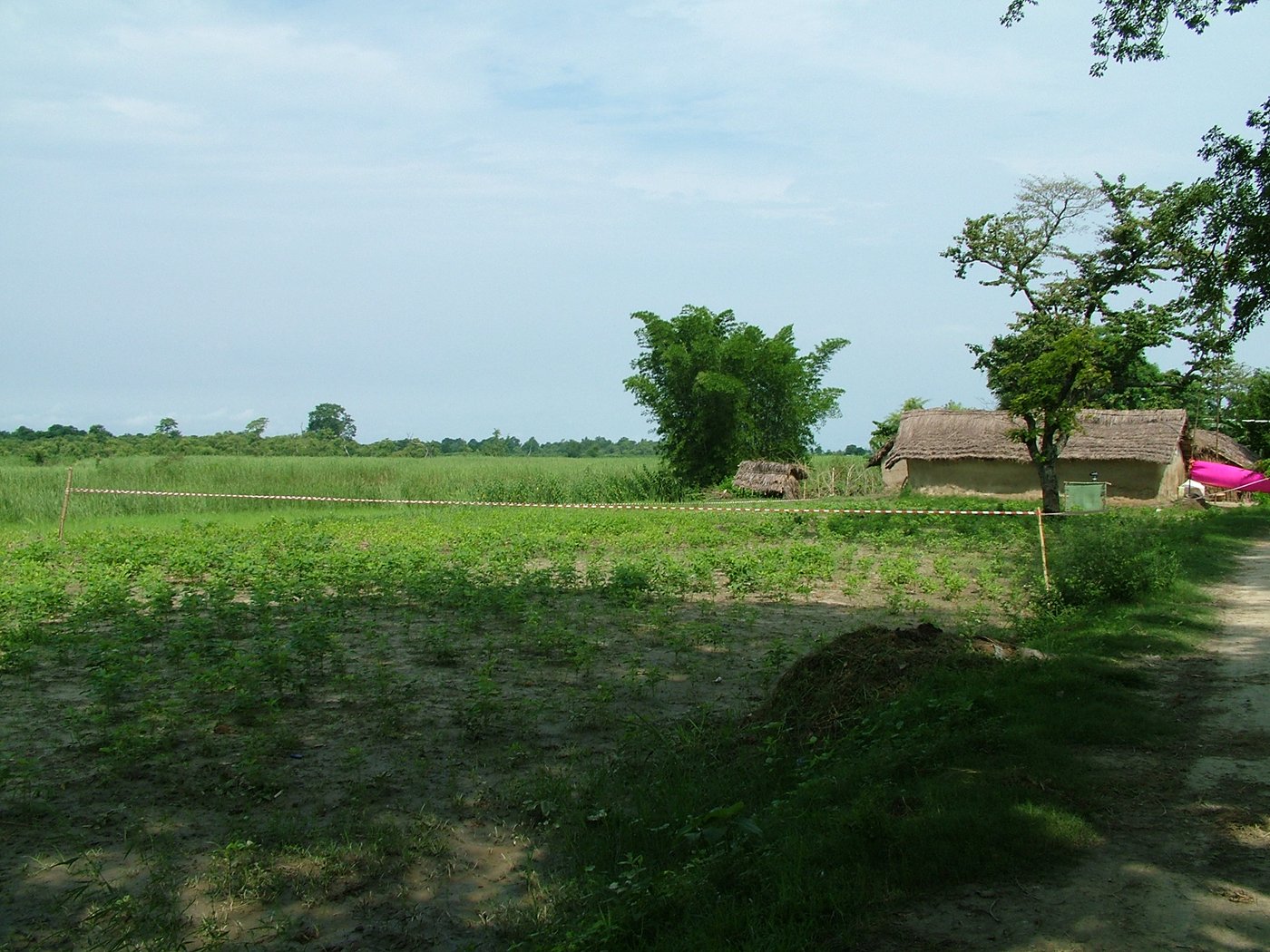
The observational field experiment commenced on 18th August 2005 at 0900 hours at site A, with the, arrival of a 16 kg black male goat supplied by the local farmer. The goat was examined by a local veterinary doctor at the site who confirmed the deformity in the eyes was causing pain and that it would not survive for long, hence the decision was taken to kill the goat by slitting the throat using a sharp knife separating the head from its body. The goat was killed at the site and immediately put into position at 0930 hours, (see Figure 3.6). An area of 35 metres x 35 metres was cordoned off using barrier tapes demarking the experimental site, see Figure 3.8. There was no enclosure as this would deny access to the approach of large carrion-feeding birds, i.e. vulture (Satheesan, pers comm., 2005), hence the aim. Local assistance was used to prevent unauthorised access to the carcass as well as to keep away other scavengers other than vultures.
Despite the obvious presence of large numbers of vultures, after approximately two hours of the goat carcass being exposed, there were no sign of the vultures perching on the carcass. However, all of the vultures were seen flying in a particular direction. Following the birds for approximately one kilometre from the first site, it was observed that the birds were perching on a recently dead male Asian water buffalo carcass. In order to avoid wasting time and lose the opportunity to study vulture scavenging, attention was shifted from the goat carcass to the serendipitous Asian water buffalo carcass. Subsequently consultation with a local ornithologist and vulture expert2, suggested that vultures prefer to devour a large animal carcass rather than a small one, because they appear to act on the basis that the next meal is not assured. Once they have fed, vultures only feed every few days once they have eaten a large enough meal (Satheesan, 1998). To maximise the opportunity and to, ensure that the period available for the field-work was well used, it was decided to use the large animal carcass for the observational study. The condition of the goat carcass was recorded before its disposal (the carcass was buried in the same field at 1145 hours with local assistance).
The field observation at site B commenced on 18th August, 2005 at 1200 hours and ended on 24th August, 2005 at 1200 hours. An area of 18 metres x 6 metres was cordoned off, and divided into grids of 2 metres x 3 metres. The animal had died at 1700 hours on 17th August 2005 according to an anecdotal report from a local witness. The carcass was abandoned on a sandy-clay road in between two rows of sugarcane fields and close to, the marshy area infested with crocodiles, (see Figure 3.9). The carcass was photographed and examined on 18th August 2005 at 1230 hours, (see Figure 3.7). The carcass was examined carefully for any external trauma as the mode of death of the buffalo was reportedly by lethal blows with a stick. The condition of the carcass was recorded.
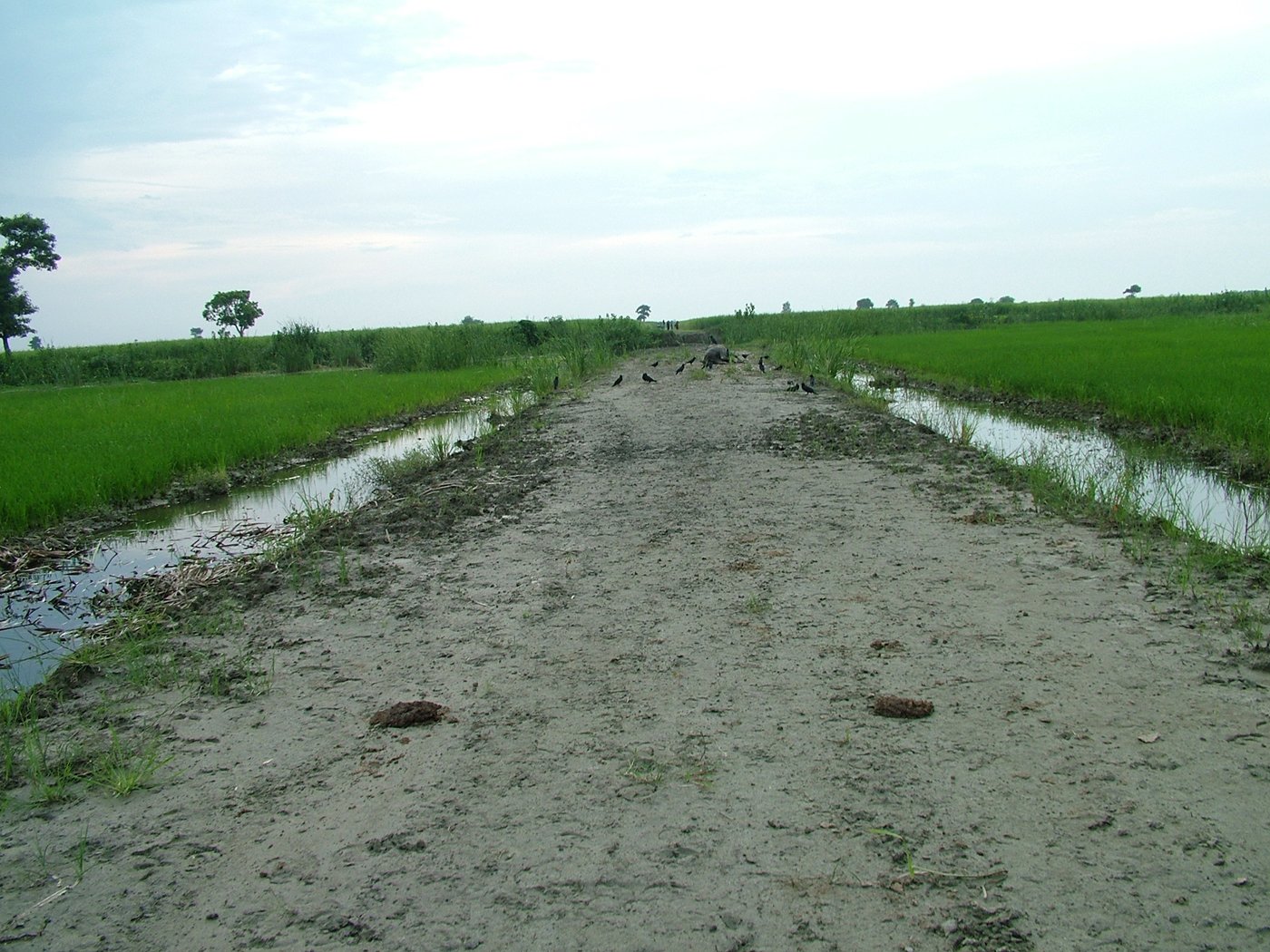
A wire-mesh enclosure was not used for study because of the expense involved in creating an enclosure of the dimensions required. The minimum size required had to be 100m X 100m X 3m, to allow the huge sized avian scavengers safe landing and take off from the site of the carcass. Local assistance was used for controlling other scavengers at site A. But at site B this was not possible due to health and safety reasons. Additional limitations included the time as well as the potential risks involved on health and safety (Site B was surrounded on three sides by an irrigation canal infested with crocodiles, see Figures 3.5 and 3.9).
It has been noted that the presence of open injury, blood, urine or faeces can attract scavengers (Haglund, 1996). It was stated by the local vulture expert that the vulture species present at the site has insufficiently sharp and powerful beaks to tear the thick hide of the buffalo carcass (much thicker than human skin), consequently on 19th August 2005 at 1000 hours, it was decided to slit open a small section of approximately 0.15 metres x 0.15 metres near the belly area of the animal carcass to facilitate the work by the actors.
As this study focussed on scavenging by the various actors in the taphonomic process and was not an entomological survey, the objective was not to catalogue or identify species of insects. However, the daily recording of the state of decomposition included the insect successions and maggot activity.
3.9.2. Study period
The goat carcass was observed from 0930 hours until 1130 hours on 18th August 2005 at site A. The buffalo carcass was observed from 1200 hours on 18th August 2005 until 1200 hours on 24th August 2005.
Recording
3.10.1. Weather Recording
Daily records of temperature, humidity and precipitation from 18th August 2005 through to 24th August 2005 was provided by the Irrigation Department at Girija Barrage (Flood Control Unit in Bahraich district about 10 kilometres south east from KWLS). Daily temperature and humidity was recorded at 0600 hours, 1200 hours and 1800 hours to provide the minimum and maximum range. Daily average temperature and humidity was calculated on the basis of the recordings and can be found in the results chapter, section 4.8.1 and 4.8.2 respectively, of this dissertation. Daily precipitation was recorded at 0600 hours.
3.10.2. Observational Recording
Observational recording included; the identification of the actors involved and the decomposition process of the carcass, with limited reference to entomology. Disarticulation and deposition was observed and recorded with respect to the actors involved.
Identification of the species of birds was aided by taxonomic manuals as well as by the presence of an ornithologist and vulture expert. The other scavengers competing with vultures were easy to identify. Number of approach3 by the scavengers to the carcass and daily changes, i.e. rate of decomposition, of the carcass was noted. On completion of the study, the site was carefully surveyed to record the location and presence of the remains of the carcass. Within the 18 metre x 6 metre area, 2 metre x 3 metre grids, (see Figure 4.12) of the results chapter, were made using barrier tapes and measuring tapes. This allowed a record to be made of the scatter pattern of the skeletal remains as created by the different species of actor, see Table 4.11 of the results chapter.
Decomposition is an uninterrupted process (Komar et al., 1998a). The buffalo carcass was observed undergoing a series of decompositional stages over the study period. The decomposition stage scoring followed a five stage protocol, modified from Anderson and VanLaerhoven, (1996) concentrating on the physical indicators of decay and general scavenging activity by the various actors. These five stages are:
| Fresh Stage : | Begins at the moment of death and continues until bloating is evident and is characterized by a decrease in body temperature over time, No odour. |
| Bloat Stage : | Gases from the anaerobic bacteria start to accumulate which results in a slight inflation of the abdomen, followed by a gradual bloat of the entire carcass Other signs include discolouration and marbling, strong odour, prolapsed rectum and a decrease in body mass. |
| Active Decay : | Onset of this stage is marked by the complete deflation of the carcass. Flesh and skin are still present. The carcass has a greasy appearance and strong odour. |
| Advanced Decay : | Much of the flesh has been removed. There is decrease in overall body weight, with primarily mummified skin and putty-like flesh remaining. |
| Dry Remains stage : | Very little of the carcass remains except bones, cartilage and some skin. No odour is detectable. |
3.10.3. Photographic Recording
Nikon D70 Digital Camera and Nikon F-100 cameras were used for the still film footage to record the decomposition and scavenging activities of and around the buffalo carcass at regular intervals. The photographs were processed and stored in JPEG format and burnt on a CD for referring during the analysis and writing of the dissertation.
3.10.4. Video Recording
A Sony DVD Camera was used for covering live video footage as direct observation to record the decomposition and scavenging activities of the buffalo carcass. 24 hour video footage could not be taken as there was a health and safety risk from wild animals. Further, the climate was not suitable and as there was no proper and continuous power supply in the village, charging of the equipments was a problem. For this reason, we could not record any footage of the vultures directly feeding on the carcass as they either arrived early in the morning or late in the evenings and travelling to the site was not safe during those hours. However, we have footage of vultures roosting, soaring in thermals, perched on trees and resting on the ground after feeding. After the study period the tapes were converted to a DVD format for further referencing purposes.
Notes
- KWLS - Katerniaghat Wildlife Sanctuary ↑
- Dr. S. M. Satheesan is an ornithologist and vulture expert from Bombay. He was present at all times during the research to assist in identification and feeding behaviour of avian species. ↑
- Number of Approach: Number of times the actors were observed on the carcass ↑
Download this chapter as the original Word document (3897 kb)