
Introduction
A female victim was discovered with multiple sharp force injuries. The injuries consisted of penetrating wounds to the torso, back, and neck, and cutting wounds to the hand and throat. On white bedsheets next to the victim were stain patterns that were consistent with bloodstain patterns. The bedsheets appeared to have been crumpled as if maneuvered to wipe blood from a knife. Two kitchen knifes were located at the scene. The knifes were in a pile with a telephone and other bloody cloths.
The question evolving from the bedsheet stains was that of the bloodstain patterns being consistent with cleaning of a knife(s). Did the suspect use a knife(s) from the victim's residence, clean the knife(s) after murdering the victim, and leave the knife(s) at the scene?
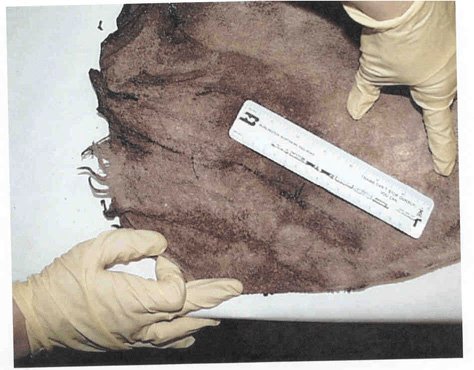
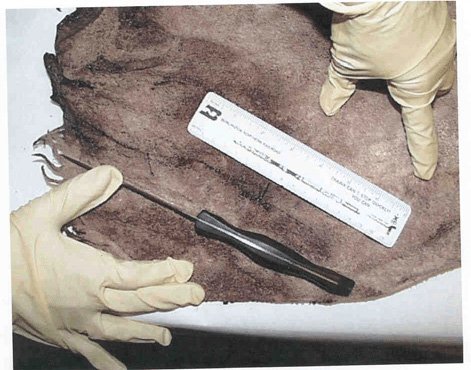
An elderly male was found deceased on the floor of the kitchen of his residence. He was found to have multiple sharp force injuries to his left arm, torso, right hand, and neck. Injuries to the arm and torso were consistent with penetrating puncture wounds. The wounds to the hand and neck were consistent with cutting wounds. A kitchen knife on a kitchen towel was found near the head of the victim. When crime scene investigators rolled the victim's body to the left the victim's right hand positioned over the knife on the towel. His pajama trousers had numerous stains consistent with bloodstains. The towel had a pattern that appeared to have an outline of a knife.
Two questions evolved from the crime scene investigation. The first question concerned the bloodstains on the victim's pajamas. Were they consistent with knife patterns? The second question concerned the mechanism to produce the pattern on the towel? Could the weight of a knife cause blood to vacate an area of a blood soaked towel?
Literature Review
A review of the literature indicated that blood may present latent images through two distinct processes. The first process involves a blood bearing object contacting another object. The second process involves an object being placed upon a blood bearing surface.
An example of the first instance would be a blood covered knife contacting a bed sheet. A knife placed upon a blood soaked towel would be an example of the second process.
Images resulting from an interaction between objects and blood have been variously termed as pattern evidence (Lee, p.279), contact-transfer pattern (Lee, p. 293), compression marks (Fisher p. 248), and transfer flow patterns (Bunker, p. 31). A. Y. Wonder, Blood Dynamics, posits two types of transfer patterns: blockage and contact (Wonder, p. 84). In the former an object blocks the transfer of blood to a surface and the void area presents a replication of the shape of the blocking object.
It has been noted that pattern transfers may be the most overlooked evidence within a scene (Bevel and Gardner, p. 230). As a practice, when trying to make a decision if a particular object produced a pattern, it is often incumbent upon the crime scene investigator to conduct a series of experiments using a similar object as the suspected object (James, Kish, and Sutton, p. 149).
It is clear that the literature recognizes a morphologically discernable image that might result from the interaction of blood, objects, and surfaces. Herbert MacDonell, Bloodstain Patterns, cautions that blood used as a medium for transferring geometric shape may produce shapes of infinite variety (MacDonell, p. 83).
An extension of MacDonell's concept, although not discussed specifically by him, is that blood related geometric images may not readily submit to a linear categorization. The amount of possible variability in the production of bloodstain geometric patterns may give the impression that production of bloodstain patterns is more chaotic than a simple cause and effect action. As an example, it may be difficult to predict the outcome of a geometric pattern given the known facts of a knife, blood, and an additional surface. The surface may be in motion, the knife may or may not be in motion, the amount of blood may vary, time may vary, the biological state of the blood may vary and so forth. In complex systems there are many sources of complexity and numerous variables to include in the observers' perceptional abilities (Biggiero, p. 9). Hence, impression patterns may not only be variable, but they may be mixed in structure, and they may all occur within a given event.
Research Methodology
Research was conducted to attempt to answer two questions. The first question was "What are the images created by pressing a blood soaked knife against a substrate?" Substrate is taken to mean a given surface for contact. The second question was "Can the weight of a knife force blood from a blood soaked towel so that a void image results from the interaction of the knife, towel, and blood?"
The research questions lead to formulation of null hypotheses. The null hypothesis is defined as that explanation believed to be true by the researchers. Refutation of the null hypothesis would mean that the alternate hypothesis, designated as Ha, would be accepted as true. In essence, the alternate hypothesis is the opposite of the null hypothesis.
The research questions lead to formulation of the following null hypotheses:
1. H01: An array of images cannot be produced which will categorically identify unknown blood images as knife images.
2. H02: A knife introduced to a blood soaked towel will cause a void area to present that is morphologically similar to the knife structure.
The research design pertaining to each hypothesis was as follows:
HO1: Knives similar in structure to those found at the two scenes were used as test objects. The knives were covered with blood and were pressed against several substrates. The handles and blades of the knives were pressed against a brown paper hand towel, a white t-shirt, and a white bed sheet. The images from these tests were compared with the images from the scene.
HO2: Four knives were selected as test objects. These knives were of varying weights. The knife from the scene weighed 113.8 grams. The tests knives weighed 43.9 grams, 79.5 grams, 141.1 grams and 273.4 grams.
Each of the test knives were manipulated through four test situations: (1) placed on a blood-soaked hand towel, and allowed to rest until the blood dried, (2) placed on a dry hand towel and blood poured over the knife, and allowed to rest until the blood was dried (3) tightly wrapped in a blood-soaked towel and allowed to rest without additional restriction, (4) tightly wrapped in a hand towel and held by hand for two minutes after blood was poured around the hand and knife. The experiment knives were selected from the property and evidence of a local police agency. The hand towels were purchased off the rack from a local dry goods vendor. The towels were ninety percent cotton and ten percent synthetic material.
The results of the experiment were compared with the towel and knife from the scene.
Data
Hypothesis One: (An array of images cannot be produced that will categorically identify unknown blood images as knife images.)
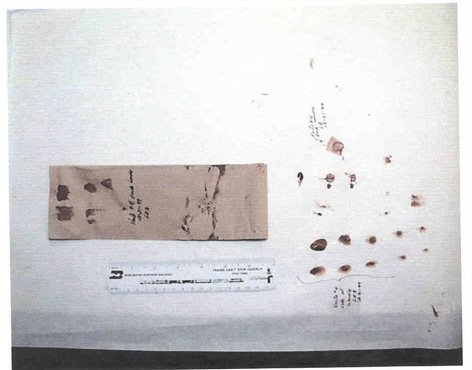
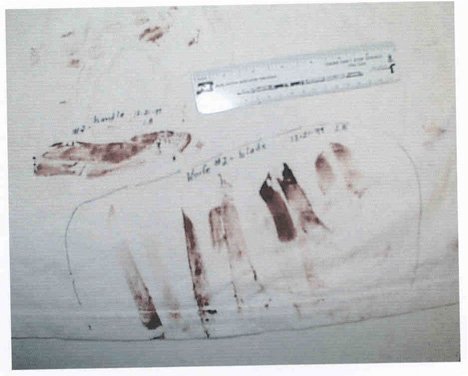
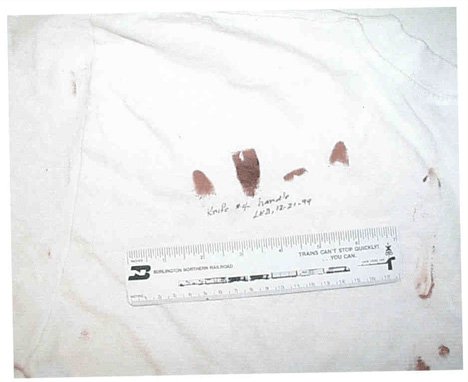
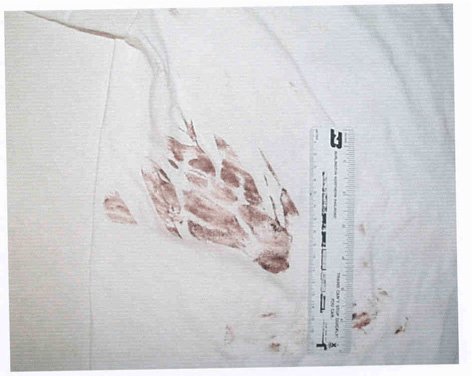
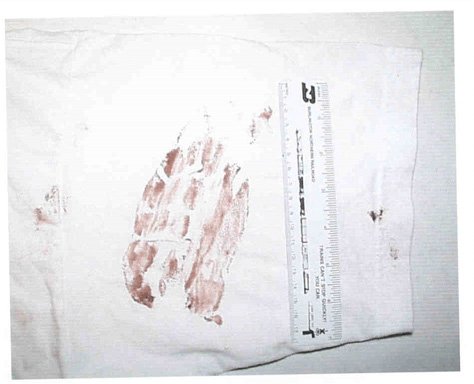
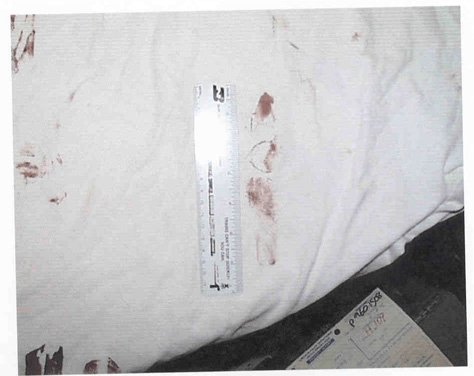
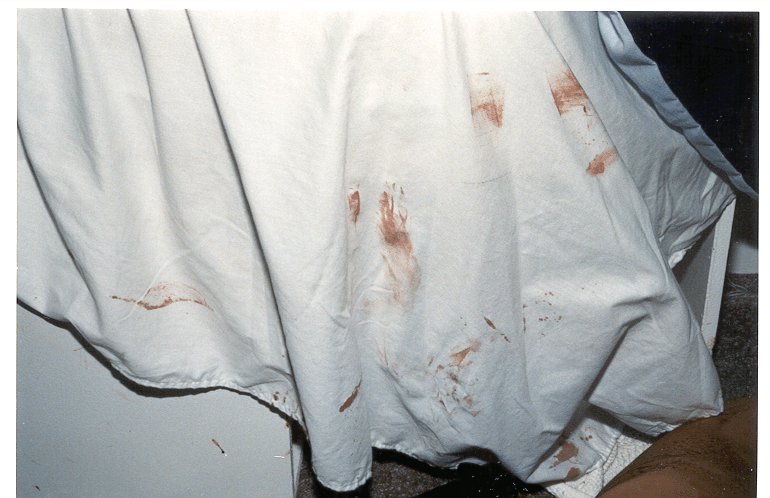
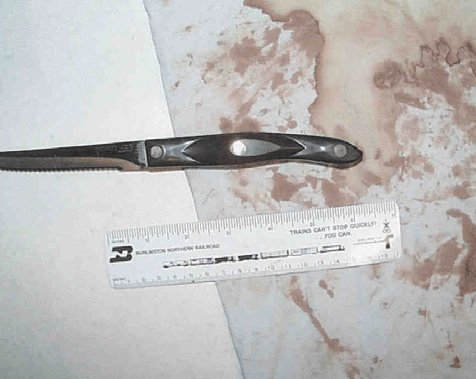
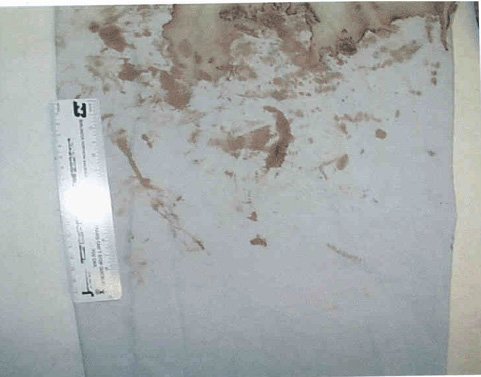
In the below displayed images, Figure 1 -6 are known test images. They were produced by the researchers using various knife structures and using known human blood. Note that the images are produced on paper, as shown by the brown hand towel, and on white, cotton cloth. The images in S1 and S2 are from the scene of two known events. In both cases the images were produced on fabric. S1 is an image produced on a white cotton bed sheet. S2 images were produced on blue cotton pajamas.
Hypothesis Two: (A knife introduced to a blood soaked towel will cause a void to present that is morphologically similar to the knife structure.)
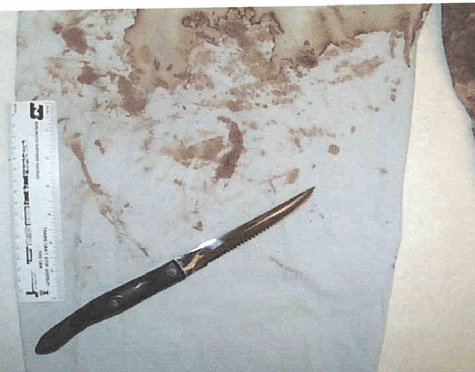
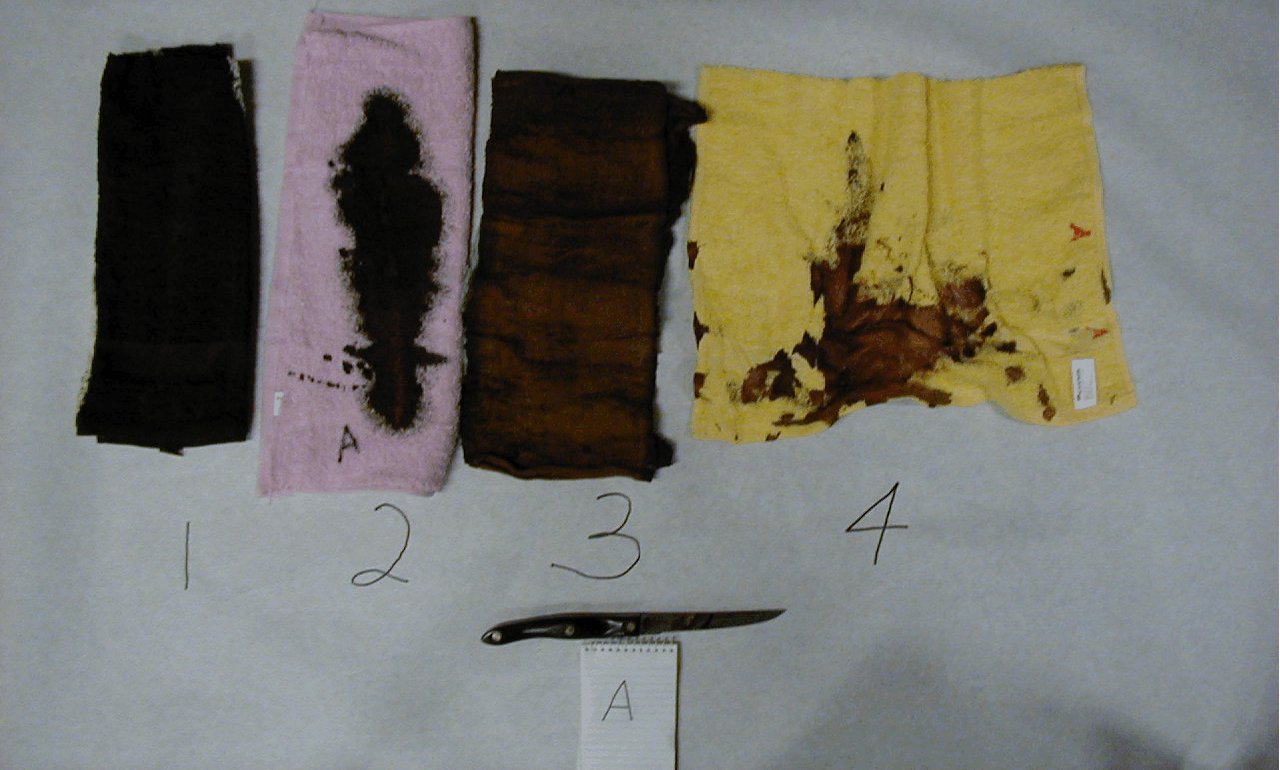
Knife A: The same handle style as the scene knife (79.5 grams).
1. The towel was blood soaked and the knife laid on the towel.
2. The knife was laid on the towel and blood was poured over the knife and towel.
3. The towel was blood soaked and then wrapped around the knife.
4. The towel was wrapped tightly around the knife, hand held, and blood was poured over the hand and knife.
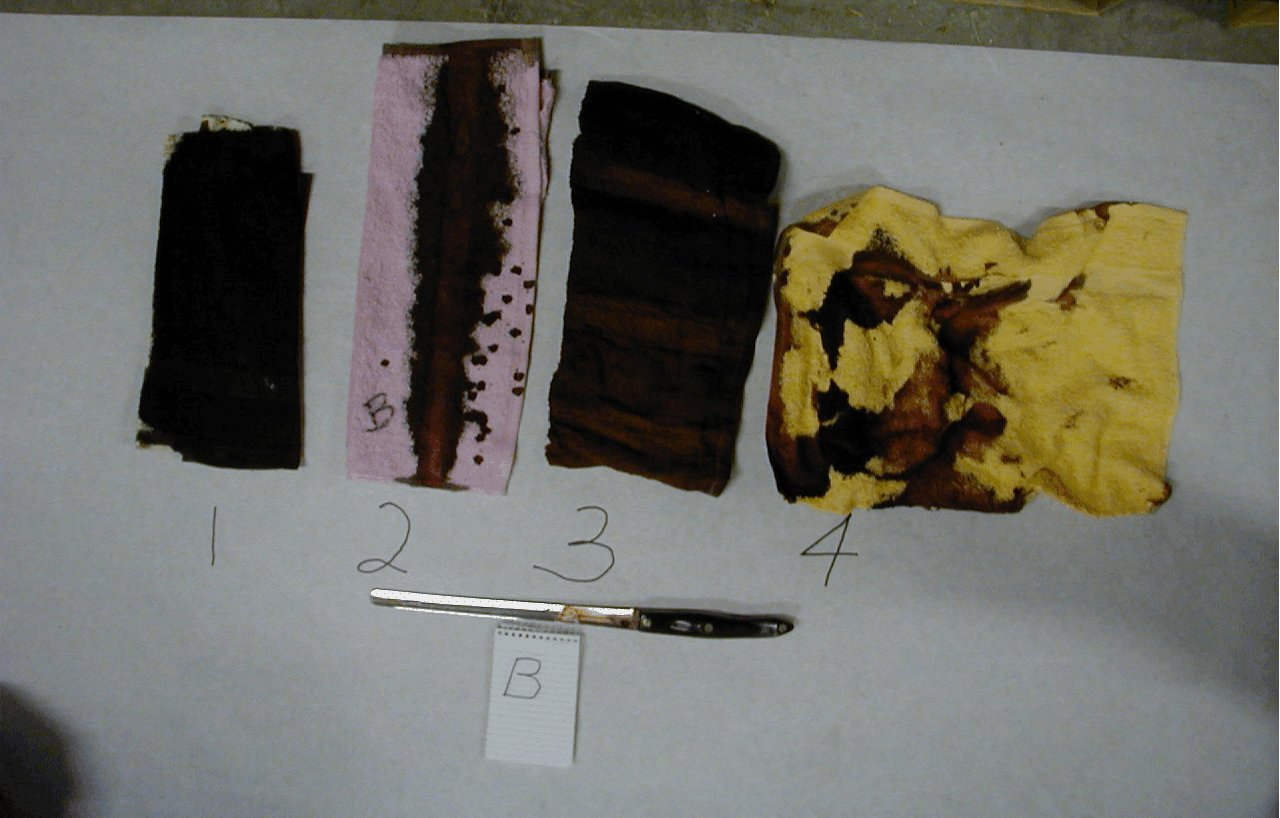
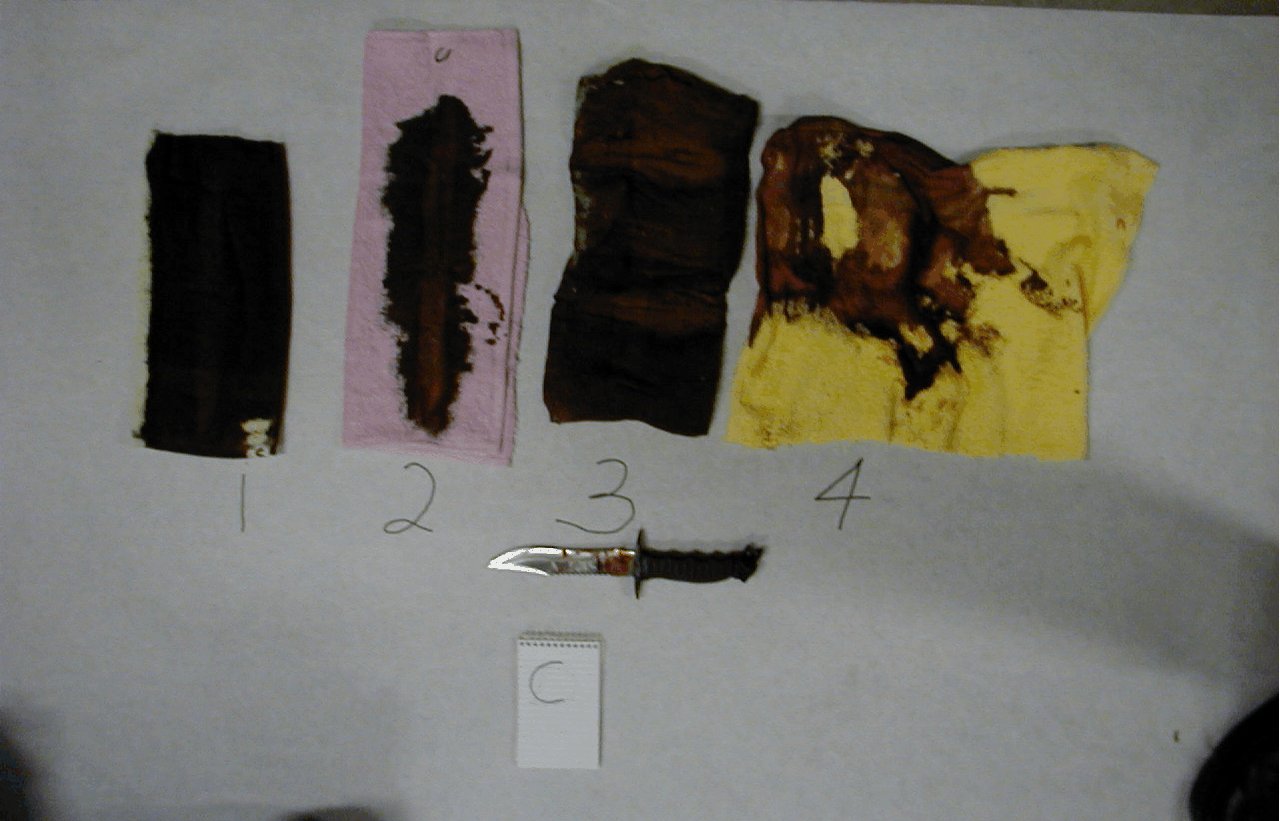
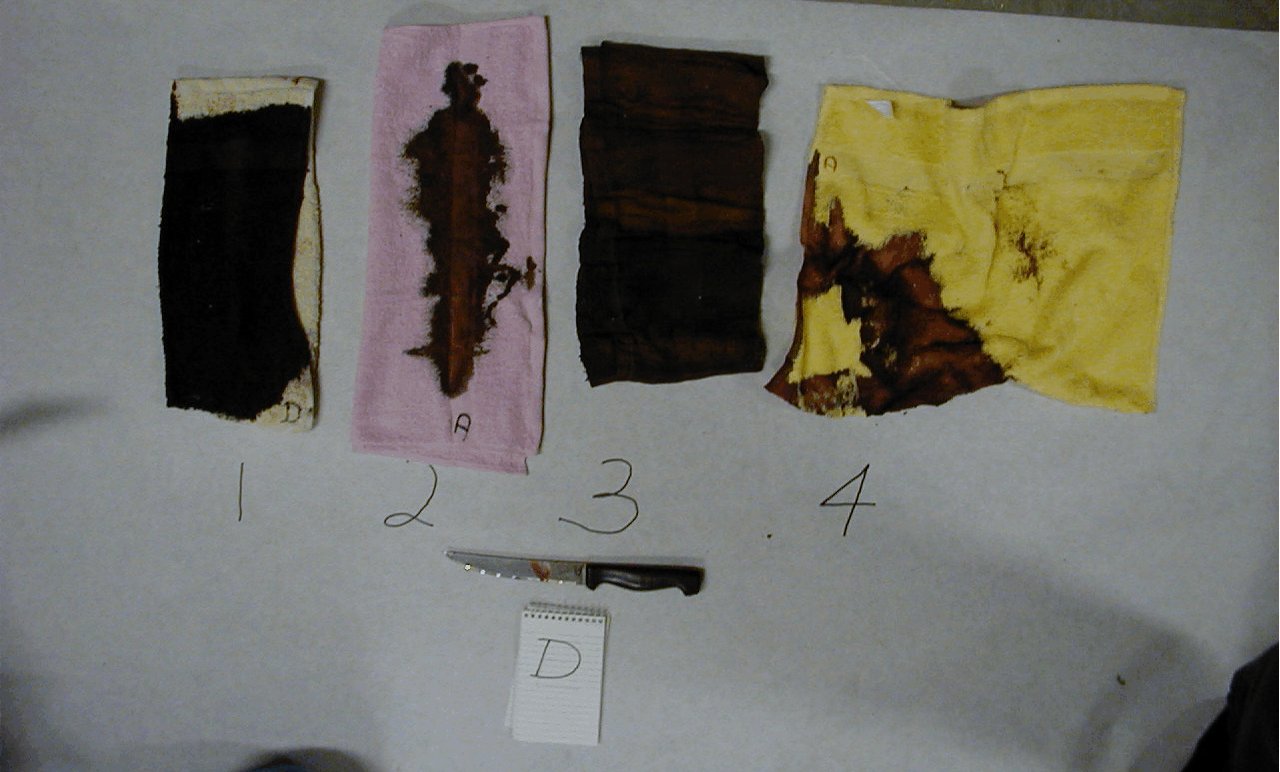
The preceding images were those resulting from the research project. The following two images are those from the scene in which the towel and knife were by the body of the victim. Hypothesis two proposed that a knife introduced to a blood soaked towel will cause a void area to present that is morphologically similar to the knife structure. The investigative question, then, relates to results from the research that is similar to the images from the scene.
Results
Hypothesis One
Hypothesis One, H01: null hypothesis, stated "An array of images cannot be produced that will categorically identify unknown blood images as knife images." The concept in this hypothesis is that all bloodstain images resulting from a knife contacting a surface will be completely random in nature. That is, there is only a possible non-linear relationship that exists between the objects and contact. If the images from the research are such that they can be used for future reference, then the images are categorized in a body of literature of knife bloodstain images.
Figures 1 (knife end test images) and Figure 3 (knife end test images) show considerable variation in their structure. However, it can be seen that there is a general pattern that is similar to an arrowhead image. There are other images that are square and others that are like a dot.
Figure S2a through S2c manifest some similarity with the test figures. In the scene photos there are bloodstain images that are similar to the arrowhead, square and dot test images. It is possible to infer that a plausible explanation is that the bloodstain impressions in Figure S2a through S2c could have been produced from the handle end of a knife. It is not possible to infer that the images in S2a through S2c were necessarily the result of knife end contact with the bed sheet or pajama bottoms.
Figure 2, Figure 4, Figure 5 and Figure 6 show test patterns from pressing a bloody knife blade and handle against a cloth, and images from wrapping the cloth around the bloody knife handle. Figure S1, S2a, S2b and S2c are the images of bloodstains from the bed sheet and the pajama bottoms. The lower left of Figure S1 and the area above the knife in S2a present an image that suggests a possibility of a structural similarity to a knife handle and a knife blade, respectively. It is clear from a comparison of the images that there are images from the test data that are similar to images from the scene data. Figure S1, in the top center of the photo, presents patterns similar to those in Figure 2. Note the consistent parallel lines in the test and scene photos.
The results of the comparison of the test and scene photos allow refutation of hypothesis one. Hence, the alternate hypothesis, Ha: An array of images can be produced that will categorically identify unknown blood images as knife images, can be accepted as the case. That is, known geometric bloodstain images produced from a bloody knife pressed against a surface can be used as a reference to identify bloodstain images at a crime scene. The known images can be used to identify probable knife images.
A word of caution is in order concerning categorization. In some instances it may be possible to make an identity of a bloodstain and a knife. It seems that the more likely scenario is that investigative information can be obtained from an examination of bloodstains that will lead to an abductive inference that a plausible explanation is that bloodstains were produced from the surface of a knife. That is, bloodstain patterns similar to those in the test photos can be included in a category of possible knife impression patterns. The categorical concept lends itself to the use of the information for purposes of event and reconstruction activities, investigative leads, and interviewing techniques. This is not to say that the test images are sufficient for making an absolute identity or an association between a scene bloodstain image and a suspect knife. Furthermore, one cannot say that there is a statistical probability that a certain bloodstain pattern can be included as a result of an action by a certain knife. It is to say that the consilience, coming together, of the information in which the categorical status of knife bloodstain patterns contributes to the totality of information is a reasonable concept. If there are patterns, categorical patterns, like those produced by a knife and there are sharp force injuries to a victim, it is plausible that the victim was injured by a knife and that the patterns on a bed sheet, as an example, are those from a knife that was used to injury the victim. This is what is meant by an abductive inference.
In the examples herein, it is a reasonable inference that someone caused a bloody knife, in Scene 1 and Scene 2, to contact the surface of the respective substrates. Additional investigation would surely attempt to locate a specific knife, witnesses, suspects and other information in an attempt to corroborate the knife related actions. Specifically, one might want to know why a knife was cleaned or pressed against a substrate such as the bedsheet in a victim's room or the pajamas. One might want to measure the morphological features of a bloodstain stain and compare such data with a suspect knife. Are the width's of both sources nearly the same, and are the structural patterns nearly the same? The gathering of additional information offers the opportunity to enhance the robustness of the original inference, and to formulate new inferences that might, as an example, lead to probable personality characteristics of the suspect.
Hypothesis Two
Hypothesis Two, HO2: null hypothesis stated "A knife introduced to a blood soaked towel will cause a void area to present that is morphologically similar to the knife structure." The concept in this hypothesis is that the weight of a knife will cause blood in a blood soaked towel to be pushed out from the area of contact of the knife so that there will be a voided area in the towel that is similar to the physical structure of the knife. If this is true, an inference could be made that a certain knife was placed on a towel after the towel had been soaked with blood.
Figure 7 through 10 suggest that an impression is possible in the case of Situation 2 (knife on towel and blood poured over knife and onto towel) and Situation 4 (towel wrapped tightly around the knife and blood poured over the knife and towel). Situation 4 (knife wrapped around the towel prior to blood introduction) presents the most distinct void area. It appears that there are some structural characteristics that relate to the structure of the knife. These are manifested as slightly lighter colored areas in the mass of the heavier bloodstain areas.
In the case of Situation 2 the weight and structure of the knife was sufficient to cause a very light voided impression in the blood soaked cloth. It did not appear as if the void impression was as visible as in Situation 4, but was visible to a degree. It was not the case that impressions were presented when a towel was blood soaked prior to introduction of a knife.
Hypothesis two can be accepted in the case of Situation 2 and Situation 4. The hypothesis is refuted in the case of Situation 1 and Situation 3. One can infer from the testing of the hypothesis that a plausible explanation is that for a void area to manifest in a hand towel that the knife must be a part of the overall structure with the hand towel prior to blood being introduced to the overall structure.
Scene S2d (hand towel from scene) and S2e (hand towel from scene) show similar characteristics to the photos in situation two and situation four. That is, there is a void area in the towel that is similar to the physical structure of a knife. A plausible explanation, therefore, for the case in Figure S2d and S2e is that the knife was wrapped in the towel prior to introduction of blood to the area of the towel. Hence, one might investigate further the theory that the victim was or was not injured by an assailant. Would an assailant wrap a knife in a towel prior to stabbing a victim, keep the towel wrapped around the knife until the victim is on the floor, place the victim on his side, and place the towel wrapped knife in the victim's hand?
Conclusion
Theory building is critical to a successful investigation. Bloodstain pattern analysis is a tool that offers a great potential for investigative theory building. In the era of Daubert evidentiary requirements, it seems that there is a climate of sorts that requires critical thinking and analytical reasoning during an investigation. There seems to be an interest in proposing explanations that lead to inductive inferences. This is manifested in the efforts to assign probabilities to fingerprint comparisons. In fact, there seem to be some opinions that inductive proof reaches a level of probability that effectively designates information as a deductive principle
David Shum suggests that hypotheses on the relevance of the credibility and probative force of evidence must be generated by imaginative and creative thinking in the application of abductive hypothesis formulation (Schum, p. 1645). Essentially, investigators generate hypotheses, abductively, that they believe will explain observations, and then set about to generate additional information that will refute or corroborate the hypotheses. That is, following an abductive hypothesis the investigator seeks further information from scene characteristics, past events, research literature, experimentation, witnesses and suspects, as examples, to be able to test the hypothesis.
If a statistical probability can be attached to any of the information, the investigator has certainly developed some very robust information. Lacking statistical probabilities the investigator is left with plausible explanations.
Plausible explanations are viable as evidence for explanation of an event. although they may not become probative fact, at the very least they are viable as signs that might point to other probable sources of information.
The research presented in this paper should be viewed from the perspective of providing information that can aid in the abductive reasoning process that can lead to hypotheses for testing that contribute to explain of an event. It is to lead to a plausible explanation.
The bloodstains from the tests are not conclusive proof of knife bloodstains in the scene photos. They are information sources that lend themselves to hypothesis formation, but not are not significant inductive proofs. The tests are information that can lead one to conclude that a plausible explanation of the stains in the scene photos are knife bloodstains. By wrapping the test photos and the scene photos in a body of reference as a category of knife bloodstain patterns, and combining the information with the rest of the scene information and witness information, it is a reasonable conclusion that the most likely or most plausible explanation of some of the stains are that the stains are knife produced bloodstains. From this point, it is reasonable to hypothesize that someone cleaned the knife or knives, in the respective scenes, on the respective bed sheet and pajamas. It is a further plausible hypothesis that the scene knife, in scene 2 (knife and towel scene), was enclosed in the hand towel prior to introduction of a volume of blood to the towel and knife structure. This hypothesis directly relates to A. Wonders blockage proposition for transfer bloodstain patterns.
Further research would certainly add to the robust nature of knife bloodstain patterns. Possible research avenues could be to use different substrates and different instruments. MacDonell's observation of the infinite variability of bloodstain patterns is well taken at this point. It should not be passed by that variability does not necessarily negate explanation. Building the body of knowledge and categorization of knowledge places initial variability in increasingly discernible entities. Schum notes that initial observations using the process of abductive or insightful reasoning can generate guesses or hypotheses to explain the very first observations (Schum, 1654). These initial observations may be very primitive and general.
It is through gathering of additional information that the hypotheses gain additional power. An additional benefit to the process of proposing abductive hypotheses and testing the hypotheses is that the possibility arises of chance discovery of useful information. Taken in totality the testing creates information that can be categorized that builds the body of knowledge, that lead to further hypotheses and testing, that lead to explanations of events at hand and that contribute to an ongoing process of discovery of information. The information herein is submitted as a humble effort in contributing to the process.
References
- Bevel, Tom and Ross M. Gardner. Bloodstain Pattern Analysis With an Introduction to Crime Scene Reconstruction. 2nd ed. Boca Raton: CRC Press, Inc., 2002.
- Biggiero, Lucion. "Sources of Complexity in Human Systems." Nonlinear Dynamics, Psychology, and Life Sciences. 1, 1 (2001):3-19.
- Bunker, Judith L. Bloodstain Evidence Manual. Ocoee, FL.: DOJE's Press, 1998.
- Fisher, Barry A.J. Techniques Of Crime Scene Investigation. 5th ed. Boca Raton: CRC Press, Inc., 1993.
- James, Stuart H., Paul E. Kish, and T. Paulette Sutton. "Recognition of Bloodstain Patterns." Forensic Science, An Introduction to Scientific and Investigative Techniques. Ed. Stuart H. James and Jon J. Nordby. Boca Raton: CRC Press, Inc., 2003.
- Lee, Henry C., Timothy Palmbach, and Marilyn T. Miller. Henry Lee's Crime Scene Handbook. New York: Academic Press, 2001.
- MacDonell, Herbert Leon. Bloodstain Patterns. Corning, New York: Laboratory Of Laboratory Of Forensic Science, 1993.
- Schum, David A. "Species Of Abductive Reasoning In Fact Investigation In Law." Cardozo Law Review. Vol. 22, No. 5-6. 9 June 2003, pp. 1645-1681. <www.cardozo.yu.edu/cardlrev/v22n5-6/schumspecies.pdf>
- Wonder, A. Y. Blood Dynamics. New York: Academic Press, 2001.