
Review · Vol. 5, No. 1
Book Reviews: Popular Books Section


(Page 2 a)
|
|
|


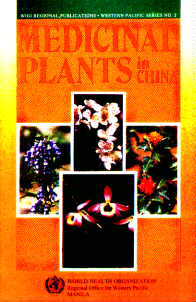
Medicinal Plants in China - A selection of 150 commonly used species, Compiled by The Institute of Chinese Material Medica, China Academy of Traditional Chinese Medicine, Paperback, 5.5" x 8.5".
World Health Organization Regional Office for the Western Pacific, Manila, Publication Date 1998 (2nd impression 1997), i- xv and 331 pages, ISBN 92-9061-102-2: Price: Sw.fr. 50.00
WHO's Catalogue of Publications
 |
The World Health Organisation Regional office for the Western Pacific based in Manila is one of six regional offices throughout the world each with a programme geared to local health problems. This book is one of several books on the subject of Medicinal Plants. Books are published in English and in French.
Others in the series include medicinal plants of Vietnam, Korea and the South Pacific. As with the other books in this series each plant is allocated one page of text and one page of illustrations. The illustrations are all colour photographs. The photographs have been taken under natural conditions during the flowering or fruiting season so that the useful parts of the plants can be identified.
China
Herbal remedies have been used in China for many centuries in spite of advances in technology and Western Medicine. China has developed a unique system for using herbal medicine and herbal medicine still plays a very important role in modern day China. As the preface informs us many plants have withstood the test of time and their safety and efficacy have been established by means of modern tests in a scientific framework. Herbal remedies are making a big comeback in the western world and plants like Ginseng and Gingko biloba are household names. There are a number of publications on medicinal plants in China but few are in English. As some of the plants found in China are found elsewhere in the world the aim of this book is to present information about these plants to the rest of the world.
The book started off as a project between the WHO regional office for the Western Pacific together with the Institute of Chinese Materia Medica and the China Academy of Traditional Chinese Medicine. The project started in 1985.
The number of species of medicinal plants in China is vast and is thought to be about 7000. A selection of 150 is presented in this book. The book was originally published in 1989 and reprinted in 1997 but has not been revised.
|
The book starts off with a short introduction, which is mostly an overview with advice on standardisation and storage of medicinal products. The main part of the book, as with the other books in the series, consists of descriptions of each plant in alphabetical order of their botanical names (Latin binomial).
Each plant is described by its botanical name and by its Chinese and common English names. The parts of the plant used in medicine are then mentioned and a detailed description of the plant is given. There is mention of the habitat and distribution and finally the indications and dosage are given. Unlike with the other books in this series however, there is no mention of the active constituents or bioactivity data. This is a serious drawback and it is hoped that this will be rectified in the next edition of this book. This omission is likely to limit the appeal of the book to pharmacologists and pharmaceutical developers and scientists. The lack of references is another drawback.
The plants
The following are some of the plants chosen by the reviewer based mostly on his familiarity with the plants or plant families.
Aconitum kusnezoffii
Aconitum kusnezoffii is a type of Monkshood and contains aconitine, which is found in the tuber. The tuber is very poisonous and extracts are used locally as a local anaesthetic and for rheumatic arthralgia and other musculo-skeletal pains.
Agastache rugosa
Agastache rugosa is a type of Hyssop also found in Vietnam and Korea. The active agents reside in the leaves and stems and is used in the treatment of fever, headache and nausea. Curiously it is also used as an emetic. Other uses include external use against Tinea.
Areca catechu
Areca catechu is the Areca palm or the betel nut palm. The active part is the seed and is largely used as a vermifuge.
Celosia cristata
Celosia cristata is a familiar plant in the tropics and is commonly known as the Cockscomb because of it's distinctive bright red flower which resembles a cock's comb. It is cultivated as an ornamental plant but the inflorescence is used in the treatment of epistaxis, haemoptysis, haematemesis and other bleeding disorders.
Chrysanthemum morifolium
Chrysanthemum morifolium should be familiar to everyone. The inflorescence is used in the treatment of vertigo. Headache, fever and ophthalmitis.
Curcuma longa
Curcuma longa is the familiar turmeric. The rhizomes when dried and powdered yields the familiar turmeric used for culinary purposes mostly in Asian cooking. In herbal medicine it is used for chest and abdominal distension, rheumatalgia, irregular menses and for injuries. The reviewer is familiar with its use as a disinfectant in his native Sri Lanka.
Datura metel
Datura metel belongs to the Solanaceae family. The active constituents of Datura are poisonous and are to be found in the leaves and the seeds. Curiously in China the dried flowers are used for treatment (of asthma, amongst other unrelated disorders). There is no mention of the use of the seeds.
Ephedra sinica
Ephedra sinica or ma-huang is well known in the western world. The stems are used for the treatment of fever and colds.
Foeniculum vulgare
Foeniculum vulgare is the familiar fennel used in China for a variety of ailments including hernia pain! I personally would not advocate its use for this purpose!
The margin between cure, life and death
Here is what our reviewer has to say as a side note: |
Hyoscyamus niger
Hyoscyamus niger is broadly distributed and is the familiar Henbane. The book does not mention it but the plant yields hyoscyamine, which is found in the seeds. Unlike with Datura, the seeds are used here.
Others
Panax ginseng, Piper nigrum (common pepper) Punica granatum (pomegranate) and Ricinus communis (castor bean tree) are too well known to merit further discussion here.Other well known plants include Zingiber officinale (ginger). Ginger is widely used in Asia as a medicinal plant the part used being the tuber.
There are of course many more plants in this book.
As with the other books in this series the index refers to not only to the botanical names of the plants but to the English and Chinese names as well. Chinese readers will be interested to note that the Chinese index gives the names of the plants in the Chinese phonetic alphabet (Pinyin) as well as in Chinese (Han) characters.
The book measures 14 x 21.5 CMS. The illustrations are all good quality colour photographs. Each page carries two photographs: One of the plants itself and one of the part used for medicinal purposes. The latter could have benefited from the inclusion of a scale especially where seeds are shown. Colour reproduction and print quality are good and the book is printed on coated paper (There are no details about the printer.)
Who would benefit from this book?
Practitioners of herbal medicine will undoubtedly benefit from this book. Botanists and naturalists would also benefit. As for pharmacologists and pharmaceutical developers the value of this book is limited because there is no information about the active agents or other bioactivity data unlike in the other books of this series.
This deficiency should be corrected in future revisions of this book.
As with the other books in this series eco-tourists travelling to this part of the world would find this book interesting.
 |
-Gyan Fernando Dr Gyan C. A. Fernando is a native of Sri Lanka and is familiar with plants used in Ayurvedic remedies. He now works as a Forensic Pathologist in Devon, England. |
Order this book by clicking here
or via
or via the website http://bookorders.who.int
or via mail at this address: WHO, Marketing and Dissemination, 1211 Geneva 27, Switzerland
Request a PDF file of this review through the contact page. (If your screen resolution can not be increased, or if printing this page is giving you problems like overlapping of graphics and/or tables etc, you can take a proper printout from a pdf file. You will need an Acrobat Reader though.)
N.B. WHO publications can be purchased in Rupees, at a very low price, through WHO's Regional Office in New Delhi at the following address:
World Health Organization
Regional Office for South-East Asia
World Health House
Indraprastha Estate
Mahatma Gandhi Road
NEW DELHI 110002
Contact: Mr Dixit, RDOC/Sales
Reviews by Gyan Fernando of the companion books [ Vietnam and Korea ] [ South Pacific ]
Reviews by V.V.Pillay of India[ China, Vietnam, Korea and South Pacific Medicinal Plants ]