
Review · Vol. 4, No. 2
Book Reviews: Popular Books Section

 (N.B. Please increase your screen resolution to 1600 x 1200 dpi or more, for best viewing)
|
|

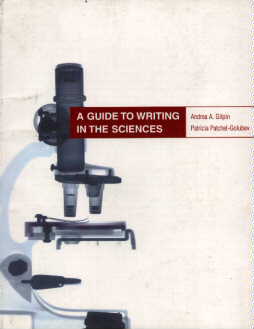
A Guide To Writing In The Sciences by Andrea A Gilpin and Patricia Patchet Golubev, Softcover, 7" x 9".
First edition, University of Toronto Press, 10 St Mary Street, Suite 700, Toronto, ON, M4Y 2W8; . Publication Date September 9, 2000. x + 106 pages, ISBN 0-8020-8366-8. Price $14.95, £9.00
Visit University of Toronto Press Books Website
 |
Writing is the most efficient means to communicate with others. As a child grows he learns to pronounce a word, copying the word from the closest person(s) who, in most cases, is his mother. He learns and also identifies a language. Experts say that this first learning lesson is the highest intellectual achievement of a person's entire life. Similarly, writing something means conveying our ideas to our readers. It is certainly a form of communication (page-4) and what matters most is how efficient we do it.
A guide to writing in the sciences is a great attempt towards producing a complete help to the writers in the field of science. Both the authors have shown real skill in drafting the book. The book clearly shows that a comprehensive research has been done on the subject. The painstaking work by the authors can be understood by the knowledge they have provided in the boxes in each chapter. The most striking feature of this book is the style of writing by the authors. The speed, continuation and of course, the language used by the authors is descriptive but simple.
This book contains five chapters, starting from the simplest (The lab reports) to the most complex one (Let's talk sentences). The authors have incorporated examples that have made the understanding process much easier. Chapter two describes how to prepare a poster presentation and a research proposal, which would be extremely important to the undergraduate students. Chapter 3 and 4 concentrate on the most difficult of all arts, 'The Essay Writing'. This chapter can prove very efficacious to the students of almost any age group. In these chapters the book describes the meaning of the word 'essay' and takes us to a journey no less interesting as of the first and second chapters. As we move on to the last chapter, we find helpful comments on the basics of all writing - the grammar. This is the most important - and perhaps the toughest - chapter. Quite appropriately, it is the last chapter of this book. This section tries to simplify the most complex terms of the language.
The book discloses the sources of materials from which an inquisitive person can consult. These references include a comprehensive list of Internet website addresses and a list of books referred. Many people have a vague idea about referencing/citing the works of others. This smart piece of text provides the answers of 'what', 'why' and 'how' of reference work. In this connection they have introduced a term often new to the beginners - "plagiarism". This term relates to the reference citing.
The authors have described various sections of a lab report, for example, Title, Introduction, Materials and Methods, Results etc. in a sequential manner. Besides this, the details of preparing tables, figures and presentation of data has been explained in a very logical manner. The appendices given in the end show the value of writing skillfully and systematically in the sciences.
Every chapter contains several boxes, which indicate the key points in very straightforward way. It can be called a sort of summary of each section.
The authors have stressed three main principles for effective style of writing. These are: 1. Clarity, 2. Conciseness, and 3. Forcefulness (page 80).
Following these rules and advices one can improve one's writing skills, as they really are not the mysterious gifts that a few people possess. Anybody can learn to master the art of writing by practice and, of course, some determination as well (page 5).
I have shown this book to a few undergraduate students and a few research scholars. Their responses were amazing. I strongly recommend this book to the students of high school level and above. But at the same time I'd like to suggest to the readers that each chapter be read in one attempt; otherwise the book might be difficult to follow.
 |
-Prateek Pandya Prateek Pandya is a research scholar in the Department of Chemistry at Dayalbagh Educational Institute (D.E.I), Agra, UP, India. He can be contacted by clicking here. |
Order University of Toronto Press Books by Clicking here
 Request a PDF file of this review by clicking here. (If your screen resolution can not be increased, or if printing this page is giving you problems like overlapping of graphics and/or tables etc, you can take a proper printout from a pdf file. You will need an Acrobat Reader though. You can also create a pdf file yourself by clicking here.)