
In recent times, the issues related to women have been raised and I discussed at various fora. Among these issues the " crimes against women have occupied the centre stage. The fact that a dozen and more cases of crime against women are registered daily while many more such cases undoubtedly go unreported, hardly makes any sense for celebration of women's day in the 50th year of independence of India.
Dowry is a social evil which is continuing since time immemorial. No body in the community is in its favour. Everyone hates it but there are no proper resources and media which can check this social scourge. Once the marriage is settled in our community, one of the initial step is to talk about dowry. It has become so much a part and parcel of our social customs that a I lot of household items such as items of luxury, sliver utensils, gold ornaments and cash money are handed over at the time of marriage of one's daughter .
The evil of dowry has deep roots in our social set up and uprooting of this stigma is not an easy task. This is due to the fact that Indian society is yet to realise the humilation which are subjected to when they bring scanty dowry . In reality, the persons who give dowry , feel and know the pains and prangs of paying of such an hefty amount hence they also ask for in return cash and other valuable things in dowry whenever they get a chance.
The matrimonial offences consequent to the scanty dowry are increasing leaps and bound. Matrimonial offences including harassament, improper I ill treatment, etc are the commonest of all women related offences. Dowry occupies only one end of the broad spectrum of social abuse, within the same spectrum are hwnilation, cruelty , punishment, molestation, physical or mental torture or any thing infact, which re-inforces a lady's helplessness consequent to dowry related unending demands of the husband or her in-laws. It may be emphasized that a girl, by the mere act of matriage is thrust into an unfamiliar world and is trapped into web of insecurities and thus she is entirely on the mercy of the husband and lor his family members who might or might not look after her, a truly scary and helpless state to be in, all owing to the social evil of dowry for which she is least to be blamed. Only in rarest of rare circumstances, a women prefers to take recourse to police and judiciary , for the system is so cumbersome that she has to move from pillar to post and will get justice only after several years if she is lucky .
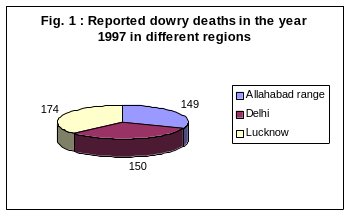
Dowry death is one of the most heinous crimes against the women. The figures of alleged dowry death cases are spiralling and are ever increasing to the extent that one women in India is killed for dowry every 10 minutes. Reported dowry deaths in the country jumped from about 400 a year in 1980' s to more than 5000 a year in 1990's as per the National Crime Records Bureau Statistics. This is just the proverbial tip of the iceberg, holds experts, since a major chunk of such cases go unreported. In India, Uttar Pradesh is topping the list of dowry deaths, with an average of 1900 dowry deaths reported annually from the entire country , Maharastra is the second largest contributor of dowry deaths followed by M.P. and Bihar .The number of reported dowry deaths in Delhi, Lucknow (the capital of U.P.) and Allahabad range was 150, 174 and 149 cases in 1997 respectively. On comparative basis, Lucknow tops the list of dowry deaths whereas the incidence of dowry deaths at Delhi and Allahabad range ( inclusive of Districts of Allahabad, Pratapgarh and Fatehpur) are almost at par (Figure 1). The reported figures for cruelty and harassment against women are also much higher and are showing a rising trend, with 850 such cases being registered in Delhi alone in year 1997.
Inspite of the long list of legislation protecting the rights of women, most importantly the prohibition of giving and taking dowry --the Dowry Prohibition Act, 1961, is the one which is most commonly defied since its inception allover the country .There is no denial that there is an ever increasing crimes against women at the hands of their husbands and / or in- laws. It was precisely to deal with this that section 304 B (Dowry deaths) and 498 A (Cruelty by husband or in-laws) were incorporated in the Indian Penel code in the mid 1980's.
A review of Dowry Prohibition Act, 1961 should again be undertaken as the law has actually failed to curb the crimes against women or in effect failed to produce the desired results. Moreover, the Dowry Prohibition Act, 1961 being a special act, ordinarily police do not act or take much interest in it, more particularity because offences under the act are treated as cognizable offences for certain limited purposes. It is the high time, severe punishment is to be meeted out to those who take dowry and strict laws be framed for dowry related harassment and dowry deaths. Strict laws should also be enacted to ban remarriages for such men whose wives have been burnt alive and / or the men who have been implicated in dowry deaths till the delivery of final judgement. Besides, a special task force of police be constituted exclusively for this purpose in each district of U.P immediately, and speedy police investigations along with other required formalities be completed for the speedy trial of each individual case. A constant monitoring is also a must for all registered dowry death cases both at district and high court level so that justice should be handed down at the earliest.
Destruction of life because of dowry is though not uncommon in this part of the country inspite of the stringent laws in practice here with higher awareness of the same and also higher literacy / educational status among the general population of Allahabad range. The observations made in this study are more or less similar to that seen in other parts of India (Satpathy, 1995 ; Bhullar, et al1996 and Rao , 1997).
During the study period a total of 151 dowry death cases were reported in Allahabad range, and out of this an approximately 51% cases were reported in Allahabad followed by Fatehpur 27.82% and Pratatparg i.e. 21.19% (Table- 1)
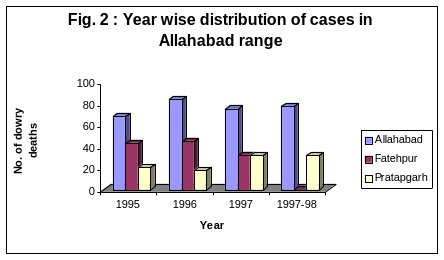
The seriousness and magnitude of dowry deaths can be assessed by perusing the Table -2 which highlights distribution of cases during the last three years i.e. 132 cases in 1995, 147 in 1996 and 149 cases in 1997. It can be seen that incidence of the crime is steadily increasing with time, being highest during the study period (97-98) and lowest in 1995. (Figure- 2).
The detailed break up of the nature of deaths both at national level or at U .P .state level are not well reported hence difficult to compare with data presented in this study. Table-3 shows the nature of deaths --homicidal or suicidal. A great majority of these cases approx 78% are found to be homicidal in nature and remaining 22% are suicidal. Amongst suicidal cases, Pratapgarh district shows highest incidence of suicide while amongst homicidal cases Allahabad accounts for maximum dowry deaths. The preponderance of homocidal cases over suicidal cases as observed in our studies, is in confonnity with other workers in the field as well (Satpathy, 1995 and Bhullar, et al 1996 ).
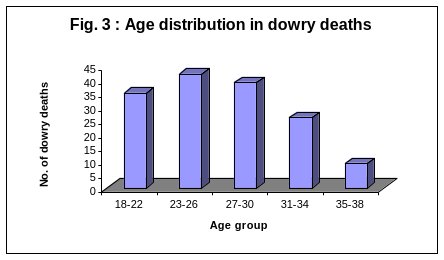
However, the statistical analysis on age incidence of dowry deaths (Figure-3) reveals the fact that the dowry death is most common in the age group of 18-30 years with highest percentage preponderance being observed in the age group of 23-26 years (i.e. 27.81%) followed by 25.83% cases in the age group of 27-30 years and 23.18% in the age group of 18-22 years.
Involvement of younger age group in cases of dowry deaths has also been corroborated by various studies and national data. Bhullar, et al (1996) also quoted similar observations. However, in contrast to Rao (1997) who reported maximum cases of dowry deaths in the age group of 19-25 years (26%) whereas as per our findings the maximum incidence were observed in the age group of 23-26 years (17.81 %) and the total incidence in the age group of 23-30 years was 53.64%.
When these deaths are analysed according to religion, Hindu females comprised of an alarmingly large group 94% while the number of deaths in other religious groups, especially the Muslim, Sikh and Christian communities, is almost negligible (Table-5). It may be argued that these religions are in minority in India hence low dowry death rates in these communities are proportional to their numbers in the population. Yet, lesser number of dowry deaths in ladies of muslim communities at Allahabad district is quite surprising since moharnmden population is considerable and that too of low socio economic strata. Considering the relation between peak time and dowry death occurrence, It is true that the incidence of dowry death most commonly happened during night (35.76%) and evening hours (32.45%) as shown in (Table-6).
In the majority of dowry deaths approx 84% either the husband and / or his relatives are responsible for killing or forcing the victim to end her life and that husband alone is found to be most common offender responsible for , 33.77% of all dowry death cases (Table- 7).
Regarding the causative agents such as burns, poisons, asphyxia (including drowning, hanging, strangulation etc. ) and other concerned causes, the fact and figures in Table-8 shows that majority (67.55%) of deaths are due I to burn followed by deaths due to poisoning (14.75%), whereas asphyxia accounts for lowest incidence of deaths. Amongst the burnt deaths, approx 72% are homicidal in nature. In deaths due to poisoning, majority (14 out of 22) cases are suicidal in nature. Younger age groups are more commonly involved. Aluminum phosphide (ALP) marketed as Celphos tablets being cheap, easily available and due to non-availability of an antidote against it, is the most frequently used poison for the purpose of suicide and next common are organophosphorus compounds. This finding was in agreement with the observation of Bhullar, et al (1996).
Educational background of ladies has a relevance. It may be assumed that highly educated ladies, who in emergency can opt for employment and earn handsomely, are minimally involved and the incidence of dowry deaths is barely negligible. Table 9 indicates that majority of dowry deaths approx 96% are reported in ladies who are either illiterate, below matric or matriculate, and only 3.97% victims are educationally highly qualified. In educated females, suicide is more common while in victims who are illiterate or having education upto matric, homicidal incidence is more common.
When dowry deaths are studied in relation to status of family. Our study highlights that most of the cases (54.97%) are found in low socio- economic group (Table -10). This finding corresponds well with other studies in the field. Approx 95% of cases are house-wives; amongst the housewives homicides comprise the highest incidence (78.47%) (Table -11). Only one case has been recorded in employed lady who died by suicidal mode. The number of victims from joint families (121) is about 4 times compared to nuclear families (30) (Table -12). Table-13 exhibits that majority (91.39%) of dowry deaths are reported in arranged marriages. The study clearly points to that young housewives from joint families are the major target particularly if they belong to poor socio-economic status.
Regarding the location of crime, it is observed that in 60% of dowry deaths, the first and foremost location of incidence is the in-law's house followed by own or husband's house (Table: 14). The plausible explanation is nobody is supporting / protecting the harassed wife and she becomes an easy prey of hostile in-laws family surroundings. Moreover, not only the husband but his brothers, sisters, parents etc. also take active part in committing the crime and she becomes an easy target.
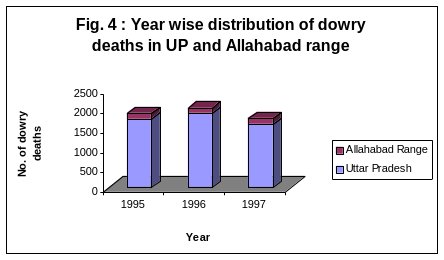
A comparative study of 'reported' dowry deaths in U .P .and those of Allahabad range (Allahabad, Fatehpur and Pratapgarh) as per the official records of U.P.P. during last three years 1995, 1996 and 1997 and during the study period are presented in Table -15 indicates that Allahabad range e:xhibited a gradual rising trend in dowry deaths; while in U .P .the overall total number of dowry deaths in 1997 were only slightly on lower side (Figure-4).
To my mind, Allahabad representing a prototypical city provides the ideal situation for dowry deaths as the major population of city belongs to poor or lower middle class families and predominance of service class families devoid of affluence. This is in contrast to industrial and rich city population of Bombay or Ahmedabad.
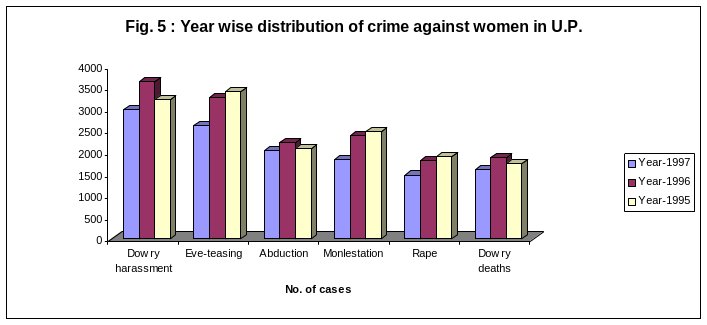
A detail year wise distribution of the cases of crime against the women in U.P. during last three years 1995, 1996 and 1997 (as per the official records of the U.P.Police) are shown in Table-16 & Figure- 5 it indicates that the overall incidence of crime against women is slightly decreased in 1997, this actually may not be due to stringent laws and awareness of people for the same but the decreased incidence may be because of the 50th year of Indian independence as well as an election year for the nation hence more strict vigils, on the part of police and probably due to more fugging or bungling of the data to present a rosy crime picture (Figure-5).
Moreover, since everyone knows that a large number of cases of crime against women go unreported and police force is not held in high esteem both by illiterate poor people as well as middle class families who treat police stations as dens of corruption and a place devoid of justice and humanitarian considerations.
Of great concern is a steady rising trend of dowry death cases. A significant rise is being noted when data for the three years 1995, 1996 and 1997 are compared. The study period which takes into account only three and half months (upto 15th April) of the current year 1998, also exhibited the similar pattern of dowry deaths. Thus, this social scourge rather than declining in early part of the year 1998 is showing a uptrend particularly as far as the Allahabad range is concerned.
The result of the present study clearly points to that law alone against dowry cannot offer a sure remedy. A multifaceted approach including socio- economic and educational upliftment, more job potentials for the ladies as well as a higher social status and respect to women along with deterrent laws and speedy justice can only help to stamp out this social scourge. The voluntary social organisations particularly those concerned with female welfare may playa vital role by not only awakening social awareness about dowry but also condemning the evils of dowry, and raising the issues of women torture and harassment at all possible fora thereby forcing the offender husband to act with restrain and give respect and social dignity to his wife at all levels. Besides, if the family is economically weak, voluntary organisations should try to procure a job for the lady if possible.
It is quite perplexing that despite a significant steady rise in divorce rate allover the country during the last 10 years, the dowry deaths rather than declining is showing an uptrend even though number of disgruntled or discordant families are decreasing due to increased divorce rate. If may be assumed that dowry deaths and divorce rate exhibit a parallel relationship rather than an inverse one.
In the end, the medicolegal aspects of dowry death need special consideration. Some of the important medicolegal aspects which deserve merited attention have been dealt in here to ponder over the ticklish situations faced by forensic experts. The first and foremost aspect is that not only the police should swing into action immediately to avoid destruction of vital clues at the site of location but also police should act promptly in registering all such F.I.R.'S without delay. If a special task force / cell is maintained then this should also be informed for prompt investigations of each case. Secondly, if local police is dragging its feet or showing a delaying tactice then either the superior officers be approached or N.G.0. and other voluntary organisations be approached for the proper probe in the matter. Approach to media also focuses a strong awareness about the occurrence of crime.
Secondly, in case, where then victim is alive say after receiving burns or in poisoning cases etc. the all efforts should be made to record a declaration by a competent authority , whenever possible is quite helpful for clinching the conviction. Hence, great priority should be accorded for recording dying declaration in all alleged cases of dowry deaths. It is well known fact that great solemnly and sanctity are attached to a dying declaration because a person on the verge of death is not likely to tell lies or cook a story to implicate an innocent person. Even supreme court has upheld this argument in number of cases. Thus, dying declaration has legal validity , for the Indian law recognises the presumption that a person who believes that her death is imminent will tell only the truth.
However, in my opinion, in certain situations female victims who make dying declaration, furnish false informations, particularly if the lady is continuously tortured for months together or else is severely depressed or under drug effect or wants to protect the future of her children. Curiously, these aspects have not been adequately probed at length by the courts. The courts never consider the emotional dilemmas faced by these victims who is furnishing dying declarations. Thus the points worth considering are as follows :
According to Hindu mythology a female, on the verge of death, will go to hell (Narak) if she makes allegations against her husband. Because of this taboo of Hindu customs and superstitions, a wife will not implicate her husband in her deathbed declaration.
In most cases a mother who is close to death worry about the future of her children and out of fear of her in-laws handing them, will be reluctant to reveal the truth.
Many middle class Hindu families maintain close relationships with other family members. A victim may remain silent to protect the lives of other family members.
A female victim who perceives that she will not die becomes fully aware that after treatment, she will have to return to her husband / in- law's home and will not be able to seek shelter with her own family. With dismal future in mind, she will try to protect the interests of her in-laws and may not reveal truth.
The above situations clearly highlight that the judiciary should take a fresh look at the veracity of dying declarations, in particular, once the truthfulness of a dying declaration has been negativated by scientific facts. The law should give recognition and preference to the scientific facts and not to the dying declaration. Moreover, the victim's motive in making a deathbed declaration is either to protect the interests of her children or other relatives while the medicolegal personnel, pathologist or the forensic experts furnish facts without any motives and in the interests of society to bring the culprit to book and to assist the administration of justice. Our opinion is in conformity with those of Satpathy (1995) who has expressed similar views in respect to dying declaration in burn cases and its critical probing by judiciary in has prolonged study spanning to 13 long years.
Third, medicolegal aspect which deserve attention is the evidences recorded by the minor children or domestic servants, if at all present, at the scene. Whether these circumstantial evidences should be fully relied or not is a major question which can not be answered with certainty because in both cases the evidences may be largely tutored or made under compulsion of threat, bribery or bargaining.
Fourthly , strict adherence to the prescribed code for the conductance of postmortem in dowry death cases be observed. Try to find out the cause, nature of death and time since death and other relevant facts from the medicolegal point of view. Since burn cases outnumbers hence care should undertaken to find out whether the burn is antemortem or postmortem because the occurrence of postmortem burns is fairly high in these situations. Moreover, multiple type of causative factors may coexists like multiple injury marks some of which may be grevious; strangulation followed by burning, is quite common. Asphyxial deaths followed by gunshot injury is fairly common in rural dowry deaths and case is linked to as dacoity and deaths due to gunshot. Such ticklish situations may always be explored to avoid catch 22 position. Where ever possible, a senior medicolegal personnel with wide experience should be included in the team, performing autopsy in alleged dowry deaths.
Fifthly, presence of a lady doctor in the autopsy team is must to visualise and investigate all angles although each case opens its own pandora' s box. It is not unusual that brother-in-law at first doing a rape and then murdering the lady or the husband's colleagues or relatives first sexually assaulting and then strangulating or burning the lady to give different colour to the story and defaming the victim. Thus signs of sexual assault must be looked for in all such cases, for before indulging in this henious crime the offenders usually resort to violent thrashing to make the lady submissive then rape her and may inflict multiple bizarre injuries sometimes with red hot iron rods before finally killing her by throttling or burning.
Yet an other interesting aspect is since most of the victims are young married women who are usually labelled as accidental deaths, but actually these are not accidental cases but are of homicidal in nature. Hence in these critical situations, it is the prime duty of forensic experts to ferret out the exact cause of death on the basis of relevant data and diagnostic criteria. Attempts should also be made to extract the cause of death especially in cases of asphyxial deaths due to hanging being allegedly labelled as suicidal deaths to befool. In antimortem hanging the ligature mark is oblique, non-continuous and high up in the neck with ecchymosis in underlying soft tissues under the ligature mark; on the other hand in post mortem hanging the ligature mark is continuous and low down in the neck and without eccymosis in underlying soft tissues.
In summary , Dowry Deaths is a burning day to day problem of the society and incidences are quite common in this part of the country and that Allahabad range is exhibiting a steady rising trend compared to national scene without any signs of abatement in the incidence of this henious crime in foreseeable future. The study reveals, what is most saddening, that Allahabad range perhaps has meritted the dubious distinction of having the highest dowry deaths rates in our Country and the picture is just a wee bit brighter at Delhi, the Capital of India.
The poor / middle class young house wives who are less educated are the prime targets; the homicidal incidences far outnumber the suicides; burn represents the commonest causative factor and husband or his parents and / or brothers and sisters are the commonest offenders, finally in-law's house is the commonest location for the dowry death.
It should be accepted that enactment of law alone against dowry will not guarantee a desired result. This social evil has to be attacked by a multipronged and cohesive approach by police, women welfare organisations, reputed public servants, judiciary and by awarding deterrent punishment to all offenders. Nevertheless, an upliftment of educational status of the ladies in general and providing easier job opportunities at the door step or self employment enterpreneur facilities will go a long way to curtail the incidences of dowry deaths. Additionally, educational cum awareness messages should be planned right at the time of marriage onwards so as to desist the husband from consuming liquors, drugs or gambling, restricting to monogamy and earning money honestly by sheer hard work rather than developing lust for easy money or consumer luxury items. In my opinion a rational and pragmatic approach on the above mentioned suggested lines will definitely bear fruitful results on long term basis.
Download this chapter as the original Word document (130 kb)