Book Reviews · Book Review · Vol. 5, No. 1
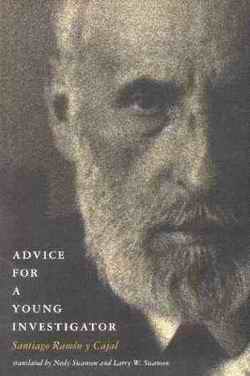
Advice For A Young Investigator
Ref:
Fernando G. Advice For A Young Investigator - Santiago Ram?n y Cajal, 3rd edition, Translated by Neely Swanson and Larry W Swanson, The MIT Press (Book Review).
Anil Aggrawal's Internet Journal of Book Reviews, 2006; Vol. 5, No. 1 (January - June 2006)
; Published March 1, 2006, (Accessed:
Email Dr. Fernando by clicking here
Advice For A Young Investigator - Santiago Ram?n y Cajal 3rd edition, Translated by Neely Swanson and Larry W Swanson, soft cover, 8.1" x 5.3" x 0.4".
The MIT Press, Massachusetts Institute of Technology, Cambridge, Massachusetts 02142: 176 Pages: Publication Date: April 2004: ISBN-10: 0-262-68150-1. ISBN-13: 978-0-262-68150-6: Price - $19.95/£12.95 (PAPER)
Official site of this book: Please Click here to access
Buy this book from Amazon by clicking here
 |
Ram?n y Cajal is hailed as the father of modern anatomy and in particular, Neurobiology. Even in his own times he reached mythic proportions. I first came across his work as a young first year medical student whilst studying histology. One could not study histology without coming across the name of this great man. The disadvantage for a student like myself not versed in Spanish was the inability to study his original papers. I can still remember his exquisite drawings of neural networks reproduced in textbooks of histology. In later life I came to know his clever neuro staining methods which are still in use today.
Cajal, born on May 1, 1852 , at Petilla in Aragon , Spain was a meticulous scientist and investigator who illustrated his works with exquisite diagrams and photomicrographs.
Santiago Ram?n y Cajal is considered to be the most important neuroanatomist since Andreas Vesalius . In addition to his investigative skills he was an exceptional artist. His first book on histology, illustrated by him, appeared when he was in his early thirties and the book remained a standard text in Spain throughout his lifetime. He was awarded the Nobel Prize in Medicine in 1906 (jointly with Camillo Golgi ). This was just one of the many awards that he received during life.
Advice For A Young Investigator is Cajal's philosophy on life. It is not one of his scientific writings and indeed shows Cajal as a philosopher. Originally written in Spanish it has been translated into English many times. This latest translation is a modernised translation with some chapters, no longer relevant, having been left out.
Cajal's philosophy is intriguing. Aphorisms such as "A new discovery is often the fruit of patient and stubborn observation." are as valid today as they were in his time and perhaps even more so.
The book starts off with the introductory chapter covering thoughts about general methods. Beginners Traps follow this. Here he comes up with gems like "I believe that excessive admiration for the work of great minds is one of the most unfortunate preoccupations of intellectual youth." There is more on these lines including "Perceived lack of ability".
Chapter three discusses Intellectual Abilities and there follows an excellent chapter entitled What Newcomers to Biological Research Should Know . At least this one chapter should be essential reading for established as well as newcomers in the field of scientific research.
Other chapters cover Diseases of the Will , Social Factors Beneficial to Scientific Work and Stages of Scientific Research.
The penultimate chapter, On Writing Scientific Papers , is also essential reading for research workers even today. The final chapter is entitled The Investigator as Teacher .
This book helps one understand Cajal the writer as opposed to the well-known Cajal the scientist. In reality Cajal appears to have been a curious mixture of scientist, romanticist, idealist, patriot and realist. This book is starkly in contrast to his scientific writing which are descriptive, deductive and highly systematic. The book reflects a very different Cajal. His delightful sense of humour is displayed in the chapter on Diseases of the Will where he writes about Contemplators, Bibliophiles and Polyglots, Megalomaniacs, Instrument Addicts, Misfits and Theorists. Of all the chapters in this book I thoroughly enjoyed this one in particular!
A rather slim volume at just over 150 pages, Advice For A Young Investigator reads well. The translation is smooth and it is obvious that the translators have done their work well.
As I have stressed before this book is essential reading for scientific research workers.
 |
-Gyan Fernando Dr Gyan Fernando is the Home Office Forensic Pathologist for Devon & Cornwall, and an inveterate reader, book reviewer, traveller and commentator. Dr. Gyan Fernando may be contacted via Email by clicking here. |
-Editor-in-Chief