Book Reviews · Book Review · Vol. 1, No. 2
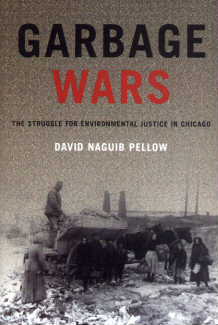
Garbage Wars: The Struggle for Environmental Justice in Chicago
Garbage Wars: The Struggle for Environmental Justice in Chicago by David Naguib Pellow, hard cover
The MIT Press, Massachusetts Institute of Technology, Cambridge, Massachusetts 02142: xii + 234 Pages: Publication Date: 2002: ISBN 0-262-16212-1: Price $24.95
 |
|
When I read the title of the book, I thought it was yet another of the routine environment books, with the author lamenting on modern society spreading garbage beyond their ability to mop it up, and causing untold environmental damage. A quick glance at some of the pages told me it was much different from that. It touches on a relatively new topic. I was certainly not aware of it. The author calls it environmental racism or environmental inequality. These terms stress that the people who generate the most wastes (the affluent ones), don't necessarily have to pay the price of being affected by it. That price is paid by those who don't produce so much waste (the less affluent ones). These are the ones, who have to live near these wastes (perhaps because the cost of living is less in these areas). They are the ones who inhale toxic fumes emanating from these wastes. They are the ones who get poisoned from these wastes, while the more affluent ones - the ones responsible for producing these wastes - go on producing more and more waste quite nonchalantly, unaware of the untold havoc they are causing all around. The author also stresses, that these less fortunate ones are mostly colored people and the Latinos, working as laborers in the US, while the producers of the wastes are mostly the white people.
Although these "garbage wars" are supposed to be going on everywhere in the US, the author has chosen Chicago for his study for a number of reasons. For one thing, Chicago is one of the first great industrial cities in the United States, and therefore is one of the most polluted. At one time known as the "slaughterhouse to the world", it was also the undisputed capital of the meat packing industry during the nineteenth and twentieth centuries. This industry was a major source of pollution during that era, making the "Windy City" one of the filthiest places in the world. Chicago, as the author informs us, "has more landfills per square mile than any other city in the United States".
The author describes several movements against this environmental depredation. In chapter 4, for instance, we are told about the indefatigable Hazel Johnson (a colored woman incidentally), who along with her daughter Cheryl Johnson has made an organization called People for Community Recovery (PCR). They live in an area known as Altgeld Gardens, an area on the South Side of Chicago, infested with crime, poverty and unemployment. Tons of waste surround the city. So much so that Cheryl prefers to call it the "Toxic Doughnut"!
Almost 10,000 residents live in Altgeld Gardens, 97% of them African Americans, 62% of whom live below the poverty line. The area is surrounded by 53 toxic facilities. 36 of them are regulated as hazardous waste facilities. Residents in the area breathe in an environment, where almost 126,000 pounds of toxic pollutants are emitted each day! No wonder this community shows one of the highest rates of infant mortality, cancer mortality, low birth weight infants, and lead poisoned people. This is a textbook case of environmental inequality. It has been called the worst case of environmental racism in the US.
What are the solutions to problems like this? Readers may want to find out by reading this book. Fully recommended to every one, especially those who feel passionately about and want to read about environmental issues. This book gives it all, with an entirely new twist.
Order this Book by clicking here
-Editor-in-Chief
of Vol. 1, No. 2 (July - December 2002)